We're thrilled to share that Allie Page (@cows2crypto ) will be AIP's first Executive Director! Allie has extensive experience in policy operations, strategic planning, and coalition building, and will be critical in helping us action our mission of tech policy education. 🧵 (1/4)
🎉 Join us Thursday for an evening of networking and innovation!
We're hosting a reception to convene the hardworking Capitol Hill staff and D.C. policy community who are advancing America's technology leadership, especially those championing crypto legislative efforts.
📍 Union Pub DC (201 Massachusetts Ave NE)
🗓️ Thursday, November 20th
⏰ 5:00 - 8:00 PM
Expect great conversation, guest speakers, and insights on how blockchain and AI are shaping America's future.
RSVP: https://t.co/QFUT5laRWU
Senator Adam Schiff (D-CA) on recent elections in NYC and Virginia:
“Zohran Mamdani wouldn’t win a governor’s race in Virginia. Abigail Spanberger probably wouldn’t win the mayor’s office in New York. Maybe the lesson for Democrats is stop trying to decide what one figure represents for the party.”
Struggling to digest another behemoth crypto draft bill? This time from Senate Ag?
We got you fam, here’s five tweets that tell you everything you need to know about this bill and how it’s different from the House’s CLARITY Act.
TLDR: this is basically the same as House Ag.
Excellent thought-leadership!
Must read editorial by Blockchain Foundation Founder & Former Board Member @katiebiber & current Board Member @domsimonee. Substantive insights on issues around crypto ATMs👇
Happy Monday. We’re nearing the end of the third week of this government shutdown (likely running into November), but there are still comments to be filed.
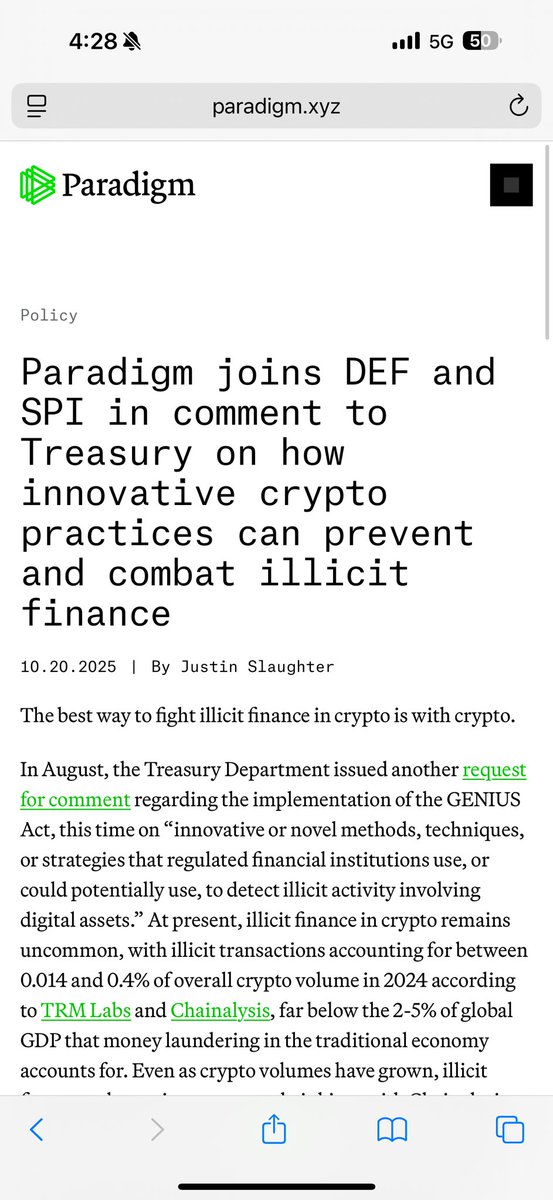
Today, I wanted to flag one we filed Friday with @SolanaInstitute & @fund_defi on preventing illicit finance in crypto.
These are strong principles; for the first time, I can see a path to bipartisan market structure legislation on crypto passing Senate.
Also, Dems are smart to insist on requiring nomination, confirmation, and no arbitrary firings of CFTC & SEC Commissioners as part of a deal.
Excited to be involved with @Tempo from day one, helping shape blockchain infrastructure purpose-built for payments.
The future is multi-chain: stablecoins will operate across diverse blockchain networks and Visa is enabling interoperability between chains and stablecoin brands.
This is a great example of how we're bridging today's payment infrastructure with tomorrow's possibilities.
Introducing @Tempo.
At Stripe, we care about high-throughput, low-latency payments use cases. As the use of stablecoins (and crypto more broadly) grows across Stripe, Bridge, and Privy, we found that existing blockchains are not optimized for them.
For example, it's valuable for real-world financial applications that fees be denominated in a fiat currency that makes sense to the user, but existing blockchains denominate their fees in blockchain-specific tokens. Batch transfers are very useful in payments, but much less important in trading. Bitcoin does ~5 TPS; Ethereum does ~20 TPS, some (like Base and Solana) get to ~1k TPS, but Stripe peaks at >10k TPS. And so on.
As such, we decided to incubate Tempo, a new blockchain, in partnership with Paradigm. We think of Tempo as the payments-oriented L1, optimized for high-scale, real-world financial services applications.
Tempo is an independent company, with Stripe and Paradigm as the first investors. To ensure that Tempo serves a broad array of needs, we're excited to be working with Anthropic, Coupang, Deutsche Bank, DoorDash, Lead Bank, Mercury, Nubank, OpenAI, Revolut, Shopify, Standard Chartered, and Visa as initial design partners. We will start with an independent and diverse validator set, and plan to move towards permissionless validation. Tempo will have a built-in stablecoin AMM to enable platform neutrality with respect to different stablecoins, and Stripe itself will of course continue to work with many chains as first-class partners.
We hope that Tempo makes it easier for things like payment acceptance, global payouts, remittances, microtransactions, tokenized deposits, agentic payments, and more, to move onchain.
The Tempo team is 15 people today, led by the terrific @matthuang. If you're interested in building Tempo, get in touch! And if you're interested in partnering, reach out to [email protected].
gm. Yesterday, Paradigm filed a comment with the SEC on how to approach tokenization and the possibility of on chain IPOs.
There’s a lot of potential opportunity here for investors and companies, but it is important the SEC charts the course into tokenization well.
Today, a coalition of 100+ signatories join DEF in sending a letter to Congress.
Software developer protections are a non-negotiable in digital asset market structure legislation. This critical issue unites us — crypto and tech builders, investors, and advocates.
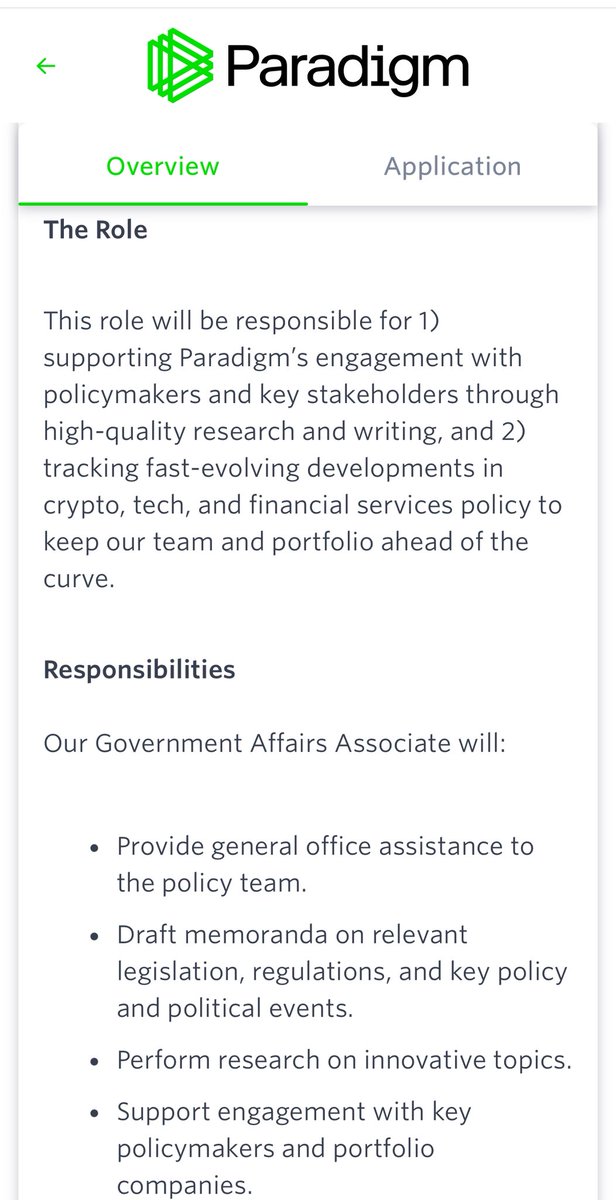
Our @paradigm Policy Team is expanding!
We’re hiring a Government Affairs Associate to join our DC team.
If you’re a young, driven policy professional who wants to work at the frontier of markets, technology, and policy — we’d love to talk to you.
Apply below!
We sent a letter this week to the Senate Banking Committee, in response to their draft of crypto market structure legislation.
On the critical question of which tokens should be regulated as securities, the Senate's draft takes a very different approach from the CLARITY Act that was already passed in the House.
We think the Senate's approach—"ancillary assets"—is better for crypto.
While both bills are an improvement on the Howey-based regime—which is notoriously difficult to apply and creates toxic perverse incentives for issuers—the Senate draft is significantly simpler, and avoids forcing decentralized tokens and protocols to fit themselves into an inflexible legislative framework.
Instead, it protects against abuse with a simple exclusion—assets that come with legal rights to specified financial interests do not qualify as ancillary assets.
As we explain in the letter, we think this is the cleanest test that protects decentralized crypto assets while preventing traditional securities issuers from improperly taking advantage of this framework.
1/ The Presidential Working Group on Digital Assets last week released their long-awaited 180 Day Report — no less than a manifesto on how America can lead the global crypto revolution, with input from every major regulator.
We @paradigm broke down some of the key takeaways:
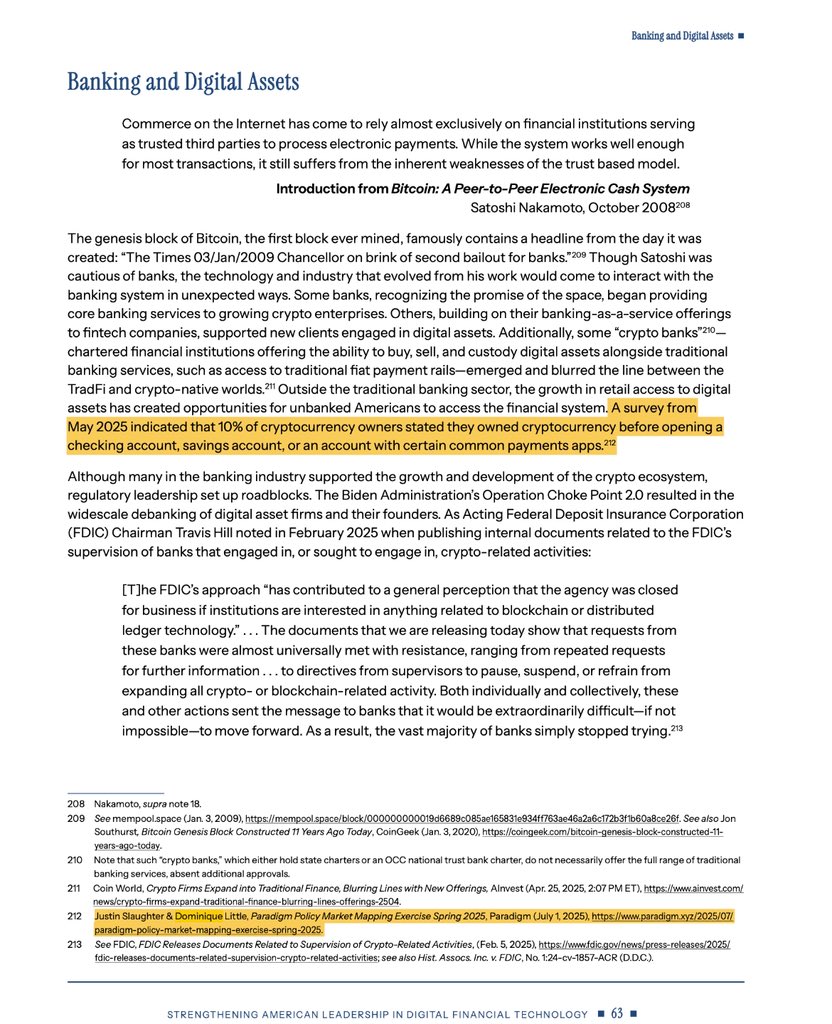
The President’s Working Group on Digital Asset Markets’ report cited a finding from the market mapping exercise @JBSDC and I conducted:
1 in 10 crypto users held crypto before opening a bank or payments app account.
That’s a powerful signal about where access is starting and what the future of our financial system can look like.
Grateful to @davidsacks47 and @BoHines47 for featuring our work in this important report!
🔥 testimony from @danrobinson
“What crypto provides is an alternative system, one that gives us the efficiency of globally coordinated markets without sacrificing the competitive benefits of peer-to-peer trading.”
“The United States can maintain its dominant position as markets shift into this new form. Not by trying to force this technology into the existing paradigm, but by doing what the United States has always done—outpacing the rest of the world on innovation and entrepreneurship.”