📢 Exciting news! The much-awaited Lybra v2 Token Distribution is now officially live! 🎉
Claim your ( $eUSD ) Token now!
🔗https://t.co/jclUku9N97
✨ Dive into the $1,275,000 Distribution pool! $LBR
Join us on an exciting journey this summer!
The #BuildOnBase team and #Layer3xyz have come together to bring you an immersive Quest.
You'll have the opportunity to earn ETH on Base as you join us in this unfolding adventure.
https://t.co/NIWmbVF59j
🐍📰 Python's Self Type: How to Annotate Methods That Return self
In this tutorial you'll gain hands-on experience with type hints and annotations of methods that return an instance of their class, making your code more readable and maintainable.
#python https://t.co/MzL2IkOgwI
Create Your Own Custom LLM Chatbot
Impressive step-by-step tutorial explaining how to choose the best LLM and the components needed for building your own custom LLM-powered chatbot.
@abacusai offers one of the best solutions that I've used to quickly build custom LLM chatbots.
The foundational parts discussed in the tutorial are:
• Data sources - data warehouses, data lakes, and a range of databases are supported. You can also transform data within the platform as needed. There is even an AI agent that can assist with operating on data.
• Chunk size - the chunk size determines how to split the text; this affects performance and varies by use case. You should also think about the overlap between adjacent chunks so information is not abruptly cut off.
• Embedding technique and document retriever - the chunks of texts are embedded and stored in a vector database that helps you build a powerful retriever that the LLM interacts with to ensure it's using the relevant information to answer questions. This is particularly useful for a lot of knowledge-intensive use cases.
• LLM - the synthesizing capabilities of LLMs combined with the retrievers enables a robust solution to create your custom LLM chatbots and pick the best LLM for your dataset and task. With @abacusai you can choose between models offered by Google, OpenAI, Anthropic, the open-source community, and Abacus's proprietary LLMs. I like that you can also fine-tune your own models as well so the offering is pretty comprehensive.
• Automation and Evaluation - picking the right model and the right configurations is challenging. The AutoML capabilities of Abacus help in this regard. You can also upload an evaluation dataset that enables the platform to compare combinations and determine an optimal solution for your use case. Metrics include BLEU score, METEOR, and others.
• Deployment & Monitoring - this whole process is iterative in nature and new data will always be available. You can deploy your LLMs and set up pipelines to keep incorporating or fine-tuning on new data. Having your solution in production means you need to continuously evaluate and monitor performance on a regular basis to ensure the solution doesn't deteriorate.
Read more here: https://t.co/WcQEbqtAZa
If there is enough interest, I will also be posting a full demo with a use case in an upcoming post. Stay tuned!
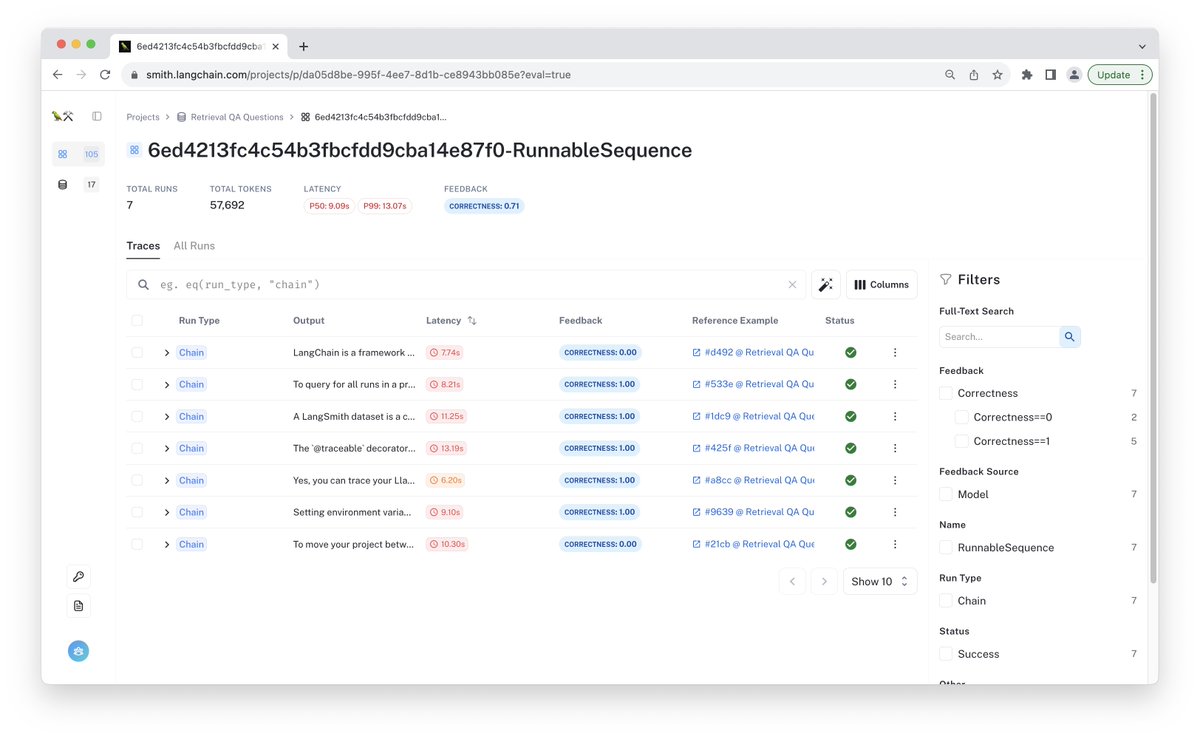
🦜⚒️Q&A System Correctness 🧠
No evaluation of a question-answering system is complete without measuring response correctness. We’ve added a tutorial to the LangSmith Cookbook showing how to do so.