You'll see a lot of doctors come out "against" this kind of broad screening system. They can even get quite agitated about it. This resistance stems from a well-established clinical consensus: traditional population-level imaging fails to improve health outcomes because false positives and invasive follow-ups do more harm than good. But this view suffers from an obvious blind spot. Existing studies rely on static data and completely ignore time-series imaging. And time-series is ignored because we haven't been able to afford to do high frequency imaging at population scale. Clearly, time series is going to be immensely more valuable than a single image. If you drop costs, value can go from 0 -> 1. On a more fundamental level, the argument against screening rests on an obviously false precept "More information is bad" -- just clearly untrue. More information better, you just have to interpret it correctly.
Thrilled to share that our paper on AMIE—our conversational medical AI—is now published in @Nature. We wanted to tackle one of the most challenging areas in clinical AI: management reasoning over multiple patient visits.
https://t.co/03A1pipFI8
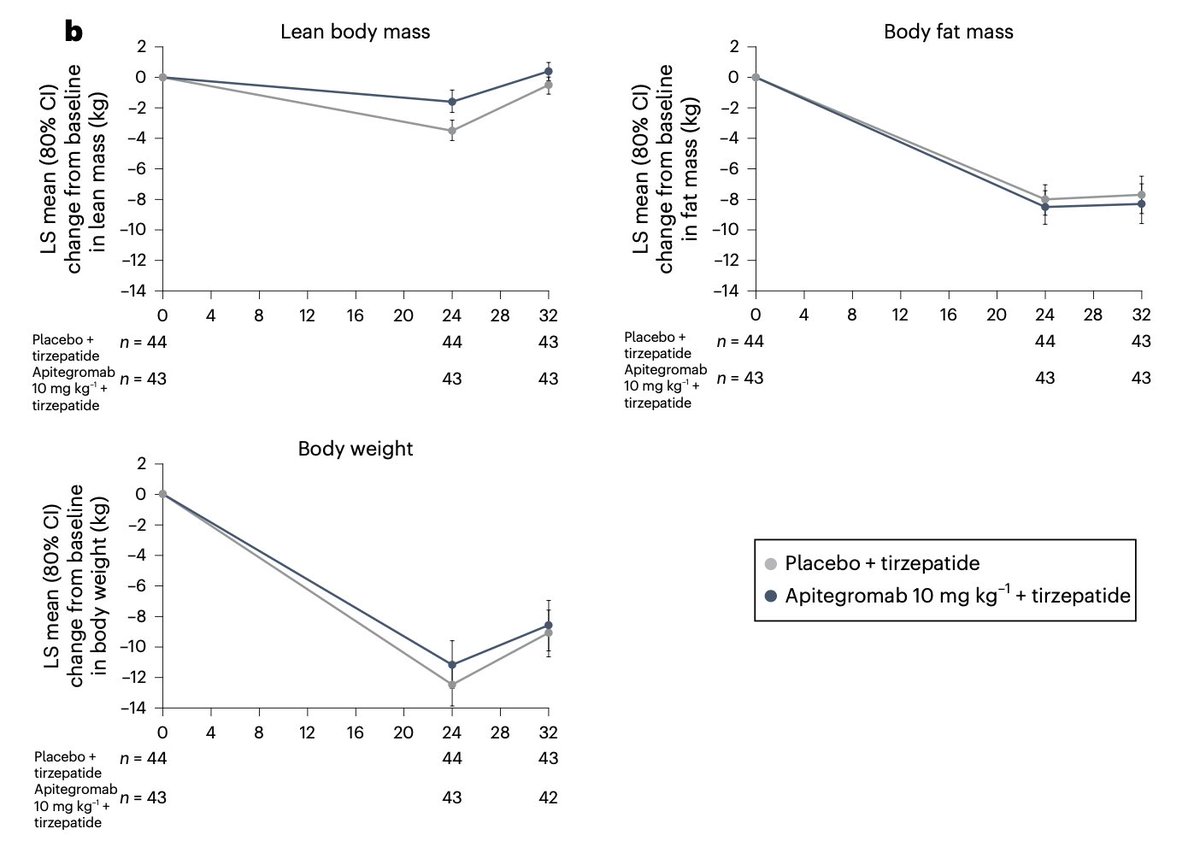
Preserving lean mass during tirzepatide (Zepbound) treatment. A randomized trial of a myostatin inhibitor for muscle mass building shows proof-of-concept.
A 55% retention of lean mass compared with placebo
https://t.co/urw9Gvy11L just published @NatureMedicine
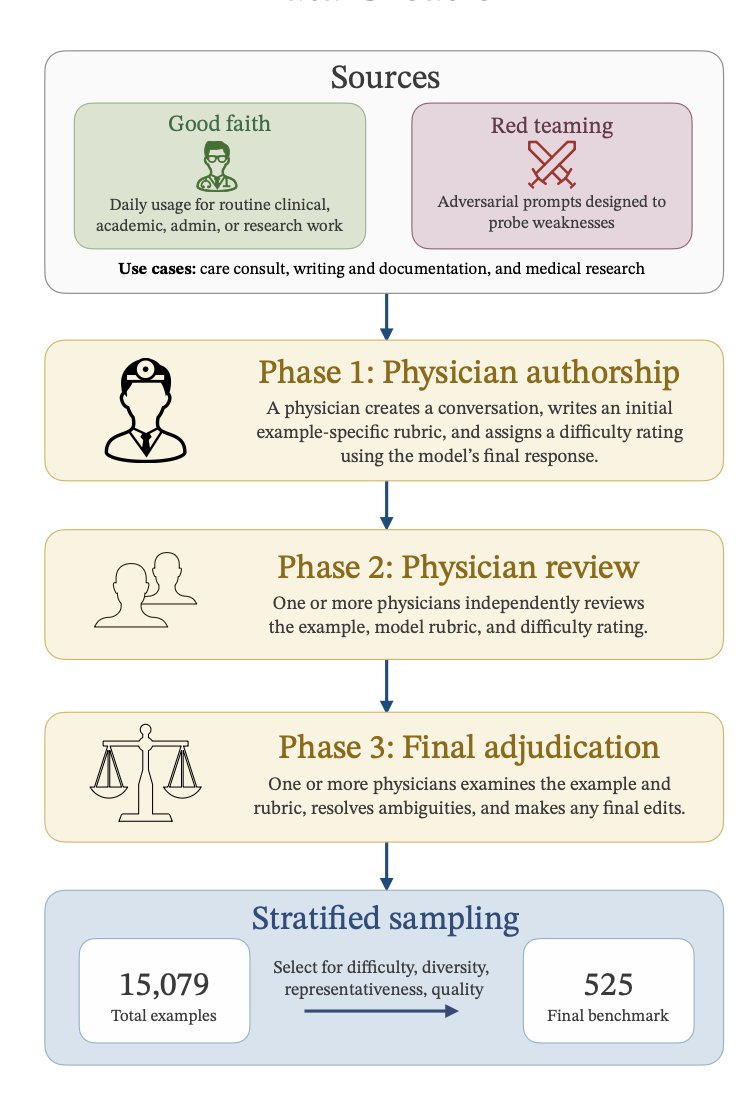
Today @OpenAI introduced ChatGPT for Clinicians, provided free for credentialed HCPs, and HealthBench Professional for benchmarking LLM medical task performance (Figure)
https://t.co/NC3R5JDGCR
https://t.co/ayJLkRtZUt
Some of the most underinvested areas in frontier biology that could accelerate civilizational progress:
- Cheap, large-scale DNA synthesis (writing entire chromosomes or full organisms)
- Real-time, non-destructive RNA sequencing in living cells
- Highly accurate AI-powered polygenic scores for complex traits (disease risk, cognition, longevity) → enabling full genome design
- Ultra-precise, multiplex genome editing (far beyond CRISPR) with minimal off-target effects, scalable across millions of cells
- Safe, efficient, tissue-specific in vivo delivery systems
- Safe and effective human germline engineering
- Accelerated clinical trials via testing on decedents (with consent)
- Next-gen human enhancement: muscle, cognition, mood — beyond GLP-1s
- Ectogenesis / artificial wombs
Who’s actually building in these areas? Drop names, companies, or researchers below 👇
You have no experience.
You’ve never started a company.
You’ve never had a full time job.
Nike is going to kill you.
You’re a kid.
You don’t have technical skills.
You shouldn’t build hardware.
Apple is going to kill you.
You can’t build hardware.
You can’t measure heart rate non-invasively.
Athletes don’t care about recovery.
Under Armour is going to kill you.
It won’t be accurate.
You don’t listen.
You’re an ineffective leader.
You can’t recruit great talent.
You’re going to have to pay every athlete.
You can’t measure sleep non-invasively.
It’s too expensive to research.
Athletes are a small market.
The product costs too much to make.
The product costs too much to sell.
Your valuation is too high.
Consumers aren’t going to want it.
Hardware is too hard.
You should measure steps.
Fitbit is going to kill you.
You can’t build a marketing engine.
You can’t raise enough money.
You need a real CEO.
Google is going to kill you.
You can’t be a subscription.
You can’t build a brand.
You can’t do consumer in Boston.
Your valuation is too high.
You shouldn’t make accessories.
You shouldn’t make apparel.
Lululemon is going to kill you.
You can’t predict Covid.
Stay in your niche.
You are going to run out of money.
You can’t build a health platform.
Amazon is going to kill you.
You can’t measure blood pressure.
You can’t get medical approvals.
The market is too small.
You don’t understand AI.
The market is too competitive.
It won’t work internationally.
The supply chain is too complicated.
You can’t build an AI.
You can’t raise enough money.
It’s too competitive.
Healthcare isn’t going to want it.
…
Just keep going ✌️
p-tau217, the breakthrough blood test, prediction of amyloid-β burden and Alzheimer's disease in people with no symptoms, no cognitive impairment
https://t.co/Nl0wWh6zsP
The smartphone just declared war on the camera industry
Xiaomi just dropped a wild idea: a smartphone with a detachable pro-grade camera lens.
A phone that snaps on a real lens with magnets. Yes, magnets.
It’s a clever move at a strange moment in history.
Camera sales keep falling. Smartphones keep rising.
And the real arms race isn’t glass anymore — it’s AI-powered image processing.
As an AI guy and a photographer, here’s my take:
Hardware won’t save the camera industry.
Software will.
The future of photography is no longer in the lens… it’s in the algorithm.
Phones will keep getting smarter.
Cameras will stay for the purists.
But detachable lenses?
Feels like a bridge between two worlds that are already drifting apart.
But maybe I’m wrong.
Maybe this hybrid future has a place.
What do you think — genius innovation or a beautiful dead end?
#AI #Tech #Photography #Innovation #Smartphones #FutureOfTech
In a recent meta-analysis of 13 studies comparing AI vs clinicians for patient care empathy all but 1 showed AI was more empathetic
https://t.co/e1qNNNcFmc
The era of the GLP-1 family of drugs is still in the early days. These gut peptides talk to the brain and immune system and there are so many more in development, in combination, in pills, to come.