BRCA1/2 may matter beyond breast, ovary, pancreas & prostate. 🧬
New ESMO Open study in a Japanese cohort:
🔬 3489 patients
🧾 9 less common cancers
👥 38,842 cancer-free controls
Key signals:
🟦 BRCA1
↑ Thyroid cancer risk
OR 5.25
🟥 BRCA2
↑ Bladder cancer
OR 4.67
↑ Head & neck cancer
OR 3.89
↑ Skin cancer
OR 6.13
Most striking finding?
🚺 In bladder cancer, BRCA2 impact was much stronger in females:
Female OR 23.63 vs Male OR 2.35
Clinical takeaway:
BRCA1/2 risk may not be limited to the “classic” cancers. These data support broader thinking around germline testing, surveillance, and future PARP inhibitor trials in selected less common cancers.
But caution:
Small carrier numbers + Japanese population + self-reported cancer history. This is hypothesis-generating, not practice-changing yet.
🔖 Save this for your genetics clinic notes.
📖 Full paper in comment ⬇️
#OncoTwitter #MedTwitter #CancerGenetics #PrecisionOncology @OncoAlert@myesmo@esmo_open@asco
A decade of progress in 1L NSCLC from chemotherapy to targeted therapies and immunotherapy combinations. Here’s a look at key FDA approvals shaping the treatment landscape from 2015 to 2026.
Get data-driven and real-time insights with CLIN 👉 https://t.co/ct6tMIQHii
#LARVOL #ELCC26 #LungCancer #LCSM #NSCLC #CancerResearch #CancerData #Oncology #OncologyInsights #ClinicalTrials #Immunotherapy #FDA #FDAApproval | @ADesaiMD | @APassaroMD | @FordePatrick | @BalazsHalmosMD
How I think about 1st line HER2+ Metastatic Breast Cancer.
Decision 1: THP versus T-DXd + P
Decision 2: Maintenance based on receptor status
@OncoAlert#bcsm
🚨 #GU26 – Day Highlights Prostate Cancer
Today was not about incremental updates.
It was about structural shifts in how we think.
@OncoAlert@ASCO
1️⃣ Biology is finally driving decisions
• PTEN-deficient mHSPC → AKT pathway targeting (CAPItello-281)
• PARPi sequencing in BRCA/ATM-altered disease
• ctDNA emerging as strongly prognostic
We are moving from “hormone-sensitive vs resistant”
to molecularly contextualized disease states.
2️⃣ Radioligand therapy is accelerating
• Alpha-emitters showing deep PSA50 responses
• OS signals maturing in mCRPC
• Sequencing will determine impact
The next battlefield isn’t activity.
It’s implementation.
3️⃣ PCWG4 redefining progression
• Imaging ≠ automatic failure
• Multimodal endpoints (PSA + imaging + ctDNA + PROs)
• Context-dependent interpretation
Trial design is evolving to match biologic complexity.
4️⃣ Overtreatment vs undertreatment tension
• Salvage RT + ADT: PSA-driven nuance
• Frailty ≠ barrier to ADT+ARPI
• 50% attrition crisis in mCRPC → many never reach 2L
The biggest threat may not be resistance.
It may be loss of opportunity.
Prostate cancer care =
🧬 Biomarker selection
📉 Strategic sequencing
⏳ Timing optimization
⚖ Toxicity balance
🚦 Access planning
Not just drug choice.
This is the transition from escalation to orchestration.
#OncoAlertAF
@acampsmalea@BRicciutiMD@HHorinouchi@FadiHaddad_MD@Abdallah81MD@FernandoOnco@ElisaAgostinett@to_be_elizabeth@bavilima@realbowtiedoc@Erman_Akkus@Lucarecco@GaiaGriguolo@JankovicK@MarioBalsaMD@DrMirallas@GIMedOnc @OscarTahuahua @UOzkerim@Onco_Cifu88@PaulJiL@DaisukeKotani@DraMartinezLago
#ProstateCancer #GU26 #mHSPC #mCRPC #Radioligand #PrecisionOncology
Local and locoregional prostate cancer: ESMO Clinical Practice Guideline for diagnosis, treatment and follow-up† - Annals of Oncology https://t.co/iWjEYd0eyZ
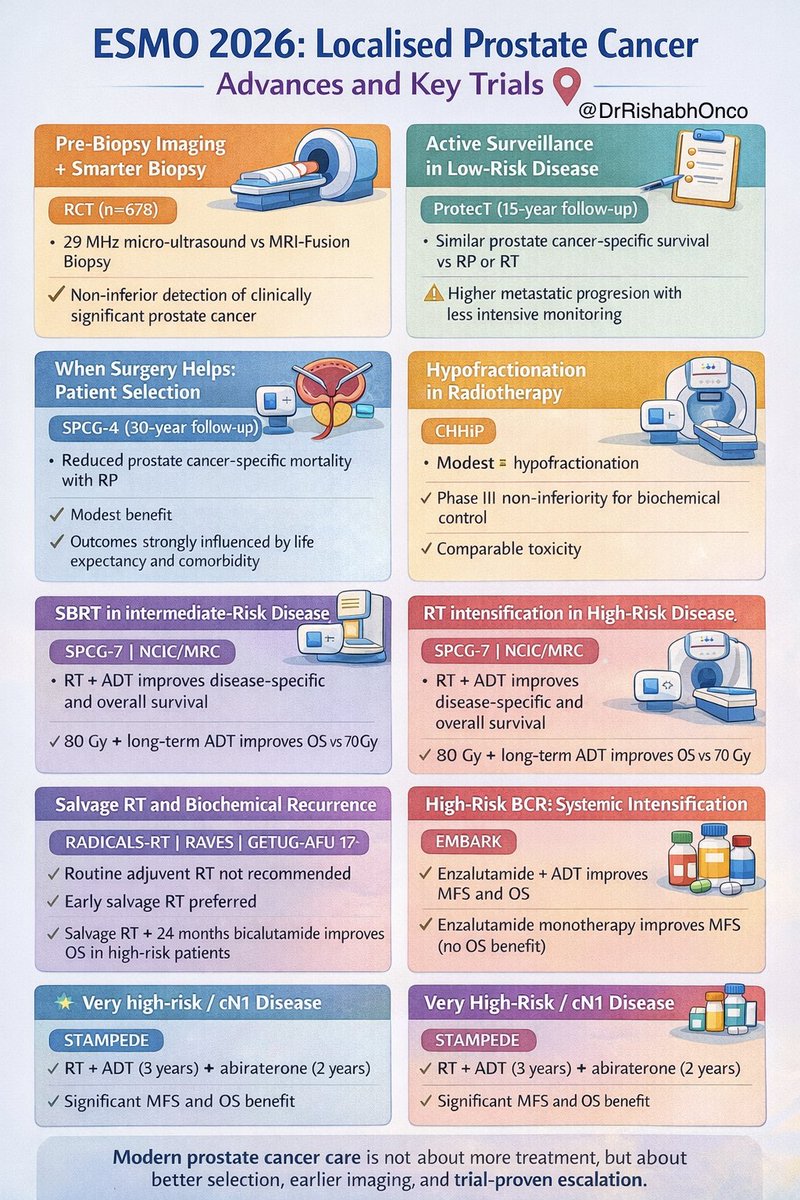
Localised prostate cancer just changed. Again.
ESMO 2026 brings clarity on who to observe, who to escalate, and which trials actually matter 👇
🧠 Diagnosis
MRI before biopsy is standard
High-resolution US is a valid alternative (RCT n=678)
🧭 Low risk
Active surveillance is safe
ProtecT 15-yr data shows similar survival vs RP/RT
☢️ Radiotherapy
Shorter is better
CHHiP ➜ moderate hypofractionation
HYPO-RT-PC ➜ ultra-hypofractionation
PACE-B ➜ SBRT works in selected IR disease
📈 High risk
RT + long-term ADT saves lives
SPCG-7 | NCIC/MRC
Dose escalation improves OS (GETUG-AFU 18)
🚨 Very high-risk / cN1
RT + ADT + abiraterone is the new benchmark
STAMPEDE delivers MFS + OS benefit
🔁 Biochemical recurrence
Avoid routine adjuvant RT
Early salvage RT preferred
RADICALS-RT | RAVES | GETUG-AFU 17
High-risk BCR? Intensify
EMBARK supports enzalutamide + ADT
🧠 Bottom line
Risk-adapted care > overtreatment
Imaging-driven decisions
Escalate only when trials prove benefit
📖 Full paper in comment ⬇️
#OncoTwitter #MedTwitter #ProstateCancer #GUOncology
@OncoAlert@myesmo@esmo_open@asco@OncBrothers
Options for HER2-positive breast cancer are increasing🚀🎉
It was announced that maintenance tucatinib combined with HP after THP provides a significant PFS advantage (HER2CLIMB-05)
Now we have 3 new options. Minds are confused. Data mining awaits us🤯
This combination might be an option for post-T-DXd treatment in HER2+ MBC.
In HER2CLIMB-02, adding tucatinib to T-DM1 extended PFS (9.5 vs 7.4 months; HR 0.76) and showed activity even in patients with brain metastases, with manageable toxicity. @Annals_Oncology
https://t.co/90CsIuaS5V
🚨 ONCO EMERGENCY: How to Manage EXTRAVASATION in 30 Seconds 🩺💉
Extravasation of chemotherapy = oncology emergency.
Early recognition + immediate action = tissue saved.
Here’s the crisp, protocol-ready approach 👇
1️⃣ STOP Immediately
❌ Stop infusion
❌ Do not flush
✔️ Leave cannula in situ
✔️ Aspirate as much drug as possible
✔️ Mark the area + click a photo
2️⃣ Identify the Agent
Classify the drug:
🔥 Vesicant (DNA-binding / Non-DNA)
😣 Irritant
🙂 Non-vesicant
(Anthracyclines, Vinca alkaloids, Taxanes, Platinum, Mitomycin etc.)
3️⃣ Two Key Pathways
A) “Localise & Neutralise” – DNA-Binding Vesicants
(Anthracyclines, Mitomycin, Dactinomycin)
❄️ COLD compress 20 min × 4/day × 1–2 days
💊 Antidotes:
<3 ml anthracycline → Topical DMSO
3 ml anthracycline → Dexrazoxane (Savene) within 6 hrs
Mitomycin → DMSO
B) “Disperse & Dilute” – Non-DNA Binding Vesicants
(Vinca alkaloids, Taxanes, Trabectedin)
🔥 WARM compress 20 min × 4/day × 1–2 days
💉 Hyaluronidase 150–1500 IU SC around site (5 injections)
4️⃣ Elevate, Analgesia, Plastics Referral
✋ Elevate limb
💊 Analgesics if required
🏥 Early plastics/flush-out team for large-volume or CVAD extravasa
tion
5️⃣ Follow-Up
Mandatory review within 1 week
Patient counselling: monitor for redness, blistering, worsening pain
Document EVERYTHING (site, size, drug, photo, interventions)
💡 TAKE-HOME
Extravasation is rare but high-stakes.
Most injuries are preventable with:
Good venous access
Trained staff
Fast action
Correct antidote pathway
Oncology teams save tissue before they save time. ⏱️🩺
🔖 Save this. Share with your residents and healthcare staff.
#OncoTwitter #MedTwitter #ChemoSafety #Nursing #Oncology @myESMO@OncoAlert@ESMO_Open@asco
🚨 NEW ASTRO GUIDELINE DROP!
☢️Radiation Therapy in Gastric Cancer - What Actually Changes?
1. Resectable Disease: Where RT Fits
🔹 Perioperative chemotherapy (FLOT) = Standard
•FLOT4 ➝ FLOT > ECF/ECX
•MATTERHORN ➝ FLOT + durvalumab ↑ pCR & ↑ EFS
•KEYNOTE-585 ➝ ↑ pCR but no OS benefit with pembrolizumab
•Asian data: CLASSIC, ACTS-GC, ARTIST 2 for postop chemo
🔹 Preoperative chemoRT
Use only if:
❌ Not fit for peri-op chemo
❗ Borderline resectable (high R1/R2 risk)
🔼 Restrict to GEJ / upper & mid-stomach
Key evidence:
•TOPGEAR ➝ ↑ downstaging, ↑ pCR (17% vs 8%)
•POET, KROSG 0301, UYG-GO (supportive phase II data)
Regimen: 45 Gy/25F + 5-FU/capecitabine
🔹 Postoperative chemoRT
Use when:
•<D2 dissection → INT-0116 (Intergroup 0116)
•R1/R2
•Not fit for adjuvant multi-agent chemo
Other data:
•CALGB 80101
•ARTIST (no benefit overall; node-positive subgroup signal)
🛑 2. When Surgery Isn’t Possible
🔥 Definitive chemoRT
•For unresectable / medically inoperable / surgery-refusing
•45–50.4 Gy + 5-FU/capecitabine
•Based on prospective studies (Kim et al., Zang et al.) → ORR ~80%
❤️🩹 3. Palliation: RT Works Amazingly Well
🔴 Bleeding → Strong evidence
Key trials/series:
•Yoon et al., Tey et al., Kondoh et al.
•Meta-analysis by Tey et al. → bleeding response 76%
🔶 Pain & obstruction
•Response 50–100%
•Data from Lee et al., Asakura et al., Kawabata et al.
Schedules:
•8 Gy ×1
•20 Gy ×5
•30 Gy ×10
Re-irradiation supported by:
•Park et al., Lee et al. (small but effective series)
🎯 4. Oligometastatic Disease (Emerging Area)
Supporting data:
•FLOT3 (systemic therapy + MDT approach)
•Franzese et al. (SBRT series)
•Kong et al., Rauschenberg et al. (surgery/SBRT outcomes)
PET-CT + staging laparoscopy recommended before labeling as “oligometastatic.”
🧠 Takeaway
RT in gastric cancer is selective, evidence-backed, and outcome-impacting.
Right patient → big benefit.
Right setting → precise role.
Right MDT → best survival.
🔖 Save this for quick review
📖 Full guideline in comments
#OncoTwitter #GIcancer #RadOnc #MedTwitter @OncoAlert@myesmo@esmo_open@ASCO@ASTRO_org
Futura vacuna:
El virus de Epstein-Barr, causante de ciertos tipos de cáncer y, muy probablemente de esclerosis múltiple, ahora también se ha relacionado con el lupus.
Si algún día logramos desarrollar una vacuna contra el VEB, podríamos prevenir muchísimo sufrimiento.
💥 “Screen or not to screen?”
After 23 years, ERSPC finally answers.
📊 ERSPC (n = 162,236 men, 55–69 yrs)
🔹 Screening: repeated PSA testing
🔹 Control: no screening
⏱️ Median follow-up: 23 yrs
🎯 Results
🧬 ↓ Prostate cancer mortality: 1.4% vs 1.6% (RR 0.87 [0.80–0.95])
➡️ 13% relative & 0.22% absolute risk reduction
📈 NNI = 456 | NND = 12 → better harm–benefit ratio
⚠️ Overdiagnosis: +27 extra cases / 1000 men (mostly low-risk)
🧩 Who should be screened?
✅ Men 50–69 y with ≥15 y life expectancy
✅ Earlier (40–45 y) if BRCA2+, family history, or African ancestry
🚫 Stop if >70 y, frail, or PSA < 1 ng/mL at 60 y
💡 Takeaway:
PSA screening saves lives - just not everyone’s.
Target the right men, at the right age, using risk-based + MRI-guided screening.
📖 Roobol MJ et al. NEJM 2025
🔗https://t.co/msFgNpODRI
#OncoTwitter #MedTwitter #ProstateCancer #Screening #ESMO25
@OncoAlert@myesmo@esmo_open@ASCO@NEJM@Uroweb@AmerUrological@UrologyTimes@EUplatinum
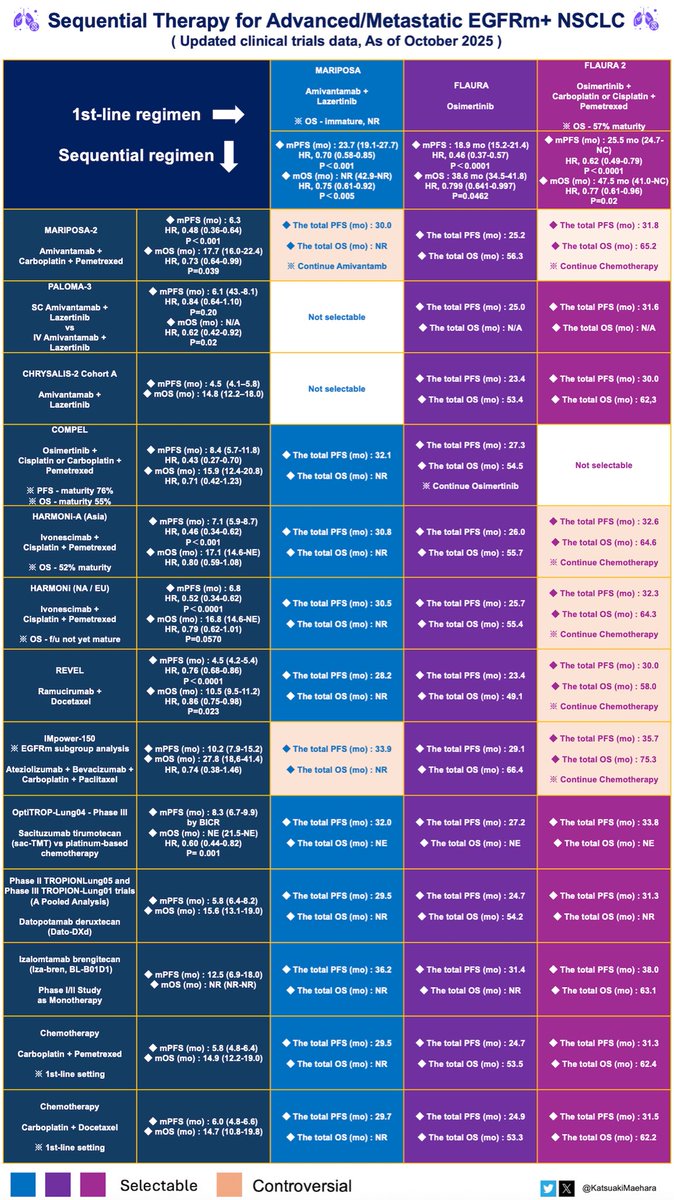
🫁 Sequential therapy for advanced/metastatic #EGFRm#NSCLC 🫁
🫁 I’ve compiled it into a table. (PFS & OS only)
🌟 After #ESMO25
🌟 OptiTROP-Lung04 (Sac-TMT) & Iza-bren (BL-B01D1) mono-therapy were added.
⚠️ For reference only ⚠️
#lungcancer#nsclc#egfr#LCSM
SG is a highly effective ADCs, and when used adequately, it saves lives. This includes careful management of toxicities, with prophylaxis when indicated. In this article we review the data & provide RW perspectives on the management of toxicities with SG. https://t.co/ACUZovlVS6











![DrRishabhOnco's tweet photo. 💥 “Screen or not to screen?”
After 23 years, ERSPC finally answers.
📊 ERSPC (n = 162,236 men, 55–69 yrs)
🔹 Screening: repeated PSA testing
🔹 Control: no screening
⏱️ Median follow-up: 23 yrs
🎯 Results
🧬 ↓ Prostate cancer mortality: 1.4% vs 1.6% (RR 0.87 [0.80–0.95])
➡️ 13% relative & 0.22% absolute risk reduction
📈 NNI = 456 | NND = 12 → better harm–benefit ratio
⚠️ Overdiagnosis: +27 extra cases / 1000 men (mostly low-risk)
🧩 Who should be screened?
✅ Men 50–69 y with ≥15 y life expectancy
✅ Earlier (40–45 y) if BRCA2+, family history, or African ancestry
🚫 Stop if >70 y, frail, or PSA < 1 ng/mL at 60 y
💡 Takeaway:
PSA screening saves lives - just not everyone’s.
Target the right men, at the right age, using risk-based + MRI-guided screening.
📖 Roobol MJ et al. NEJM 2025
🔗https://t.co/msFgNpODRI
#OncoTwitter #MedTwitter #ProstateCancer #Screening #ESMO25
@OncoAlert @myesmo @esmo_open @ASCO @NEJM @Uroweb @AmerUrological @UrologyTimes @EUplatinum](https://pbs.twimg.com/media/G4gejGFaQAEVasz.jpg)


