Istanbul mosques are the best. I walked into a big one and immediately saw kids playing hide and seek, some dude sleeping, another guy praying and another guy doing push ups while his friends watched.
Plato Attended by Aristotle
Deccan, 17th century
Two brief inscriptions in Persian and Telugu: at left, "Hakim Iflatun" (the sage Plato); at right, "Arastu" (Aristotle). Plato reads a manuscript, while Aristotle cools him with a scarf and carries his walking stick.
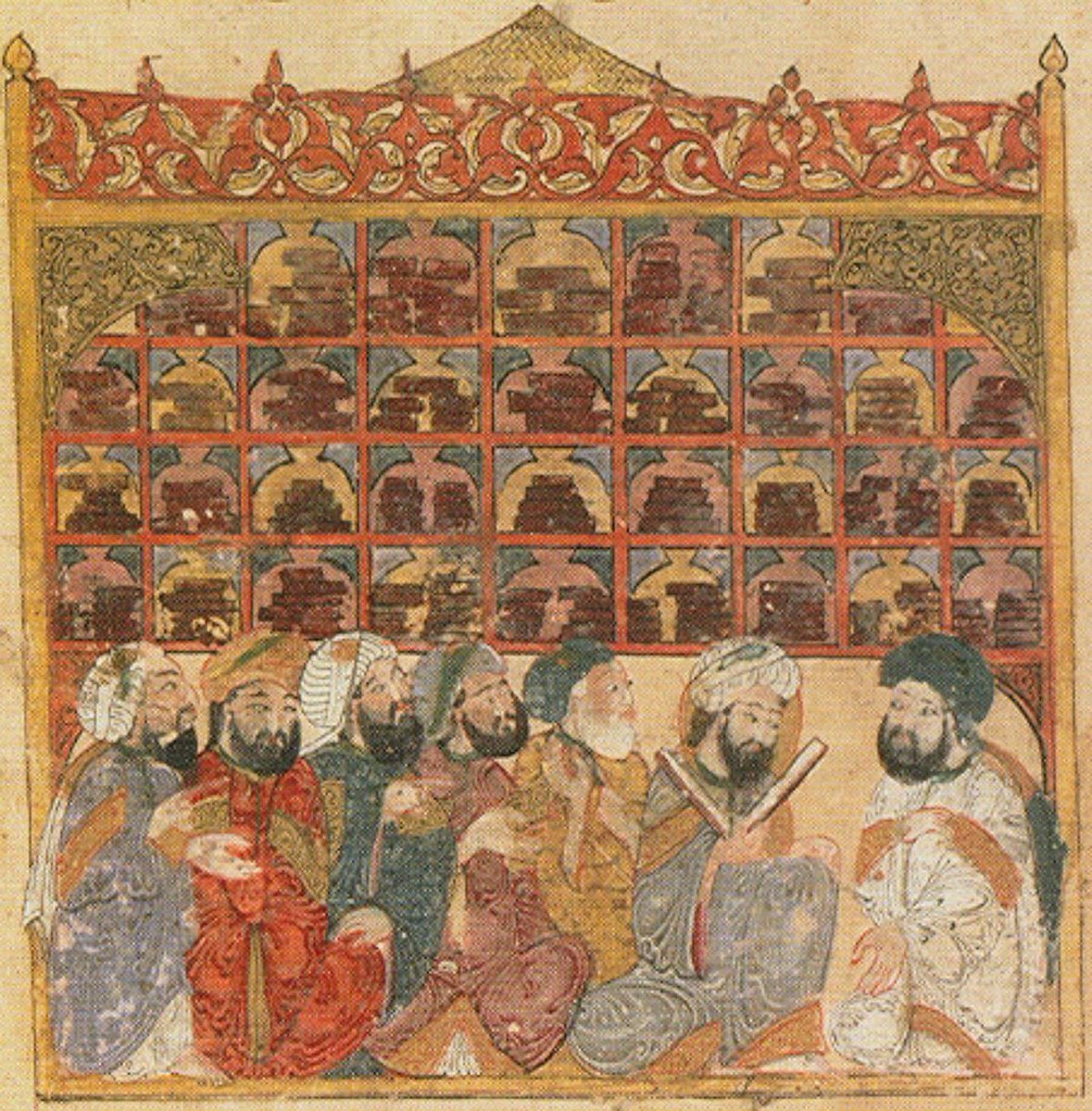
A fun aspect of ancient tales like Maqamat al-Hariri (1237) is that they inadvertently give us insight into their era.
For example, the depiction of Abbasid-era libraries.
Construction of a circle tangent to two given circles and passing through a given point, Book of Perfection / Kitab al-Istikmal, by al-Mu'taman ibn Hud.
✨One of geometry's most famous theorems is known today as Ceva's Theorem, after its publication in Europe in 1678. Yet the earliest known formulation appears nearly 600 years earlier in the work of the Muslim ruler and mathematician al-Mu'taman ibn Hud.
Al-Mu'taman Billah (d. 1085) was a mathematician, geometer, and the king of the Taifa of Zaragoza in Andalus (Spain).
At a time when the taifa kingdoms of al-Andalus faced mounting pressure from the Christian north, al-Mu'taman devoted himself to one of the most ambitious mathematical projects of the medieval world: the Kitāb al-Istikmāl ("Book of Perfection"). Far more than a compilation, it sought to gather, reconcile, and extend the entire geometric tradition inherited from Euclid, Archimedes, Apollonius, Menelaus, and the great mathematicians of the Islamic world.
For generations, students have learned about Ceva's Theorem, named after the Italian mathematician Giovanni Ceva, who published it in 1678.
It states that "if three lines are drawn from the vertices of a triangle to the opposite sides, those three lines meet at a single point if and only if a specific relationship between the divided side lengths holds."
Yet modern historians of mathematics have shown that the theorem's earliest known formulation appears nearly six centuries earlier in the work of al-Mu'taman.
The irony is striking. Ceva's name became attached to the theorem because his work circulated throughout Europe, while al-Mu'taman's manuscript was largely lost and remained unknown to later generations for centuries.
In past ages, Europe too considered the norwood a mark of high culture, status and even holiness.
(When I reach this stage, I will start to go on about how this was the high mark of our civilizational greatness, and that reverence for this hairstyle MUST be brought back)
His name was Major Paeta Hess-von Kruedener of Kingston, Ontario, an infantry officer with the Princess Patricia's Canadian Light Infantry.
He was serving as an unarmed United Nations military observer with the UN Truce Supervision Organization (UNTSO) when he was killed on July 25, 2006, during the Israel-Hezbollah war in Lebanon.
He was stationed at Patrol Base Khiam, a long-established UN observation post in southern Lebanon. The site had been built in 1948 and was clearly marked. Both sides in the conflict had the coordinates of the compound. It was a white concrete structure emblazoned with "UN" in large black letters and flying a UN flag.
On the day he died, the post came under sustained Israeli bombardment over roughly six hours, beginning around 12:11 pm. According to the UN, the post called an Israeli liaison officer at least 14 times throughout the day to call off the bombardment much like the sailors of the USS Liberty did, and an Israeli official promised to halt the bombing each time.
The UN force commander famously radioed the Israelis that "you are killing my people." Around 19:30, the post was destroyed when the Israeli Air Force dropped a massive bomb on the site, a 500-kg satellite-guided 'bunker-buster' bomb that killed Hess-von Kruedener and three other UN peacekeepers from Austria, China, and Finland.
The aftermath was politically charged. UN Secretary-General Kofi Annan said he was "shocked and deeply distressed by the apparently deliberate targeting by Israeli Defence Forces," noting the attack came despite personal assurances from Israeli Prime Minister Ehud Olmert that UN positions would be spared. As The Globe and Mail reported Israel expressed regret, denied targeting the UN, and attributed it to an "operational error", though it never fully explained how the error occurred. Much like they did during the "accidental" bombing of the USS Liberty...
Within Canada, the response drew criticism. Prime Minister Stephen Harper expressed doubt that Israel would intentionally target a UN post, and even suggested the peacekeepers bore some responsibility by remaining at their post...
His widow, Cynthia, rejected the "accident" explanation and believed her husband may have been targeted because of his role observing and reporting on the conflict. Following a Department of National Defence Board of Inquiry, the full report was quietly removed from the department's website
The Centre for International Governance Innovation leaving mainly a news release described the incident as a "tragic accident".
In 2007 he received a posthumous decoration for "outstanding performance and dedication to duty" while serving at the observation post, for staying at his post until his death
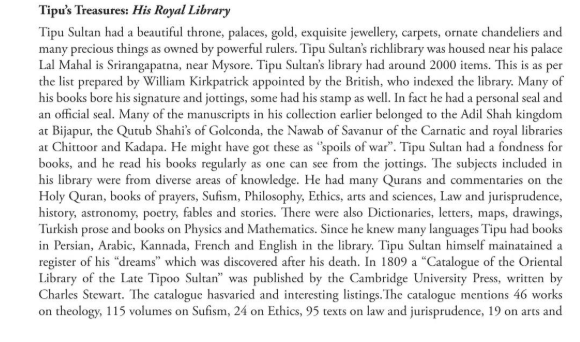
On Tipu's famous library.
He had around 2000 items and in it many manuscripts that belonged earlier to the Adil Shahis and the Qutb Shahis. He also had many Qur'ans, commentaries on the Qur'an, books of prayers, Sufism, philosophy, ethics and so on.
Western leftists will tweet out the laziest anti-Islam snark imaginable, and then, when Muslims call it what it is, they’ll hide behind “critique of religion.”
Buddy, if that’s the level of your critique, it’s no wonder you now find yourself living out your revolutionary fantasies through a people whose struggle is openly rooted in a faith and worldview you clearly resent.
You romanticize their resistance, borrow their imagery, chant their slogans, and cosplay their courage, all while sneering at the very Islam that sustains so many of them under siege.
And that would be bad enough on its own, but it’s even more pathetic coming from people whose entire political posture depends on being geographically, materially, and psychologically cushioned by the same empire they claim to oppose. You mock the ideology of people facing bombs, prisons, starvation, and extermination while clasped tightly to the teat of the enemy dropping those bombs.
So no, this isn’t about Muslims being unable to handle criticism. Islam has been critiqued by far more serious minds than yours for centuries. What we’re not obligated to entertain is your Reddit-tier contempt dressed up as intellectual courage.
But hey, keep at it. The pinnacle of your ideological achievement is always going to be cosplaying revolution from the safety of the imperial core while outsourcing every real consequence to Muslims you secretly resent, and that’s a ceiling you’re never going to shatter.
reading Herodotus for the first time and while Homer is foundational for some aspects of "western civilisation" Herodotus is more important in terms of something about the West far closer to my heart: thinking the East is really cool and confidently getting things wrong about it
The Legend of the Middle Ages: Philosophical Explorations of Medieval Christianity, Judaism, and Islam
Rémi Brague , Transl. Lydia G. Cochrane , Univ of Chicago Pr, 2011
PDF🎯
https://t.co/U8EBnM116e
Aurangzeb’s fame spread across the Islamic world when in the heat of battle with the Khan of Bukhara, he dismounted from his elephant and calmly offered Dhuhr in sight of both armies. The Khan, stunned, declared "to fight with such a man is to ruin oneself" and halted the battle.