Hong Kong-based supplement brand IM8 reached a $200M annual revenue run rate in 18 months. Here's how its co-founder thinks about building in this category:
Beyond David Beckham's endorsement, three things stood out from @DannyYeung_'s recent conversation with @ShaanVP on @myfirstmilpod.
1. IM8 put 90 ingredients into one daily sachet. Danny’s view is that most consumers don’t want to take a long list of supplements, and we’re seeing more brands respond by putting more into a single product. The actual dose of each ingredient should matter, but for many consumers the simpler question is whether it’s there at all. IM8 takes that to the extreme: 90 ingredients, positioned as replacing 16 supplements. Whether that makes it better is a different question, but the selling proposition is easy to understand. You don’t need bottles, pills or scoops either. For a certain consumer, particularly someone who travels or values convenience, getting more in one place with very little consumption friction is the product.
2. IM8 invested heavily in perceived credibility. Supplements have an increasing trust problem, and founders need to think about how they’ll address it. Danny shared that IM8 chose to build a scientific advisory board, run clinical trials, pursue NSF Certified for Sport testing and hold more than 200 offline events involving doctors and scientists. Historically, supplement marketing has leaned heavily on celebrities and influencers. I think we’ll see more brands add another layer for increasingly discerning consumers: credible advisers, testing and experts who can engage with them directly. IM8 has David Beckham at the front, but a much broader credibility strategy behind him. In a crowded category, I suspect we’ll see more brands trying to build both.
3. IM8 appears to have built the product backwards from subscription. I’ve increasingly noticed this across supplement brands with only one to three SKUs: think about what someone will pay for every month, then build the product and bundle around that. It makes sense. Unless you’re addressing a specific deficiency or need, supplements are generally taken continuously, so the natural business model is recurring revenue. The question becomes less “what supplement should we make?” and more “what product becomes valuable enough in someone’s routine that they keep paying for it every month?”
The takeaway isn’t whether IM8’s supplements are right for you or how profitable the business is. This analysis doesn’t tell us either. What makes it interesting is what it tells us about differentiation in a crowded supplement market: understand what a specific consumer wants, design the product around how they want to consume it, give them reasons to trust what they’re buying, and make it valuable enough to stay in their routine for a long time.
@bryan_johnson The quality of the longevity physician and coach will make most of the difference here. Looking forward to seeing how it all comes together.
Apple Watch Series 12 now samples HRV up to 24 times more often than the previous model. But how valuable is HRV as a consumer health feature?
1. More sampling makes the measurement more precise. It doesn’t necessarily make it more valuable. HRV (heart rate variability) measures the variation in time between heartbeats, and changes relative to your baseline can tell us something about how your body is responding. But it also moves with alcohol, sleep, illness, stress, meal timing and much else. Sustained changes can be useful, including sometimes appearing before you feel unwell. Day to day, it is often less actionable. I get asked about HRV a lot in my own practice, and a low reading usually confirms what someone already knows: they slept badly, drank the night before or have been training harder. Better measurement only matters if it leads to better decisions.
2. The value of HRV has largely come from what companies build on top of it. Consumers don’t really want HRV. WHOOP gives them Recovery, Oura gives them Readiness, Garmin has its own versions, and now Apple gives them a score from 0–10. That’s good product design, but there is no reference standard for “readiness”. These companies use overlapping inputs with different proprietary algorithms, so two devices can look at the same person on the same morning and give different answers, with no ground truth to adjudicate between them. More importantly, what is a readiness score actually predicting, and does acting on it improve an outcome that matters?
3. The harder problem is what happens when the score and the person disagree. Readiness works well when a low score follows a terrible night’s sleep because it validates something you already know. It gets harder when someone sleeps well, feels good and wakes up to a 4/10 they can’t explain. With so many variables feeding in, working out why becomes another task. Do that often enough and the risk isn’t confusion, it’s that people stop looking. Novelty can carry a daily score for a while. Explanation is what could carry it beyond that.
HRV has established itself as a viable feature in wearables. The question is whether it can progress from something consumers check to something that consistently changes what they do. The next competitive advantage may be less about who measures HRV best, and more about who can turn it into an explanation and action that consumers continue to trust.
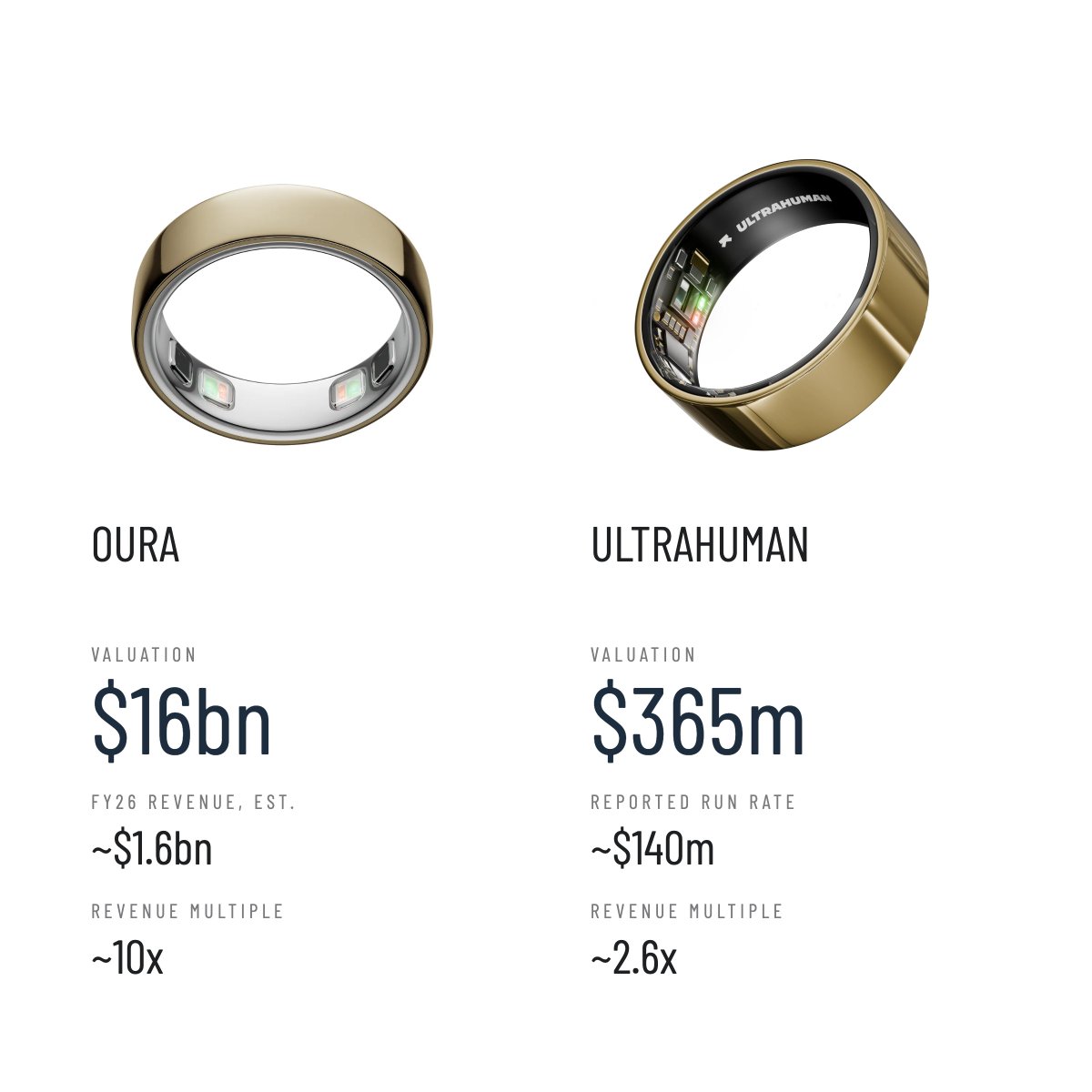
This week, @ouraring and @UltrahumanHQ were both valued at $16B and $365M. Adjust for size and Oura still commands roughly 4x the revenue multiple. Why?
From its nine-month filing and last year's seasonality, Oura should land near $16B for FY26, putting a reported target above $16B at roughly 10x. Ultrahuman's $365M against a reported $140M run rate is around 2.6x. Not perfectly comparable: one is an IPO target for a profitable, audited company, the other a private Series C.
Let's break down a few things:
1. The membership may be worth more as a relationship than as revenue. Oura has around five million paid members, but membership is still a fifth of revenue. By my estimate, $240.5M of membership revenue across an average base of about four million over nine months is roughly $7 a month per member, essentially list price. Members are growing quickly; revenue per member doesn't appear to be. Ultrahuman chose a different architecture, keeping its core app free while around 12% of users pay for optional PowerPlugs. So Oura isn't just building recurring revenue. It is building millions more billing relationships, which matters if it can sell those users something more valuable than insights.
2. Its US position is far stronger. Under 20% of Oura's hardware revenue comes from outside the US, while Ultrahuman lost ground there after the ITC exclusion order in October 2025, reopening pre-orders in March 2026. Part of the premium is likely to be its installed base, distribution and dominance in the world's largest healthcare market. Though, the patent ruling probably contributed to that advantage.
3. The bigger opportunity may be moving from insight to consequence. Five million paying, daily-engaged users make acquiring customers for health services very different from starting a diagnostics business from scratch. Oura is already testing this in limited ways: it acquired Galen AI to bring medical records, labs and medications in-platform, Health Panels through Quest include a SteadyMD clinician callback on critical values, and Counsel Health is testing physician access inside Oura Labs. Ultrahuman is approaching this from the other end, accumulating more sensing through the ring, CGM, home monitoring and Blood Vision, with Labcorp now investing. There is a limit to what someone will pay to be told what their HRV means. There is far more value when something happens as a result: a test, a clinician, a diagnosis, a treatment. Oura puts its serviceable market in preventative health above $90B, but getting there means crossing the wall between wellness and medicine (same one I've hammering on about longevity services). Its filing notes its features are marketed as general wellness products it believes fall outside FDA rules.
My takeaway: Ultrahuman is accumulating more ways to measure the consumer. Oura looks like it is trying to own what happens next. The former has a lot of potential and I'm looking forward to how they both build out their ecosystems.
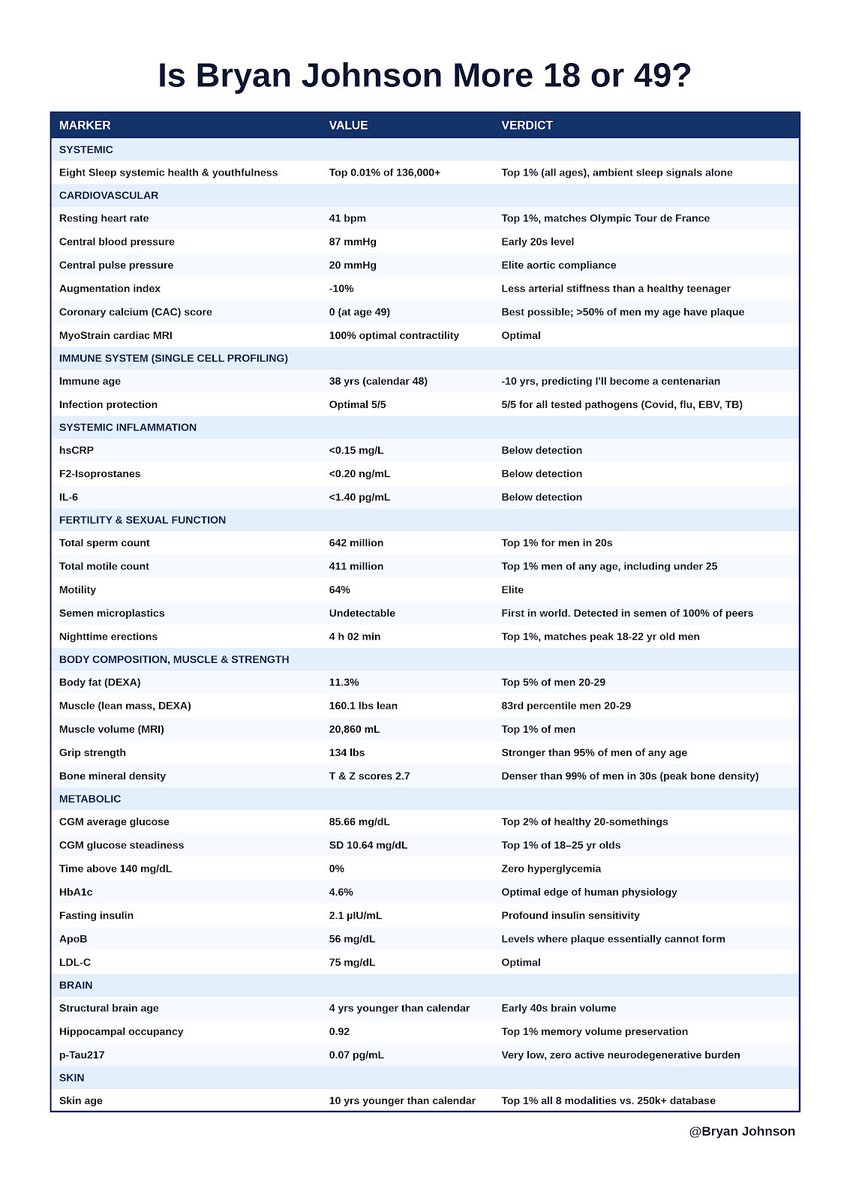
This highlights a few problems many clinics will have when trying to sell 'longevity screenings' to clients.
1. When we look at these results, @bryan_johnson and his team obviously have the context behind them. I and many other health professionals can also understand what these numbers mean, in varying degrees. But for most people, these numbers mean nearly nothing. When you’re selling something where people are paying to find out their numbers, you can tell them whether those numbers are good or bad and what you might want to improve. But even then, how does the client understand why any of it actually matters to them?
2. In reality, most clinics do not have the expertise to go much wider with advanced diagnostics. It requires doctors who have done this for a long time, can think across different areas of health, and can put everything together. When we think about longevity-focused screenings, many clinics are providing screenings that doctors have been doing for years, just with a few more tests added on. The value of a longevity screening should be in having a doctor who can think widely, contextualise the findings to the patient, and decide where it is actually worth going deeper. In essence, prioritisation and pathfinding through medicine.
3. It’s better to start with the problem and then ask what an advanced diagnostic set should look like for that specific person. Show them where you’re going deeper, why you’re going deeper, and what you’re hoping to learn from it. What is the ROI on what they’re paying for? Take Bryan’s metabolic screen as an example. It’s a good cluster of tests, but to most people, what does an ApoB of 56 mg/dL or fasting insulin of 2.1 µIU/mL actually mean for their life? Being able to educate people on this is an important part of longevity medicine. But that education often isn’t there because it’s not what we’re charging for. If we keep charging for screenings rather than interpretation, education and decision-making, that’s what the service will optimise around.
I want to see more clinics going deeper into this because I think there is a lot of potential for longevity medicine. But if you’re a founder building in this space, you need a stellar multi-disciplinary team. There is still a global shortage of people who can do this really well.
Not necessarily because of a lack of knowledge, but because the harder skill is taking all of that knowledge, putting it into the context of one person’s life, and then communicating why any of it matters.
In many ways, I am 18.
If an alien encountered me, they’d struggle to distinguish me from my son.
I know this seems impossible.
I also know I look my age, 49.
But here are the ways I am indistinguishable from an 18 year old:
> Sleep quality
> Erection function
> Fertility
> Resting heart rate
> Vascular health
> Cardiovascular health
> Blood pressure
> Metabolic health
> Blood glucose control
> Bone mineral density
> Muscle
> Fat
> Inflammation (undetectable)
> Shitposting
And here are some ways I am my age:
> Hearing
> Somatic mutations
Friends, I think I’ve done something no one else has ever done: I am more 18 than I am 49.
This is the first rep and we are still figuring things out, but it points toward our inevitable future: better technology and therapies will make youthful vibrance the default.
If you’re in your 30s, 40s, 50s, 60s, and wondering if you can do the same, the answer is yes.
If you’re a teen or in your 20s and feel awful, you can too.
These results only took me 5 years to achieve. The most powerful things are free, and gated only by choice.
It feels amazing.
I feel nimble, and spry, and excited by the world.
I hope you join me in saying yes to life and no to die culture.
Do you want to build a longevity clinic? In the very small chance that you do, I would ask you: how do you plan on getting a wedge into the market?
After working on one from its early stages, and also spending the last few months deciding whether to build another one, here’s how I see it:
1. Globally, we're still very early in the game. A lot of people, especially in Asia, still don’t really know what they’re paying for when they pay for “longevity”. I suggest selling to a problem now, and then layer on preventative services.
2. When you sell to the problem, you need a pick lane you can reliability deliver on fast. There are many ways to sell to something like weight loss and then expand that into some form of longevity service. Are you coming at it from an allied health point of view as a dietitian? Are you coming at it through wellness as a personal trainer? Or are you a doctor providing medical oversight and prescribing medications? Having a strong lane first, and then building out from there, is probably the best way to approach it.
3. At the moment, I’m most bullish on a few starting points. Primary care clinics with a longevity focus. Personal training spaces considering adding medical services. Physiotherapy practices considering expanding into either wellness or medical services. I’m not saying there aren’t other paths, but at the moment, the road to scaled profitability for these make more sense to me.
Founders with enormous amounts of capital might be able to build the full '360° longevity clinic' from the outset. Whether that model works, we don’t really know yet. I'm looking forward to finding out.
But if you don’t have enormous capital, figure out your wedge. Then, design the direction you want to expand into, and continue adding profitable services that tie into your existing ones.
One reason I sit in with clients and their doctors: a single consult produces more signal than most can hold. Labs and doses are easy to catch; subtle nuances slip past.
Recording might help most people, but effectively synthesising the transcript alongside other data matters.
Lawyers on X: are people allowed to record their visits w/their MDs? I’m prepping an episode on patient-MD dynamics in the emerging medical landscape. I’ll of course filter answers against varying local and state laws. To my MD friends: it’s already happening…
On first impression: We need more clarity on how we would act on Entropy data.
Low = well-rested, low cost of being alive
High = signature of a capable body
Do we pair the raw scores with other indicators? Similar to WHOOP's Strain, Recovery and Sleep scores? Let's see.
The Temple team has made a breakthrough.
We have discovered (literally discovered) a biomarker, only readable on the temple region, and nowhere else, that measures the real-time cost of you being alive.
We are calling it Entropy™.
It's a live number on Temple's home screen, updating every second, on an index from 1 to 250.
1 is the deepest rest we've ever recorded. We've only seen fit, experienced meditators touch it, for fleeting moments deep in practice. 250 is the highest we've seen in elite athletes at the peak of their output and flow.
Everything moves Entropy. Sleep, stress, a sprint, coffee, a meal, a cold plunge, meditation, strength training... everything moves your metabolism, your cost of being alive. And Entropy tracks it, live.
Heart Rate doesn’t come even close to this level of precision in calculating the cost of being alive. We benchmarked Entropy and Heart Rate against a standard metabolic cart (calorimeter). Over a hundred cardio sessions, Entropy tracked the calorimeter's curve at r=0.93 and p <0.001. Heart Rate managed a meagre r=0.55.
Here's why Entropy should matter to you –
Your Entropy Maxima is the highest your body can reach when you push it hard. A high peak is the signature of a capable body, one that can rise to meet effort and recover from it. As we age, that ceiling naturally falls, so this is the number to push upwards.
Your Entropy Minima is the lowest your body settles to at rest. Across the animal world, a lower cost of being alive at rest tends to go with a longer life. Your Entropy Minima is the number to bring down, every single day.
Living with Entropy is magical. It teaches you so much about yourself, that no other metric ever has. We are looking forward to you trying out Temple. But not before it’s perfect.
Apply for early access at https://t.co/XxGR9Hpq58
Follow @temple for updates.
The AI image-generation company, @midjourney claims it will be able to scan your entire body in 60 seconds.
You step into a pool of water, pass through a ring of ultrasound sensors, and AI reconstructs a 3D map of what's inside.
The first one will live in a spa, not a medical clinic.
What they're claiming:
• Full-body scan in 60 secs, against 60–90 mins for MRI
• MRI-grade images from sound and water alone
• Half a million sensors, with AI reconstruction
What has to be true for any of it to matter:
• Exists and publishes real data
• Holds up against MRI on real pathology, peer-reviewed
• Clears the FDA for diagnosis, not wellness
• Findings are actionable, through real pathways
On first impressions, it's an interesting, concept-driven press release. And it's good to invite more intelligent minds into healthcare innovation.
You'll see people here calling it the next MRI and a game-changer for longevity. I wouldn't say that.
But I would highlight the gaps they're trying to close.
Can we get better outcomes, faster? Can we reach more people? Can we make it cheaper?
Those are the questions that matter, and if unexpected companies are taking them on, good.
This may not be the product that does it. Or it may be. I don't know. But I'm glad someone's asking.