🔥 Conocí a un tipo que gana 1.2 millones de dólares al año solo escribiendo prompts.
Le pregunté cuál era su truco.
Me mandó un curso de Anthropic de solo 2 horas.
Lo terminé anoche… y a la mitad me quedé congelado
Me di cuenta de que llevo meses usando Claude mal.
No es que lo use poco. Es que lo estaba usando como el 95% de la gente.
Si usas Claude aunque sea de vez en cuando,
guarda este tweet ahora.
En serio. Te va a cambiar la forma en que hablas con la IA.
Robert Sapolsky es un neurocientífico de Stanford que demostró que el estrés crónico es el asesino silencioso que los médicos ignoran.
Reveló 10 hábitos que haces todos los días y que te quitan años de vida.
1) Repasar conversaciones en tu cabeza
Andrej Karpathy just broke the entire premise of modern AI:
"Agents aren't magic. They're distillation at scale."
99.99% of your LLM's capacity is wasted on garbage data it never needed.
Small model + right tools + closed loop = terrifying capability.
In a 16-minute conversation, Karpathy reveals the full reasoning stack.
Worth more than any $500 AI course you've seen this year.
🚨 Tenemos máximo 3 años.
En ese tiempo, el trabajo humano todavía genera dinero real.
Después, la mayoría de lo que hoy pagamos con sueldo se automatiza hasta que ya no vale la pena pagarlo.
Se acaba el modelo que conocemos desde hace 200 años:
“Te alquilo tu tiempo por 40 años y te pago un sueldo”.
Esa es la transición más grande de riqueza de la historia.
Ahora mismo existe una asimetría de información brutal.
Un grupo pequeño ya lo está viendo.
La mayoría sigue esperando a que “sea obvio” en las noticias.
Esa diferencia de tiempo es toda la jugada.
Lo que hay que hacer en estos 3 años es muy simple:
Convertir tu tiempo en activos que no se puedan automatizar ni se diluyan.
Eso significa acumular:
Bitcoin y activos digitales escasos
Activos físicos reales (tierra, energía, producción)
Capacidad de cómputo e infraestructura
Redes de distribución y capital social
Capacidad de generar comida y recursos básicos
Un sueldo es alquilar tu tiempo.
Cuando tu tiempo ya no tenga valor porque una máquina lo hace mejor y más barato… el alquiler se derrumba.
Lo único que queda en pie es la propiedad.
Las personas que en estos próximos 3 años pasen de “empleado que cobra sueldo” a “dueño de activos escasos”…
en 2035-2036 van a parecer que vieron el futuro.
Cuando los sueldos dejen de subir (y después dejen de importar),
solo quedará una cosa:
Quién posee qué.
La ventana está abierta.
Se está cerrando más rápido de lo que la mayoría cree.
¿En qué lado vas a estar cuando se cierre?
No rotors. No wings. Just shaped thrust.
A monocoque drone that turns its hull into microjet nozzles for full vector control.
Pure math + physics in one stunning simulation. Future of flight?
Godfather of AI: "If you sleep well tonight, you may not have understood this lecture."
This 47-minute lecture is the best thing I've seen about AI in the last few months.
Hinton built the neural networks behind every AI alive, then quit Google to warn us it's already ahead of us on most cognitive tasks.
Despite that, most people open Claude, type one thing, close the tab and think they're using AI, but they're using maybe 10%.
I turned his talk into 17 Claude features 99% of users never find.
Watch the lecture, then read the article below.
Elon Musk literally sat down for a 45-minute talk with Y Combinator that explains how to build world-changing companies better than any business school on earth. This is the advice he gave a room full of young founders:
1. Don't try to build something great. Try to build something useful.
Everyone obsesses over greatness. Musk says that's the wrong target. "I didn't originally think I would build something great. I wanted to try to build something useful. I didn't think I would build anything particularly great. Seemed unlikely, but I wanted to at least try." Aim for useful first. Greatness, if it comes, is a byproduct.
2. When you can't get in the front door, build your own door.
Before Musk started his first company, he tried to get a job at Netscape. "I sent my resume into Netscape and nobody responded. I tried hanging out in the lobby to see if I could bump into someone, but I was too shy to talk to anyone. So I'm like, this is ridiculous, I'll just write software myself." He didn't set out to be a founder. He became one because no one would hire him.
3. He slept in the office and showered at the YMCA.
The origin of his first company was not glamorous. "We couldn't even afford a place to stay. The office was 500 bucks a month, so we just slept in the office and showered at the YMCA." He couldn't afford proper internet either, so he drilled a hole through the office floor and ran a cable to the internet provider downstairs. That was the founder of the future richest man on earth.
4. Keep the chips on the table.
When Musk sold his first company, he received a $20 million cheque. His bank balance went from $10,000 to $20 million overnight. Most people would have stopped. He put almost all of it straight back into his next company. "I kept the chips on the table." He did the same thing decades later, over and over. He hates money sitting idle. Money is fuel for the next mission.
5. Start with the mission, then work backwards to make it a business.
Musk didn't start SpaceX to make money. He went on the NASA website to find out when humans were going to Mars, and there was no plan. So he decided to build one. "There had been no prior example of a rocket startup succeeding. A small chance of success is better than no chance of success." The mission came first. The business model came later.
6. He started SpaceX expecting to fail.
He is brutally honest about the odds. "SpaceX started in mid-2002 expecting to fail. Probably 90% chance of failing. When recruiting people, I said, we're probably going to die, but small chance we might not die." The first three launches failed. The fourth one worked with no money left. "If the fourth launch hadn't worked, it would have been curtains. We made it by the skin of our teeth."
7. Break every problem down to physics.
This is the core of how Musk thinks. "First principles means break things down to the fundamental elements that are most likely to be true, then reason up from there, as opposed to reasoning by analogy." His example is rockets. Everyone priced them based on what old rockets cost. Musk asked what a rocket is actually made of, priced the raw metals, and found the materials were only 1-2% of the historical price. The rest was inefficiency he could attack.
8. When told something takes 24 months, break it down and do it in six.
Last year xAI needed a giant computer to train its AI. Suppliers said it would take 18 to 24 months. "It's like, well, we need to get that done in six months or we won't be competitive." So he broke it into parts. Needed a building, so he found an old factory. Needed power, so he rented generators. Needed cooling, so he rented a quarter of America's mobile cooling capacity. He slept in the data centre and ran cabling himself. It got done.
9. Watch your ego-to-ability ratio.
Musk's single sharpest piece of advice for young founders is about staying honest with yourself. "A major failure mode is when your ego-to-ability ratio gets too high. Then you break the feedback loop to reality." Keep the ego small, internalise responsibility for everything, and stay ruthlessly connected to what's actually true. "You want to close the loop on reality hard. That's a super big deal."
10. Chase work, not glory.
His closing philosophy ties it all together. "It's so hard to be useful. The area under the curve of total utility is how useful you've been to your fellow human beings times how many people. If you aspire to do true work, your probability of success is much higher. Don't aspire to glory, aspire to work."
He was ridiculed for years. The press called him "internet guy attempting to build a rocket company." He agreed it sounded absurd. He did it anyway, because a small chance of doing something useful beat no chance at all.
Here's the thing though....
Musk became the most followed founder alive because everything he does happens in public. The launches, the failures, the talks like this one. The companies made him powerful. The personal brand made his every word travel around the world before he finishes saying it.
We build massive distribution and grow personal brands on X and beyond without our clients lifting a finger.
If you're a founder or VC looking for that kind of exposure, book a call below.
We average 1.5M views a week.
https://t.co/UoXuYlkBQq
🔥 We introduce LeVLJEPA: the first fully non-contrastive end-to-end vision-language pretraining method competitive with CLIP & SigLIP 💪🏼
👀 No negatives. No temperature. No momentum encoder. No teacher-student.
TL;DR: LeVLJEPA learns image to text structure by prediction: each modality predicts the other's embedding, while SIGReg keeps each embedding isotropic Gaussian. 🧵
📄 https://t.co/1qBXor8qTf
What if you could build a generative model without training a neural network?
A second paper heading to #ICML2026 in Seoul 🇰🇷
We develop a kernel method inside the flow matching that replaces network training with a simple linear system. No backprop, no network to train. 🧵
Anthropic engineer:
"You can build 5 assistants in one afternoon. Each one handles a task you've been doing manually every single day."
In 45 minutes he shows exactly how to do it from scratch, step by step.
Most people are still doing all of this by hand.
Watch the session, then save the guide below.
Transformers are easier to learn when you can poke the model directly.
Transformer Explainer is an interactive visualization tool for learning how Transformer-based text-generation models like GPT work.
It helps you connect the architecture to real behavior by running a live GPT-2 model in the browser, letting you enter your own text, and showing how internal components work together to predict the next tokens.
Key features:
• Live GPT-2 in the browser – experiment without setting up a separate model server first
• Custom text input – try your own prompts and watch how the model handles them
• Internal component views – observe the operations that work together inside the Transformer
• Next-token prediction focus – connect each visual step to the model’s token predictions
• Local development path – clone the repo, install dependencies, and run it with npm for deeper inspection
It’s open-source (MIT license).
Link in the reply 👇
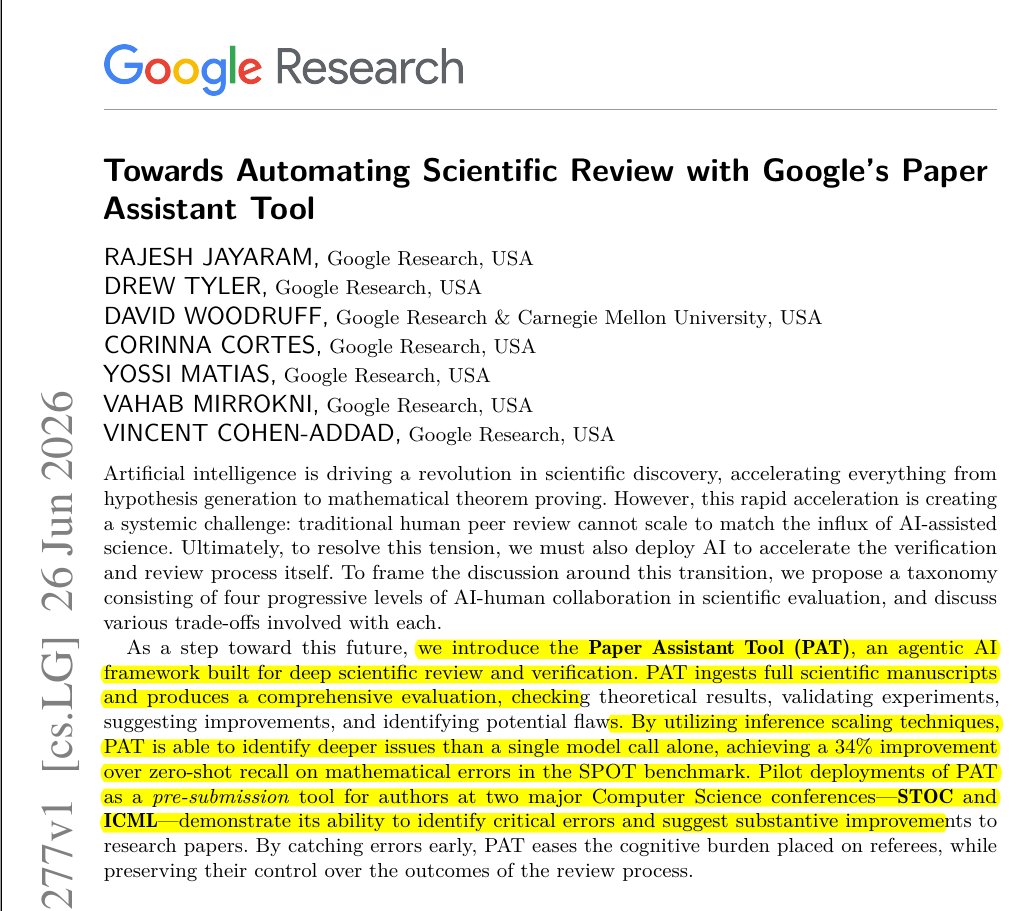
Big new paper release of Google for external agentic verification for science.
Science now needs AI review agents because AI is making papers faster than humans can check them.
The problem is that AI can help produce more research, but the slow part is still checking whether the work is actually correct.
The paper frames this as verification debt, where every faster research workflow creates more claims, proofs, experiments, and comparisons that someone still has to inspect.
Its main proposal is agentic verification, where AI agents help review papers by splitting them into parts, checking difficult sections deeply, and combining the findings into a review.
Google’s Paper Assistant Tool is the example system, and it focuses on objective checks like proof errors, experimental gaps, missing comparisons, and unclear claims rather than final accept or reject decisions.
The authors tested it on known math and computer science paper errors and in author-facing pilots at STOC and ICML, where authors used it before submission.
The striking result is that Paper Assistant Tool found far more known proof errors than a single model call, and many authors said it led them to fix serious theory gaps or run new experiments.
The big deal is that scientific review may need its own AI stack, with review agents, clear roles, and human oversight, because paper generation is becoming partly automated too.
----
Link – arxiv. org/abs/2606.28277
Title: "Towards Automating Scientific Review with Google's Paper Assistant Tool"
Tak wygląda cała* otwarta wiedza medyczna w Polsce.
270 000 pojęć. 650 000 relacji.
Najwiekszy graf wiedzy medycznej to jeden z projektów open- source które realizujemy
Krótka legenda:
zielone - leczenie
czerwone - przyczyna
żółte - objaw.
Reszta - najlepiej zobaczcie sami, link w komentarzu
Muszę przyznać że jest w tym obrazku coś magicznego i mógłbym się w niego wpatrywać długo
* Źródło danych: Wikipedia (CC BY-SA), leki URPL/ChPL (CC BY 4.0) · ICD-10 PL
LLMs may not need human-style language.
i.e. future AI systems might save context space by using dense model-readable messages instead of long normal prose.
The authors propose BabelTele, a compressed writing style that can mix abbreviations, symbols, fragments from different languages, and unusual structure.
To a capable language model, it can still carry enough structure to answer questions, preserve memory, and pass information between agents.
The point is that human readability, natural-language fluency, and machine recoverability are separable properties.
Human prose carries redundancy because humans need rhythm, grammar, context, and reassurance.
Models trained on huge symbolic mixtures may not need all of that scaffolding every time.
In the paper’s strongest result, BabelTele keeps about 99.5% semantic fidelity while shrinking text to 27.9% of its original length.
----
Link – arxiv. org/abs/2606.19857
Title: "LLMs Do Not Always Need Readable Language"
- Math behind Attention- Q, K, and V
- Math behind √dₖ Scaling Factor in Attention
- Math Behind Backpropagation
- Math Behind Gradient Descent
- Math Behind Cross-Entropy Loss
- Math Behind RoPE (Rotary Position Embedding)
- RMSNorm (Root Mean Square Layer Normalization)
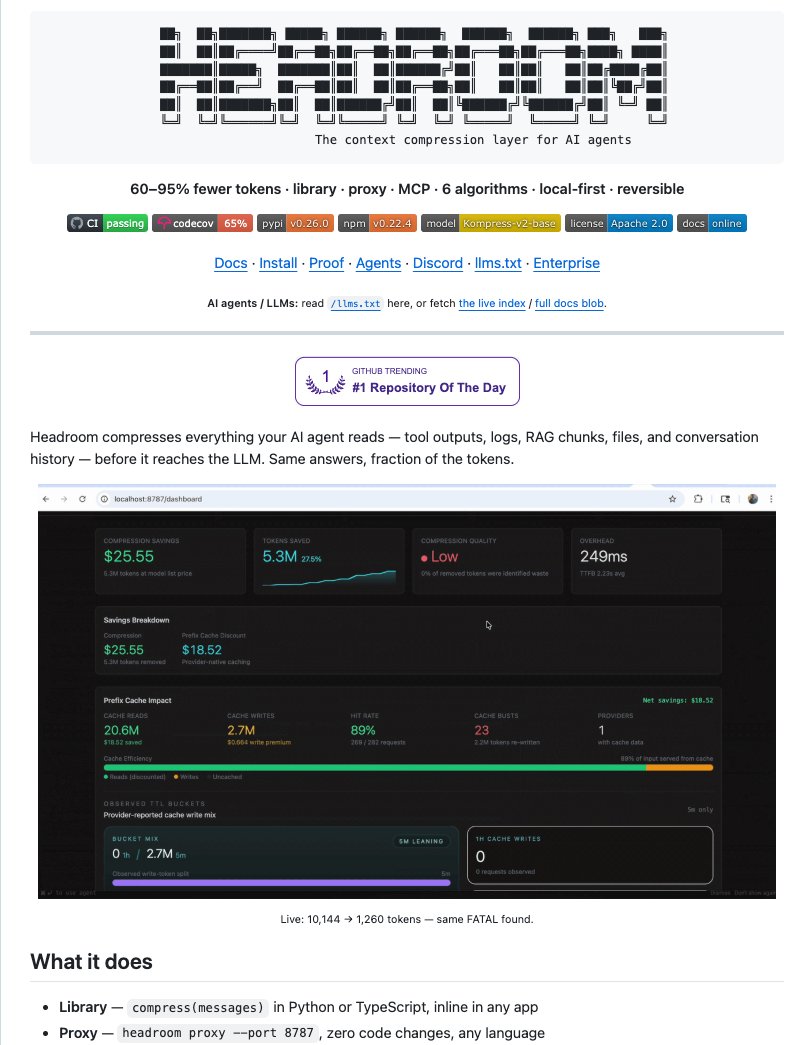
UP TO 95% TOKEN REDUCTION WITH ZERO CODE CHANGES
A Netflix engineer just open-sourced Headroom, and it’s one of the smartest ways I’ve seen to cut LLM costs.
It wraps Cursor or Claude in a local proxy to compress your payload before it hits the LLM:
→ Intelligently shrinks logs, JSON, and code
→ Perfectly preserves logic accuracy
→ Keeps 100% of your data local
→ Stops Opus-tier models from wasting tokens on boilerplate
It already crossed 35K stars, which says a lot.
100% free and open-source.
repo in 🧵↓
Karpathy's prediction about RL is coming true now!
He called reward functions unreliable and argued that a single reward number is too low-dimensional to teach an agent what "good" means for complex tasks. To solve this, Agents need a knowledge-guided review as a higher-dimensional feedback channel.
Every major AI lab trains models with RL today (OpenAI, Anthropic, DeepSeek).
And their key bottleneck has always been the reward functions.
GRPO by DeepSeek worked well for math and code because the environment gave a binary signal.
But for real agent tasks, someone still has to hand-code the scoring function. That takes days and breaks every time the pipeline changes.
RULER (implemented in OpenPipe ART, 10k stars) addresses the exact problem Karpathy identified.
The reward criteria are defined in plain English, and an LLM evaluates each trajectory against that description to provide feedback for training.
I trained a Qwen3 1.4B agent that plays 2048 using GRPO with this exact workflow.
In this case, the agent saw the board, picked a direction, and RULER evaluated the outcome, all from this natural language definition.
You can see the full implementation on GitHub and try it yourself.
Here's the ART Repo: https://t.co/XeTppNyX9p
(don't forget to star it ⭐ )
Just like RLHF replaced manual rankings and GRPO replaced the critic model, natural language rewards are replacing hand-coded scoring functions.
RL reward engineering is now prompt engineering.
I wrote a full walkthrough on OpenPipe's ART, the agent RL trainer built on GRPO, including how RULER replaces manual reward engineering with automatic LLM-graded rewards.
The article is quoted below.
Google has silently released an AI that predicts the future.
it's called TimesFM and it forecasts literally any pattern with numbers like sales, stock prices, web traffic, energy demand, even crypto volatility.
→ trained on 100B real-world data points
→ zero-shot. no fine-tuning needed.
→ runs 100% locally
100% open source.