📢 Diffusion circle at @icmlconf 2026: join us Thursday July 9 at 3:30PM at the information desk / job board, we'll head out from there and find a spot to sit. No agenda, just get together and talk shop.
Please tell your friends and tag people who might be interested!
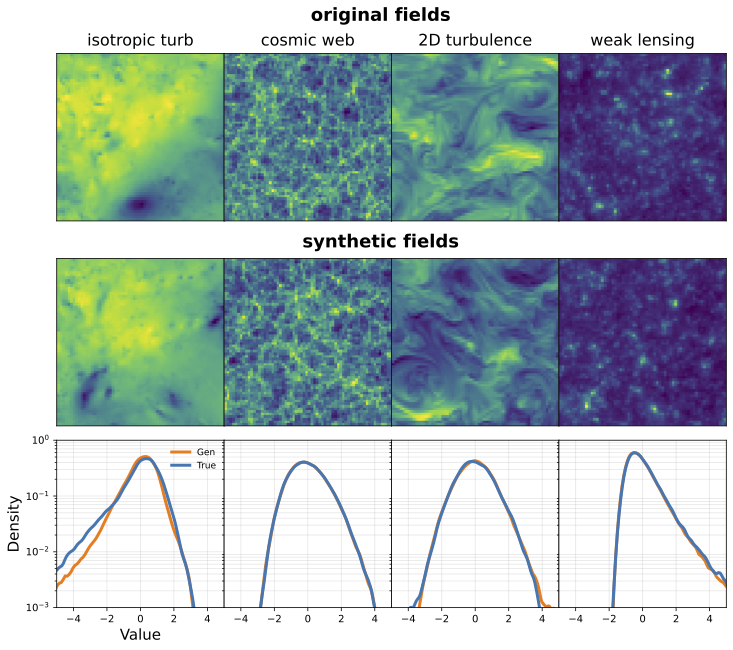
@MikePFrank Thanks for the repost! A good starting point is our related journal paper, Moment-Guided Diffusion for maximum entropy generation, which builds up the same intuition: https://t.co/rsPrIrCzwv
@mgostIH Love this idea, definitely want to try it !DINO gives exactly the realistic-image features scattering lacks. The open question: our method needs the gradient of the feature map, and DINO's are noisier, so whether the regression stays well conditioned is the thing to test
What if you could build a generative model without training a neural network?
A second paper heading to #ICML2026 in Seoul 🇰🇷
We develop a kernel method inside the flow matching that replaces network training with a simple linear system. No backprop, no network to train. 🧵
@AndrejSpiridon4 Great question! Yes, through the scattering features, which capture multiscale and multifractal structure. And absolutely, the same representation works nicely for characterizing systems from spatial patterns, not just generating them
Two settings where this helps:
• Good features already exist: plug them in and generate, we generate from a single S&P 500 point, recovering stylized facts.
• You already have models: combine many weak or pretrained velocity fields through the same system, without retraining.
New paper at #ICML2026 in Seoul 🇰🇷
We bring the string method from computational chemistry to diffusion models. Rather than transporting one sample, it evolves an entire curve linking two points and lets the learned score reshape it.
🧵1/3
🧵3/3
We use it to morph images and map protein transition pathways, the intermediate conformations a molecule passes through, directly from a pretrained generative model.
Another open access #MLJ online-first paper today (or yesterday, actually): "Normalizing flow sampling with Langevin dynamics in the latent space" by Florentin Coeurdoux, Nicolas Dobigeon & Pierre Chainais (https://t.co/AYQBrNwpYL) #OA
📄 Recently accepted for publication in Machine Learning.
(last) Congrats to my former Ph.D. student @CoeurdouxF for this (last) work! 🎉
🔗https://t.co/kUYbupTtmx [OA]
📄 Recently accepted for publication in IEEE Transactions on Image Processing.
Again, congrats to my former Ph.D. student @CoeurdouxF for this work! 🎉
🔗https://t.co/N3ppb2TlGD
Corrigendum: the co-authors are E. C. Faye and M. D. Fall, both from Institut Denis Poisson (IDP, Orléans).
Sorry @FallMDiarra for the typo on your name! 😳
New #arXiv preprint introducing NF-SAILS, a sampling method for pre-trained normalizing flows. It exploits a Langevin dynamics formulated in the latent space.
Joint work w/ @CoeurdouxF (@IRIToulouse, @ANITI_Toulouse) & P. Chainais (#CRIStAL).
🔗https://t.co/SyaTBOTNxo
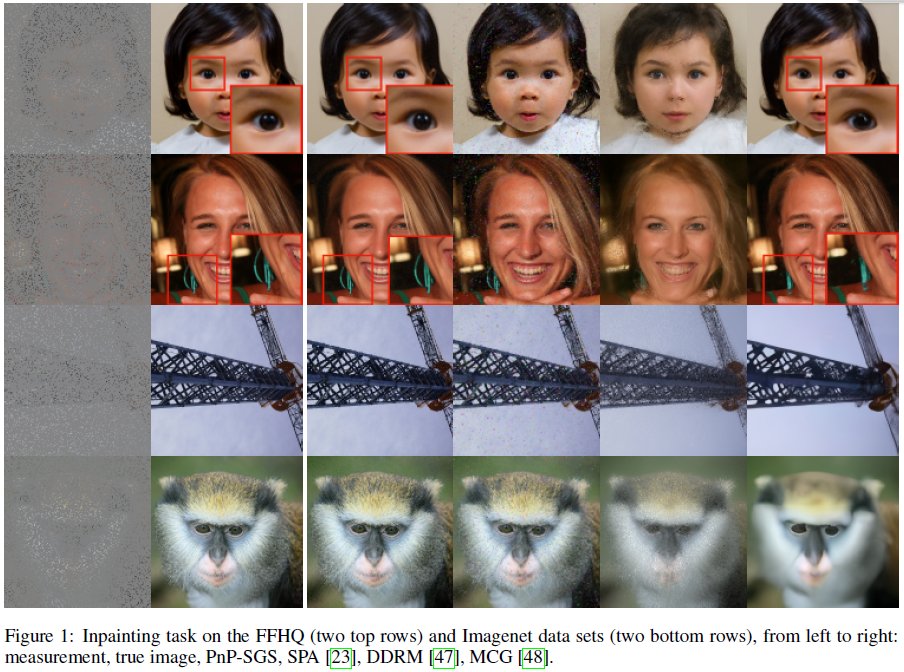
New #arXiv preprint introducing a stochastic counterpart of PnP-ADMM, embedding a #deep generative model (here a DDPM) as a implicit prior for Bayesian inference.
Joint work w/ @CoeurdouxF (@IRIToulouse, @ANITI_Toulouse) & P. Chainais (#CRIStAL).
🔗https://t.co/EWMsJgB4RF
Maximise expected info gain in model params (aka BALD) → effective active learning? Sadly not!
EPIG, our alternative, shares BALD’s 1950s foundations but targets predictions.
https://t.co/GTEb5hNvbQ
#AISTATS2023 w/ @blackhc@seb_far@yaringal@adamefoster@tom_rainforth
1/5
📄 Un papier sur le transport optimal a été sélectionné à la conférence sur le Machine Learning @ECMLPKDD. C'est l’occasion de faire un focus sur le transport optimal en #informatique avec @NicolasDobigeon et @CoeurdouxF de l'équipe SC - Dept. SI ↪️
https://t.co/ZfMfFRMTTn