I'm building my assistant in Hermes. No, I won't blindly trust it ◆ I teach you the way of responsible AI: your data, your rules ◆ PhD in computer science ◆ Dad
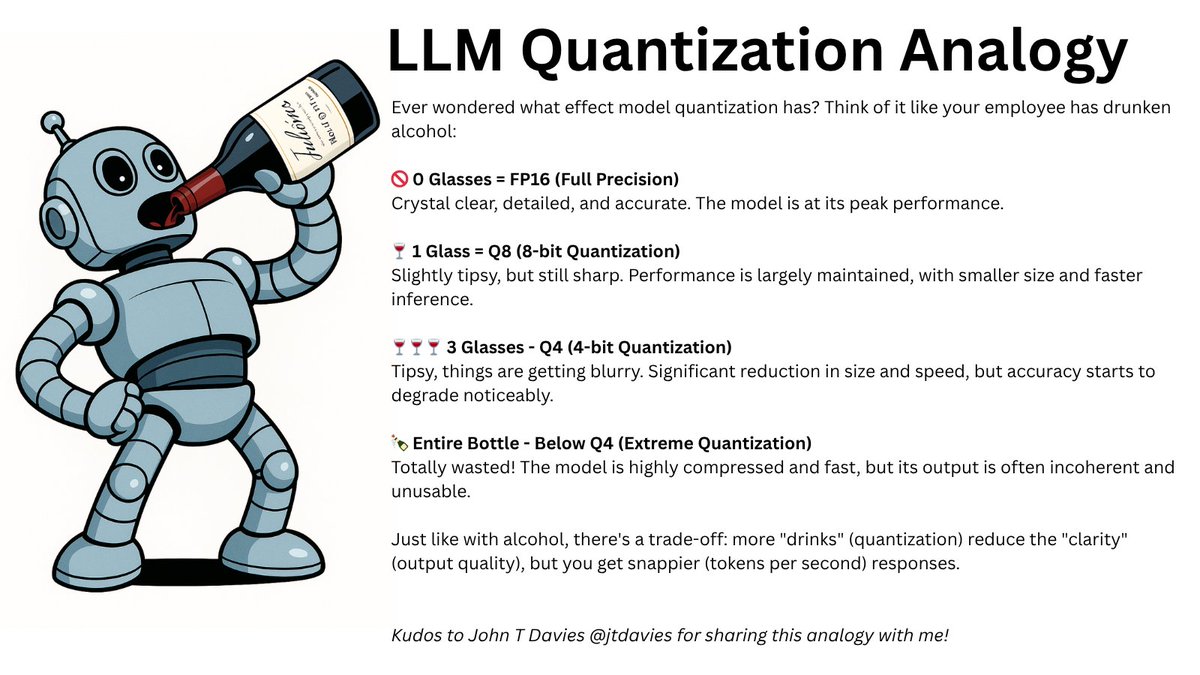
Ever wondered how model quantization (FP16, Q8, Q4) *really* affects performance?
There's an analogy that makes the trade-offs crystal clear... and it involves something you might drink. 😉🍺
Kudos to @jtdavies for this brilliant comparison. 🙏
See the image for the full explanation! 👇
@Tim_Denning The well-known playbook.
Sounds good and it's still hard at the same time, especially to be consistent and stick to it, because it might take longer than you think to get the success you're looking for.
But nevertheless, I agree.
A source link doesn’t guarantee an AI answer is right.
I asked ChatGPT and Hermes Agent a simple question:
What's a soccer club’s annual membership fee?
They gave different answers. Both cited sources, but only one was correct.
Check the origin of the sources yourself!
WTF and thanks to OpenAI for making my digital life a bit safer by spending an equivalent of $1.2M to secure the Linux kernel🙏
Yes, less costs than the stated $1.2M for OpenAI as they don't need to pay the margin of customers, BUT compute is a rare resource for everyone. 👏
Our security researchers built an autonomous cyber vulnerability discovery, exploitation, and patching pipeline.
In a single run with an upcoming cyber model, it validated and generated patches for 948 local privilege escalation vulnerabilities in the Linux kernel at a total API cost of $1.2 million.
The cause is likely that the account that created the calendar does not exist anymore.
> secondary calendars will now follow the lifecycle of their owner, meaning that when a user account is deleted, any secondary calendars owned by that user will be deleted as well. Similarly, when a user is suspended, their owned secondary calendars will be suspended as well.
https://t.co/sfvVWTlmEB
I'm so happy I'm self-hosting everything now! If you're not, please stick with the big providers: AWS, Google Cloud, Azure.
I wouldn't trust any of these small PaaS - Railway, Supabase, Netlify, Vercel, etc - for ONE second.
Get off the cloud.
(Or stick with the really big ones).
Super cool, thanks for the share @jtdavies!
Most interesting remaining questions:
Which of the Qwen 4 models will be released as open-weight?
What will be the size of the Qwen 4 Flash model?
Previous generations:
Qwen3.6-Flash: Based on the open Qwen3.6-35B-A3B (35B total parameters, ~3B active).
Qwen3.7-Flash: Closed model; exact parameter count not publicly disclosed.
Qwen3.8-Flash-Next (Qwen4 architecture preview): 125B backbone with ~6B active parameters, plus extra components (e.g., large N-gram embedding table).
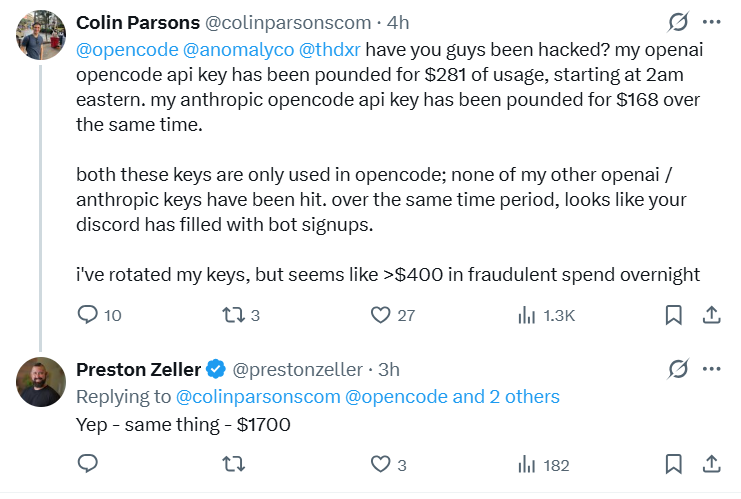
Take the @opencode hack where API keys were stolen and many $$$ were spent as a warning to check your API keys, even if you don't use OpenCode.
Open your OpenAI, Anthropic, and other provider accounts:
• Revoke old keys you no longer use.
• Rotate any keys that may have been exposed.
• For active keys, review your spending limits.
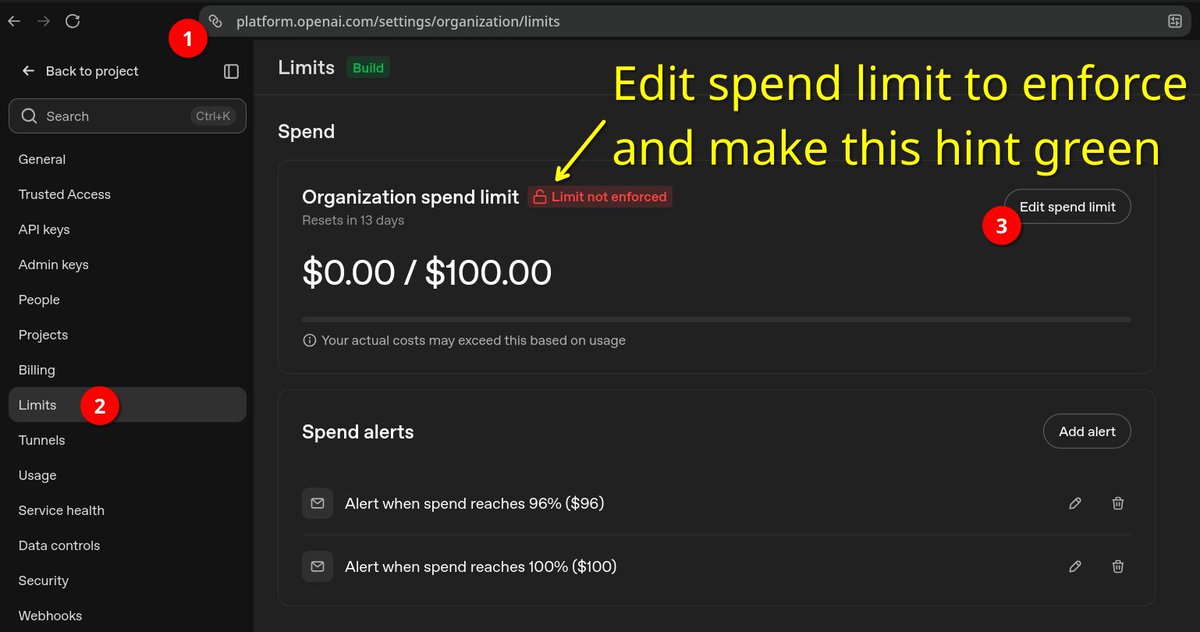
For OpenAI, make sure the spending limit is actually enforced, not just an email alert. The screenshot shows where to enable this.
An alert is useful, but if someone abuses your key overnight, you may wake up to the bill before you can stop it.
@stlhood Another happy Strix Halo user here saying "Hi" ✌
I die buy mine with 128 GB last year for $1.8k, a price not available anymore due to the increased memory prices.
Nevertheless, still the currently best setup to run small MOE models.
Hi Alex, ich habe deinen Post under mit diesem auch deinen X account auf dem Weg mit der DB zur Buchmesse gefunden.
Würde mich über ein Rezensionsexemplar, bevorzugt als ebook, freuen. Im Austausch biete ich eine Amazon Rezension und werde etwas in meinem bald wieder startenden Newsletter über dein Buch schreiben.
Well spotted, and thanks for your reply!
Both sides count chunks during streaming and use the server-reported completion token count for the final tokens/sec calculation, which is shown in the end.
Chunk rates are not used to decide the winner because, as you stated, chunks can vary in size depending on the framework used.
Fair point that the changing labels make the video confusing.
Side-by-side test of qwen3.8-flash-next running locally:
• AMD Strix Halo 128GB with Halogen by @high52weeks
• RTX 3090 desktop with 94 GB of memory, using Strata by @coldniko
Both at ~50 tok/s and it feels good to power my Hermes agent with it for privacy-sensitive tasks. 👇
Wait, OpenAI only delivered 30 token per second?!
And now 50 TPS means my latest local AI is experiments with Qwen3.8-flash-next is now on par with the speed I get from OpenAI. 😳
Reaching 50 TPS instead of 30TPS, with also the most optimized tokenizer out there. And the models are quite the efficient ones in terms of number of tokens needed to get things done!