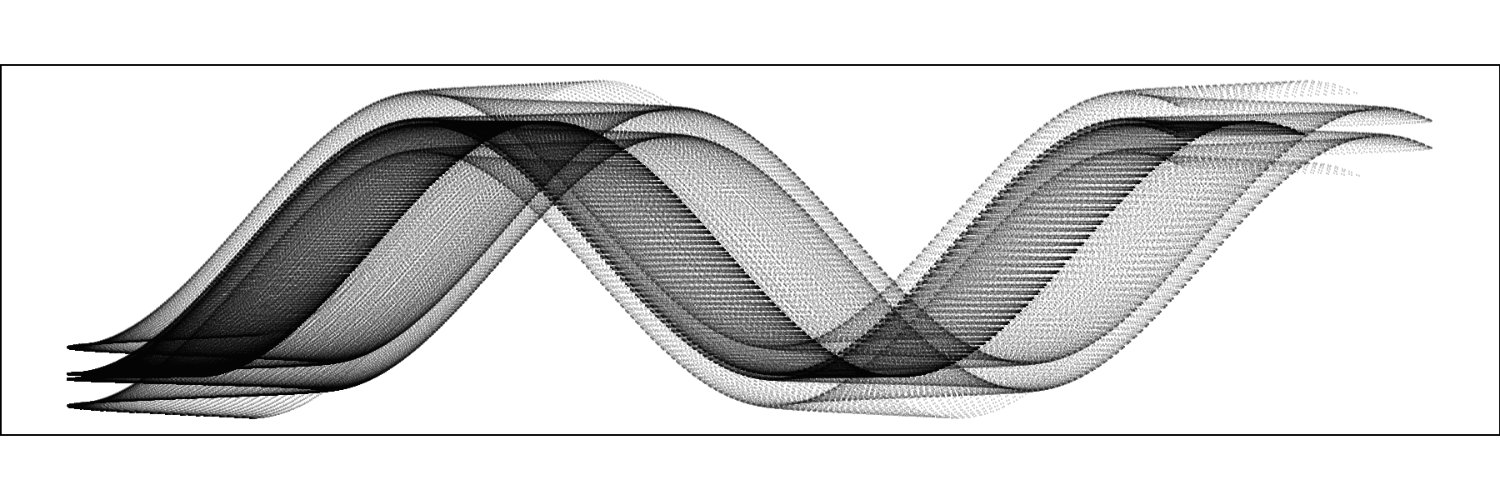
Final part of the trilogy on dynamical systems in neuroscience is out!
https://t.co/0ko74AhWA3
In the video we talk about spiking orbits and bifurcations; bistable and monostable neurons, and the distinction into integrators and resonators 🧠🌀
This is the most technically challenging video I've ever done, with After Effects crashing multiple times, even on an M4 Max mac ...
P.S. code for animations also available on GitHub:
https://t.co/imRMyPh2Kh
35 year old Chinese man arrested in Bangkok, driving around populated areas with a SMS blaster with a 3km radio sending 1,000,000 phishing SMS per hour. "Phone users within range received a message stating: “Your 9,268 points are about to expire! Hurry up and redeem your gift now��. This was followed by a URL for phishing website."
Video of the arrest: https://t.co/OE8cJio84o
Generative AI is cool and all, but procedural 3D modeling just hits different. Check out this Houdini setup by Pepe Buendia.
Why this is cool: Instead of manually placing every building and car, this system generates an NYC-style city that builds itself -- automatically spawning buildings with unique variations, plus a traffic system where cars actually obey traffic lights and avoid crashing into each other (all orchestrated through houdini VEX code).
Each car knows exactly which road it's on and makes real-time decisions about navigation. The whole thing runs on custom algorithms that handle everything from road directions to building placement.
If you did this with generative AI, even approaches to conditioning and taming the chaos -- you'd still get a ton of variance which might be an issue for visual and spatial consistency.
To me this is procedural modeling at its finest - precise control meets infinite scalability. Immensely useful for media & entertainment, but also synthetic training data for robotics and augmented reality.
I of course can't wait until multimodal LLMs to have the spatial understanding to write these kind of controllable 3D worlds for us. Claude counting 2D pixels on a screen is a step in this direction. Soon they'll be able to manipulate 2D ortho viewports, and eventually spawn procedural 3D worlds.
📣Check out our #NeurIPS24 paper Geometric Trajectory Diffusion Models (GeoTDM), a new diffusion-based generative model that captures the temporal evolution of the ubiquitous geometric systems!!
Paper: https://t.co/wy8lQGxaNe
Code: https://t.co/6FW1UiRCZV
🧵1/8
The 2024 #NobelPrize laureates in chemistry Demis Hassabis and John Jumper have successfully utilised artificial intelligence to predict the structure of almost all known proteins.
In 2020, Hassabis and Jumper presented an AI model called AlphaFold2. With its help, they have been able to predict the structure of virtually all the 200 million proteins that researchers have identified. Since their breakthrough, AlphaFold2 has been used by more than two million people from 190 countries. Among a myriad of scientific applications, researchers can now better understand antibiotic resistance and create images of enzymes that can decompose plastic.
Read more about their story: https://t.co/nWxcZs6wqC
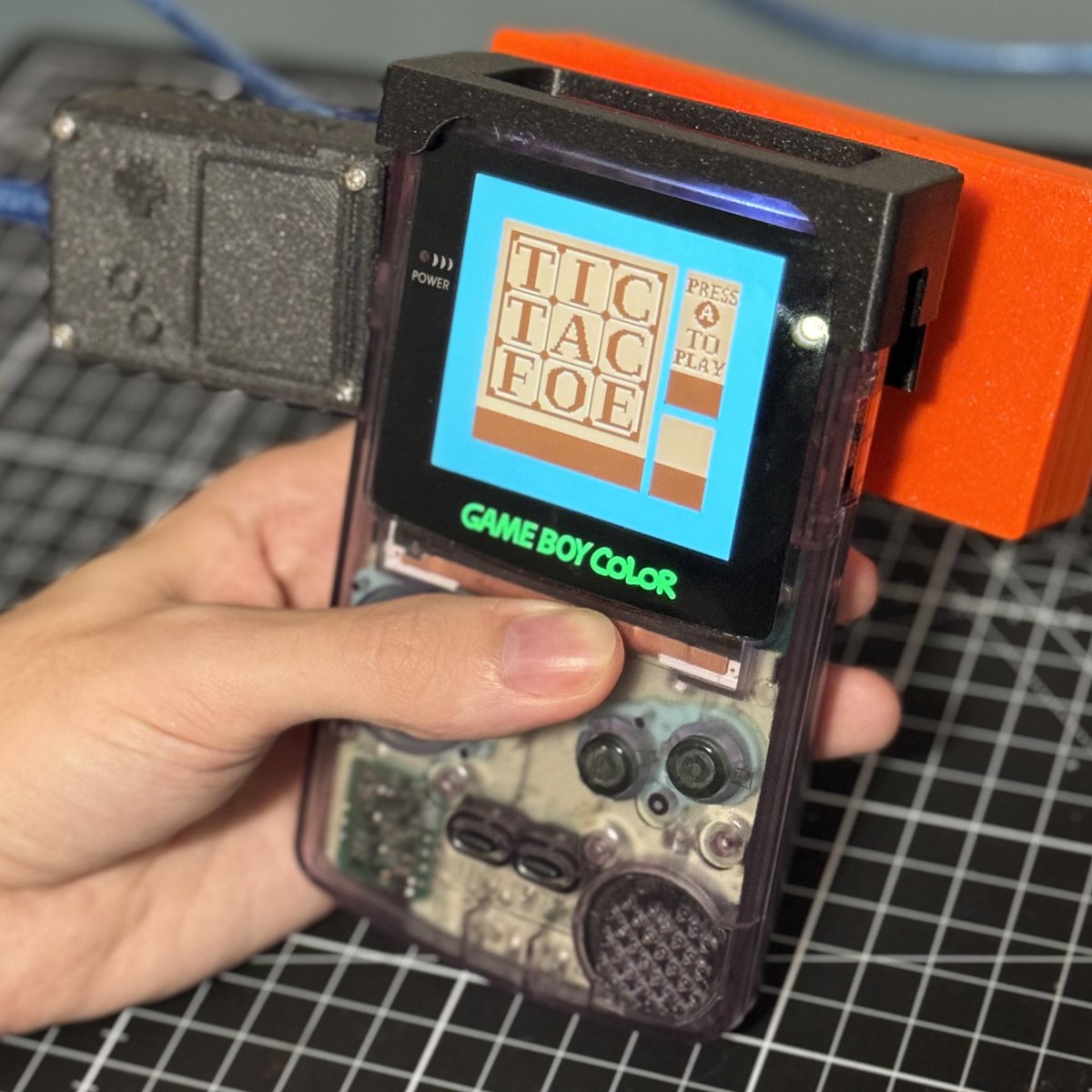
I call it the “NetBoy”, a device which connects any Game Boy Color to the internet.
It’s an esp32 with firmware written in C which is using the stock serial port on the Game Boy to facilitate communication between my custom cartridges and in this example a game server to run a simple game of tic-tac-toe cross-platform.
arXiv -> alphaXiv
Students at Stanford have built alphaXiv, an open discussion forum for arXiv papers. @askalphaxiv
You can post questions and comments directly on top of any arXiv paper by changing arXiv to alphaXiv in any URL!
I wanted to learn Rust for a long time, and finally, it's time to open source what I've been up to these last 2 weekends.
Presenting picograd, inspired by Andrej Karpathy (@karpathy)'s good old micrograd : https://t.co/10M0RBHksI
Here are my 7 takeaways from this project:
1. I used to think that Rust is similar to C++. It's not. It's way different!! You have to learn a whole bunch of new concepts and the learning curve is steep.
2. Rust design patterns are difficult and weird. If you are coming from a strong Object Oriented Programming (OOP) background, it might be a hard pill to swallow.
3. Rust is not for every Python developer. You must move from a dynamically typed language to a strongly typed one. And you face tons of warnings while writing your lines of code.
4. I loved the concept of ownership. And I think Mojo🔥 by @Modular does that too! I feel that Mojo is a hybrid of Python and Rust. MLIR Compiler instead of LLVM is a story for another day.
5. If you come from a C++ background, you are gonna be reminded of your good old friend templates. Generics used to be so much fun.
6. I just love the @rustlang 's build system, man it's so easy to set up than C++.
7. Rust compiler is your excellent friend, although it's annoying to see (until you don't) an error every time you compile your code, it's for the greater good. Rust wants to ensure your code is safe and free of bugs. I think Rust is a very good language for production code. Not to mention its performance & speed.
It's been a fun ride at @_buildspace and @_nightsweekends, where I'm seeing so many people like me coming together to build stuff. I love the community's energy.
Hacking time to recover $3m worth of lost Bitcoin.
Sounds crazy, right?
This is how two white hackers cracked an 11 year old password behind this massive fortune.. 🧁
Someone left a "secure" Russian phablet on the back of a bus in Salisbury, England. It was running Aurora OS, a so-called "trustphone" device for use by Russian Government and corporations... here's the flash ROM dumps for 4.0.2.249, 4.0.2.82 and 3.2.1.65. https://t.co/vsT6qkziyM