Pitt to pause PhD admissions, following Vanderbilt and USC, because of uncertainty of NIH funding to academic universities.
Who will teach and train US scientists for pharma and biotech? Should we import them from countries that do?
https://t.co/YkhmAyKNWV
It's clear that many do not understand what @NIH-funded research does to improve health. It's time to revive a study published 10 years ago that provides incredible information about this. link in the comment
Every single new drug approved by the FDA from 2010–2016 was built on NIH-funded research—that’s all 210 drugs. But what the public sees is just the tip of the iceberg.
Pharma takes credit for the final product, but beneath each drug developed, there are ~20 years of basic research, and 90% of the cost is from basic research funded by the NIH, which discovers drug targets, understands disease mechanisms, and creates life-saving treatments.
Figuring out how cancer evades the immune system, how addiction rewires the brain, and how heart disease develops is the role of the NIH, creating the foundation for the breakthrough drugs that come 20 years later, and the NIH does all that with only 0.8% of the US budget.
Without NIH, there would be no cancer immunotherapy, no anti-overdose medication, no anti-heart attack or stroke medication, no cutting-edge treatments.
If NIH funding is cut, the iceberg will melt. That means fewer cures, more suffering, and more lives lost.
The science beneath the surface keeps us afloat.
Invest in NIH. Invest in life
@JohnStreicher1 We need to be talking the contribution the NIH investment makes to our economy. 2.5x ROI is significant and that is in a stifled system you kneecap us more and it will impact the GDP. Everyone just sees the $9B in savings but the cost will be greater to many beyond science.
Why does @elonmusk, a citizen, act as if he has the power of congress? Congress is composed of 535 people — elected by us to represent us. Musk is not a cabinet member, he’s not an elected official. Doge does not exist without the approval of congress.
Impact of NIH funding in Ohio:
NIH funding: $1.01 billion
Jobs supported: 13,061
ECONOMIC ACTIVITY SUPPORTED: $2.59 billion
Bio industry impact in the state:
Jobs: 56,267
Businesses: 4,243
These indirect cost cuts will gut all of this
https://t.co/pxGCUnBU2p
China is increasing spending on biomedical research as the U.S. limits funding. We are currently #1 for clinical trials and Nobel prizes. China is #1 for patents and publication of breakthroughs. This will not make us healthier, smarter, wealthier or more competitive globally.
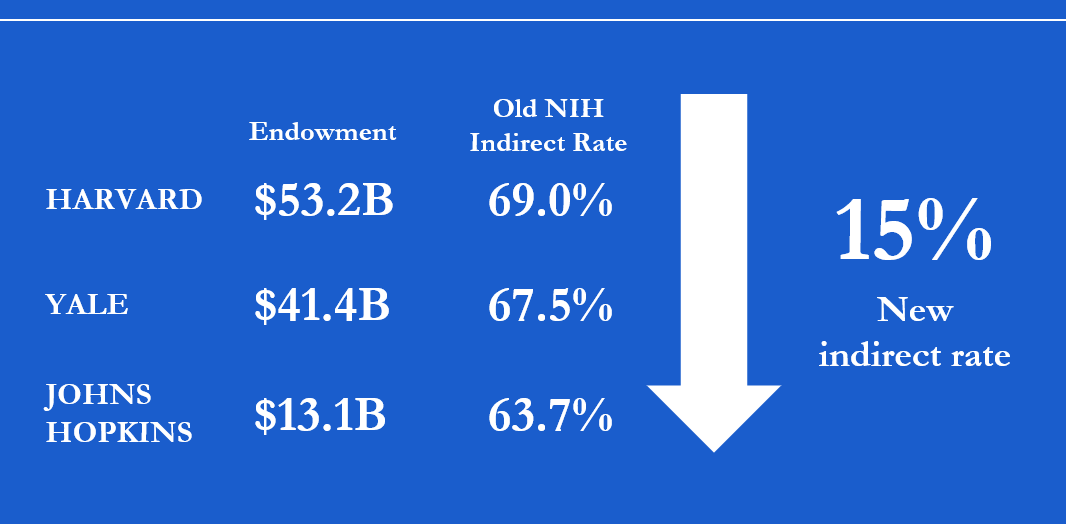
Last year, $9B of the $35B that the National Institutes of Health (NIH) granted for research was used for administrative overhead, what is known as “indirect costs.” Today, NIH lowered the maximum indirect cost rate research institutions can charge the government to 15%, above what many major foundations allow and much lower than the 60%+ that some institutions charge the government today. This change will save more than $4B a year effective immediately.
@NIH China is increasing spending on biomedical research as the U.S. limits funding. We are currently #1 for clinical trials and Nobel prizes. China is #1 for patents and publication of breakthroughs. This will not make us healthier, smarter, wealthier or more competitive globally.
Astrocytes are usually seen as supporting brain cells, says @drkruyer, but some astrocytes seem to have an active role in taming neuronal hyperactivity and constraining behaviours similar to those seen in obsessive–compulsive disorder. https://t.co/I93JuIZx0G
Are you an underrepresented undergrad interested in a neuroscience career?
Join us at "Neuro-Horizons", our summer 3-day workshop for populations underrepresented in science hosted by U of Cincinnati.
https://t.co/haiO4Y2wW5
@BlackInNeuro@ABRCMS@sacnas@GradCollegeUC