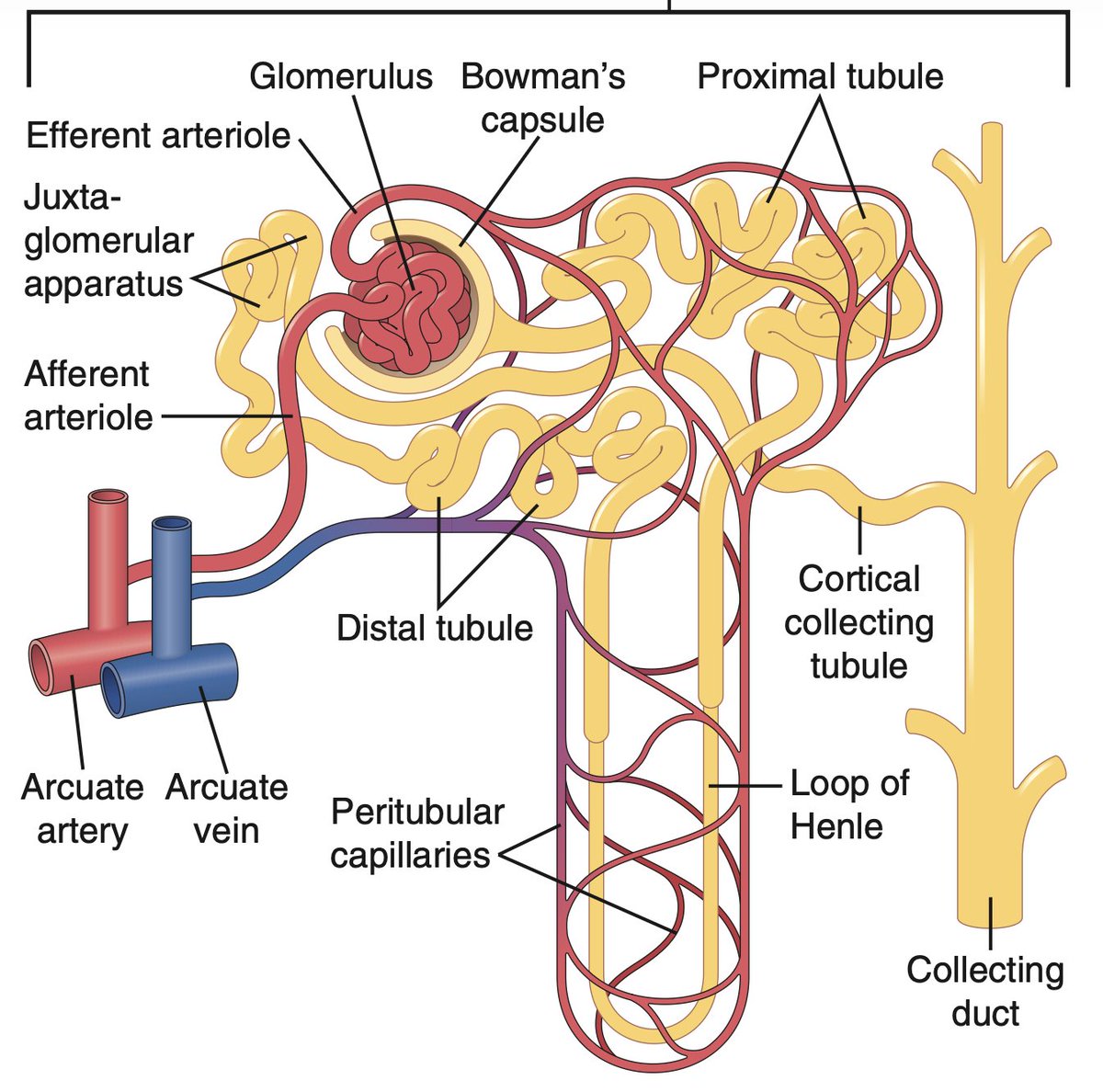
This is the most sophisticated machine in the human body.
The nephron is not a passive filter, but an energy-intensive microfluidic processing system: less a simple tube than a miniaturised biological machine that spends blood flow and ATP to transform a crude filtrate into the precise internal stability we call homeostasis.
At rest, the kidneys receive a strikingly disproportionate blood supply: roughly 20–25% of cardiac output, about 1–1.2 L of blood per minute in an adult, despite representing well under 1% of body mass.
That flow is not there mainly to “feed” renal tissue, but to sustain filtration and the enormous transport workload of the nephron. About 180 L of filtrate are generated per day, and almost all of it must be selectively reclaimed.
Metabolically, the kidneys account for roughly 7–10% of whole-body oxygen consumption at rest, which is remarkably high for such a small organ.
Most of that energy bill is tubular, not glomerular: two thirds or more of renal oxygen use is spent on the Na⁺/K⁺-ATPase, the engine that powers sodium reabsorption and, with it, water, glucose, amino acids, bicarbonate, and countless coupled transport processes.
In practical terms, this corresponds to a continuous ATP demand on the order of several millimoles of ATP per minute across both kidneys, overwhelmingly devoted to solute transport rather than biosynthesis or contraction. This is why the nephron is best understood not as a passive filter, but as an energy-intensive microfluidic processing system.
What makes it extraordinary is the paradox: one of the body’s best-perfused organs is also one of its most metabolically constrained, because so much of its function depends on converting blood flow into vectorial transport with exquisite spatial precision.
In that sense, each nephron is less a tube than a miniaturised biological machine: a structure that spends blood flow and ATP to turn a crude filtrate into internal homeostasis.
Multiple views of the 2020 accidental explosion of a ship carrying ammonium nitrate in the Port of Beruit, caused by a nearby warehouse fire, and considered one of the largest non-nuclear or non-natural explosions in history.
They fought, they bled, they conquered fear.
From Abbakka Chowta to Kanaklata Barua — India’s unsung daughters who defied empires and carried the dream of freedom.
Let’s remember the women who made history but were forgotten by it.
@timesofindia@nehakhanna_07 It's time for all countries to think and act beyond USA. Ignore Trump and focus on themselves. His statements and actions change on hourly basis
Black 💊: There is a huge difference between not corrupt and not having a chance to become corrupt
Given a chance 99.9% will become corrupt
Preaching of honesty is more like whining of not getting a chance to get corrupt
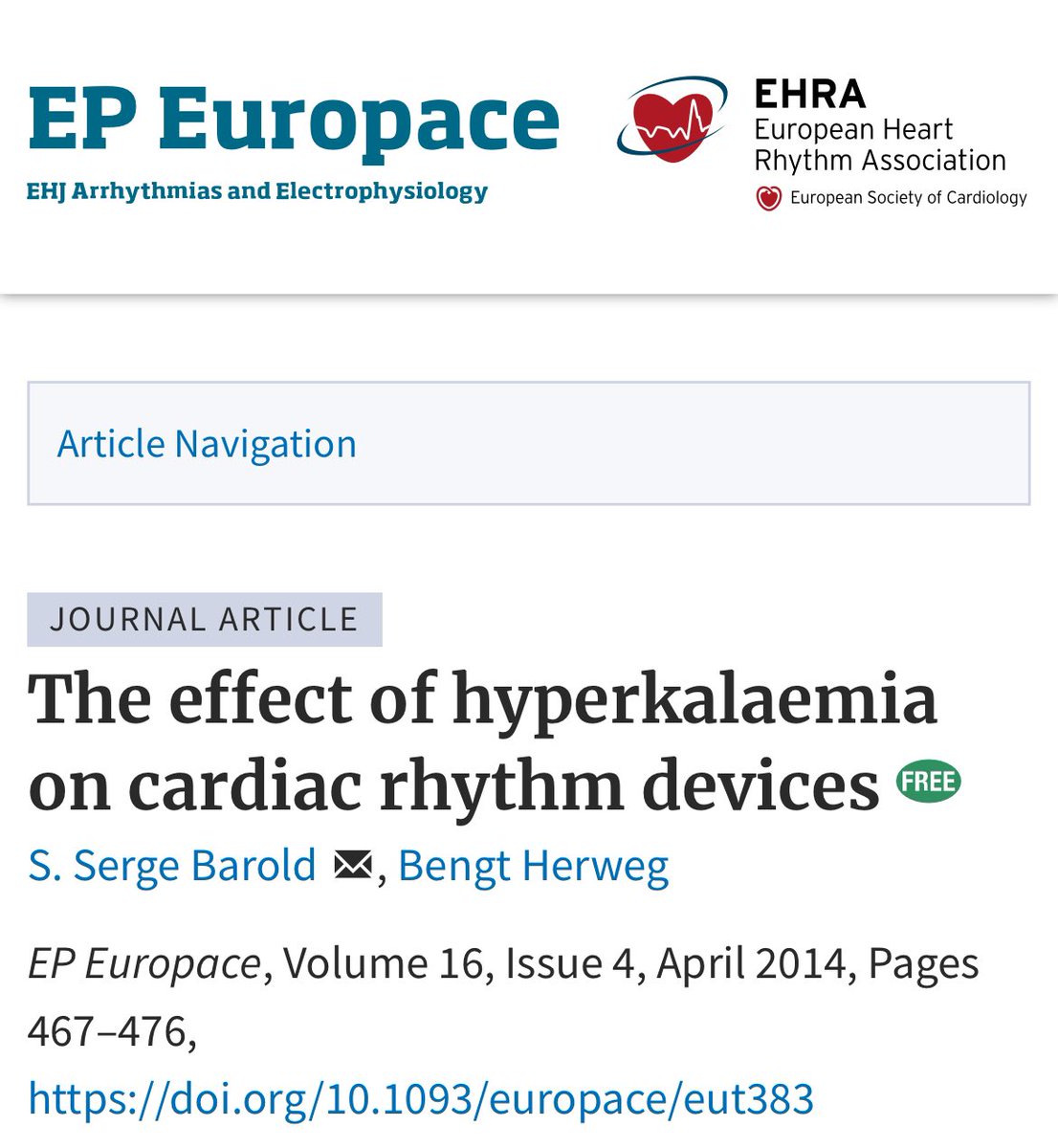
In patients with pacemakers, hyperkalaemia causes three important abnormalities that usually become manifest when the K level exceeds 7 mEq/L:
(i) widening of the paced QRS complex from delayed intraventricular conduction velocity,
(ii) Increased atrial and ventricular pacing thresholds that may cause failure to capture. In this respect, the atria are more susceptible to loss of capture than the ventricles, and
(iii) Increased latency (usually with ventricular pacing) manifested by a greater delay of the interval from the pacemaker stimulus to the onset of depolarization.
Excellent review article 👉https://t.co/K9RrJ52txI
@mansukhmandviya@PMOIndia@narendramodi
Dear Sir,
With another wave of JN1 varient (covid 19), need to be extra vigilent. I am finding it very difficult to procure recommended drugs; molnupiravir / favipiravir for pts. Remdesvir also seems to be outof stock with distributors.