CBSE goes Vishwaguru Way..
The biggest education board in the country new Mantra...
"Make reels, back OSM, forget Shortcomings, forget Students"
Instead of correcting its failures of On Screen Marking System, students,Principals are forced to create Reels praising CBSE...
Crowdsourcing here. Who are the Indian Bollywood and sports celebrities who promote carcinogens like tobacco, alcohol, sugary drinks?
I'm happy to launch a campaign (and if necessary, beg them to desist). Please reply or RT this so that we can reach the right folks
@sundaysarthak We hv been to Haridwar so many times and saw stray dogs bathing, swimming n enjoying Ganga water at Har ki paudi…..nobody bothered….but now things r getting so bad!
#WorldHealthDay 2026
From preventing childhood infections to shaping national #policies, #research at CMC Vellore continues to strengthen #immunisation efforts and protect communities:
• Hib (Haemophilus influenzae type b): Hib probe study helped realise the disease burden, supporting the introduction of the Hib vaccine in India.
• Pneumococcal disease: Long-term research helped identify common strains, laying the groundwork for the pneumococcal vaccine rollout.
• Rotavirus (ROTAVAC®): As one of three key trial sites, research at CMC Vellore helped demonstrate the vaccine’s effectiveness in preventing severe diarrhoea in children.
• COVID-19: Heterologous (‘mix and match’) vaccine booster studies (effectiveness of taking different vaccines).
• Polio & enteric viruses: Studies demonstrated enhanced mucosal immunity with Inactivated Polio Vaccine (IPV, given as injection), following Oral Polio Vaccine (OPV), which supported the introduction of IPV as part of polio endgame.
• Typhoid: Research on disease burden and antibiotic resistance helped guide national vaccine recommendations.
• Maternal & child immunisation: Work focused on improving vaccine access and uptake in resource-limited settings.
Together for health. #StandWithScience
THOSE OF YOU WHO ARE SIGNING THE LETTERS FOR FREEBIES, WITHOUT UNDERSTANDING THE IMPLICATIONS, KNOW THAT THERE ARE GOOD PEOPLE EVERYWHERE WHO WILL REACH YOUR LETTERS TO US, AND YOU WILL BE MADE TO COME UNDER THE RADAR OF ED, FOR SURE.
These are the letters being sent by some paediatricians (guess why? It's a no brainer) to the FSSAI. Exactly, the format given by again, guess who? Ashamed of them that they r from my fraternity! Ashamed of them that they can't even understand the basic fact that ignorant parents will be handed out ERZL as ORS(in the same way they had been handed out ORSL for 2 decades). Ashamed of them that they do not understand the difference between GRAS and WHO recommendations about Sucralose, and the recommendations of various paediatric academies with regard to artificial sweeteners for children . Ashamed that they do not understand that CDSCO permitting sucralose doesn't directly extrapolate to selling drinks as daily hydration drinks and making children drink Sucralose everyday. Shame on them. The script is the same. The company marketing people are getting their signatures and sending them to FSSAI. As I said, I may be silenced soon(may be a gag order or something even worse), but, dear Indians, you have stand up for the truth. This is not fear mongering. This is protecting our children from the same deception that happened for two decades, the same deception that jeopardized their lives and health.
@fssaiindia@JPNadda@iapindia@MoHFW_INDIA@narendramodi
#ERZL #ORSL #kenvue #johnsonjohnson
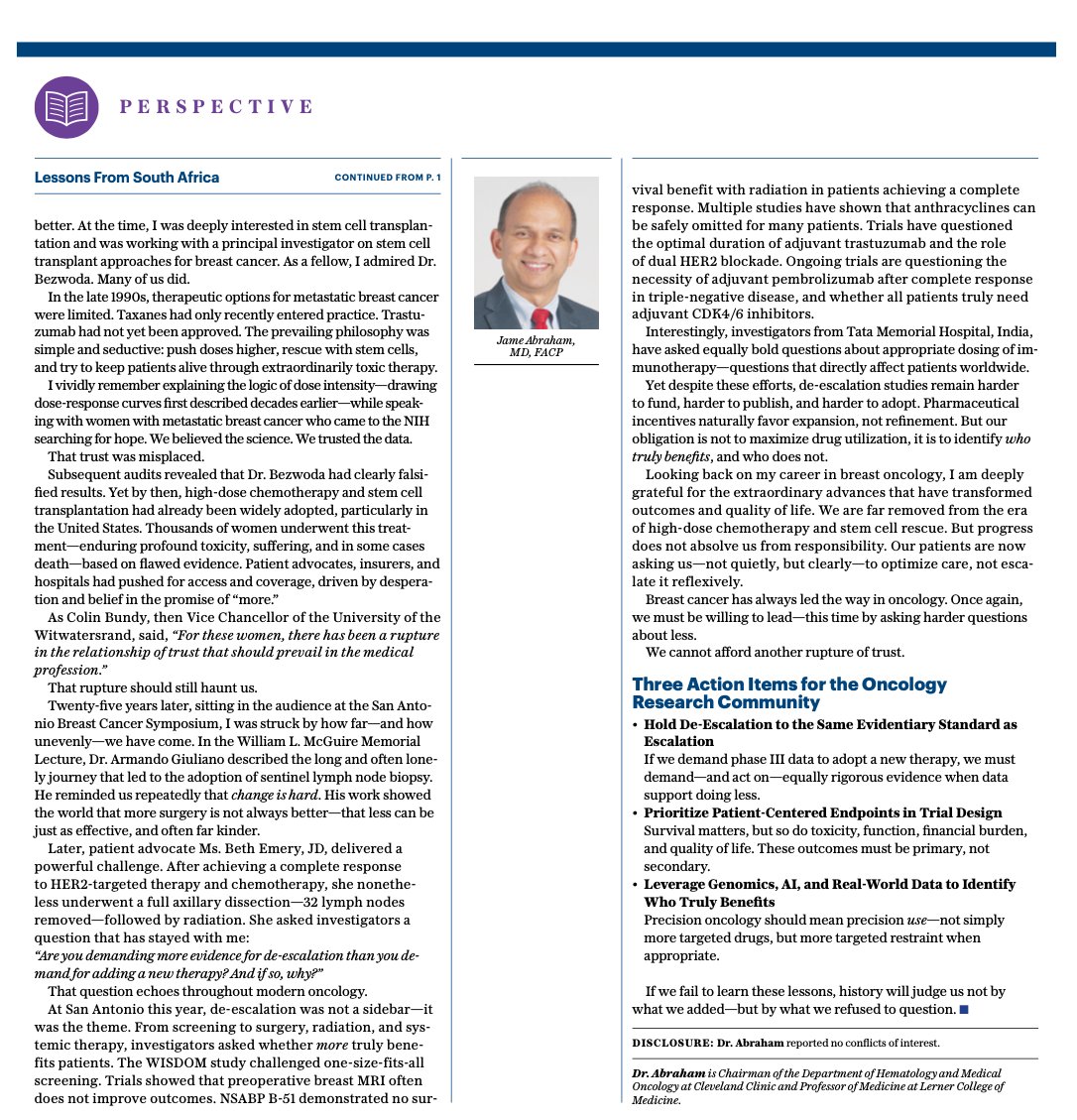
Forgotten Lessons From South Africa: My Oped in @ASCOPost https://t.co/DPnDa2BrHl @ASCO@SABCSSanAntonio@OncoAlert Are you demanding more evidence for de-escalation than you demand for adding a new therapy? And if so, why?”
This is a must read.
A study in the New England Journal of Medicine showed that simply following evidence-based guidelines reduced Vitamin D testing by 25.3% and saved nearly $112,000 (!!!)
Vitamin D is one of the most "abused" test-and-treat practices in medicine.
Low vitamin D levels are linked to a large number of diseases, but supplementing vitamin D rarely fix them. In fact, all the studies on vitamin D has been mostly neutral and largely negative.
Correlation ≠ causation. Low Vitamin D is often a marker of poor health, not the driver of diseases.
High Vitamin D levels often reflect a healthy lifestyle (outdoor activity, better diet, fitness). The benefit comes from the lifestyle, not just the vitamin level.
When in large high quality trials (like VITAL or D2d) researchers gave vitamin D supplements to general populations, it failed to prevent cancer, heart disease, or diabetes.
Sickness causes low Vitamin D, not the other way around. This thelogic of reverse causality.
Vitamin D as a disease marker is like the Fire-Fighter logic. Firefighters are always found at the site of fires, but they don't cause them. Similarly, low Vitamin D is often a responder to bodily stress. Pumping up the levels artificially is like sending more firefighters. It doesn't necessarily mean they will put out the fire.
"Vitamin D is associated with disease" is a story about risk markers. "Supplements prevent disease" is a claim that science mostly doesn't support. This is why fixing the number on the lab report (especially a low vitamin D) with a pill doesn't always translate to fixing the patient's health.
Supplement Vitamin D only in these situations (as per guidelines). For the rest, stop wasting people's money on testing and vitamin D supplementation.
[1] Children and adolescents (1–18 years) to prevent nutritional rickets and potentially reduce respiratory infections.
[2] For adults with high-risk prediabetes, the guidelines suggest empiric Vitamin D supplementation. Studies (like the D2d trial analyses) suggest this may help reduce the progression from prediabetes to Type 2 diabetes.
[3] In pregnant women, to lower the risk of pre-eclampsia (high blood pressure risk), intrauterine mortality (death of fetus in uterus), and preterm birth.
[4] Only in older adults (75+ years) - to potentially lower mortality risk.
That fatigue you feel. That hair loss you developed. That skin colour change you see. That poor sleep you experienced. That muscle pain you have and that non-specific joint discomfort you feel every week - guess what? Those are not because of a low vitamin D. Some actually develop these symptoms AFTER testing for vitamin D and finding it to be low.
Stop listening to useless influencers, science illiterate nutritionists and dietitians and overconfident gym bros on social media.
@vilas_jaihind@prakashraaj This is d problem. You people turn every real issue into Hindu hatred. Are these rats Hindu? Bec in THIS tweet he is talking against these rats! Or does your love for Hindus is just this much that u aren’t bothered if there r rats on prasadam as long as ur fav party is in power?
Regular micro-activity breaks throughout the day can partly reverse glucose, lipid, and vascular impairments caused by prolonged sitting
🟢 CME INDIA Clinical Pearls: Sedentary Behaviour (SB) and Cardiometabolic Risk
SB is a silent killer
Prolonged sitting is independently linked to ↑ risk of T2DM, CVD, obesity, cancer, and all-cause mortality.
Risk persists even in physically active people if sedentary time is excessive.
Molecular mechanisms of harm
Glucose metabolism: ↓ GLUT4 translocation, impaired insulin signaling.
Lipid metabolism: ↓ LPL activity → impaired triglyceride clearance, ↓ HDL.
Oxidative stress & inflammation: ↑ ROS, cytokine release, chronic low-grade inflammation.
Vascular dysfunction: Endothelial impairment, arterial stiffness, altered microcirculation.
Micro- & macrovascular consequences
Prolonged sitting → endothelial dysfunction, impaired vasodilation, ↑ carotid intima-media thickness.
Contributes to hypertension, atherosclerosis, and microvascular rarefaction.
Interrupting SB: simple but powerful
Short, frequent activity breaks (2–3 min every 20–30 min) improve postprandial glucose and lipid profiles.
Light activity (standing, walking, calf raises) restores insulin sensitivity and endothelial health.
“Soleus push-up” and desk-based movement have measurable metabolic benefits.
Research insights
Multi-omics integration (genes, proteins, metabolites, enzyme activity) confirms SB-driven metabolic disruption.
Key knowledge gap: dose-response relationship between sitting time vs activity breaks.
Public health message
“Exercise is good, but sedentary breaks are essential.”
Clinicians should counsel patients on reducing sitting time, not just on adding exercise.
🔑 Take-home: Sedentary behaviour is an independent cardiometabolic risk factor. Regular micro-activity breaks throughout the day can partly reverse glucose, lipid, and vascular impairments caused by prolonged sitting.
📖 Source: Metabolism, 2025. “Molecular mechanisms linking sedentary behaviour to cardiometabolic health”
https://t.co/Y6hgZezyFz