When Doreen volunteered for the NHS-Galleri trial evaluating a multi-cancer early detection (#MCED) test, she never expected the study would identify a signal for #lymphoma in her own blood.
Follow-up testing confirmed a Stage I-II lymphoma diagnosis and Doreen was able to promptly begin treatment. Today, she’s back on her bike and sharing her journey to help others understand the importance of #EarlyCancerDetection.
See more about the NHS-Galleri trial: https://t.co/35Vkh5jFlL
#ASCO26
The overall sensitivity in study participants with lymphoma was 56.3% (27.3% for stage I, 58.3% stage II, 71.7% stage III, 60.9% stage IV).
MCED testing in pop screening
NHS-Galleri-RCT of 142,250 pts
➡️blood up to 3 visits
➡️aim to reduce stage III/IV
Med FU 17mths
❎primary endpt not met-but ⬇️in stg4
➡️52% PPV; 99.5% specificity
✅4 fold⬆️ in screen detected ca
Huge effort from NHS #ASCO26@ASCO@OncoAlert
These "interventions" by David Cameron and Rishi Sunak however well intentioned are now verging on irresponsible. There is good reason why activism even by ex PMs should not dictate national screening decisions. As a surgeon, researcher and recent health minister I'll explain why......
Screening for any disease is not a risk and harm free exercise both in terms of harms of the test itself and the complications of unnecessary treatment. That is why they are carefully balanced decisions based on whole populations not individual case studies as emotive as they might be.
Current studies and evidence from international trials in prostate cancer are not representative of the UK population which has higher numbers of black men who are indeed at higher risk of prostate cancer but need evidence and data tailored to their needs.
What we need is better modern screening tools rather than a blanket application of suboptimal tests which may miss cancers and lead to unnecessary treatment. And there is a clinical trial ready to answer exactly these questions set up by some of the brightest minds in the UK and backed by the @NIHRresearch and @ProstateUKVoice https://t.co/ExdKV1MOMQ
So please do use your activism to push politicians and researchers to answer these questions faster, to break the mould, to push the boundaries to get the science done. But do not inadvertently become complicit in an uncontrolled screening experiment of men and black men because of your desire to do “something”.
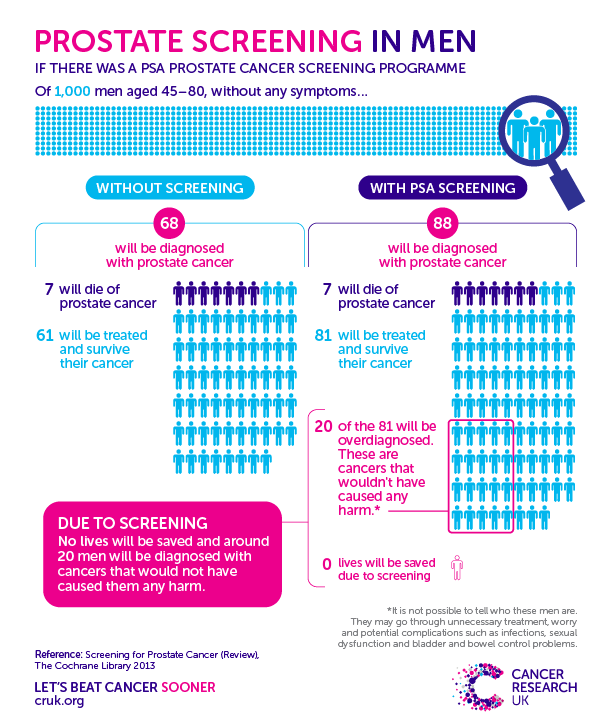
am going to write about this, but in meantime: here's a v good graphic from @CR_UK on the portion of benefits/risks of PSA screening https://t.co/K5ezqDrApE.... overdiagnosis is a weird thing and counterintuative -
@Smyth_Chris@TomPMarshall Been advocating for this for years….lets hope doesn’t get pulled again like the last ideas on this. Massive evidence based reform needed and to relieve pressure on GPs, & supporting people into some form of work
@rcsloggett NHS=National Hospital Service. Seems SoS always like a shiny tertiary hospital visit. Primary care 6% of budget for 90% patient contacts (&20% real term cuts whilst ⬆️efficiency 20%). Great to see some actual left shift into community care funding!
Wow. Everyone needs to read this.
All Labour MPs and party members need to understand this.
Especially @jamesmurray_ldn
The Lords will stop this, & we will support them. So let’s work together to make it right.
https://t.co/tZfdxMFxjT
@BMA_GP
In today's @thetimes, @DrDLittle warns a radiologist shortage is delaying cancer diagnosis. "More scanners are important for earlier cancer detection, but without more radiologists to interpret extra scans, backlogs & delays will grow."
Read the letter➡️https://t.co/TighYgn2BB
Scurvy killed more British sailors than France and Spain ever did. 🇬🇧
The Royal Navy's greatest enemy wasn't cannon fire. It was a disease.
In 1747 a Scottish naval surgeon named James Lind had a theory.
He took twelve sailors suffering from scurvy aboard HMS Salisbury. Divided them into six pairs. Gave each pair a different remedy the navy believed in... Cider, vinegar, seawater.
And gave one pair two oranges and one lemon a day.
After six days, five pairs were unchanged.
The sixth pair were almost recovered. 🍊
Lind had just conducted the first clinical trial in recorded history.
Every medicine you have ever taken was tested using his method.
He published his results in 1753.
The Admiralty ignored him for forty years.
Meanwhile Captain James Cook used citrus on his second voyage.
He lost only one sailor to scurvy in three years at sea.
The Admiralty noted it. Did nothing.
Tens of thousands of sailors died of a disease that had already been cured.
In 1794 one admiral finally acted. He ordered lemon juice issued to every sailor aboard HMS Suffolk for a twenty three week voyage to India.
Not one case of scurvy.
The following year the Royal Navy made it standard issue. Every sailor. Every ship.
Scurvy vanished from the fleet almost overnight. ⚓
Then the Navy switched from lemons to West Indian limes... Cheaper and easier to source from British colonies.
Limes carry a fraction of the vitamin C that lemons do.
American sailors watching British sailors drink their lime rations had a name for it.
They called us limeys. And it stuck.
Ten years later, at Trafalgar, Britain's navy was at full strength.
The French and Spanish fleets were not.
One Scottish surgeon. Twelve sailors. Two oranges and a lemon.
James Lind died in 1794. One year before the navy he served finally adopted his cure.
He invented the clinical trial. He saved more British sailors than any admiral in history.
Your ancestors proved the truth.
Did they teach you that?
It's time to prove the truth again.
Your support pays for the research, production and hours it takes to get it right.
https://t.co/rih7iKwnvf
Be part of us. Be Proud Of Us. 🙏🇬🇧
GP software EMIS down nationally for 45 mins
Let’s do the maths!
58% of practices
3654 practices
52900 appointments potentially lost
£1.2 million pounds lost
Compensation to practices £0.00
When the NHS is gone (and it will be soon), I will think back to those who felt they deserved first-class treatment while 500 people a week were unnecessarily dying in hospital corridors.
Gratitude builds people up. Entitlement wears them down.
Latest podcast @rcgp
Respiratory tract infections (RTIs) 🤧🦠& primary care 🩺
With Professor Paul Little
@unisouthampton
👉https://t.co/gacibObYI3
👉https://t.co/6dRVkRrnSo
#meded#podcast#medicine
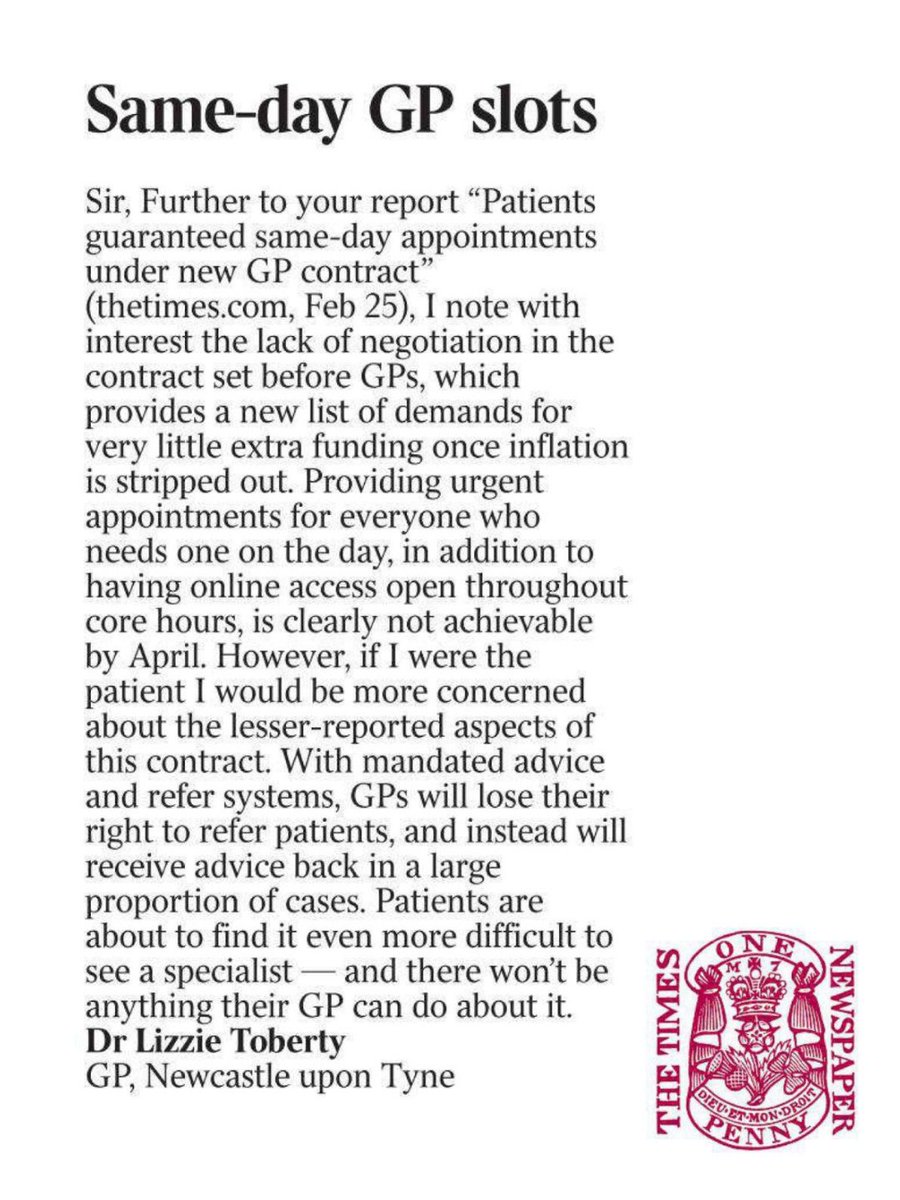
Yesterday you may well have seen the headlines announcing that from April onwards, GPs will be “made” to offer patients same day appointments for 'urgent' health issues. The implication, which I cannot imagine Wes Streeting is unaware of, is that he is on the side of patients, whereas recalcitrant & possibly even workshy GPs are the problem. A subtle undercurrent of GP-bashing, in other words, just as in previous governments.
The headlines omit a crucial aspect of the new GP contract, which this letter in the Times brilliantly highlights.
GPs will no longer be able to refer patients for specialist care as they do currently. New mandated "advice and refer" systems are being introduced for all specialist referrals from general practice, supposedly to 'streamline' care (as though GPs aren't highly trained physicians who know when a referral is needed).
As anyone waiting desperately for an appointment with a neurologist, oncologist, rheumatologist or orthopaedic surgeon will already know to their cost, currently waiting times can be absolutely horrendous – and this looks horribly like yet another barrier to patients receiving the prompt care they need from a specialist.
Already, for example, I am aware of patients with a new diagnosis of major, life-changing diseases such as multiple sclerosis, motor neurone disease or lupus having to wait many heartbreaking months to see a specialist for the first time. That is simply not right. It is a national scandal. If Wes Streeting’s aim is to massage the waiting list figures so that it ‘looks’ as though he’s improving care for NHS patients (while actually keeping patients away from doctors via a tortuous saga of ‘pathway navigators’ and other hoops that only create more delays) this would be an excellent way to do to.
#BMJExclusive: Four fifths of England’s integrated care boards would need to at least double their number of general practitioners to meet staffing standards considered safe for patients, a BMJ analysis finds
https://t.co/7vLh8Nk8EI
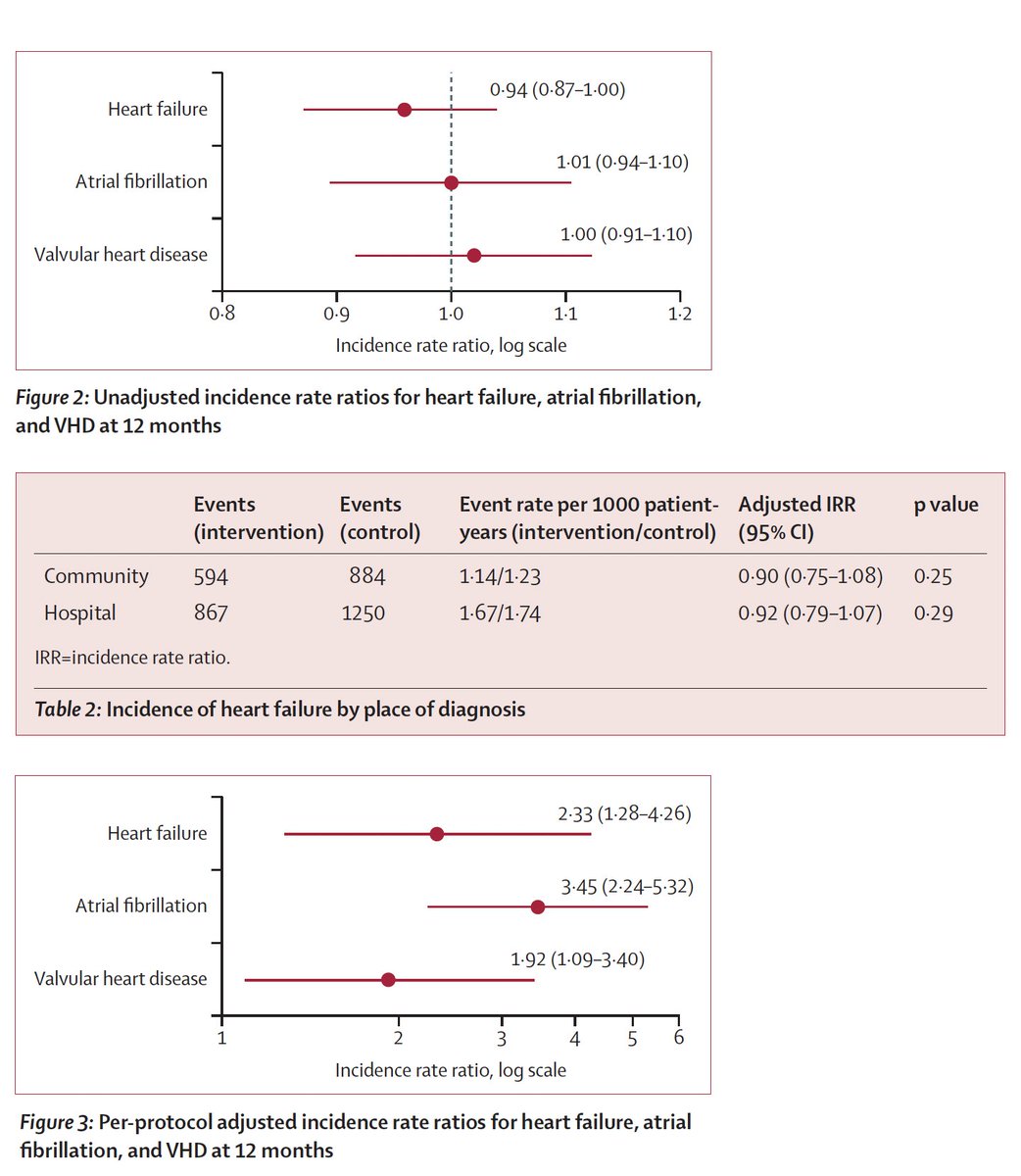
An AI stethoscope for primary care doctors was assessed in a randomized, controlled trial of >1.5 million patients to detect heart failure, valve disease and AF.
It didn't help make the diagnoses.
Because it wasn't used enough by the doctors.
It improved diagnoses when it was used.
New @TheLancet, an important lesson for AI med trials https://t.co/assYNk0Qix
People come to us frightened, exhausted, in pain, & half-humiliated by the process, filled in the forms, waited, called back, been cut off, tried again, been told to do it online, discovered the link doesn’t work, then finally - they’re in a room with someone….a human, a GP 😥