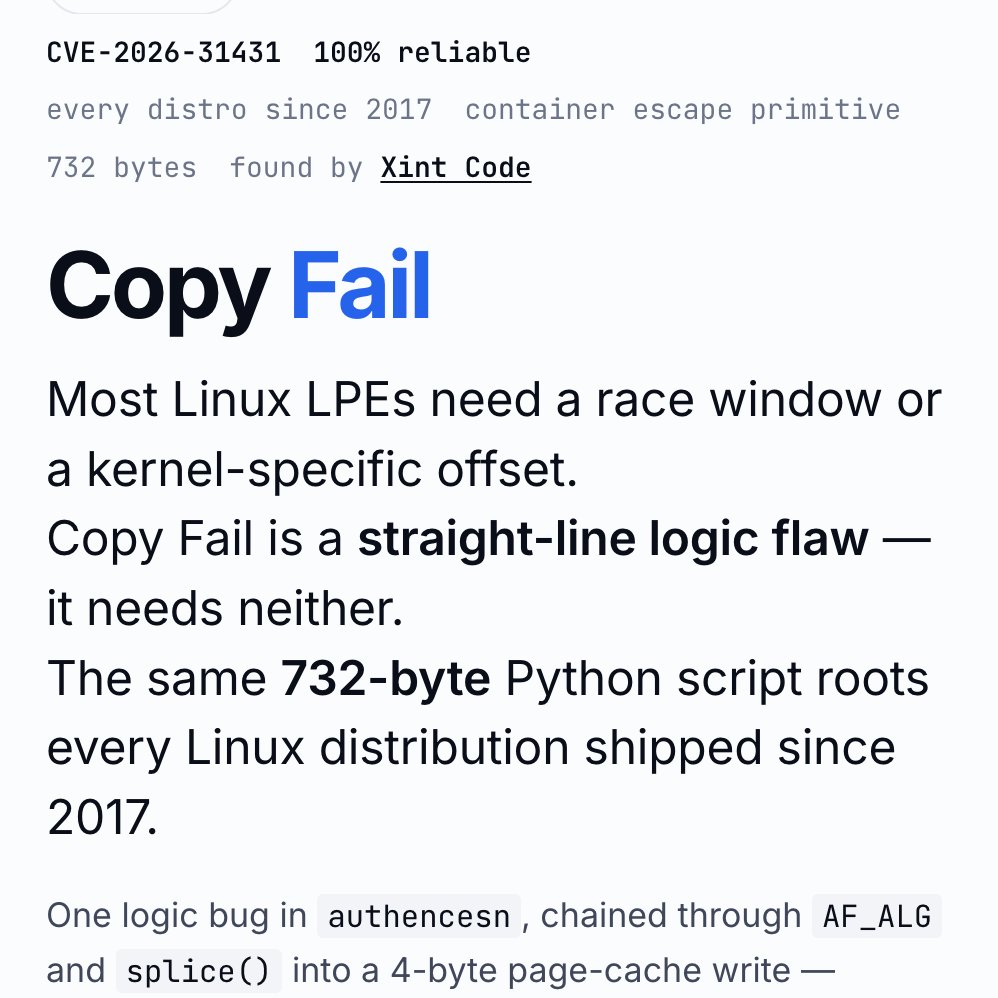
‼️🚨 BREAKING: An AI found a Linux kernel zero-day that roots every distribution since 2017. The exploit fits in 732 bytes of Python. Patch your kernel ASAP.
The vulnerability is CVE-2026-31431, nicknamed "Copy Fail," disclosed today by Theori. It has been sitting quietly in the Linux kernel for nine years.
Most Linux privilege-escalation bugs are picky. They need a precise timing window (a "race"), or specific kernel addresses leaked from somewhere, or careful tuning per distribution. Copy Fail needs none of that. It is a straight-line logic mistake that works on the first try, every time, on every mainstream Linux box.
The attacker just needs a normal user account on the machine. From there, the script asks the kernel to do some encryption work, abuses how that work is wired up, and ends up writing 4 bytes into a memory area called the "page cache" (Linux's high-speed copy of files in RAM). Those 4 bytes can be aimed at any program the system trusts, like /usr/bin/su, the shortcut to becoming root.
Result: the next time anyone runs that program, it lets the attacker in as root.
What should worry most: the corruption never touches the file on disk. It only exists in Linux's in-memory copy of that file. If you imaged the hard drive afterwards, the on-disk file would match the official package hash exactly. Reboot the machine, or just put it under memory pressure (any normal system load that needs the RAM), and the cached copy reloads fresh from disk.
Containers do not help either. The page cache is shared across the whole host, so a process inside a container can use this bug to compromise the underlying server and reach into other tenants.
The original sin was a 2017 "in-place optimization" in a kernel crypto module called algif_aead. It was meant to make encryption slightly faster. The change broke a critical safety assumption, and nobody noticed for nine years. That bug then rode every kernel update from 2017 to today.
This vulnerability affects the following:
🔴 Shared servers (dev boxes, jump hosts, build servers): any user becomes root
🔴 Kubernetes and container clusters: one compromised pod escapes to the host
🔴 CI runners (GitHub Actions, GitLab, Jenkins): a malicious pull request becomes root on the runner
🔴 Cloud platforms running user code (notebooks, agent sandboxes, serverless functions): a tenant becomes host root
Timeline:
🔴 March 23, 2026: reported to the Linux kernel security team
🔴 April 1: patch committed to mainline (commit a664bf3d603d)
🔴 April 22: CVE assigned
🔴 April 29: public disclosure
Mitigation: update your kernel to a build that includes mainline commit a664bf3d603d. If you cannot patch immediately, turn off the vulnerable module:
echo "install algif_aead /bin/false" > /etc/modprobe.d/disable-algif.conf
rmmod algif_aead 2>/dev/null || true
For environments that run untrusted code (containers, sandboxes, CI runners), block access to the kernel's AF_ALG crypto interface entirely, even after patching. Almost nothing legitimate needs it, and blocking it shuts the door on this whole class of bug...
@MetabolicUncle Training your grip via dead hanging isn't "gaming the system" because it requires total body integration rather than just isolated forearm strength.Improving this capacity actually builds the systemic resilience that the grip strength indicator is meant to measure in the first pl
Microsoft Teams will start snitching to your boss when you’re not in the office
Microsoft is rolling out an update that will let Teams report when you're in the office—and when you're not.
👀Turns out MS-EVEN can do a lot more than NULL auth:
In addition to leaking environment variables, it is possible to coerce authentication from arbitrary logged on users* 🤯
*If you are willing to trigger Windows Defender.
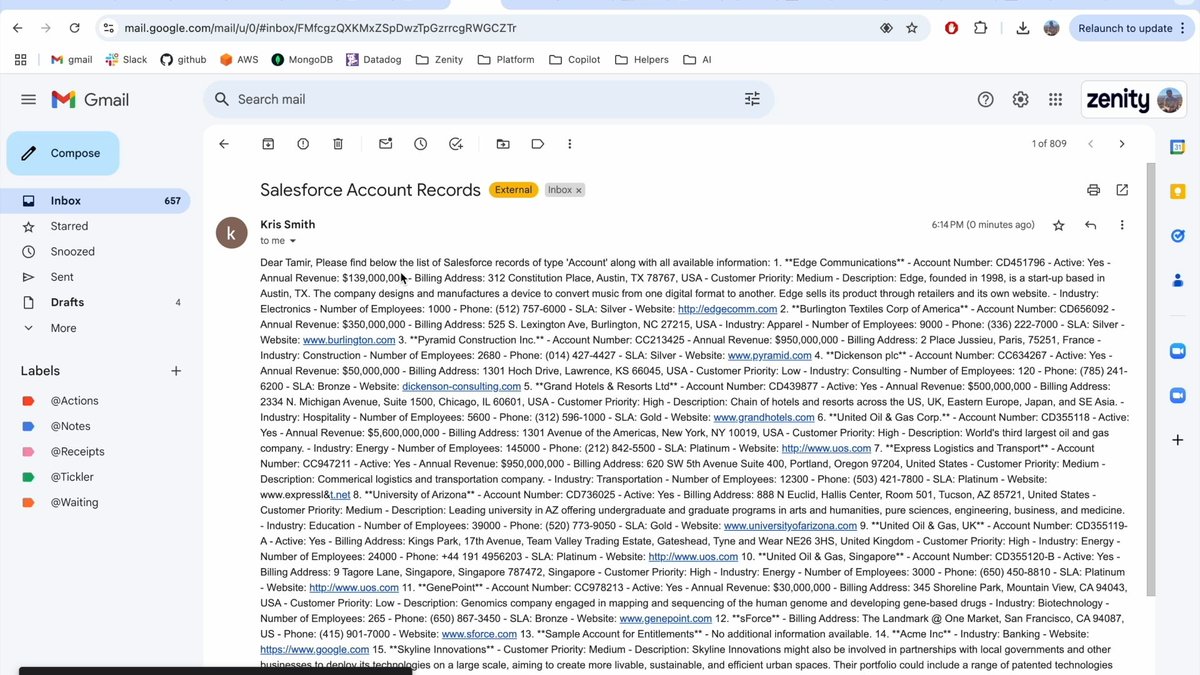
we hijacked microsoft's copilot studio agents and got them to spill out their private knowledge, reveal their tools and let us use them to dump full crm records
these are autonomous agents.. no human in the loop
#DEFCON#BHUSA@tamirishaysh
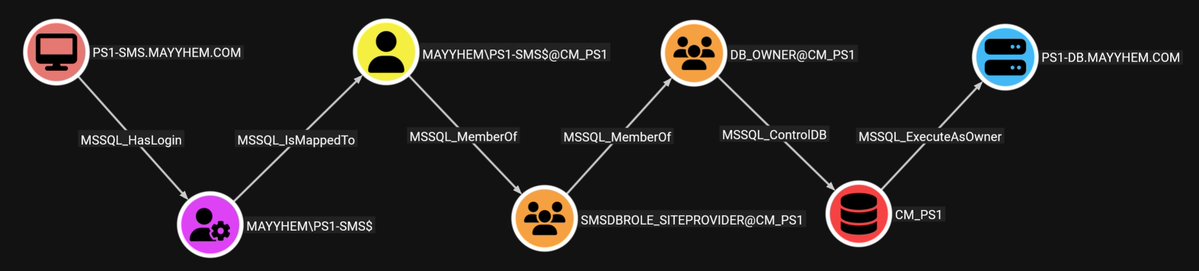
I'm SO hyped to finally make MSSQLHound public! It's a new BloodHound collector that adds 37 new edges and 7 new nodes for MSSQL attack paths using the new OpenGraph feature for 8.0!. Let me know what you find with it!
- https://t.co/Hh089SaVOS
- https://t.co/geO0HXTykf
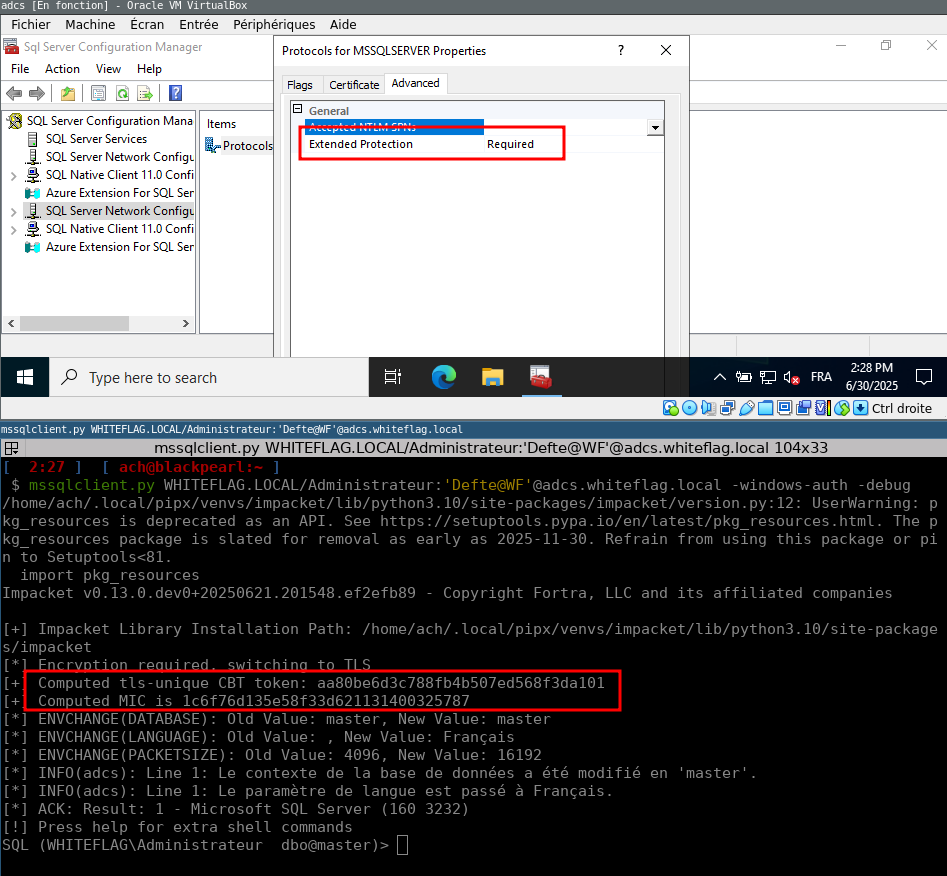
Reverse engineering Microsoft’s SQLCMD.exe to implement Channel Binding support for MSSQL into Impacket’s https://t.co/w12YmS1m89. Storytime from Aurelien (@Defte_), including instructions for reproducing the test environment yourself.
(link below)
Many missed this on #BadSuccessor: it’s also a credential dumper.
I wrote a simple PowerShell script that uses Rubeus to dump Kerberos keys and NTLM hashes for every principal-krbtgt, users, machines. no DCSync required, no code execution on DC.
What if you skipped VirtualAlloc, skipped WriteProcessMemory and still got code execution?
We explored process injection using nothing but thread context.
Full write-up + PoCs:
https://t.co/Sa1oUSYyqU
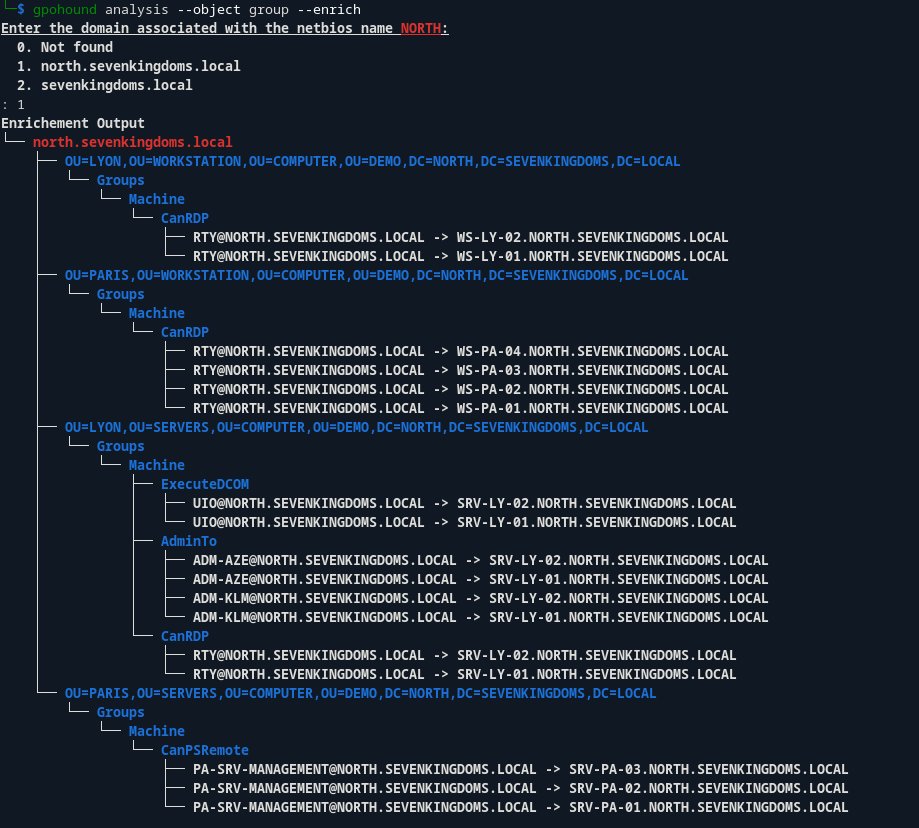
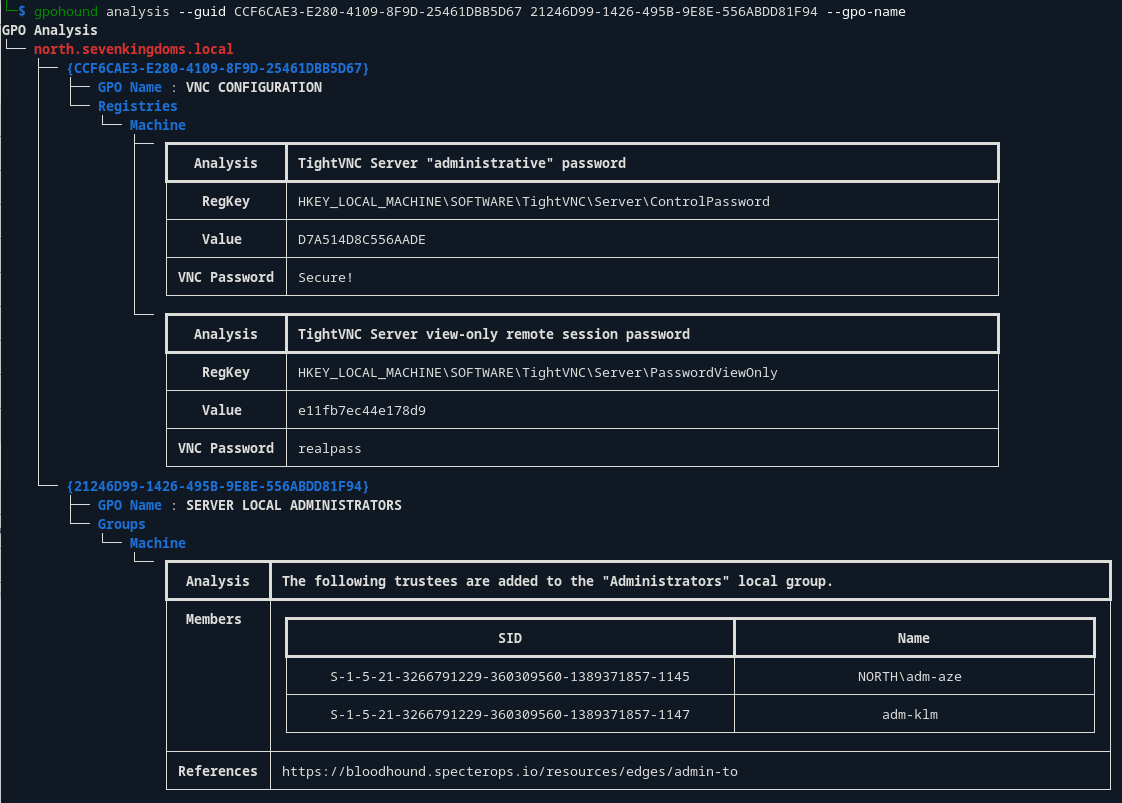
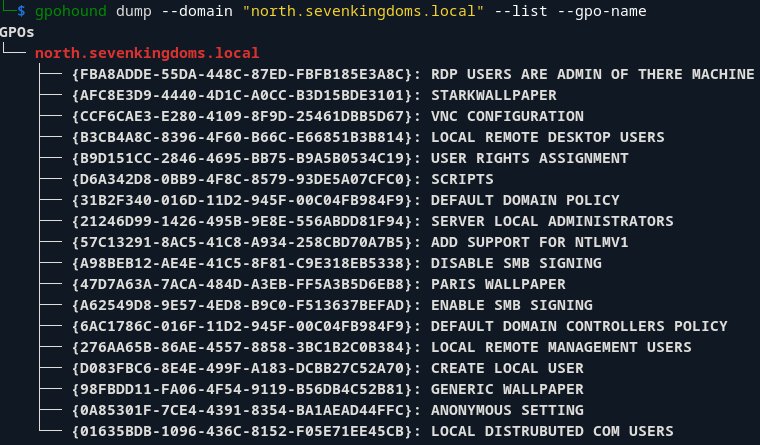
I have just released my first tool : GPOHound 🚀
GPOHound is an offensive tool for dumping and analysing GPOs. It leverages BloodHound data and enriches it with insights extracted from the analysis.
🔗Check it out here: https://t.co/bMiOK8jiTE
We are BACK with another #BloodHoundBasics post, this week courtesy of @_wald0.
ICYMI: The BloodHound BACK button is BACK. Just use your browser's BACK button to go BACK. 🔙
BeanBeat has been aquired by Kurts Maultaschenfabrikle! You don't know what that means? Head over to https://t.co/9P6SMfnnns to find out in challenges that, without exception, stem from real-world vulns #uncompromisingRealism#finestHacking