Landsat 9 captured very clear images of the Himalayan glacier that collapsed, triggering the catastrophic flash floods in Nepal.
Estimating very roughly from these images, it appears that the area that failed may have spanned ~1 km² of ice and rock.
h/t @theiaincameron
Tackling a 60-year-old challenge in quantum chemistry: making density functional theory scale nearly linearly with system size.
This has huge implications for opening the door to realistic systems that have traditionally been too expensive to simulate.
AI has attempted to accelerate these calculations, but models generally struggle to extrapolate, particularly to systems larger than those seen during training. Unlike text or images, quantum-mechanical training data is extremely expensive to generate.
We present a single unified AI model that performs quantum-mechanical simulations of both molecules and materials in quasi-linear time.
Using a novel Fourier neural operator variant, we learn the underlying Kohn–Sham equation map to produce physics-informed, self-consistent answers.
Unlike prior AI approaches that directly predict chemical properties, our model works through intermediate steps to improve difficult predictions, resembling inference-time reasoning in large language models.
To demonstrate its scalability, we run a self-consistent calculation of a magnesium dislocation with about 80k electrons on a single GPU, which previously required about 7k GPUs.
https://t.co/5DG12E04Rh
@DanishK42@Caltech
Physics is going to be as cooked/cooking as math. I fed Claude an open problem in stochastic thermodynamics of the kind I'd suggest to a mathematically inclined grad student. And over a few days of back and forth, it did months of work and closed the whole problem class.
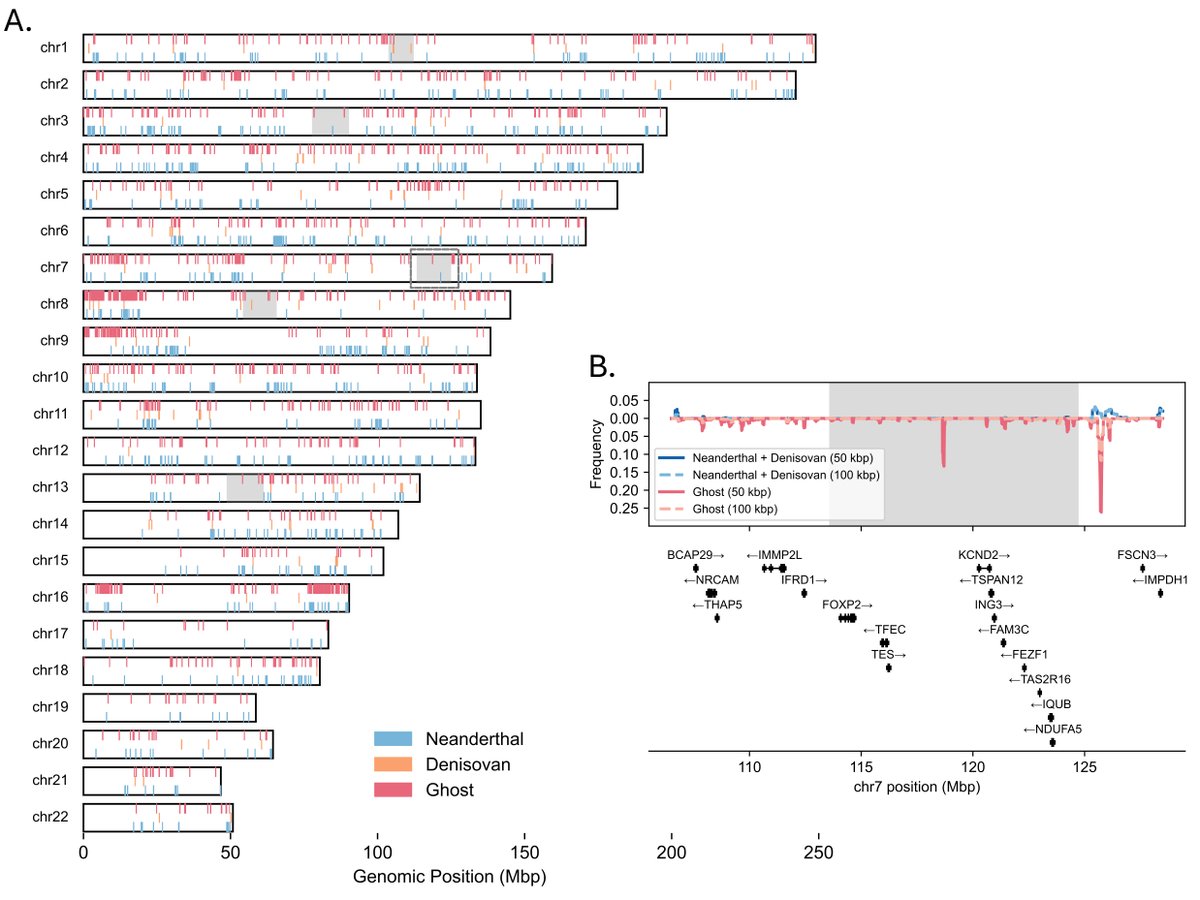
A new computational approach that can detect ancient hominin ancestry in modern humans without requiring archaic reference genomes reveals a more complex picture of human evolution than previously imagined.
Leveraging this approach, researchers report in Science that an unidentified "ghost" population contributed DNA to the ancestors of all modern humans before they dispersed out of Africa.
Learn more: https://t.co/GkzPlwxpih
The math on this image is insane.
New Horizons transmitted at 2,000 bits per second from 3 billion miles away. Slower than a 1990s dial-up modem. It took 16 months to download all the flyby data.
The spacecraft had to hit a target box 100km wide, arriving within 150 seconds of schedule, after 9 years of flight. Miss it and the preloaded observation commands point at empty space.
Ten days before arrival, the spacecraft crashed and went into safe mode. Engineers had 72 hours to restore everything.
The probe is now 5 billion miles out, still whispering data back to Earth. We got 50 gigabits of Pluto photos using technology slower than your phone’s bluetooth.
Wild honeybees have just been declared endangered in the EU.
Once thriving in forests and cities alike, they’re now vanishing under the weight of habitat loss, parasites, and industrial beekeeping.
Life is losing its sweetness.
https://t.co/EDObfuTIHG
“Put simply, the outlook is grim. It is highly likely that Thwaites Glacier will eventually be lost, which will destabilise adjoining parts of the West Antarctic Ice Sheet, increasing the committed long-term rise in global mean sea level by more than 3 m.”
Disappointingly little media attention being paid to this alarming new study. Instead, we're hearing about Bill Gates "tough truths" [read b.s.] downplaying the climate crisis.
We are living in #DontLookUp
🔥Today we're excited to announce a major milestone for the machine-learned interatomic potential (MLIP) ecosystem: TorchSim is moving to community ownership and governance through a partnership with Radical AI and the open-source community!
MLIPs have become critical computational tools for materials discovery. These models predict atomic forces orders of magnitude faster than traditional methods with high accuracy - bridging the gap between DFT and MD. But, the MLIP ecosystem has been fragmented. Each new MLIP requires custom integration code, and the existing simulation engines aren't built for GPU-native workflows. As such, research teams are currently spending too much time on infrastructure instead of discovery.
TorchSim changes this. It's an atomistic simulation engine built for the AI era, offering faster batched inference, full GPU utilization, and perhaps most importantly, a unified interface across model architectures enabling rapid prototyping and model swapping.
Our team at @UChicago and @argonne, is proud to help facilitate TorchSim’s development and growth as an open source community. Special thanks to @radicalai, who invested in and built the software. The original development team, including Abhijeet Gangan, Orion Archer Cohen, @jrib_ , Rhys Goodall, Adeesh Kolluru, Stefano Falletta, and Curtis Chong, built something special, and we want to ensure their work not only continues to serve the community but grows. A special shoutout to Radical AI founders Joseph F. Krause (@josephfkrause) and Jorge Colindres (@colindresj_) for making this transition not only possible but continuing to build with the community. 🙌
But, for more success we now need your help!
🔷 MD practitioners: Build examples, tutorials, and benchmark your workflows
🔶 ML engineers: Integrate new MLIP architectures and optimize GPU utilization
🔷 Computational scientists: Implement integrators, optimizers, and simulation methods
🔶 Everyone: Help us document and build this ecosystem along with the Hugging Face AI for Science community (@cgeorgiaw).
Thanks to the many community contributors already pushing this forward, including Thomas Loux, Ryan Liu, J Kian Pu, Filippo Bigi, Stefan Bringuier, Ph.D. , Myles Stapelberg, Yutack Park, John Gardner, Guillame Fraux, Chuin Wei Tan, and Timo Reents.
This is just the beginning. With your help, we see a future where these models are as easy to use in your research as LLMs today and help drive materials discovery across the world.
More than 3/4 of Earth’s support systems are outside the safe zone. Ocean acidification is the latest boundary breached. The warning is stark, but failure is not inevitable. It is a choice. Read the 2025 Planetary Health Check here: https://t.co/ySl8Cag5ye
🔥 Today we announce the Meta OMol25 Electronic Structures Dataset - 500 TB of molecular data in collaboration with @mshuaibii and team at @AIatMeta. We envision a future where researchers can rapidly design molecules and peptides to treat diseases, discover catalysts to revolutionize synthesis and manufacturing, identify the next electrolyte to store and transport energy to protect the grid, and more. But these breakthrough discoveries require data.
Data to train next-generation AI models and interatomic potentials. Data to push the boundaries of what's computationally possible in molecular chemistry and lead the world in AI for science. Data that captures the full complexity of chemical systems, from small organic molecules to massive biomolecular complexes.
The OMol25 Electronic Structures dataset includes the raw DFT outputs, electronic densities, wavefunctions, and molecular orbital information for over 4M million high-accuracy quantum chemical calculations. We see this as a transformative opportunity to develop higher quality partial charges, partial spins, and advanced electronic features to unlock the next generation of physics-informed ML models.
The Materials Data Facility is proud to make these data available via the Eagle cluster at ALCF through a high-performance Globus endpoint. Given the dataset's unprecedented scale, we're first releasing all output data for a 4M random OMol25 split, with the full multi-petabyte dataset following based on community engagement.
For this first release, the data are quite raw, and as-created by the Meta team. There's a significant opportunity for the community to build tools that simplify access to these data, allow data query and browsing, create databases of calculated properties and descriptors, and much more. We intend to work on these topics with all of you.
We can't wait to see what you can do with these data!
Access Details: https://t.co/2fQPtpnT3e
Eagle was pioneered as the Petrel project, a new way to provide researchers access to high-quality, high-volume data by Ian Foster, Rachana Ananthakrishnan, Kyle Chard, Michael Papka, Rick Stevens, and others. https://t.co/G9BHCfxdU6 provides core platform capabilities (auth, data transfer, workflow automation, and compute) to over 600k researchers.
Thanks to support from NIST and James Warren for making the MDF vision of vast troves of open data to fuel discovery possible.
@mshuaibii, @zackulissi , @argonne, @argonne_lcf
“Far from reducing reliance on fossil fuels, nations are planning higher levels of fossil fuel production for the coming decades than they did in 2023, the last time comparable data was compiled.” https://t.co/Nt4idBKrk6
Science delivers medicines, clean air and water, safe food, and smarter choices—saving billions of lives. Proposed cuts to @NIH and @NSF would shutter labs, stall new cures, hurt our economy, and send future scientists elsewhere. Hear from patients saved by science: https://t.co/XyJ6JEXUXi. To share your story of how #ScienceSavedMe, email [email protected].
1/2
Congratulations to Professor Adam Willard, who has been selected to hold a Francis Wright Davis Professorship. This is awarded to distinguished faculty in honor of Davis’s legacy and dedication to the practical advancement of scientific knowledge.
https://t.co/k2znSxQBaj
The NSF has been supporting some of the best American scientists to get their PhDs since 1952. NSF fellows have gone on to make discoveries that have changed our world and started countless companies including Google.
Today the administration cut the number of fellows in half.