We release our protein chatGPT, Evola! 🌟 https://t.co/xHrp0Oo3IS
Evola comes in two versions: 10B & 80B. The 80B model has a 1.3B Saprot encoder & a 70B LLaMA3 decoder.
Trained on 546 protein question-text pairs with an 150 billion word tokens! 💡🔬
https://t.co/wYBpVKpwkU
✨ Plain-language function in. Wet-lab proteins out—now in Nature.
Pinal (Westlake + collaborators) is a 16B text-to-protein model trained on 1.7B protein–text pairs. The point isn’t another pretty fold score; it’s candidates that cleared four orthogonal lab bars.
Lab readout:
→ Fluorescent protein, PET hydrolase, alcohol dehydrogenase, metabolic H-protein—intended function in each
→ Both designed enzymes catalytically active
→ H-protein in a multi-enzyme CO₂-fixation pathway: 1.7× product titre vs native E. coli—no iterative experimental optimization
Worth reading when “NL design” has to survive the tube and the HPLC.
📄 Paper: https://t.co/QOFaHAqzCy
💻 Code: https://t.co/eHolwSBtpz
🔗 Weights: https://t.co/3oX3KBBO2t
#ProteinDesign #Nature #AIforScience
@sokrypton@samsinai Even sequences, still not enough:), it would be great if the data could be increased by 1,000x to 10,000x. Structure and function data is very limited to train foundation models.
🧬 Design proteins with natural language.
Pinal is now online in Nature!
Pinal democratizes computational protein design by turning functional intent into protein candidates.
Open weights + code: https://t.co/mm8mynEuxL
Paper: https://t.co/VxZRSfpDjw
Pinal is now published in Nature.
The 16B-parameter AI model designs functional proteins directly from natural-language prompts.
Four protein classes were experimentally validated, including PET-degrading enzymes. A designed H-protein achieved 1.7× the native control’s product yield in a CO₂-fixation system.
Paper: https://t.co/TT4dAvc1qy
Code: https://t.co/uxGMhTvnkg
Biology just got a prompt box, and I think that beats any chatbot launch this month.
Oct 21, two protein-design AIs:
• Pinal (Westlake Univ, Nature): plain English in, protein out. Worked in all 4 lab tests, incl. a PET-plastic enzyme
• RFD4-Proteina (UW + @nvidia): 5-10x higher success, 5-10x faster, per UW. Open source
What would you prompt first?
#AI #Biotech #Science
Describe a protein’s job. AI proposes its structure and sequence.
A scientist might want an enzyme that breaks down plastic without knowing what its molecular structure should look like. Many protein-design tools require the scientist to supply some of that structural information first.
Dai and colleagues developed Pinal, a generative AI model that proposes proteins from written descriptions of their intended function.
Its Transformer-based architecture first generates a compact description of a possible protein structure. A second model uses that description, together with the original request, to generate the amino acid sequence. Structure provides a useful bridge: proteins with quite different sequences can still adopt similar shapes.
One experimental test went beyond designing an isolated enzyme. The team requested an H-protein, which carries reaction intermediates between enzymes in a CO₂-fixing pathway. The best design supported 1.7 times the glycine production of the native E. coli protein in a laboratory-reconstituted pathway, without repeated rounds of experimental optimization.
Getting there still required selection: 50,000 generated candidates were narrowed to 20 for testing, and five were functional. The written request opens the search. Computational screening and experiments establish which designs actually work.
Dai et al., Nature (2026). Journal license. https://t.co/xhIqq69vee
After the *best* 3-year review/revise saga, the final version of EvoDiff is finally out at @eLife!
I'm still as excited about protein sequence models as ever, and extremely proud of the team that came together for this.
Antibodies remain a particularly difficult challenge even for protein language models — a point that may diverge from the more optimistic views held by many working on PLMs. In light of this (and consistent with the limitations highlighted here), I believe the work of aligning specialized protein models with LLMs is especially meaningful: it can genuinely serve as an interface between humans and sequences. Current PLMs focus heavily on representation and understanding on the protein side, yet they are still quite cumbersome to use in practice. Several groups have already done excellent work aligning protein representations with natural language (e.g., ProTrek and Pinal). Going further, natively incorporating carefully curated and corrected protein sequence–structure–function–name pairs alongside natural language during the training of GPT-5-level models would be truly interesting.
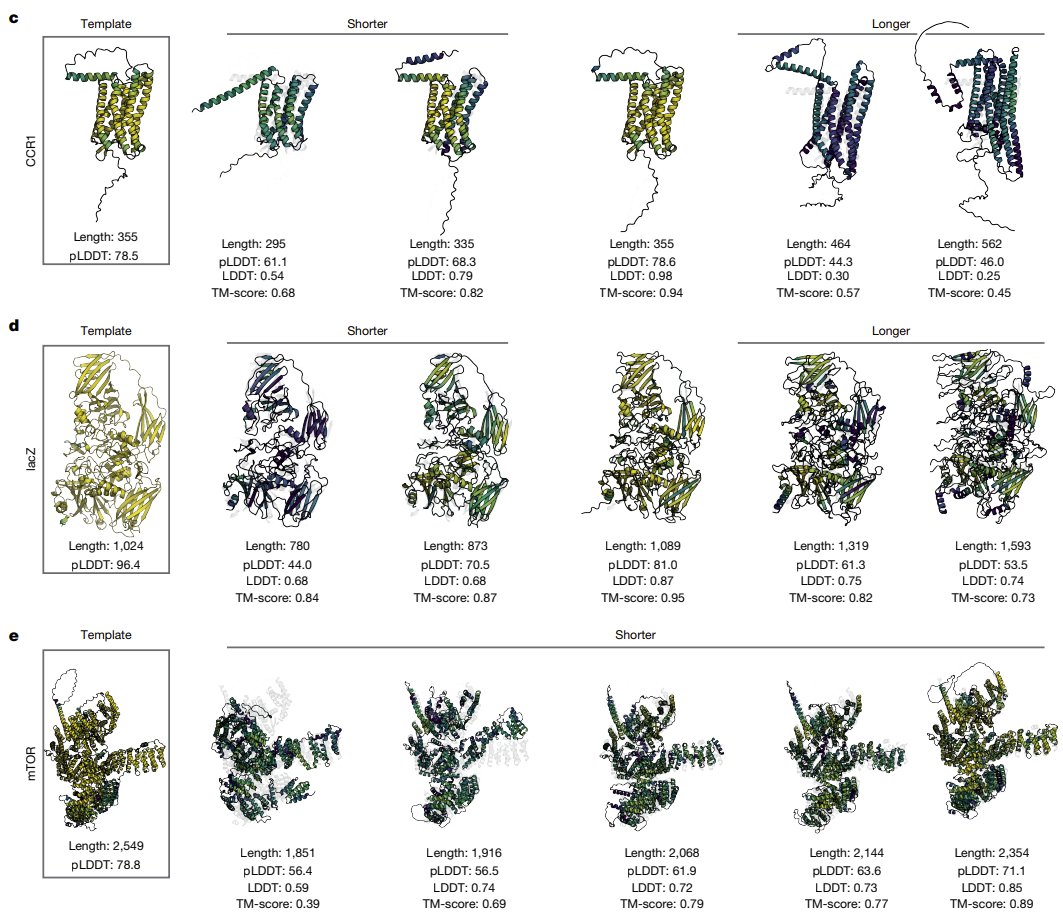
Raygun 1, our model for redesigning proteins the way evolution does, is out today in @Nature. For an arbitrary protein, it can:
- miniaturize (eGFP, shorter than any natural FP)
- magnify (EGF, into a tighter EGFR binder)
- modify (dozens of edits at once-- indels and subs)
ProtBLIP2-SST: Protein Function Prediction via BLIP2 with Sequence, Structure, and Text
1 ProtBLIP2-SST reframes protein function prediction as open-ended Swiss-Prot-style caption generation (FUNCTION + SUBCELLULAR LOCATION + SIMILARITY) instead of rigid GO multi-label classification, enabling a single free-text output that can jointly express mechanism, localization, and homology context.
2 The key design choice is early, unified sequence–structure fusion using SaProt: residues are tokenized together with Foldseek-derived 3Di structural tokens in a structure-aware vocabulary, so sequence and 3D information interact from the first representation layer (not via separate encoders or late fusion).
3 The framework adapts BLIP-2 to proteins with a two-stage pipeline: Stage 1 aligns protein features to text space using a lightweight Q-Former (8 learnable query tokens) while keeping large unimodal backbones frozen; Stage 2 conditions a scientific LLM to generate captions from the aligned protein embeddings.
4 Stage 1 uses a frozen SaProt protein encoder and a frozen BiomedBERT text encoder, training only the Q-Former via three objectives: protein–text contrastive learning (InfoNCE), protein–text matching with hard negatives, and protein captioning with a causal mask that forces generation to flow through the query bottleneck.
5 Stage 2 connects Q-Former outputs to Galactica-1.3B by linearly projecting the 8 query embeddings into the LLM embedding space and prepending them to the prompt; only parameter-efficient adapters are trained (LoRA on attention and FFN layers, r=8), while base PLM/LLM weights remain frozen.
6 Data: 441k Swiss-Prot protein–text pairs were filtered to require AlphaFold DB structures, yielding 410,925 train / 9,236 val / 9,239 test triplets; sequences are truncated to 1024 residues and captions to 128 tokens.
7 Retrieval (Stage 1): ProtBLIP2-SST improves over sequence-only ProtT3 at matched scales on Swiss-Prot test retrieval after PTM re-ranking over 128 candidates; the 650M variant reports the best overall average (90.83) with test Acc 69.28 (P→T) and 68.70 (T→P), highlighting gains from explicit structural integration.
8 Captioning (Stage 2): ProtBLIP2-SST achieves consistent improvements over ProtT3 on BLEU/ROUGE/METEOR; at 650M it reaches EM 33.07 with B-4 58.53, R-L 68.23, METEOR 69.54, while the 35M model also improves over ProtT3(35M) (e.g., B-4 55.37 vs 54.74).
9 Analysis and takeaways: field-stratified comparisons show structure helps most for FUNCTION text (fold/active-site constraints), while SIMILARITY labels benefit less (often motif-driven). The authors also note a decoder bias: Galactica tends to start outputs with FUNCTION even when the reference begins with other fields, suggesting future work on field-balanced decoding and improved alignment objectives.
📜Paper: https://t.co/wq3rzpCEYi
#ProteinFunctionPrediction #ProteinLanguageModels #MultimodalLearning #ProteinStructure #AlphaFold #SwissProt #BLIP2 #LLM #Bioinformatics #ComputationalBiology
Why bigger is not better in protein language models
Scaling laws are close to an article of faith in deep learning, so protein language models are an awkward case. ESM2-650M and 3B beat the 15B model at predicting mutation effects. xTrimoPGLM-3B beats the 10B and 100B. ProGen3-1B beats the 46B. Chao Hou and coauthors explain why, and the mechanism is more interesting than a data-scarcity story.
Start with what these models actually output. A protein language model reads sequences the way a text model reads sentences, and it can score how plausible a given protein looks under everything it has seen. That score, p(sequence), is its estimate of how likely that exact chain of amino acids is. Mutation effects then come almost for free: swap one residue, rescore, and the drop in likelihood stands in for how damaging the mutation is.
The trouble is that this likelihood absorbs factors unrelated to fitness. The authors show that homolog counts in the training set, model size, and even the random seed all shift it. And because probabilities at each site must sum to one, a bigger model that pushes the wild-type residue toward certainty necessarily drives every mutation score toward extreme negative values. A tiny model does the mirror image and collapses everything toward zero. Both extremes are uninformative, and neither reproduces the bimodal spread seen in experiments.
Across 154 ProteinGYM assays, performance versus wild-type likelihood traces a clean bell curve, peaking near a likelihood of about 0.3, and it holds for sequence-only, structure-hybrid, autoregressive and inverse-folding models alike. Inside that optimal band, model size stops mattering. Family-specific models such as EVE show no bell curve at all. General models track evolutionary conservation best at intermediate likelihoods, and it is that alignment, not parameter count, that predicts performance.
For teams in variant interpretation, antibody engineering or enzyme optimization, this reframes model selection. The question is not which model is largest but whether it has learned your protein family at all, and the paper offers a cheap check: correlate its per-residue likelihoods against a simple alignment-frequency model, with about 0.5 as a working cutoff, before committing a wet-lab campaign.
Paper: Hou et al., Nature Computational Science (2026), journal license | https://t.co/s8YCjLQ3uQ