New supply chain attack this time for npm axios, the most popular HTTP client library with 300M weekly downloads.
Scanning my system I found a use imported from googleworkspace/cli from a few days ago when I was experimenting with gmail/gcal cli. The installed version (luckily) resolved to an unaffected 1.13.5, but the project dependency is not pinned, meaning that if I did this earlier today the code would have resolved to latest and I'd be pwned.
It's possible to personally defend against these to some extent with local settings e.g. release-age constraints, or containers or etc, but I think ultimately the defaults of package management projects (pip, npm etc) have to change so that a single infection (usually luckily fairly temporary in nature due to security scanning) does not spread through users at random and at scale via unpinned dependencies.
More comprehensive article:
https://t.co/EJAZbqAPIQ
Celery workers freeze, RUNNING but idle. Traced to epoll flaw on RabbitMQ disconnects. Fix: HAProxy for clean RSTs. Issue #3773 still remains https://t.co/mGU3RXOzIZ #Celery#RabbitMQ#DevOps
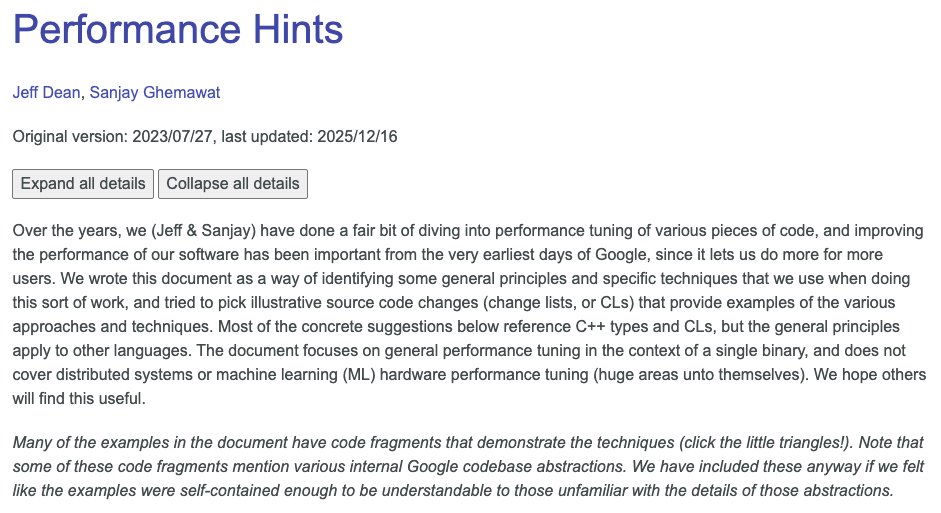
Performance Hints
Over the years, my colleague Sanjay Ghemawat and I have done a fair bit of diving into performance tuning of various pieces of code. We wrote an internal Performance Hints document a couple of years ago as a way of identifying some general principles and we've recently published a version of it externally.
We'd love any feedback you might have!
Read the full doc at: https://t.co/jej95g236P
Elasticsearch and Lucene vector database report card: up to 8x faster and 32x more efficient searches! Read this blog for recent noteworthy work: https://t.co/tZH3Uu53b7
#elasticsearch#apachelucene#vectordatabase
How Discord Stores Trillions of Messages
In 2015, Discord started using MongoDB to store messages. By November 2015, there were already 100 million messages that did not fit in RAM, causing unpredictable latency.
In 2017, Discord moved to storing billions of messages in a Cassandra database. By 2022, the number of stored messages had ballooned to trillions across 177 nodes.
But Cassandra was plagued by several serious issues.
- Hot partitions occurred when a small number of high traffic channels overwhelmed nodes, cascading latency across the cluster.
- Garbage collection pauses created latency spikes.
- Compactions fell behind, forcing expensive reads to query multiple SSTables.
- Maintenance like node repairs interrupted service.
Discord migrated to ScyllaDB for the following benefits:
- Written in C++ instead of Java, eliminating disruptive garbage collection pauses
- Shard-per-core model provides stronger workload isolation to prevent hot partitions from cascading latency across nodes.
- Reverse query performance optimized to meet Discord's needs
- They reduced nodes to 72 while increasing disk space per node to 9TB.
To further protect ScyllaDB, Discord:
- Built intermediary data services in Rust that limit concurrent traffic spikes
- Data services sit between the API and database, coalescing requests
- Query the database just once even if multiple users request the same data
- Rust provided fast, safe concurrency ideal for this workload
The results? Tail latencies down from 40-125ms to a steady 15ms. Database uptime improved from weekend-long outages to smooth sailing. The system easily handled World Cup traffic spikes, processing events like goals and penalties without breaking a sweat. Discord continues to scale, now reliably storing trillions of messages with ScyllaDB.
–
Subscribe to our weekly newsletter to get a Free System Design PDF (158 pages): https://t.co/kNfv0DVDdf
Twitter has enforced very strict rate limiting. Some people cannot even see their own tweets.
Rate limiting is a very important yet often overlooked topic. Let's use this opportunity to take a look at what it is and the most popular algorithms.
A thread.
#RateLimitExceeded
Announcement: "PEP 594 has been implementated: Python 3.13 removes 20 stdlib modules": https://t.co/IAdKptBznZ I wrote a long message explaining the rationale to coordinate efforts to make this migration (to Python 3.12 and then to Python 3.13) as smooth as possible.