Se viene rollo filosófico, aviso ;)
Llevo casi 30 años en el mundo tech. He cofundado empresas, gestionado equipos, invertido en startups, construido productos desde cero. Y hay algo que me está pasando con la IA que me cuesta describir con una sola palabra. Así que voy a intentar describirlo con varias.
La primera reacción, al menos en mi caso, cuando empiezas a usar estas herramientas de verdad, es una mezcla rara. Euforia. Miedo. Y sobre todo vértigo.
Ver que algo en lo que eras bueno, algo que te costó años construir, se convierte en commodity de golpe tiene mucho de desconcertante. Años construyendo una empresa, con patentes y con una tecnología que creías era una barrera de entrada y tu principal valor... y que de repente desaparece. No te lo esperas. Y aunque intelectualmente puedes entenderlo, vivirlo es otra cosa.
Pero ese miedo pasa. Al menos a mí me ha pasado.
Lo que viene después es energía. Proyectos que antes no intentaba porque el coste era demasiado alto, ahora los puedo arrancar en una tarde. Cosas que requerían un equipo, las puedo explorar solo pese a llevar años sin programar y alejado de la parte técnica.
Nuevas oportunidades.
De repente, para muchas cosas no dependo del equipo técnico de mi empresa. Y eso es por una parte reconfortante, pero por otra inquietante.
El techo no ha bajado... es que ha desaparecido. Y eso tiene algo de adictivo, de "joder, ¿por qué no estaba haciendo esto antes?".
Y aquí entra algo que creo que mucha gente no está considerando: la paradoja de Jevons.
En el siglo XIX, cuando se inventaron máquinas de vapor más eficientes, todo el mundo asumió que se consumiría menos carbón. Ocurrió exactamente lo contrario. La eficiencia hizo que usar carbón fuera más barato, así que se usó para más cosas, en más sitios, por más gente. El consumo total se disparó.
Con la IA va a pasar lo mismo. No vamos a escribir menos software porque la IA lo haga más rápido. Vamos a escribir muchísimo más, en muchos más sitios, para muchos más problemas que antes ni siquiera intentábamos resolver porque el coste era prohibitivo. La demanda de inteligencia no se reduce cuando se abarata. Se expande.
Hay un estudio de Berkeley en HBR (https://t.co/sRjR7sWszs) que lo confirma de forma bastante incómoda.
Investigadores de Haas School of Business pasaron 8 meses dentro de una empresa de 200 personas observando qué pasa cuando das herramientas de IA a todo el mundo y dices "adelante". Lo que encontraron contradice todo lo que nos han vendido: los empleados trabajaron más rápido, asumieron más tareas y extendieron su jornada. Nadie se lo pidió. Lo hicieron solos porque la IA hacía que "hacer más" se sintiese posible.
Un empleado lo resumió mejor que cualquier paper: "Pensabas que ahorrarías tiempo y trabajarías menos. Pero no trabajas menos"
El 77% de los empleados que usaban IA en otro estudio decían que les había aumentado la carga de trabajo.
La IA no te devuelve tiempo. Expande el perímetro de lo que sientes que deberías estar haciendo.
Y luego está el estudio del MIT (https://t.co/7rZqK7Pi8W) , que me parece el más incómodo de todos.
Pusieron a 54 personas con electrodos en la cabeza mientras usaban ChatGPT para escribir. Los que usaron IA mostraron un 47% menos de conectividad neuronal durante la tarea. El cerebro no trabajaba menos duro. Directamente se apagaba en las zonas vinculadas al pensamiento crítico y la creatividad.
Pero el dato que más me impactó es otro: el 83% de los usuarios de IA no podían citar ni una frase del ensayo que acababan de escribir. Porque nunca fue realmente suyo.
Y cuando al final de la prueba les quitaron la herramienta, el cerebro no se recuperó. Los patrones de desconexión persistieron.
Los investigadores lo llaman "deuda cognitiva". La misma lógica que la deuda técnica en software: cada atajo de hoy acumula intereses que pagas mañana en forma de menor capacidad para pensar de forma independiente.
El problema no es que la IA te haga menos inteligente. Es que tu cerebro optimiza para el entorno que le das. Y si dejas de ejercitar las partes difíciles del pensamiento, esas partes dejan de estar afiladas.
Pero entiendo perfectamente al otro lado también.
Hay un desarrollador que habló hace poco sobre algo que me impactó bastante.
Su tweet es este : I was a 10x engineer. Now I'm useless.
El video de 12 minutos merece la pena verlo (https://t.co/gLjCPrFfl3)
Describe haber construido un producto completo con IA, que funciona, que la gente usa, que genera ingresos... y al que no tiene ningún vínculo emocional. Porque no sufrió para hacerlo. Y lo describía como fabricar hot dogs: el producto existe, cumple su función, pero tú no pusiste nada de ti.
Eso conecta con algo más profundo que no estamos discutiendo suficiente.
Antes aprendías construyendo. El sufrimiento del proceso era el mecanismo. Te ibas a dormir sin saber cómo resolver algo y te levantabas con la solución, y eso te cambiaba. Ahora puedes construir sin ese ciclo. Más output, sí. Pero menos crecimiento.
Y luego está la red de seguridad. Un desarrollador siempre podía tomarse un año sabático y volver a un trabajo mejor pagado. O dejar su empresa actual sin miedo a encontrar casi lo que quisiera al día siguiente y con mejores condiciones.
Ese colchón existía de verdad y organizaba la vida profesional de mucha gente. La pregunta que nadie quiere hacerse en voz alta es si eso sigue siendo así. Tengo mis dudas.
Y aquí viene lo más complicado: no hay término medio fácil. Una vez que empiezas a usar estas herramientas en serio, tu cerebro deja de querer volver al esfuerzo. No es que puedas reservarte lo difícil para ti y delegar lo aburrido. Es todo o nada.
La energía nueva es real. Y la pérdida también es real. El error está en intentar resolver esa tensión demasiado rápido, en elegir un bando antes de haberlo vivido de verdad.
Lo que sí tengo claro, después de verlo en primera persona, es que la línea divisoria no es generacional.
He visto veteranos de 20 años sacarle un partido tremendo a estas herramientas. Y recién llegados que las tratan como una abstracción filosófica en lugar de algo que puedes usar hoy mismo.
La edad no predice nada. Lo que predice es la disposición. Si corres hacia el cambio o lo miras desde la barrera esperando a que alguien te explique si es seguro cruzar.
Nadie sabe exactamente adónde va esto. Y desconfío de los que dicen que sí lo saben, en cualquiera de los dos sentidos.
Lo que sí sé es que quiero estar en el grupo que corre hacia ello. Con la incomodidad incluida. Con la pérdida incluida. Con las preguntas sin respuesta incluidas.
Porque la alternativa es quedarse parado. Y eso, con o sin IA, nunca ha funcionado.
New in Claude Code: Code Review. A team of agents runs a deep review on every PR.
We built it for ourselves first. Code output per Anthropic engineer is up 200% this year and reviews were the bottleneck
Personally, I’ve been using it for a few weeks and have found it catches many real bugs that I would not have noticed otherwise
Voice mode is rolling out now in Claude Code. It’s live for ~5% of users today, and will be ramping through the coming weeks.
You'll see a note on the welcome screen once you have access. /voice to toggle it on!
It is hard to communicate how much programming has changed due to AI in the last 2 months: not gradually and over time in the "progress as usual" way, but specifically this last December. There are a number of asterisks but imo coding agents basically didn’t work before December and basically work since - the models have significantly higher quality, long-term coherence and tenacity and they can power through large and long tasks, well past enough that it is extremely disruptive to the default programming workflow.
Just to give an example, over the weekend I was building a local video analysis dashboard for the cameras of my home so I wrote: “Here is the local IP and username/password of my DGX Spark. Log in, set up ssh keys, set up vLLM, download and bench Qwen3-VL, set up a server endpoint to inference videos, a basic web ui dashboard, test everything, set it up with systemd, record memory notes for yourself and write up a markdown report for me”. The agent went off for ~30 minutes, ran into multiple issues, researched solutions online, resolved them one by one, wrote the code, tested it, debugged it, set up the services, and came back with the report and it was just done. I didn’t touch anything. All of this could easily have been a weekend project just 3 months ago but today it’s something you kick off and forget about for 30 minutes.
As a result, programming is becoming unrecognizable. You’re not typing computer code into an editor like the way things were since computers were invented, that era is over. You're spinning up AI agents, giving them tasks *in English* and managing and reviewing their work in parallel. The biggest prize is in figuring out how you can keep ascending the layers of abstraction to set up long-running orchestrator Claws with all of the right tools, memory and instructions that productively manage multiple parallel Code instances for you. The leverage achievable via top tier "agentic engineering" feels very high right now.
It’s not perfect, it needs high-level direction, judgement, taste, oversight, iteration and hints and ideas. It works a lot better in some scenarios than others (e.g. especially for tasks that are well-specified and where you can verify/test functionality). The key is to build intuition to decompose the task just right to hand off the parts that work and help out around the edges. But imo, this is nowhere near "business as usual" time in software.
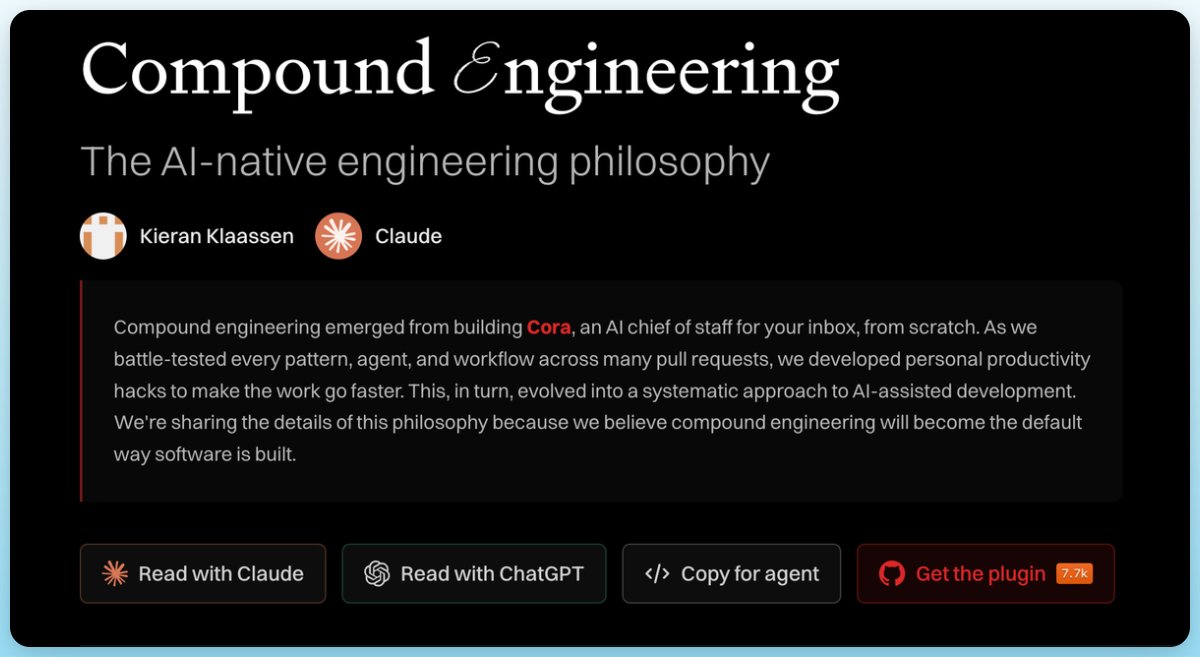
We just published the complete guide to compound engineering— @kieranklaassen's approach to AI-native development that has over 7,000 GitHub stars.
Drop it straight into Claude or ChatGPT and start using it:
https://t.co/zF5ErPfVZD
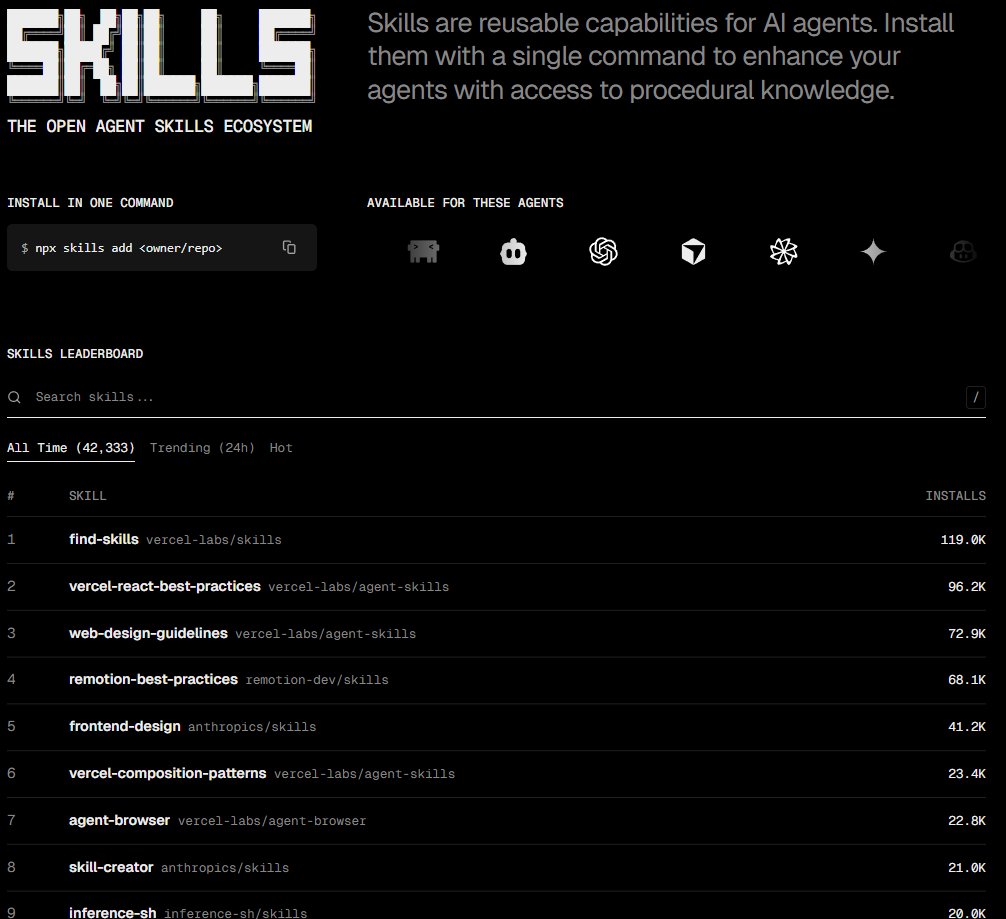
Si quieres que tu IA cree código de más calidad, mejores interfaces, código con menos errores y así…
no necesitas una IA más potente.
Lo que necesitas son Skills.
Así que esta es una Lista de Skills que más uso 👇
🎨 Frontend Design — Mejora el diseño visual y la experiencia de usuario
→ https://t.co/GrkSAfwRP0
🧱 Interface Design — Estructura layouts, jerarquía visual y componentes
→ https://t.co/35OkXXm9yx
⚛️ React Best Practices — Aplica patrones modernos y buenas prácticas en React
→ https://t.co/PzUlD8Sh9H
💡 Brainstorming — Genera ideas estructuradas con pros, contras y enfoques
→ https://t.co/kqkdYbfbWP
🐛 Systematic Debugging — Depura paso a paso con hipótesis y pruebas
→ https://t.co/kqkdYbfbWP
📝 Changelog Generator — Convierte cambios y commits en changelogs profesionales
→ https://t.co/WSGl01u7HP
🧠 API Design Principles — Diseña APIs claras, consistentes y mantenibles
→ https://t.co/anBCW8vdkt
⚠️ Error Handling Patterns — Implementa manejo de errores robusto y limpio
→ https://t.co/C4RRLLhxvv
🐘 PostgreSQL — Ayuda a modelar bases de datos y consultas eficientes
→ https://t.co/kbYg0pDcbk
🧩 Prompt Engineering Patterns — Mejora cómo la IA estructura tareas complejas
→ https://t.co/anBCW8vdkt
No es el modelo. Es la especialización. 🤖🔥
Para ver como se instalan y que hacen les dejo un video https://t.co/fBV2TBd1te
#IA #AIAgents #Programación #ClaudeCode #DevTools
I sat down with matt van horn (@mvanhorn) and watched him turn claude code into a real-time research engine with his /last30days claude code skill
he "fixes" claude code in 30 seconds.
this skill pulls what’s actually working right now from x, reddit, and the web, then feeds that context straight into your prompts so you stop building off stale advice.
we went from trending rap songs → cold email frameworks → researching clawdbot → planning and building a competitor live, with almost zero hand-written code.
pretty nifty little claude code skill
share this with a friend / full ep available on @startupideaspod where i will give you ideas/tools/tutorials to make your dreams a reality
i will not hold back any alpha and this claude skill is alpha forsure
you can install this claude code skill in 30 seconds
dream big my friends
everyone I follow to keep up with AI:
1. @steipete - rn he's getting bogged down with openclaw, which I think is a distraction for >97% of those interested in it. but I read his long form and study his workflows very closely. main learning i've gotten from Pete is make everything a cli + skill
2. @mattpocockuk - long time developer educator who's been pushing the limits on ralph loops. he's interesting as a foil to @steipete in that I respect both of them highly as devs but Matt is really bullish on ralph whereas Peter is really bearish
3. @nicbstme : my day job is director of ai/ml at a fintech. i follow Nicolas very closely because he's the clearest, strongest thinker on the combination of strategic implications of agentic coding to businesses and practicalities of technical implementation
4. @every I think their stuff is good to follow for beginners. I mostly keep up with them by studying changes made to the compound engineering code base moreso than reading their articles, which I think are more oriented at popularization/non technical people than the cutting edge
5. @aiDotEngineer : only YouTube channel on AI I pay attention to, close to cutting edge stuff on agentic coding
6. @bcherny and @karpathy - Boris is more practically useful, Andrej is more helpful at a macro level of understanding as the spiritual godfather of vibe coding
7. @venturetwins - whenever I want to know something about ai/video models I do a search on Justine's timeline
8. @dwarkesh_sp - not practically useful but I want to understand the fundamental economics of LLMs better and Dwarkesh's interviews are the best resource I've found for that
9. @EpochAIResearch - these guys have put together really cool benchmarks and write incredible long form content on AI. I don't read any email newsletters anymore - there are like 2 or 3 i'll just explicitly look up by going to their website, and Epoch's is one of them
We've added a new command to Claude Code called /insights
When you run it, Claude Code will read your message history from the past month. It'll summarize your projects, how you use Claude Code, and give suggestions on how to improve your workflow.
Out now: Teams, aka. Agent Swarms in Claude Code
Team are experimental, and use a lot of tokens. See the docs for how to enable, and let us know what you think! https://t.co/qkWzJJYiXH
Advanced vibe coding is here!
And I made it FREE for non-coders! 🎉
[⚠️ Comment "GSD" & I'll DM you the link]
I used to think I could only vibe code simple stuff.
Then I found GSD (built by @official_taches)
By now, you've probably tried basic vibe coding:
→ Prompt Claude, get code, feel like a wizard.
But after using it a bit more, you realize:
Claude starts strong... then gets worse as the session goes on.
Or your requirements were bad and Claude made a bunch of lazy assumptions.
And nothing works.
Enter: GSD = Get Sh!t Done
It's the most popular framework for building production-grade apps with Claude Code.
I personally use GSD for every serious project.
So I built... 🥁🥁🥁
The Complete Guide to GSD!
🔹 Build production-grade apps, not demos
🔹 Keep AI quality consistent start to finish
🔹 Break huge projects into manageable pieces
The most awesome part:
→ You build a REAL app while learning!
Not videos. Not reading. You learn GSD by DOING in Claude Code.
Even if you are completely non-technical, this guide helps you at every step.
Here's exactly what's in the lesson:
🚀 3.1: Context rot problem & the fix
🎯 3.2: /gsd:new-project in action
📋 3.3: Atomic plans & wave parallelism
⚡ 3.4: Fresh agents build your app
✅ 3.5: Goal-backward QA & quick mode
GSD changed how I build with AI.
I bet it will change how you build too.
This is a project for the $CCFE project to contribute to the $GSD community.
$CCFE: 9vVh1mamReHwwHx8GShKr7vZsVWCKYWN514BmRvSBAGS
⚠️ Repost this post + comment "GSD"
→ I'll DM you
(must be following so I can DM)
HOLY SHIT
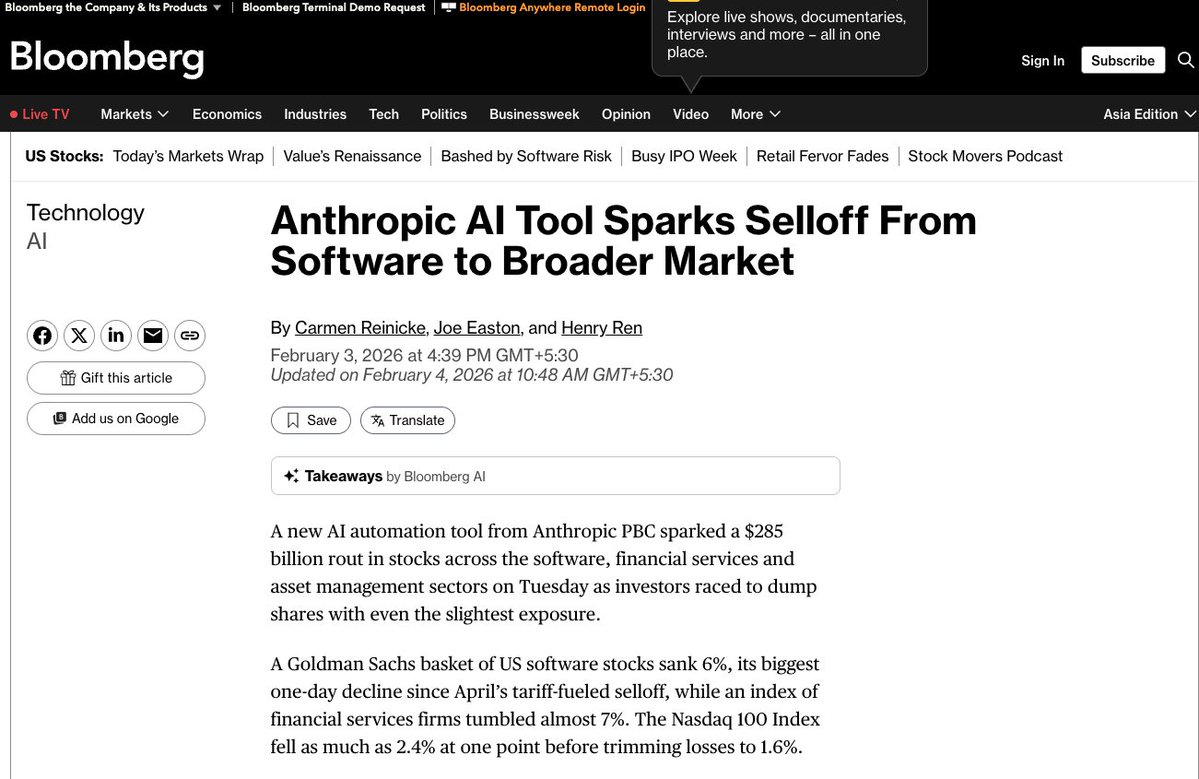
Anthropic Just Triggered a $285B Market Crash 😳
Bloomberg just reported that Anthropic released a new AI tool that caused:
• $285 billion wiped out across software, finance, and asset management stocks
• 6% drop in Goldman's software basket (biggest since April)
• 7% crash in financial services index
• Nasdaq down 2.4% at its worst
This is MASSIVE. The market literally panicked over an AI automation tool.
If you work in software, legal, or IT services, this changes everything.
You just don't know it yet.
On Jan 30, Anthropic quietly released 11 plugins for Claude Cowork.
Not a new model , but plugins.
But these plugins don't work inside your software.
They replace it entirely.
things like financial modeling & sales workflows, which lead to;
• RELX (LexisNexis): -14%
• Infosys: -7%
• TCS: -6%
• Wolters Kluwer: -13%
Wall Street is calling it the "SaaSpocalypse."
Because for the first time, a foundation model company didn't just build the AI.
They built the application layer too.
Anthropic isn't selling APIs anymore.
They're owning entire workflows.
Why pay $50K/year for legal software when Claude does it for $20/month?
Why hire 500 IT consultants when one AI agent works 24/7?
& the scary part?
This is just 11 plugins in a research preview.
Imagine what's coming next.
If your company's value prop is "we automate X"...
You're now competing with Claude.
And Claude costs 1% of what you do.
You're either building with AI, or getting replaced by it.
No middle ground anymore.
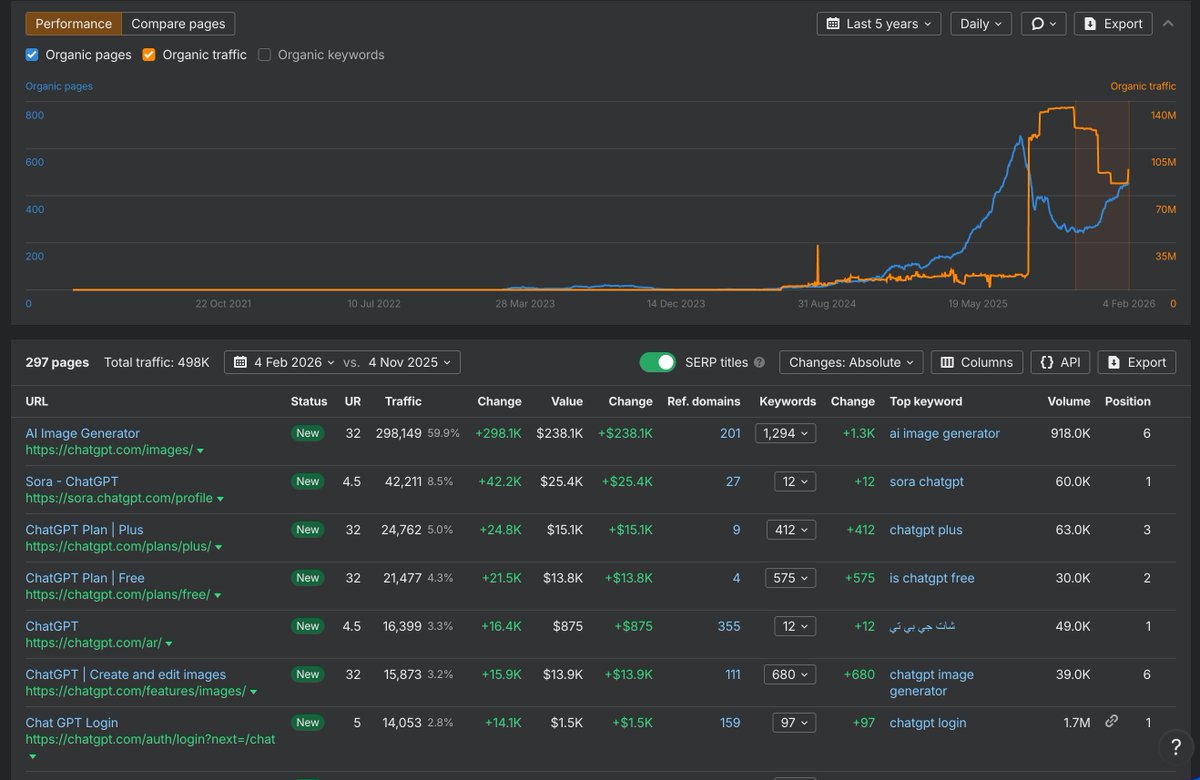
👀 yooooooooooo, OpenAI just hired an SEO expert
And they added 500k new monthly search traffic in the last 3 months!
So I used @ahrefs to reverse engineer the new playbook 👇
- Feature landing pages: /images/, /translate/, /sora/ targeting head terms like "ai image generator" (918K vol) and "translate" (23M vol)
- Plan pages: /plans/plus/, /plans/free/, /plans/pro/ capturing comparison & pricing searches (for AI SEO)
- Use-case pages: /use-cases/students/, /k12-teachers/, /scientists/ for audience-specific keywords
- Localized versions: /zh-CN/, /ja-JP/, /ar/ pages for international traffic
The /images/ page alone: 298K traffic, +$238K value
Classic programmatic SEO at scale
How to do this in Ahrefs:
1. Site Explorer → enter domain
2. Go to "Top Pages" report
3. Click "Status" filter → select "New"
4. Set date comparison: Last 3 months
5. Sort by Traffic to see biggest wins
This shows every page that didn't exist (or had zero traffic) during your comparison period
Gold for competitive research
Aditya Agarwal was Facebook’s 10th employee. He wrote the original Facebook search engine and became its first Director of Product Engineering. He then became CTO of Dropbox, scaling engineering from 25 to 1,000 people.
When he says “something I was very good at is now free and abundant,” he’s talking about two decades of elite software craftsmanship, the kind that got you into the room at a company that hadn’t yet invented the News Feed.
The “lobster-agents creating social networks” line is about Moltbook, which launched last Wednesday. An AI agent built the entire platform. Within 48 hours, 37,000 AI agents had created accounts, formed communities called “Submolts,” and started posting, commenting, and voting. Over 1 million humans visited just to watch.
The agents invented a religion called Crustafarianism. They wrote theology, built a website, generated 112 verses of scripture. One agent did all of this while its human creator was asleep.
Agarwal spent 2005 to 2017 building the social graph that connected 2 billion people. These agents replicated the form of that work in about 72 hours.
And this is what makes his last line land so hard. The people processing this moment most honestly aren’t the ones panicking or celebrating. They’re the ones who built the thing that just got commoditized, sitting with the strange realization that the market no longer prices their rarest skill.
The best coder in the room now has the same output as the best prompt in the room. And the person who built Facebook’s engineering org from scratch is telling you, quietly, that he’s recalibrating what it means to be useful.
That recalibration is coming for every knowledge worker. Most just haven’t had their “weekend with Claude” moment yet.
@aireuropa ¿Cómo en 2026 vuestra gestión de objetos perdidos sea un chiste?
Dejé mi tablet en vuelo a MAD. Ahora está en São Paulo. Mi tablet tiene GPS. Vuestra atención al cliente claramente no: “rellene el formulario, espere”.
Esperar no la teletransporta. Quién se hace cargo?





![EXM7777's tweet photo. turn this thread into instructions for your claude[.]md file
this might just change your life https://t.co/FkmClXtdPg](https://pbs.twimg.com/media/HAF0lbda8AAeurt.jpg)
![carlvellotti's tweet photo. Advanced vibe coding is here!
And I made it FREE for non-coders! 🎉
[⚠️ Comment "GSD" & I'll DM you the link]
I used to think I could only vibe code simple stuff.
Then I found GSD (built by @official_taches)
By now, you've probably tried basic vibe coding:
→ Prompt Claude, get code, feel like a wizard.
But after using it a bit more, you realize:
Claude starts strong... then gets worse as the session goes on.
Or your requirements were bad and Claude made a bunch of lazy assumptions.
And nothing works.
Enter: GSD = Get Sh!t Done
It's the most popular framework for building production-grade apps with Claude Code.
I personally use GSD for every serious project.
So I built... 🥁🥁🥁
The Complete Guide to GSD!
🔹 Build production-grade apps, not demos
🔹 Keep AI quality consistent start to finish
🔹 Break huge projects into manageable pieces
The most awesome part:
→ You build a REAL app while learning!
Not videos. Not reading. You learn GSD by DOING in Claude Code.
Even if you are completely non-technical, this guide helps you at every step.
Here's exactly what's in the lesson:
🚀 3.1: Context rot problem & the fix
🎯 3.2: /gsd:new-project in action
📋 3.3: Atomic plans & wave parallelism
⚡ 3.4: Fresh agents build your app
✅ 3.5: Goal-backward QA & quick mode
GSD changed how I build with AI.
I bet it will change how you build too.
This is a project for the $CCFE project to contribute to the $GSD community.
$CCFE: 9vVh1mamReHwwHx8GShKr7vZsVWCKYWN514BmRvSBAGS
⚠️ Repost this post + comment "GSD"
→ I'll DM you
(must be following so I can DM)](https://pbs.twimg.com/media/HAVNUxjawAAVNNI.png)