Timepass talk on Sunday
1. Marksans Pharma
Marksans Pharma is a globally focused consumer healthcare and generic pharma company with a dominant presence in OTC (over-the-counter) store brands. It manufactures and markets 350+ products across 2,000+ SKUs, primarily for regulated markets including the US, UK, Europe, Australia, and Canada. The company operates 4 manufacturing facilities (India, US, UK) with 26 billion units of annual capacity and is amongst the top 5 Indian pharma companies in the UK by revenue.
Top Growth Drivers
The company's growth is being propelled by four key engines. First, European front-end expansion is the most significant new driver, Marksans has acquired QliniQ in the Netherlands (contributing ₹44 crore in Q1FY27) and ABCnow in Germany (consolidating from Q2), while also establishing new entities in Ireland and Germany, with Europe revenue already surging 75% YoY. Second, product pipeline momentum remains robust with plans to launch 20–25 new products annually, 112 SKUs added in the US in FY26, and a target to double the portfolio in every country over the next 2–3 years. Third, manufacturing scale and operating leverage is improving as Goa Unit 2 (acquired from Teva) ramps toward ₹80 crore revenue, and the company aims to expand total Indian capacity from ~8 billion to 16 billion units per annum. Fourth, new geography entry through Canada (entity incorporated, filings underway) and continued strength in Australia/New Zealand (54% YoY growth in Q1 with new Rx brand launches under Nova Pharma) is diversifying revenue beyond the traditional US and UK markets.
How Big Could the Europe Opportunity Be?
Europe is rapidly emerging as Marksans' most exciting new growth frontier. In FY27, management expects the region to generate approximately ₹180 crore in revenue, a sharp step-up from the sub-€10 million historical run-rate at QliniQ, reflecting both the acquired base and roughly 40% organic growth expected. Looking further out, management has explicitly guided that they hope Europe can reach "about thousand odd crore" (~₹1,000 crore) within 3–5 years, driven by additional acquisitions and scaling the existing platform across more European countries. The strategic appeal is heightened by Europe's prescription-heavy market structure (80–90% Rx versus 50–50 in the UK), which offers higher-margin, stickier revenue streams compared to the company's traditional OTC-heavy portfolio.
Bottom line: Marksans offers a rare combination of high-teens revenue growth, expanding margins, net-cash balance sheet, and a clear M&A-driven geographic expansion roadmap, all at a scale where the company is transitioning from a niche OTC player to a multi-continent consumer healthcare platform.
Now, what's the anti-theis, that's for you to figure out!
2. Sona BLW Precision Forgings
Sona Comstar is executing a bold "Sona Comstar 2.0" strategy that aims to replicate its historical 10x revenue growth over the next decade. The company delivered its best-ever quarter in Q1 FY27 with 54% revenue growth, 49% EBITDA growth, and 45% PAT growth. What makes this growth particularly impressive is its quality and diversification, BEV revenue surged 107% YoY to ₹435 crore, now constituting 44% of automotive product revenue, while the company simultaneously won significant hybrid and ICE programs. The management has demonstrated exceptional capital allocation discipline, having invested ~₹2,750 crores across acquisitions (Comstar, NOVELIC, Railway Business) that now contribute roughly 40% of revenue, alongside organic innovation where over 35% of revenue comes from products that didn't exist seven years ago.
New Growth Verticals
The recently announced DENSO joint venture represents arguably the most important strategic partnership in the company's history, filling a critical gap in high-voltage electric and hybrid powertrain systems for passenger and commercial vehicles. This two-JV structure, where DENSO leads the 4-wheeler high-voltage segment and Sona Comstar retains control of the 2/3-wheeler segment with reciprocal royalty arrangements, provides access to world-class technology while validating Sona's own IP.
Equally significant is the company's early and substantive entry into Robotics and Physical AI, a market management believes could be transformational given AI's emergence as the next general-purpose technology. With three orders already secured (aggregating ₹6 billion, taking the vertical's total order book to ₹8 billion), and SOPs beginning as early as next quarter, this is no longer conceptual, it is a real business with customers. The company's net order book stands at a robust ₹240 billion (5.4x FY26 revenue), with 64% from automotive EV, providing multi-year revenue visibility.
Strong Market Position
Sona Comstar holds dominant market positions, 55-60% share in Indian PV differential gears, 80-90% in CVs, and 75-85% in tractors, while expanding globally with 7 of the world's top 10 PV OEMs and 3 of the top 10 EV OEMs as customers. The company maintains a negative net debt position (net debt/EBITDA of -1.06x), providing significant balance sheet flexibility for future investments. Despite near-term margin pressure from input cost inflation and product mix (traction motors carry lower margins), management expects progressive improvement from Q2 onwards as cost pass-throughs materialize. With 69 EV programs across 36 customers, a technology roadmap spanning mechanical to software capabilities under "EPIC Mobility," and a proven ability to both build and buy capabilities, Sona Comstar appears well-positioned to capture outsized value as mobility undergoes its most significant transformation in a century.
3. Finolex Cables
Finolex Cables is one of India's largest manufacturers of electrical wires and cables, with a dominant 23.9% market share in the organised wires industry. The company manufactures a comprehensive portfolio spanning electrical cables, power cables, communication cables (including optic fiber), switchgear, lighting, fans, water heaters, and conduit fittings. It operates five manufacturing facilities across India and sells through an extensive distribution network of ~800 distributors, ~5,000 channel partners, and ~2,15,000 retailers pan-India.
Top Growth Drivers
The company's growth is being propelled by four key engines. First, optic fiber and communication cables is the standout performer, Q1FY27 revenue surged 62% YoY with margins near 30% (which will normalize from Q2 on), driven by a global fiber shortage, AI/data center demand, and export opportunities to the US and Europe. The company is aggressively expanding fiber draw capacity from 4 million to 8 million km by Q2FY27 and cabling capacity from 8 million to 10 million. Second, electrical cables diversification continues with strong volume growth in auto cables, solar cables, agricultural cables, and flexible wires (all high double-digit growth), while the company is actively bidding for utility-side power cable projects and planning greenfield expansion once utilisation crosses 70%. Third, backward integration via preform manufacturing, the company has commissioned India's second preform plant (100 metric tons, equivalent to 4 million km fiber), eliminating import dependency, saving 5% duty, and creating potential for external sales; Phase 2 expansion is under evaluation given the demand boom. Fourth, FMEG scaling and channel expansion, despite Q1 headwinds from LPG shortages and PVC supply issues, the company maintains its ₹500 crore FMEG revenue target by FY28, with new product launches in fans and water heaters expected within 6 months and retail reach targeted to expand from 2,15,000 to 2,50,000 outlets.
How Big Could the Communication Cables Opportunity Be?
The communication cables segment is positioned for a step-change in scale and profitability. In Q1FY27, the segment generated ₹176 crore revenue (vs. ₹109 crore YoY), with exports contributing ₹35–40 crore. At full 8 million km fiber draw capacity and assuming $11/km fiber prices, management indicated potential revenue of ~$88 million (~₹730 crore) if selling only fiber, with an additional 25–30% value-add from cabling, implying peak potential revenue of ₹900 crore+ annually from this segment alone. The demand drivers are structural and global: AI-driven data center buildouts (hyperscalers investing $5–6 billion+ in India), 5G rollout completion by telecom operators, BharatNet Phase 3, and India's per capita fiber consumption at just 25 million km/year vs. China's 400+ million km, suggesting significant runway. Management also noted that fiber prices have risen from $5–6/km to $12–13/km currently, with premium fibers selling at $25–50/km, and that the global shortage is likely to persist. The company is also evaluating doubling preform capacity and has the technical capability to manufacture cables with fiber counts up to 14,000+ for data center applications.
The balance sheet is exceptionally strong, net worth of ₹5,099 crore, negligible debt (debt-to-equity near zero), and cash equivalents of ₹163 crore, providing capacity for the ₹300 crore annual capex plan without strain.
4. Kusumgar Limited
Kusumgar is an India-headquartered specialty engineered textiles and aerospace & defence solutions company with deep expertise in polyamide and polyester filament technology, polyurethane chemistry, and advanced fabric engineering. Founded in 1970 and listed on NSE/BSE in July 2026, the company manufactures high-performance fabrics for critical applications including parachute canopies, tactical clothing, camouflage systems, and bulletproof jackets, serving both as a fabric supplier and as a forward-integrated solutions provider for military and aerospace end-users. It operates six vertically integrated manufacturing facilities across Gujarat and Uttar Pradesh with a workforce of ~2,000, and holds the distinction of being one of only two global suppliers of zero-porosity parachute fabrics and the only Indian manufacturer of Kevlar filament fabrics.
The company's moat is exceptionally wide, four to five decades of accumulated technical know-how in engineered fabrics, extensive qualification and approval barriers that take years to clear, exclusive global partnerships providing access to proprietary IP, and co-development relationships that translate into long-term sticky recurring business.
Top Growth Drivers
The company's growth is being propelled by four key engines. First, aerospace and defence solutions expansion, Kusumgar has successfully forward-integrated from fabric supplier to complete systems provider (parachute systems, camouflage solutions, rapid deployment systems), driving a significant portion of the ~7-8x revenue growth seen over the last five to six years; ready parachute contracts were a major contributor to Q1FY27's 102% YoY revenue growth. Second, indigenization tailwinds in Indian defence, India is accelerating its shift toward indigenous defence manufacturing to reduce import dependency, and Kusumgar is deeply embedded as an incumbent supplier to the Indian military with decades of qualification barriers and approval cycles that make switching costs prohibitively high for customers. Third, outdoor and lifestyle fabrics scaling, the company is rapidly building partnerships with global outdoor and activewear brands entering or expanding in India, with product approvals progressing brand-by-brand and season-by-season; this segment offers more predictable, recurring demand compared to the lumpy defence business. Fourth, global defence spending and export growth, the company is a challenger in international markets with growing inroads into foreign militaries, and management explicitly views geopolitical tensions and heightened global defence budgets as a secular tailwind; exports already contribute ~10-15% of revenue and the company has put in place arrangements to mitigate tariff risks.
How Big Could the Aerospace & Defence Opportunity Be?
The aerospace and defence segment is positioned for sustained multi-year growth driven by structural indigenization and global rearmament. In Q1FY27, the company reported revenue of ₹247 crore (up 102% YoY) with EBITDA margins of 31%, though management cautions that Q4FY26 was an anomaly due to tariff-resolution-driven export shipments, and Q1FY27 is more representative of normalized quarterly run-rates. Over FY20-FY26, revenue grew at a ~35% CAGR while PAT grew at an even faster ~70%+ CAGR, reflecting the shift from lower-margin fabric supply to higher-margin integrated solutions. The addressable opportunity is substantial: India's defence budget continues to expand, with increasing emphasis on domestic procurement; Kusumgar's product portfolio spans parachutes, tactical clothing, sleeping bags, rucksacks, bulletproof jackets, camouflage nets, and stealth systems, all of which have both steady replenishment demand (consumables for standing armed forces) and surge demand during geopolitical escalations. Management also highlighted partnerships in stealth/camouflage and lightweight carbon-based materials with Russian and Japanese technology partners, which could open new premium product lines. While management deliberately avoids formal guidance due to tender unpredictability, they indicated FY25 and FY26 margin levels (~19-27% EBITDA) are reasonable benchmarks for FY27, with the business broadly on track for continued steady growth.
5. Solar Industries
Solar Industries is executing a compelling strategic pivot from a pure-play explosives manufacturer into a diversified defence-industrial complex, and the Q1 FY2027 numbers validate this thesis with force. The company delivered its highest-ever quarterly revenue (₹3,668 crore, up 70% YoY), EBITDA (₹1,024 crore, up 82%), and PAT (₹666 crore, up 89%), demonstrating that the defence vertical is not merely additive but multiplicative to profitability. With an order book of ₹21,350 crore, of which defence constitutes roughly ₹18,000 crore, the revenue visibility extends well beyond the current fiscal year.
Management has guided for ₹14,000 crore in annual revenue (up from ₹9,800 crore previously), and has explicitly flagged potential upward revisions after H1, suggesting conservatism in their base case. The ~28% EBITDA margin, which management characterizes as the "new normal," is being structurally supported by a higher mix of defence products, efficient supply chain management, and recent capacity expansions.
The defence segment is the critical engine for re-rating. It grew 123% YoY in Q1 and is targeting ₹4,500 crore for the full year. The Pinaka rocket system remains the anchor order, with extended-range variants (up to 75km) in final negotiation stages expected by H2. Beyond Pinaka, the Bhairavastra anti-tank guided missile is completing advanced trials with formal orders anticipated next year, while the 155mm artillery ammunition facility is being commissioned with initial revenue recognition in FY2028. These are not one-off contracts but platform-level opportunities that create annuity-like revenue streams and deepen the company's moat as India's first private-sector player in integrated defence manufacturing. The management's commentary on "increasing engagement with customers across domestic and international markets" implies export potential, which would further expand the addressable market.
The balance sheet provides strategic flexibility without compromising returns. With approximately $80 million in cash and equivalents, the company is actively evaluating greenfield projects, acquisitions, and startup investments to augment organic growth. The planned capex of ₹2,050 crore for FY2027 (₹450 crore already deployed in Q1) is directed at capacity expansion in high-growth geographies, Dhule in Western India, Dholpur in the North, and upcoming facilities in Odisha and South India, ensuring that volume growth is not constrained by infrastructure. International explosives growth of 65% YoY, led by South Africa and Australia, confirms that the global footprint in 90+ countries is more than a marketing claim; it is a scalable revenue base.
Now, what valuation offers you comfort is your own judgement!
That's all for this edition. Have a great Sunday!
Disclaimer: None or buy or sell recommendations. This publicly available information is shared for learning and education purposes.
What's the next country to blow up? Our Datacenter Model subscribers got the answer back in February: India. Scaling to just under 10GW by 2030, India enters the top 4 global datacenter markets! All the AI Labs and hyperscalers are itching for capacity. (1/3)🧵
Sharing my presentation on MV Electrosystems (MVEL), presented at Investing Accelerator Summit 2026 (#ias2026) (8th August 2026)
https://t.co/WVg4c8kwve
Disclaimer - we may have positions here, and the presentation does not constitute a recommendation to buy or sell. Sharing it for learning purpose only!
Businesses I was reading this week and found interesting across sectors, market sense note
(09/08/26)
1) Cohance Life Sciences: There seems to be something interesting happening here in terms of a possible turnaround, usually when private equity is involved, I don’t like it so much but in this case something seems interesting
Q1 was expected to be on the weaker side and just played out that way , now the management has guided for some really good incremental growth led by major opportunities in the commercial pipeline that start to deliver for them
Some context on them when things started to look interesting in early May this year , they hired Umang Vohra as the new Chairman and Group CEO , he was CFO at Dr.Reddy’s for North America , then global CEO and MD at Cipla and now moving his capability stack into a much smaller less than $2B company which is Cohance ( earlier suven run by Jasti Family and now sold their stake to Advent PE in 2023 )
Lets see what is happening now :
The company has a very high capability set in Anti Body Drug Conjugates payloads ( ADC payload linker bioconjugation, working with 3 large pharma innovators , with 10 molecules in phase 3 , RFQ’s almost doubled with good tailwinds and also Amongst few CDMOs globally specialized in Oligonucleotide and mRNA building blocks including specific delivery systems and Tri-cyclo-DNA
So capability wise they are pretty good, so if they are so good why are they not so successful?
Answer really lies in the NJ bio ADC platform ( spends far more then it earns ) , which is directly associated to the Biotech Funding winter in the US where there is lower funding activity from the peak , even though as written in my last note with some deals where Biotech M&A is very hot last month in the US >All of 2025 size , there are very large M&A deals happening in the pharma space in the US as well ( Vertex acquiring Crinetics for $10B , endocrine therapies rare disease pipeline ) , Eli Lily acquisition of AtaiBeckly ( $2.8B , Psychedelic medicines entry , very interesting as first for them) Chinese Biotechs rising on the Global front Astrazenca licensing Chinese technologies in Pharma with CPSC and more
This with a management transition happening often, better scope for plant compliance and few issues of molecules going off patent are few issues to name.
In fact one thing I liked here was Umang who just joined , honestly admitting on how they missed out on the opportunities that Laurus caught very well on engaging anchor clients , deepening relationships , scaling accounts and being an end to end player , he agreed that due to managements changing they did loose some focus on the larger tailwinds that were there, but now he wants to change that by re engaging this focus back on this and hence looking at scaling the business substantially with CDMO and Oligonucleotides and Nucleic acid building blocks
The thing I don’t like in private equity ownerships is they are always looking at that exit multiple peak story where it has now been 3 years to this from when Advent got in , I wont be surprised in the next 1-2 years there might be a stake sale again by advent like what Carlyle is doing in Sequent by “ creating value” by merging a high quality business like Viyash with Sequent
Now they are suggesting that they do see growth coming back post Q1 and this year H2 being good post which they expect to be on a sustained growth trajectory to reach an “aspirational “ target of $1B by 2030 , this is a story worth tracking on incremental execution pick up if they are able to deliver now with Umang Vohra heading this.
2) MV Electro systems : Interesting company to track , they make railway propulsion equipment is the product or equipment that makes trains move on tracks. It includes main parts like Converter-Inverter Systems, Vehicle Control System or Train Control Management System, Driver Displays. Propulsion provides the traction power needed to pull coaches and wagons over long distances.
Railway propulsion equipment is used across a wide range of applications. These include passenger trains such as metros, suburban rail, intercity trains, and high-speed rail, as well as freight trains that transport coal, steel, cement, containers, and other goods. They are also critical in urban rail systems like metros, monorails, and in specialized rail vehicles used in mining and heavy industries.
IGBT based 3-Phase Drive Propulsion equipment for electric locomotives, switchgear panels for railway coaches & EMU’s, cable protection & management products and electrical components, systems & sub-systems.
focused towards research, design & development of electrical equipment & power electronics systems for usage in railways industry and to play a strategic role as a domestic manufacturer with technical capabilities, indigenous designed and developed propulsion equipment and in-house assembling cum manufacturing facilities. The ingenious in-house design & development of 3-Phase Propulsion Equipment for 6000 HP Locomotive is a key achievement of our Company which will lead the way for us to create various other energy efficient railway power conversion systems. Such developments requires expertise in multiple domains including, Electrical Engineering, Embedded Design, Software Development, Mechanical Engineering, Thermal Design & Instrumentation With this in-house development and approval from CLW, we have become one among the global players that possess their proprietary technology for rail propulsion equipment
Propulsion systems R&D post 5 years has now got the company here to this level (current , and now they are getting orderbook now worth more than 1000 crores ( current sales 45 crores) , now they are joining the league of very few players in the rail propulsion side
They are listing post this gestation period where now orders will start flowing through , there are only few global European and South Korean suppliers in the world who are in the railways propulsion business ( true make in India player ) , they are doing this IPO largely for WC and , the last approval for this product was given in 2010 , hence it is a deep R&D product with deep and intricate mechanical engineering , current capacity of making 50 propulsion systems per month , commercialisation started , first batch of 5 delivered in April , now at a very interesting stage for the company to scale this up with new WC unlocked from IPO , this has to be looked like a startup getting into a large TAM as there are new orders on the propulsion systems every year , this is a must track business and thing to track here is the incremental execution of these orders , as this as B2G business this has to be mapped well , valuations are also not cheap but incremental opportunities are good but seems very interesting to track folks
3) Styrenix Performance chemicals and Parag Milk : Styrenix led by a very honest management team was rewarded with a 8% fall post result day as management sounded very neutral and refused to make forward looking statements on the market situation
Do not commit anything for the sake of it , as analysts on call are only looking for guidance so they can model their excel sheet and tell their boss " accha/kharab numbers "
talk less do more, styrenix has acquired a plant in Thailand , creating a platform for Asia , offices in Vietnam , Malaysia , Osaka and more , but most are interested in what is the realization of this quarter
One thing that I found interesting , management has a 50KT ABS capacity that goes live in this year , FY has already seen 4 months completed , and the management refused to comment on the specific month , because they know how challenging the environment is , it is a brownfield extension capex , they said if we give a fixed date and then we put our other stakeholders such as employees and workers at risk , they will still complete it in this year he committed , but refuse to put targets that create bad internal goals
These are the qualitiaves that creates a good management in my opinion , and yes we may not be right , who knows , but the idea is that in commodity businesses you want to be with the best managements with the right mindset , and that is never found in the managements that create hype !
Parag milk , new age business led by Avvatar , has finally crossed 10 % of the mix of the business , post which it can start gaining that critical mass that is required to start contributing meaningfully to incrementally , they have been running some great marketing campaigns as well to engage better reach with shows like India’s got Latent which has one of India’s highest live viewership ( live youtube views crossing:400K )
Yes the other parts of the business are facing headwinds with milk prices and the cost pressures overall , but if Avvatar keeps growing like this in 3-4 years , the business could start looking very different
Some other small things that I found interesting :
1 ) QSR : There is a comeback thesis being built by many here especially after recent results from Jubilant Foodworks and RBA ( Old bridge also added JF ) , now this is not the first time this thesis is built, but need to think about asking the right questions , can this SSG growth sustain , is this a cycle turn or just a relief in pain for sometime and what is structurally changing , one quarter may be too short to judge this , but now if they are able to deliver another quarter of sector wise growth , things will start to look interesting , until then I am still on wait and watch mode , but watching closely
2) Earnings season has actually been better than most had expected , low base ,inflation many reasons are helping , in fact we are seeing market share gains across many sectors for companies with stronger balance sheet, IT has made a comeback from the lows just as we had expected few quarters back and the profit pools are being concentrated to players that can transistion to the right business from hours to outcome ,domain specific edge and expanding wallet share in these times , Indegene , Coforge and Rategain are on a great path in my opinion with two of them already delivering big for us from May lows
3)Capabilty based busineses always reward in short cycles , focus on tracking companies that are building capabilities aggressively , we have seen this play out across sectors , capability + capacity + execution approach suddenly flows to PAT, but it takes decades to build , track the capability investments , invest at inflection points and ride the J curve , most of the work is to track , buying is the easiest decision in this chain
4) Alot of importance must be given to improving the quality of decisions made with incomplete information , ability to take the right decision with 60% of information and still come out of it with higher hit rates is something that I really work on , I think it is crucial in investing
That’s all for this one folks, hope you all found some value on this one , and this note is fully Ameya Deosthali Generated( that’s my name ) and fully typed out by me till late last night , ( no AI involved at all ) , hope you all enjoyed reading this one , and if you did , let me know in the comments
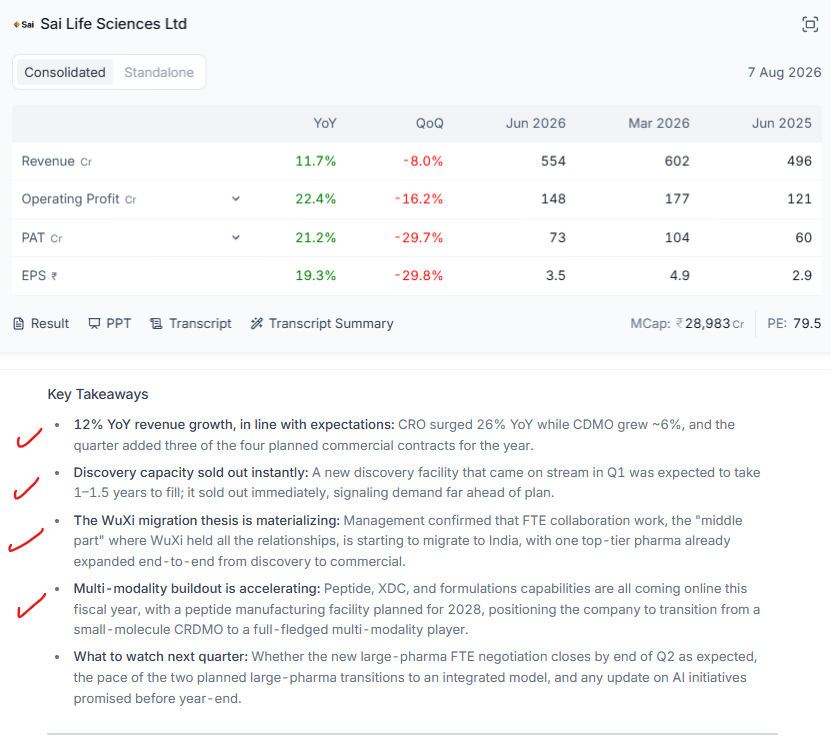
Sai Life CEO explained how pharma outsourcing to India happened in stages.
Stage 1 was discovery chemistry, small early work. Stage 3 was making drugs at big scale, where Divis and Laurus won contracts on already approved molecules. WuXi dominated because it controlled Stage 2, dedicated scientist teams staying with each drug through development.
That middle work is now starting to come to India. Sai Life CRO segment grew 24% YoY in Q1 FY27. CRO is not some side business. It is where client relationships begin and grow.
For 20 years Indian pharma companies won manufacturing contracts without controlling how drugs reached that stage.
WuXi built $7bn revenue by keeping scientist teams embedded inside client projects from early discovery to final approval. Once your team runs process development and testing, clients cannot switch easily because re-doing all validation takes over 1 year.
BIOSECURE Act became law December 2025, Pentagon put WuXi on military company list June 2026, That relationship layer where client loyalty lives is now open. Sai Life says it is building this capability.
Sai Life Sciences plans ₹1100 to ₹1300 cr capex in FY27, twice last year. Money goes into discovery labs and expanding Bidar factory from 700 KL to 1150 KL.
Management says it has 90% visibility on FY27 revenue targets. 33 commercial molecules and 14 late phase molecules sit in active pipeline. Revenue from top 19 of 25 big global pharma companies rose from 28% in FY22 to 49% in FY26.
Spending is backed by customer demand. Pharma companies need new homes for drug programs that ran through WuXi operations before.
Had ordered this book as Elon Musk referred to Iain Bank's books to understand how advanced AI can work in future- in his recent interview with the Economist.
Hopefully good read if nothing more.
In 1983, a BBC interviewer asked Richard Feynman why two magnets push each other apart — and he refused to answer it.
What he did instead is the best seven minutes on thinking ever filmed.
Bookmark & watch today, no matter what.
Following our Q1 FY27 performance, our CEO, Deepak Acharya, spoke with @kavitath on @ETNowSwadesh about INOXCVA's growth trajectory and the opportunities driving the next phase of industrial development. With a strong order book, disciplined execution, and robust order inflows, he also shared insights on the expanding potential across semiconductor manufacturing, steel, clean energy, and advanced cryogenic technologies, where INOXCVA continues to enable critical industries through engineering excellence.
#INOXCVA #HistoricallyFuturistic #ETNowSwadesh #FY27 #CryogenicSolutions #Growth
After more than 70 years without wild tigers, Kazakhstan has released its first tiger into its natural habitat, marking a milestone in one of the world’s most ambitious wildlife restoration and conservation efforts.
https://t.co/CNRs21SKgT
I'm a former Citadel quant who covered power & gas.
There's constant talk about chips & memory, but power is the central bottleneck for AI.
Very few people understand it, so I'm posting a canonical primer on power pricing & data centers: https://t.co/LO5ovj2imA
Holy shit. This is 100 pages long. It’s the entire oil midstream.
I won’t be coy. This is the most important oil piece we’ve produced. It took a while. Collaboration with @jackprandelli.
It covers what a barrel actually costs to move, who owns every link in the chain, how the benchmarks are manufactured, why insurance reprices a war instantly, and who really made the money in 2026.
Then we created the strongest bear cases we could build against ourselves, with dates and tripwires.
Everyone is trading oil this month. Almost nobody can tell you how it works. That ends today.
https://t.co/9iiCCHEqDs
.@elonmusk says there’s a “good chance” China will be the world leader in AI. The Tesla and SpaceX CEO also speaks to @zannymb about what’s holding back Chinese models—and why banning them won’t stop China from overtaking America. Watch the full Insider interview: https://t.co/alRkryS0Wq
प्रोटेस्ट में एक छात्र हाथ जोड़कर खड़ा है पुलिस लाठियों से पीटती रही उस सिपाही ने आखिर में उसके सिर पर लाठी मारा उसके बाद वह छात्र वहीं सड़क पर गिरकर बेहोश हो गया।
कुत्ते पुलिस वाले हत्या के लिए भेजे गये हैं।
उस पुलिस वाले पर attempt to murder का मुकदमा दर्ज कर उसे गिरफ्तार किया जाय।
@HMOIndia@AmitShah
X-Men: Days of Future Past
1. Vimta Labs - First order in Biologics
"...We successfully secured our first order for biologic services..."
2. Dynamic Cables - US Market foray
"...During the quarter, we also achieved an important milestone with our entry into the US markets..."
3. Globus Spirits - Prohibition in Bihar could go away
"...our belief is firmly that prohibition in Bihar is a thing of, will be a thing of the past. In terms of timelines, my expectation is one to two years..."
4. JSW Steel - On Coking coal costs
"...Coking coal prices increased by around $17 per ton, slightly higher than our guidance of $12 to $15....coking coal costs are expected to be higher by $12 to $15 in quarter two...Coking coal costs have come down recently, and that should be reflected in the subsequent quarter, and that is Q3..."
5. Poonawalla Fincorp - AI adoption
"...we are building is that we are building an AI brain for the enterprise. Not a portfolio of disconnected tools, but a single governed intelligence layer...Approximately 130 smart agents live in production..."
6. Tatva Chintan Pharma - Semiconductors Foray
"...Coming to semiconductors...our first batch produced on commercial plant scale was delivered to the customer during this quarter. And this batch has been successfully qualified by the customer..."
Disc: Not a buy or sell recommendation. Just sharing publicly available information.
Hydrogen is the future of clean energy, but how do we distribute it at scale?
Our latest technical piece breaks down how specialised cryogenic solutions are laying the foundational pipeline for global clean energy distribution.
Read the full deep-dive blog here: https://t.co/1435XXnmMT
#INOXCVA #HistoricallyFuturistic #Cryogenics #CryogenicEngineering
“There is a vulnerability at the heart of the U.S. economy so profound it imperils our national sovereignty, and most Americans have no idea it exists.
The public is well aware of China’s manufacturing dominance. The scale is alarming, yet it is not the real danger. The deeper, more insidious vulnerability is that China has secured control over a narrow set of manufacturing chokepoints that the entire U.S. industrial base relies on to function.”
My latest report for @commonplc breaks down the mechanics of this leverage and the national security logic behind US industrial policy:
https://t.co/bgPIeXvs0q
We published our thoughts on how banking stocks should be analysed (at least how we do it) with the help of J&K Bank as a case study.
Link to the post: https://t.co/VR4TVv8jUm
Disclosure: Invested/ recommended J&K Bank in RIA/ SEBI RIA: INA000018814
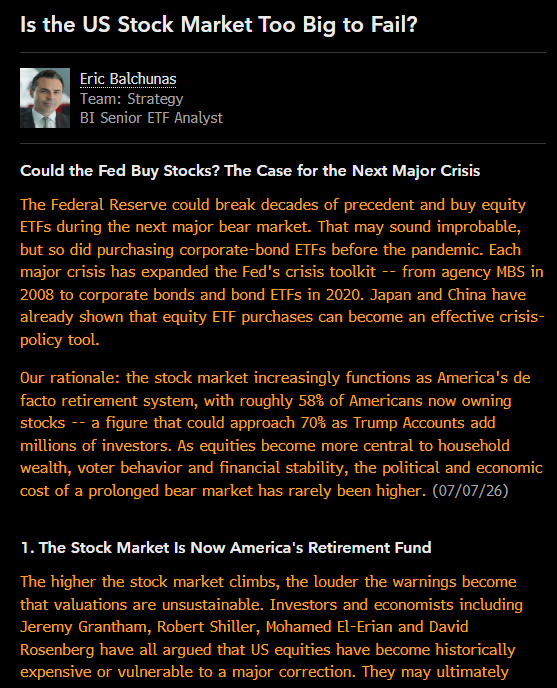
I published a note today that I've been thinking about for months.. About how the US stock market has arguably become too big and too imp to fail.. It's basically America's retirement fund now and poss even the savior of social security which is expected to run out of money in less than 10yrs
-Curr 55% of ppl own stocks, by far most in world. And w/ Trump Accounts bringing in 28 million add'l americans into stock ownership the vast majority of ppl (incl Top 1% (who own HALF of stock mkt), middle class and lower income) will have financial interest in the health of stock mkt and they're all voters = the political pressure to keep stocks out of a prolonged bear market is going to be very powerful.
-As such I think there's good chance the Fed will buy equity ETFs in the next major downturn to support market and it will be common practice going fwd. China and Japan already do this. They may even target certain sectors or Capex cos with the purchases.
-This is a massive variable that I feel like is a blind spot among the experts out there and why the bears get run over time and time again altho I think investors are onto it as evidenced by the persistent flows into ETFs during pullbacks as well as a survey of 1000 ppl showing 3/4 of them are confident the Fed will bail out markets in next crisis.
-This is just one byproduct of the 'Nothing Stops This Train' monetary supply explosion and debt extravaganza sweeping the world but esp in US which at this point feels irreversable.. Thoughts? lol