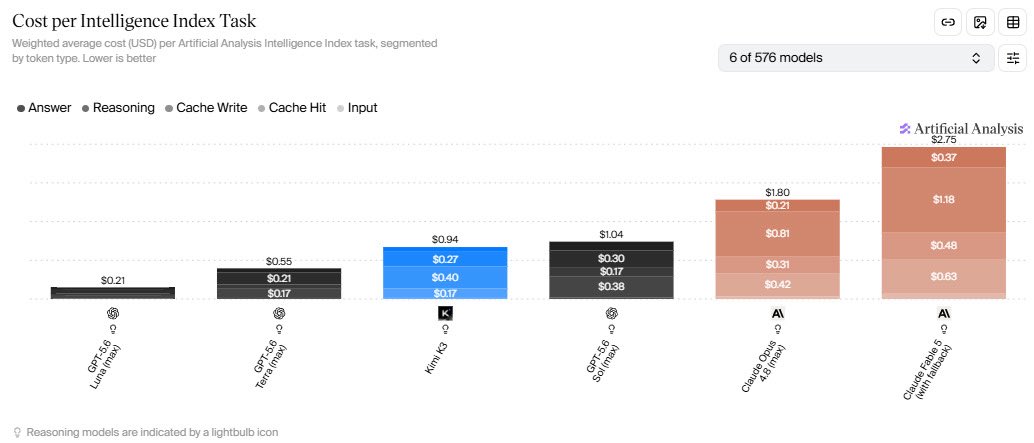
Kimi K3 may be an important inflection point for AI. Potentially negative for Anthropic and OpenAI while being net positive for essentially every other company in the world. I mean that very literally. Although the real “Sputnik moment” would be an open-source frontier model that was also token efficient unlike Kimi K3 which is 50-70% more expensive to run than GPT 5.6 per Artificial Analysis.
Rationale:
A world where there are only 2-3 dominant frontier labs with 90% inference margins is net negative for every other layer while being awesome for those 2-3 labs. Those labs would become monopsonies for power, data centers, semiconductors and hyperscalers and would obviously vertically integrate over time into all those layers while also completely subsuming the application/software layers.
Anything that lowers margins and increases competition at the model layer is good for every other AI layer: power, semiconductors, hyperscalers, neoclouds and yes even software.
This is why Jensen is so supportive of open-source. An open-source model requires the *exact* same amount of compute to run as a closed frontier model of similar size and architecture. Kimi K3 is roughly the same price as GPT 5.6 Terra on a per token basis, which actually suggests that it is less computationally efficient as I am sure that GPT 5.6 is priced to a higher margin than K3. And given that K3 is a token wastrel, i.e. token inefficient, it is significantly more expensive per task than GPT 5.6 and Grok 4.5, which are much more token efficient. Cost per token and token efficiency (i.e. intelligence density per token) are the drivers of intelligence per unit of cost. The winning AI companies will be those that offer the most intelligence per $ over time.
Lower margin % at the model layer = more margin $ at every part of the infrastructure layer and is a godsend for software. This can happen either through open-source models like K3 at the frontier *or* having a vertically integrated model company like Meta, SpaceX or Google at the frontier. Both outcomes result in a lower margin % at the model layer as vertically integrated model companies don’t really care where the margin $ come from. This is why it was so painful for OpenAI and Anthropic when Google was right there with them from a model competitiveness perspective and why Grok 4.5 and Muse 1.1 were just as important as Kimi K3.
The reason Kimi K3 is only *potentially* negative for Anthropic and OpenAI is 1) the @ericvishria point that the Claude and ChatGPT products and harnesses may be more important than their models today and 2) the hypothesis that they have much more advanced model checkpoints internally that are already being used for RSI. In the latter scenario, reaching RSI even a few months ahead of other labs might be enough to cement a permanent lead.
Time will tell on both points. And likely fairly quickly.
Caveat would be that since Kimi K3 is not token efficient and thereby actually more expensive than ChatGPT 5.6, we may need to see a more token efficient open-source model at the frontier or see Grok 5/Composer 4/Muse 2 at multiple points on the Pareto frontier for this potential risk to Anthropic and OpenAI to play out. And I am sure they will both vertically integrate as quickly as possible while continuing the product/harness strength they have shown over the last 8 months.
One of the many properties that code has that makes it highly amenable to agents is that you can more or less quickly test it. You can either go see if the application works manually, or you can actually run a test on what you built.
Most other areas of work don’t have this benefit. You only get the testing when the final product hits the real world in some capacity - a stock trade is executed, a contract is negotiated, a sales pitch is delivered, and so on.
There’s probably going to be a whole new set of opportunities for how we begin to test the rest of work in this way. Ultimately it will mean more agents being layered into workflows.
It also means we need much better evals on most of our workflows. Most work today in enterprises doesn’t have an associated eval to know if something broke or improved with a model, prompt, or system change.
The enterprises that are able to eval their knowledge work the best also stand to gain the most from AI. Will become a critical aspect of agent adoption over time.
Existence itself is a miracle - the rest is science.
There is no single meaning to existence - if there were, we’d be slaves to it.
Within existence, there are rules of logic and science. If it was magic, the world would be un-navigable.
Truly the best of all possible worlds.
I talk to engineers at other companies every day and hear the same thing: one person is 10x'ing their output with Claude but the rest of the org hasn't caught up.
Watching teams adopt AI, I keep seeing the same 4 steps.
I mapped them out here: Steps of AI Adoption https://t.co/kQnRAUMKpP
We're building AI that people and organizations can shape and make their own. AI should extend our will and judgment instead of neglecting it; enabling that is the technical challenge we are working to solve.
https://t.co/Bi558y4vqD
Today, we’re introducing [schema]: a harness reaching 99% RHAE with Opus 4.8 + Fable 5 and 95.35% with GPT-5.6 Sol on ARC-AGI-3 Public set.
[schema] makes an LLM think like a physicist. 🧵
I am excited to announce that we are officially writing a new version of Postgres. In Rust - and creating the LLVM of databases in the process.
In the span of a year, we have rewritten SQLite. Keeping the compatibility, increasing its feature set. MVCC, Types, (Live) Materialized Views, among other things. In the process of doing that, we have realized: At the end of the day, what makes SQLite special is that it compiles SQL to a database-specific bytecode. So why can't we compile *Postgres* to the same bytecode?
Turns out we can. I ran an experiment called pgmicro as a way to prove this hypothesis, and it works very well. It is time to make this official, and put the weight of Turso behind it. We shall give the world a modern take on Postgres. Wire compatible, but built on a new architecture.
We have already heard of others wanting to extend this. MySQL? Redis? the sky is the limit. What can we do if we do for databases what LLVM did for compilers? To prove how powerful the SQLite bytecode is, we are actually running DOOM compiled to the unmodified SQLite instruction set. And because Turso runs natively in the browser, you can play the game in your browser. With the database executing it.
Read the full story below! 👇
I built a variant of @mattpocockuk's grilling skill dedicated to frontend and it has improved how I build new apps and components.
The general idea:
1. Use /grilling and /prototype as a base
2. Tell Claude to build 5 WILDLY different prototypes
3. Tell Claude to include a picker that lets you switch between each variant live
4. Each round you select your favorite(s) + leave feedback, and Claude will walk down each branch of the design tree, helping you zoom in on your desired design
And THEN, I went and added it to /wayfinder, so whenever I make a new map and there's novel frontend work, a ticket is created specifically referencing that /grilling-frontend-prototyping needs to be invoked.
This will not be the last time I build a cool skill and add it to Wayfinder; this is a very powerful pattern for planning work.
You can find my skill here: https://t.co/4M4QPlfnp1
Kimi K3 is out, and it's beautiful. Go try it now.
Also, a (very) late life update: I joined @Kimi_Moonshot a few months ago to build open frontier intelligence. Honored to ship K3 alongside an incredible team.
Only the beginning. Scaling never stops.
(Btw, please don't sleep on the chip design demo
Big news: Kimi-K3 by @Kimi_Moonshot is now #1 in the Frontend Code Arena with 1679 pts, surpassing Claude Fable 5.
This is a 17-place jump from Kimi-k2.6 (#18 -> #1).
In Frontend, Kimi-K3 ranked #1 in 6 of 7 domains: Brand & Marketing, Reference-Based Design, Data & Analytics, Consumer Product, Simulations, and Content Creation Tools, landing #2 only in Gaming behind Fable 5.
The full model weights will be released by July 27.
Congrats to the @Kimi_Moonshot team on this major milestone!