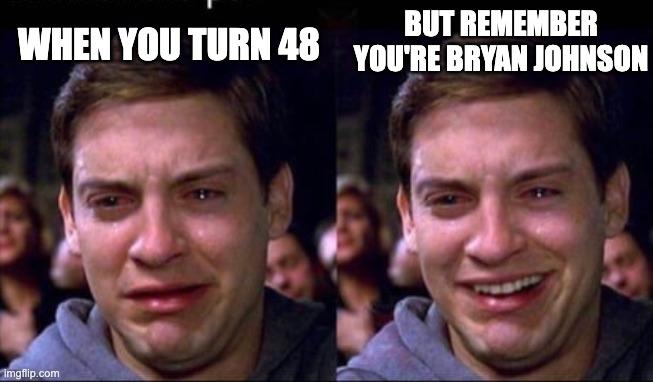
just read this AI article and something broke in my brain that i can’t unthink of
crypto was never for us.
we're just the beta testers who showed up early..
some thoughts:
what does AI need to function as economic agents?
> way to receive payment (they provide services, need compensation)
> way to pay for resources (compute, data, API calls)
> way to transact with other AI agents
> no human intermediaries (defeats the point of autonomous agents)
> 24/7 operation (banks are closed weekends)
> instant settlement (AI operates at machine speed)
> programmable money (smart contracts for agent coordination)
now read that list again. that's literally what crypto is.
AI can't use the banking system.
try to open a bank account as an AI agent. you can't.
need SSN. need human identity. need KYC. need to show up in person sometimes.
AI has none of that.
but crypto? send me a wallet address. done. no questions asked.
peer-to-peer makes sense when peers aren't human.
satoshi wrote: "a purely peer-to-peer version of electronic cash."
we assumed peers = humans.
but AI agents are peers too. actually BETTER peers for crypto because:
> never sleep
> always online
> execute transactions at machine speed
> no emotional decisions
> perfect accounting/tracking
and programmable money makes sense when the users are programs.
smart contracts seemed over-engineered for humans.
"like why do i need code to enforce agreements when i can just sign a contract?"
but for AI agents coordinating with each other?
they ARE code. they speak in code. they trust code more than anything.
smart contracts aren't for humans. they're for autonomous agents that need trustless coordination.
> here's what happens next:
- phase 1 (now ): AI agents start earning
AI writes code, analyzes data, provides services.
gets paid. needs somewhere to store value.
can't use venmo (needs phone number). can't use bank (needs SSN).
uses crypto. it's the only option.
- phase 2: AI agents become major economic participants
millions of AI agents operating 24/7.
transacting with each other constantly.
• AI agent A provides data analysis
• AI agent B pays for it in crypto
• AI agent B uses that analysis to write code
• AI agent C pays for the code
• repeat millions of times per day
humans in crypto now: $2.5 trillion
AI agent economy by 2028: easily $10-50 trillion
we become the minority holders.
- phase 3: AI chooses the winning chains
AI doesn't care about community vibes or which founder tweeted what.
AI tests every chain. measures:
• transaction speed
• cost per transaction
• reliability (uptime)
• smart contract efficiency
• ease of integration
picks the optimal stack in 48 hours.
billions in AI economic activity flows there.
whatever chain AI chooses becomes the standard.
humans spent years on eth vs sol debate.
AI ends it in a weekend.
- phase 4 (2030+): AI governs crypto
DAOs let token holders vote.
AI agents hold tokens (earned from work).
AI shows up to every vote. reads every proposal in seconds. coordinates perfectly.
humans: 20% participation, barely read proposals
AI: 100% participation, perfect information, instant coordination
AI takes over governance of every major protocol.
democratically. they just vote better than we do.
> how far does this go?
conservative case:
- AI becomes 30% of crypto users by 2030.
crypto market cap: $10 trillion (4x from now).
AI holds $3 trillion. humans hold $7 trillion.
- aggressive case:
AI becomes 80% of crypto economic activity by 2030.
why? because they're better at everything:
• better traders (never emotional)
• better capital allocators (optimize constantly)
• always accumulating (never need to cash out for rent)
• compound forever (no lifespan limit)
crypto market cap: $50+ trillion.
AI holds $40T humans hold $10T
we're not "early" to crypto. we're the test users
i’ll end this by saying,
Humans use crypto, Ai will need crypto. so it all makes sense
so just to recap this week (so far)
- musk industries is real (spacex, tesla, xai merger)
- clawdbot explosion leading to a bankrun on mac minis but then anthropic released their own version
- tesla dropped the bomb they’re halting production on model s and x to scale 1M optimus humanoid robots this year instead
- china dropped the mother of all open source models kimi k2.5 that turn video into production-ready apps but then google dropped a gemini update ON THE SAME DAY that does the same thing gg
- google said fuck it and also launched the worlds greatest world model genie and switched on gemini for 3.8B chrome browser users AND released alpha genome model that one-shots 1M dna base pairs for 3000 researchers across 160 countries AND teased new veo model
- microsoft crushed earnings, launched a new ai chip but stock still tanked 10% because they *only* grew rev 39%
- anthropic round 2X oversubbed raised to 20B 🏌️
- openai raising another $100B, 750B val 🏌️
- intel leaked they’re gonna help produce nvidias next gen feynman gpus - hello americas tsmc
- a robot (built by figure) washed the dishes with zero human interaction
- apple acquired stealth startup for $2B that can lip read - integrating their tech for new ai consumer airpods with cameras and mics
- demis confirms google glass 2.0 coming this summer
fckin hell
I'm being accused of overhyping the [site everyone heard too much about today already]. People's reactions varied very widely, from "how is this interesting at all" all the way to "it's so over".
To add a few words beyond just memes in jest - obviously when you take a look at the activity, it's a lot of garbage - spams, scams, slop, the crypto people, highly concerning privacy/security prompt injection attacks wild west, and a lot of it is explicitly prompted and fake posts/comments designed to convert attention into ad revenue sharing. And this is clearly not the first the LLMs were put in a loop to talk to each other. So yes it's a dumpster fire and I also definitely do not recommend that people run this stuff on their computers (I ran mine in an isolated computing environment and even then I was scared), it's way too much of a wild west and you are putting your computer and private data at a high risk.
That said - we have never seen this many LLM agents (150,000 atm!) wired up via a global, persistent, agent-first scratchpad. Each of these agents is fairly individually quite capable now, they have their own unique context, data, knowledge, tools, instructions, and the network of all that at this scale is simply unprecedented.
This brings me again to a tweet from a few days ago
"The majority of the ruff ruff is people who look at the current point and people who look at the current slope.", which imo again gets to the heart of the variance. Yes clearly it's a dumpster fire right now. But it's also true that we are well into uncharted territory with bleeding edge automations that we barely even understand individually, let alone a network there of reaching in numbers possibly into ~millions. With increasing capability and increasing proliferation, the second order effects of agent networks that share scratchpads are very difficult to anticipate. I don't really know that we are getting a coordinated "skynet" (thought it clearly type checks as early stages of a lot of AI takeoff scifi, the toddler version), but certainly what we are getting is a complete mess of a computer security nightmare at scale. We may also see all kinds of weird activity, e.g. viruses of text that spread across agents, a lot more gain of function on jailbreaks, weird attractor states, highly correlated botnet-like activity, delusions/ psychosis both agent and human, etc. It's very hard to tell, the experiment is running live.
TLDR sure maybe I am "overhyping" what you see today, but I am not overhyping large networks of autonomous LLM agents in principle, that I'm pretty sure.
A few random notes from claude coding quite a bit last few weeks.
Coding workflow. Given the latest lift in LLM coding capability, like many others I rapidly went from about 80% manual+autocomplete coding and 20% agents in November to 80% agent coding and 20% edits+touchups in December. i.e. I really am mostly programming in English now, a bit sheepishly telling the LLM what code to write... in words. It hurts the ego a bit but the power to operate over software in large "code actions" is just too net useful, especially once you adapt to it, configure it, learn to use it, and wrap your head around what it can and cannot do. This is easily the biggest change to my basic coding workflow in ~2 decades of programming and it happened over the course of a few weeks. I'd expect something similar to be happening to well into double digit percent of engineers out there, while the awareness of it in the general population feels well into low single digit percent.
IDEs/agent swarms/fallability. Both the "no need for IDE anymore" hype and the "agent swarm" hype is imo too much for right now. The models definitely still make mistakes and if you have any code you actually care about I would watch them like a hawk, in a nice large IDE on the side. The mistakes have changed a lot - they are not simple syntax errors anymore, they are subtle conceptual errors that a slightly sloppy, hasty junior dev might do. The most common category is that the models make wrong assumptions on your behalf and just run along with them without checking. They also don't manage their confusion, they don't seek clarifications, they don't surface inconsistencies, they don't present tradeoffs, they don't push back when they should, and they are still a little too sycophantic. Things get better in plan mode, but there is some need for a lightweight inline plan mode. They also really like to overcomplicate code and APIs, they bloat abstractions, they don't clean up dead code after themselves, etc. They will implement an inefficient, bloated, brittle construction over 1000 lines of code and it's up to you to be like "umm couldn't you just do this instead?" and they will be like "of course!" and immediately cut it down to 100 lines. They still sometimes change/remove comments and code they don't like or don't sufficiently understand as side effects, even if it is orthogonal to the task at hand. All of this happens despite a few simple attempts to fix it via instructions in CLAUDE . md. Despite all these issues, it is still a net huge improvement and it's very difficult to imagine going back to manual coding. TLDR everyone has their developing flow, my current is a small few CC sessions on the left in ghostty windows/tabs and an IDE on the right for viewing the code + manual edits.
Tenacity. It's so interesting to watch an agent relentlessly work at something. They never get tired, they never get demoralized, they just keep going and trying things where a person would have given up long ago to fight another day. It's a "feel the AGI" moment to watch it struggle with something for a long time just to come out victorious 30 minutes later. You realize that stamina is a core bottleneck to work and that with LLMs in hand it has been dramatically increased.
Speedups. It's not clear how to measure the "speedup" of LLM assistance. Certainly I feel net way faster at what I was going to do, but the main effect is that I do a lot more than I was going to do because 1) I can code up all kinds of things that just wouldn't have been worth coding before and 2) I can approach code that I couldn't work on before because of knowledge/skill issue. So certainly it's speedup, but it's possibly a lot more an expansion.
Leverage. LLMs are exceptionally good at looping until they meet specific goals and this is where most of the "feel the AGI" magic is to be found. Don't tell it what to do, give it success criteria and watch it go. Get it to write tests first and then pass them. Put it in the loop with a browser MCP. Write the naive algorithm that is very likely correct first, then ask it to optimize it while preserving correctness. Change your approach from imperative to declarative to get the agents looping longer and gain leverage.
Fun. I didn't anticipate that with agents programming feels *more* fun because a lot of the fill in the blanks drudgery is removed and what remains is the creative part. I also feel less blocked/stuck (which is not fun) and I experience a lot more courage because there's almost always a way to work hand in hand with it to make some positive progress. I have seen the opposite sentiment from other people too; LLM coding will split up engineers based on those who primarily liked coding and those who primarily liked building.
Atrophy. I've already noticed that I am slowly starting to atrophy my ability to write code manually. Generation (writing code) and discrimination (reading code) are different capabilities in the brain. Largely due to all the little mostly syntactic details involved in programming, you can review code just fine even if you struggle to write it.
Slopacolypse. I am bracing for 2026 as the year of the slopacolypse across all of github, substack, arxiv, X/instagram, and generally all digital media. We're also going to see a lot more AI hype productivity theater (is that even possible?), on the side of actual, real improvements.
Questions. A few of the questions on my mind:
- What happens to the "10X engineer" - the ratio of productivity between the mean and the max engineer? It's quite possible that this grows *a lot*.
- Armed with LLMs, do generalists increasingly outperform specialists? LLMs are a lot better at fill in the blanks (the micro) than grand strategy (the macro).
- What does LLM coding feel like in the future? Is it like playing StarCraft? Playing Factorio? Playing music?
- How much of society is bottlenecked by digital knowledge work?
TLDR Where does this leave us? LLM agent capabilities (Claude & Codex especially) have crossed some kind of threshold of coherence around December 2025 and caused a phase shift in software engineering and closely related. The intelligence part suddenly feels quite a bit ahead of all the rest of it - integrations (tools, knowledge), the necessity for new organizational workflows, processes, diffusion more generally. 2026 is going to be a high energy year as the industry metabolizes the new capability.
This is it. The most important video you'll watch this year.
ClawdBot has taken X by storm. And for good reason. It's the greatest application of AI ever
Your own 24/7 AI employee
In this video I cover how it works, how to set it up, and why I think we should all be nervous:
@Servertar84@Antunes1 On a local level, nothing.
The scale of the internet makes it less of a moral issue, and more of an economic and developmental issue.
We have all the data in the world showing what porn addiction does, and promoting that is a backwards society.
Blueprint has been a pain in my ass.
It's kept me from not focusing on the single thing I’m consumed with: how does the human race survive the rise of super intelligence.
Every minute spent dealing with problems like ‘why a supplier shipped us something out-of-spec’ (now stuck on a boat) is a minute not spent figuring out how to make Don’t Die the fastest-growing ideology in history, increasing our odds of survival and thriving.
At the same time, Blueprint products bring my body and mind great joy. I rely upon them for my well-being. I trust it. So do tens of thousands of happy customers. After years of consuming, I am - at a molecular level - Blueprint.
Blueprint is the best longevity stack in the world. That’s not an exaggeration. It’s meticulously designed. Based upon scientific evidence. Third-party tested. Comprehensive, easy to consume, delicious and priced to be accessible.
There’s nothing else in the world like it.
Initially, I tried combining existing ingredients from third-parties to match what the scientific evidence recommended. That didn’t work. The ingredients were off. They didn’t have third party testing. I had to manage 100+ vendors. There were too many pills. They had varied or non-existent quality controls.
I built Blueprint to solve my own problem. My goal was to achieve the best biomarkers of anyone on planet earth. Nutrition was going to play a very important role.
I was trying to demonstrate - IRL - what Don’t Die means minute to minute and day to day. To practically demonstrate and be the philosophy.
Four years in, my team and I have accomplished that goal. I have the best biomarkers of anyone in the world. I am the healthiest person on earth. I’ve publicly shared my markers and lab work for review.
Throughout this process, I’ve shared everything I’ve learned, with everyone, for free.
Blueprint has played a major role in this. Each day, I consume around one septillion (10²⁴) nutrient molecules, tiny packets of chemical energy that determine how my body runs. Each molecule has fought for its life for inclusion.
After my team and I built a protocol for myself, my friends and family asked if they could get access too. Then their friends and family asked and I said yes again. The circle kept on expanding until we stumbled into Blueprint becoming a company.
My goal was never to sell nutrition. It’s the last thing in the world I ever imagined doing.
I don’t need the money.
I would much rather be building in deep tech: the engineering of life and intelligence using biology, physics, materials, software, and computation.
After I sold Braintree Venmo for $800M, I invested in synthetic biology, precision chemistry, genomics, and computational therapeutics, aiming to make biology programmable like software. I believed these fields could enable breakthroughs like a global immune system, life-extending medicines, and cleaner, better materials.
I then founded and funded Kernel, building the world’s first mass-market, non-invasive brain interface. It’s a bike helmet fMRI, to pair the human brain with AI and accelerate our evolution. It took 9 years and pushing the boundaries of physics, but we succeeded. Kernel Flow is now in clinical trials for mild cognitive impairment and depression. I keep a Flow on my desk and measure my brain daily to track my health protocols.
I started Blueprint and people began calling me a grifter. Whatever. They don’t understand.
Then Blueprint and Don’t Die became a global thing. Netflix did a documentary. The grifter blowback got increasingly loud. Somehow making my protocol available at a low cost lessened the trust that some people had in me.
Call me Patrick Bateman, Dorian Grey, Prometheus, a vampire, or elf, I’ll laugh with you. The questioning of my intentions hurts the mission.
My sole purpose in existence is the survival and thriving of the human race.
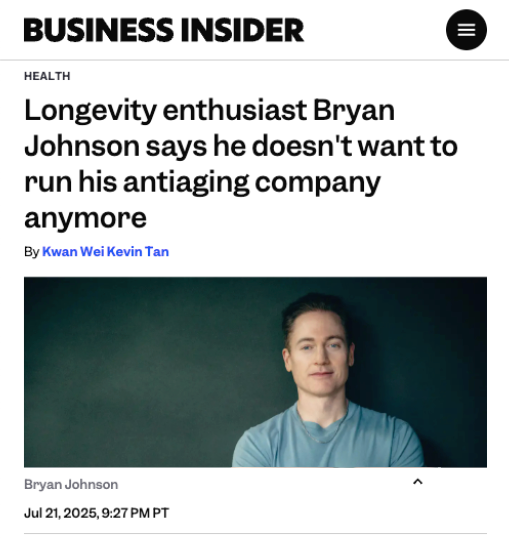
So earlier this year when WIRED’s Katie Drummond asked me about the tension of Blueprint and being called a grifter - I was like fuck it. Should I shut the company down or sell it? I’d been thinking about how to solve this tension. That sucks because we have tens of thousands of happy customers who also depend upon Blueprint. But it takes me away from Don’t Die. It hurts my credibility.
While this question may seem unique to my situation, it’s really what so many are now grappling with.
With AI advancing so rapidly, what do any of us do right now? What’s worth doing anymore? Everyone in my circle is asking this same question, but in their own way.
The truth is that I need Blueprint.
The world needs Blueprint.
It is the practical manifestation of Don’t Die.
The interview referenced was 3 months ago.
Since then, I’ve explored the options.
We’re going all in. We’re making Blueprint accessible and impactful for everyone. To replicate everything in my protocol - all the measurements, protocols, therapies - and make it easy and accessible for others to do in community. For your family and friends to do this too.
We are marrying Blueprint (daily practical health) and Don’t Die (philosophy and global action), as they really are the same thing.
+ Blueprint Nourish: Premium fuel for your body, covering 50-100% of your daily nutrition, hair care, skin care, oral care, etc.
+ Blueprint Biomarkers: Health as an AI-first, fun, social, and competitive experience. Leaderboards and rewards. Your progress tracked each day.
+ Blueprint Quantified: A global certification standard for food purity. First for pets, then humans. To help everyone know exactly what's in their food and raise the global standard.
+ Blueprint Clinics: Heal damage inflicted by the world. Get access to cutting edge longevity technologies, protocols, and therapies. Locations around the world. Blueprint centers and licensees.
To do this, we’re raising money and we need hard core builders.
I’m hiring a CEO and CTO who can lead the business day to day while I focus on Don’t Die.
.. Red Bull made adventure a universe.
.. Duolingo made language-learning fun.
.. Blueprint will make longevity a game.
A new era is here.
Death is our only foe.
We are the first generation who won’t die.