Supposedly standing helps blood flow and therefore focus. Not for me tho. Standing strains legs/feet so I found it hard to finish reading a long technical article. But watching a video lesson on AI agent is fine. Maybe I should test how much I really learned :) #brain#DeepWork
@AndrewYNg Completed the course and would recommend to others, even if you are not a coder day to day. I was initially concerned about the labs, because the course was labeled intermediate. It turned out to be very doable.
Announcing my new course: Agentic AI!
Building AI agents is one of the most in-demand skills in the job market. This course, available now at https://t.co/zGHUh1loPO, teaches you how.
You'll learn to implement four key agentic design patterns:
- Reflection, in which an agent examines its own output and figures out how to improve it
- Tool use, in which an LLM-driven application decides which functions to call to carry out web search, access calendars, send email, write code, etc.
- Planning, where you'll use an LLM to decide how to break down a task into sub-tasks for execution, and
- Multi-agent collaboration, in which you build multiple specialized agents — much like how a company might hire multiple employees — to perform a complex task
You'll also learn to take a complex application and systematically decompose it into a sequence of tasks to implement using these design patterns.
But here's what I think is the most important part of this course: Having worked with many teams on AI agents, I've found that the single biggest predictor of whether someone executes well is their ability to drive a disciplined process for evals and error analysis. In this course, you'll learn how to do this, so you can efficiently home in on which components to improve in a complex agentic workflow. Instead of guessing what to work on, you'll let evals data guide you. This will put you significantly ahead of the game compared to the vast majority of teams building agents.
Together, we'll build a deep research agent that searches, synthesizes, and reports, using all of these agentic design patterns and best practices.
This self-paced course is taught in a vendor neutral way, using raw Python - without hiding details in a framework. You'll see how each step works, and learn the core concepts that you can then implement using any popular agentic AI framework, or using no framework. The only prerequisite is familiarity with Python, though knowing a bit about LLMs helps.
Come join me, and let's build some agentic AI systems!
Sign up to get started: https://t.co/FX35dloqw4
Andrej Karpathy calls large language models the new computing paradigm:
CPU -> LLM
bytes -> tokens
RAM -> context window
this is the large language model OS (LMOS)
Design has changed.
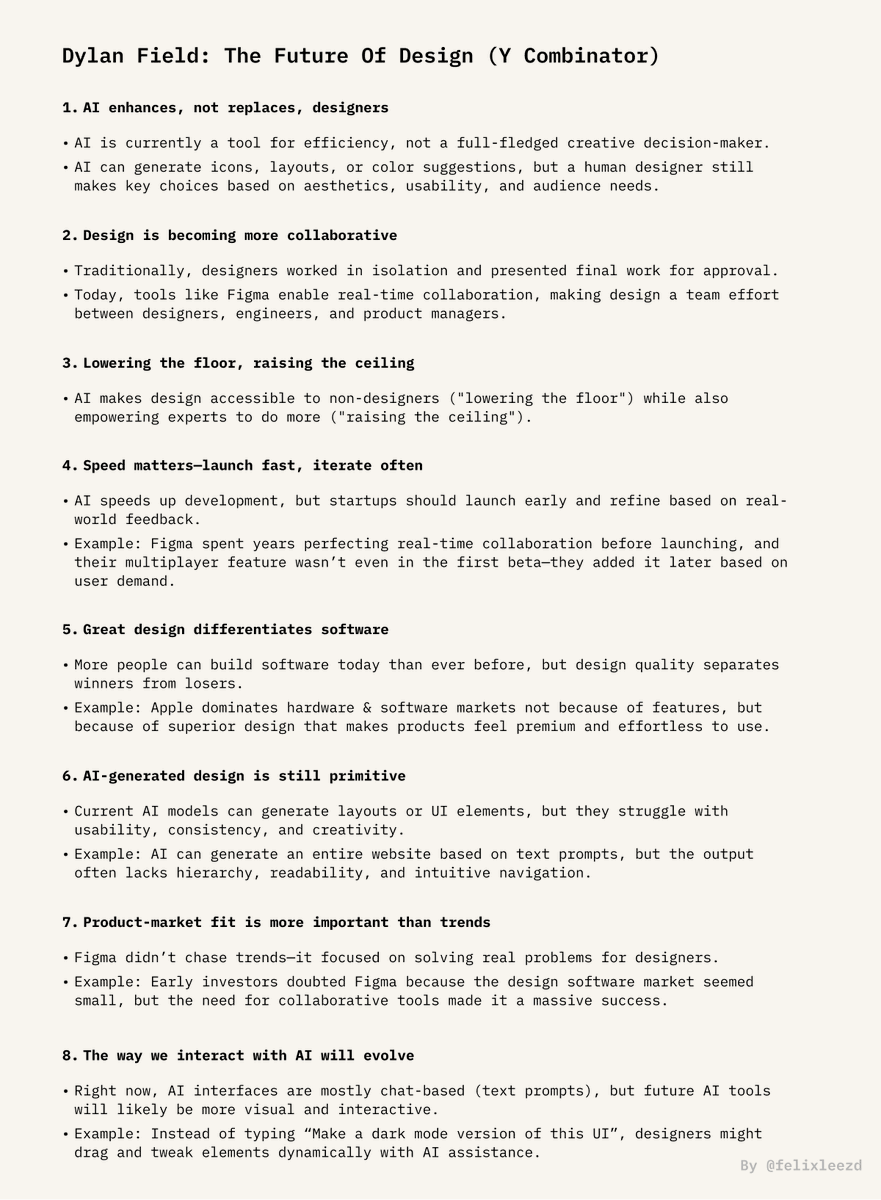
Figma's CEO on the future of design and AI - "A designer's judgment, taste, and agency will matter more than ever." This is especially true with the rise of vibe coding.
Important lessons from Dylan Field's convo at YC.
The classic software startup writes code to solve users' problems. If AI makes writing code more of a commodity, understanding users' problems will become the most important component of starting a startup. But it already is.
There's a new kind of coding I call "vibe coding", where you fully give in to the vibes, embrace exponentials, and forget that the code even exists. It's possible because the LLMs (e.g. Cursor Composer w Sonnet) are getting too good. Also I just talk to Composer with SuperWhisper so I barely even touch the keyboard. I ask for the dumbest things like "decrease the padding on the sidebar by half" because I'm too lazy to find it. I "Accept All" always, I don't read the diffs anymore. When I get error messages I just copy paste them in with no comment, usually that fixes it. The code grows beyond my usual comprehension, I'd have to really read through it for a while. Sometimes the LLMs can't fix a bug so I just work around it or ask for random changes until it goes away. It's not too bad for throwaway weekend projects, but still quite amusing. I'm building a project or webapp, but it's not really coding - I just see stuff, say stuff, run stuff, and copy paste stuff, and it mostly works.
Asking for help is hard. Especially at work. Here's a template to make it easier.
You don’t need to use all of its parts, nor in this exact sequence, nor with these specific words. Treat it as an example, and modify it based on the strength of the connection, overlap in your goals, and expertise of the recipient.
🔸 Signpost: “I’d like to ask for your help with something.”
🔸 Clear request: “Specifically, I need [type of help] with [specific task/problem].”
🔸 Rationale: “This is important because [reason].”
🔸 Why them: “I’m asking you because [specific reason].”
🔸 Timeline: “I’d need this by [date/time].”
🔸 Opt-in/out: “Is this something you’re able to help with?”
Three real-life examples in thread below 🧵
Don't miss the full post by @natatouille with much more to help you ask for help even when you really don't want to: https://t.co/ygOdqlAynO
"Life is short. Art is long." This quote reminded me of someone I used to follow and who tweeted about intranet 2.0. Then he retired and started tweeting about art. I lost interest... Only years later, I realized it was because I haven't lived long enough... #art
Great opportunity for innovators interested in the library and cultural institution space: Library of Congress Opens Search for Next Innovator in Residence https://t.co/vbqNWrM2FY
Ethan Evans (@EthanEvansVP) is a coach, writer, teacher, and retired VP at @Amazon. During his 15 years at Amazon, he helped invent @PrimeVideo, @AmazonVideo, the @AmazonAppstore, @PrimeGaming (formerly Twitch Prime), and @Twitch
Commerce. He led global teams of over 800, holds more than 70 patents, and helped draft one of Amazon’s 14 core Leadership Principles, “Ownership.”
In our conversion, we discuss:
🔸 The Magic Loop framework for rapid career growth
🔸 Why L6/M1s get stuck in their career
🔸 Advice on how to break out of a career plateau
🔸 How to cultivate inventiveness in your work
🔸 How to stand out in interviews
🔸 A personal story of failing Jeff Bezos
🔸 Much more
Installing apps now on a new laptop I got over the holidays (good deal). Is Slack downplaying the desktop version? The Download links are at the bottom of each menu if you pull those down but there isn't a Download menu. Nor is it in the footer. #product









![lennysan's tweet photo. Asking for help is hard. Especially at work. Here's a template to make it easier.
You don’t need to use all of its parts, nor in this exact sequence, nor with these specific words. Treat it as an example, and modify it based on the strength of the connection, overlap in your goals, and expertise of the recipient.
🔸 Signpost: “I’d like to ask for your help with something.”
🔸 Clear request: “Specifically, I need [type of help] with [specific task/problem].”
🔸 Rationale: “This is important because [reason].”
🔸 Why them: “I’m asking you because [specific reason].”
🔸 Timeline: “I’d need this by [date/time].”
🔸 Opt-in/out: “Is this something you’re able to help with?”
Three real-life examples in thread below 🧵
Don't miss the full post by @natatouille with much more to help you ask for help even when you really don't want to: https://t.co/ygOdqlAynO](https://pbs.twimg.com/media/GUVG9PSWYAA11aG.jpg)