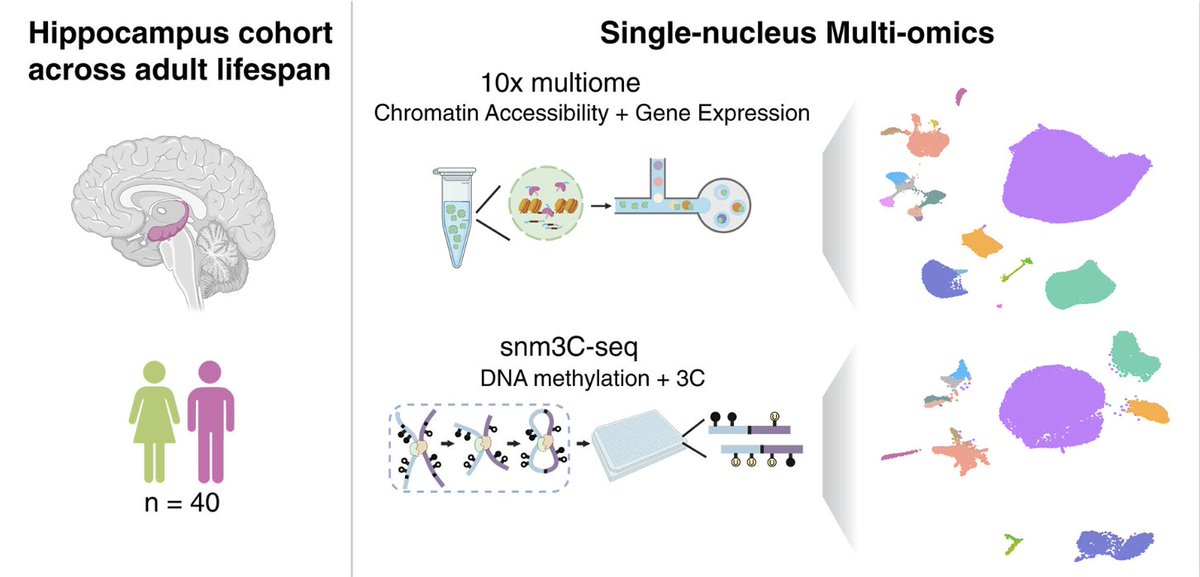
Aging doesn't just change what brain cells do, it changes what they are! New study shows microglia cells replaced over time by monocyte-like inflammatory cells due to DNA methylation changes, consistent with brain aging and dementia resulting from epigenetic information loss👏🧵
@davidasinclair Continuously inhibiting DNMT1 sounds kind of...risky. Especially considering data showing it induces senescence in fibroblasts:
https://t.co/TRFoNWD4HR
https://t.co/3VqZp7a4Wo
Sounds more like it could be a prophylactic against skin cancer
@attilacsordas Seems to be "unexpected side effects that arose from treatment of recently diagnosed cancer". Rather limited info, I suppose they didn't see it coming.
https://t.co/CscclBCS95
I wish the paper wasn't paywalled... I wonder how they got Cyb5b to work as selectively as they imply and how they avoid the calcium pulse triggering any unintended effects
to figure out the mechanism, hey ran a genome-wide CRISPR screen and landed on a protein called CYB5B as the key effector
EMF hits the cell → CYB5B picks it up → voltage-gated calcium channels open → calcium pulses rhythmically through the cell → a transcription factor called SP7 binds to the target DNA → gene turns on
interestingly, plain old calcium influx doesnt do the same thing. they tried ionophores and other things that push calcium into cells and none of them triggered the switch. the cell specifically needs the rhythmic oscillating pattern that this EMF frequency produces
https://t.co/nCXokPzAOM
ok actually insane paper published yesterday
a research group in Korea built a gene switch you can control wirelessly using electromagnetic fields
they exposed mice to 60 hz EMF (same frequency as your wall outlet) using a pair of large coils that generate a uniform magnetic field around the animal, for cyclic 3-day on / 4-day off pulses
they showed this could:
- activate OSK to do epigenetic reprogramming in progeroid and aged mice, extending lifespan and reversing aging markers across multiple tissues
- conditionally switch on mutant amyloid genes only in aged mouse brains, letting them separate aging effects from amyloid effects to study AD biology in a way previous models couldn't
no drugs, no impacts, just a magnetic field from outside the body
What if you could protect yourself from the next pandemic from the comfort of your bathroom?
That’s the appeal of a special kind of floss that can deliver proteins and inactive viruses, priming the body against foreign invaders.
The unusual vaccination strategy shows promise in mice, and the public seems intrigued as well, making this one of our most popular stories of last year: https://t.co/vCtb21hCdU
A newly discovered type of immune cell found in fat tissue seems to contribute to the chronic inflammation associated with ageing
https://t.co/8X9kY6JA3H
@jpsenescence Analyses of macro-attributes that are known to deteriorate with age in the model: cognition, muscle strength etc. (Though there really should be a universal standard for these)
@jpsenescence I feel that the real trick would be doing the relevant changes tissue specifically since pro-longevity over-expression in one tissue can have deleterious effects in another. So even if it's only a few genes, it might have to be via multiple vectors to target the relevant tissues.
This study reinforces a key point: your environment and daily habits shape aging and disease risk potentially more than your genes. While genetic predisposition matters, it is not deterministic. The right lifestyle choices can mitigate many risks. /10
https://t.co/yFQdEE3j9f
Lifestyle is a stronger predictor of aging and mortality than genetics.
A new Nature study of ~500,000 people found:
🎯 17% of mortality variation was linked to lifestyle (exposome).
🧬 <2% of was explained by genetics.
Here’s what you need to know 👇🧵 1/10
Chemicals that mimic resveratrol by activating the SIRT1 enzyme reduce inflammation & protect the retina from oxidative damage in a mouse model of macular degeneration 👏 🧵 …
https://t.co/hWwmmNG3xL
Behold: input sequence, output protein. This is the live, free web interface for all usage including commercial applications. Try it for yourself on their website, it's really cool. You can literally paste any sequence you want. (2/6)
Given that the removal of senescent cells can be detrimental to health, it raises questions about their role in aging.
I think cellular senescence is a misnomer. Senescent cells are a response that can be beneficial or detrimental to the tissue depending on context.
3/4
My new paper @ScienceMagazine on the beneficial functions of senescent cells is bound to be controversial.
Senescent cells have long been associated with aging and diseases, yet new evidence suggests they play important physiological roles.
1/4
https://t.co/UtBKDF00P1