Really good thread from @oyhsu on physical AI - robotics, autonomous labs, BCIs.
The part that stuck with me - we're starting to see the same data-scaling dynamics in physical systems that drove the jump from GPT-2 to GPT-4. Except now the bottleneck isn't text on the internet, it's sensor data and sim-to-real transfer.
Worth reading if you think about where AI hits hardware constraints.
https://t.co/GN3DDB7Hrb
Private markets are no longer a "rising tide lifts all boats" game.
We just released the NonPublic Private Markets Report, and the data is clear:
the spread between top-quartile and median outcomes is extremely wide.
3 Key Takeaways:
1️⃣ Alpha is Concentrated: Access to "A-list" deals is now the primary driver of returns.
2️⃣ Liquidity is Evolving: Secondaries are no longer a "plan B", they are a core portfolio tool for DPI.
3️⃣ Breakthrough Sectors: Conviction is hardening around AI-native apps, AI infrastructure, Robotics, and Defense.
Our “NonPublic” Thesis:
Every great company we back today is obsessed with dominating at least one of these three variables:
Compute Power × Data Quality & Scale × Algorithmic Efficiency
If a founder can’t clearly win in one of those areas, they’re not in the race. Every investment decision we make is made downstream from this framework.
Longer term, defensibility will shift away from code itself and toward distribution, proprietary data, and physical AI (e.g., robotics and embodied systems).
In a stock picker’s market, manager selection and deal access are the only real edges.
Full 2025 report link 👉🏼 https://t.co/u8NhyYEm6L
normie trad work: Do the job yourself
1st derivative: Use AI to help you do the job
2nd derivative: Teach AI to do the job for you
3rd derivative: Manage AIs that do the job
4th derivative: Design the AI systems that run the work
5th derivative: Do new work that only AI teams can do
No AI will not kill Capitalism.
The market is selling off because AI will Kill capitalism. You can’t make this stuff up.
The claim that AI marks the terminal crisis of capitalism sounds less like economic analysis and more like a revival of Marx’s old prophecy — that capital would eventually automate away its own labor base. But history has consistently humbled that idea.
Capitalism is not a fixed system dependent on human inputs at one stage of production; it is an adaptive architecture of incentives that constantly redefines what constitutes value, work, and ownership. The spinning jenny didn’t collapse feudal mercantilism because it displaced artisans — it birthed industrial capitalism by shifting where value creation occurred. Likewise, AI-induced displacement is not the endpoint of labor’s role in the economy, but the transition to new modes of resource allocation: creativity, judgment, taste, governance, and capital stewardship.
What AI automates are routine cognitive tasks, not the social processes of coordination, aspiration, and meaning that markets ultimately monetize. The idea that capitalism cannot survive without employment misunderstands capitalism’s engine: it is not “jobs” that power the system, but exchange, of ideas, capital, data, and experience. As the cost of intelligence falls toward zero, capitalism will not die; it will mutate toward higher-order scarcity, attention, authenticity, and trust.
Marx predicted the end of capitalism when labor lost its bargaining power. What actually happens is that capitalism internalizes the new technology, re-prices the factors of production, and rebuilds itself around the next frontier of value. AI may destroy the old middle class, but it will not end capitalism. It will end this phase of capitalism and give birth to the next.
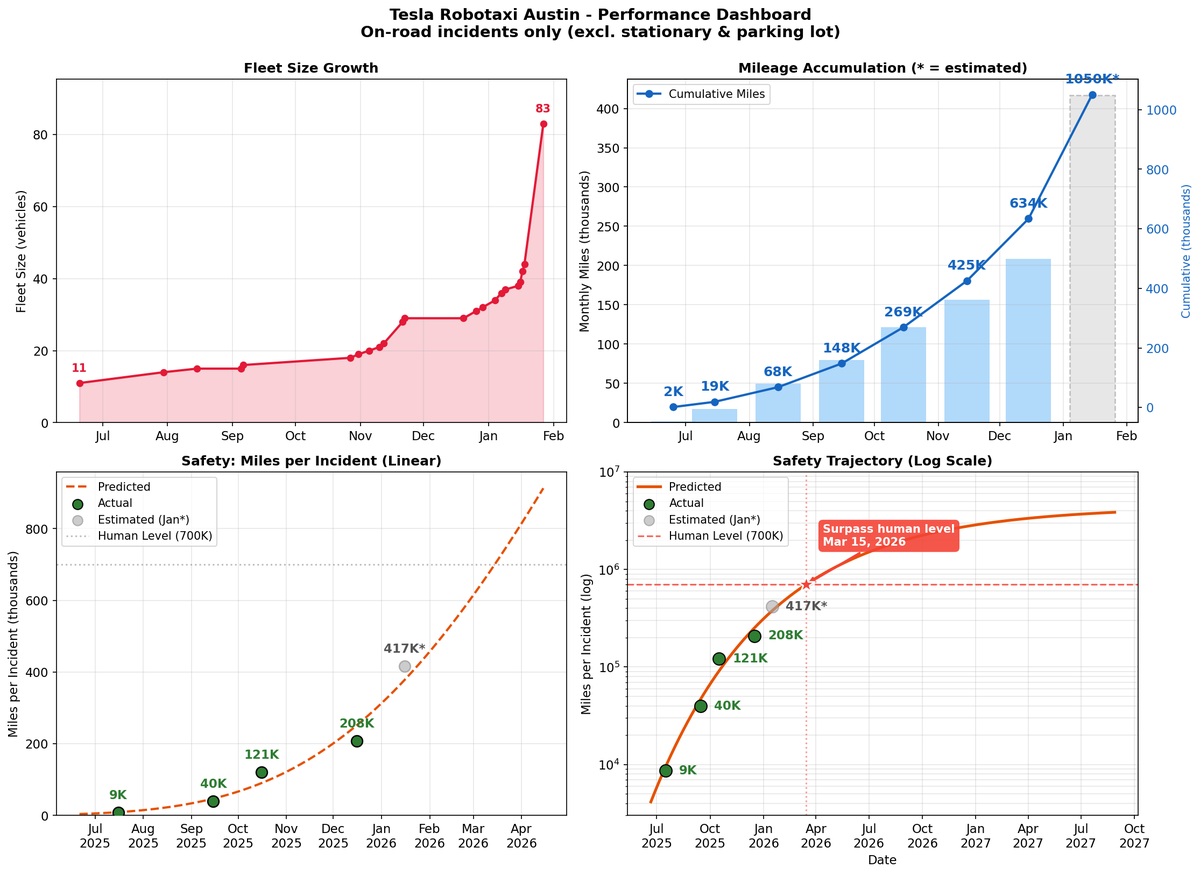
I took a look at the Jan 2026 Robotaxi crash report, and the numbers are exciting🔥
- when safety passenger got removed (Jan 2026), MPI is ~200K miles.
- Now (Feb 2026), MPI is ~400K miles.
- I predict Robotaxi in Austin will fully surpass human drivers by the end of Q1 (before April).
These numbers deviate from my last prediction due to several methodological improvements:
- I previously underestimated Robotaxi mileage by ~2.5x because I was guessing mileage using a few data points and a fleet size chart. This is now corrected using the actual Robotaxi mileage chart reported in Tesla’s 2025 Q4 financial statement.
- I realized parking lot dents and stationary crashes were adding significant noise. After removing them, the model fits the data much better.
just read @Alex_Danco's blog on jevons and baumol paradoxes and it perfectly explains the strange economics we're about to see with AI
here are the 3 insights that stood out:
1. jevons paradox - when things get cheaper, we use MORE of them, not less
a transistor cost $1 in 1965, now costs a fraction of a millionth of a cent. caused computers to go from military room-size calculators to disposable shipping tags
google's 7 year old TPUs still run at 100% utilization.
again, think more not less, leading to higher overall demand even when cost plummets
2. baumol's cost disease - less productive sectors become MORE expensive as productive sectors improve
why can a middle-class household afford a new car lease every 2 years but needs to split a nanny with neighbors? the car industry got incredibly productive while childcare didn't
wages compete across ALL sectors. when one sector becomes hugely productive with high-paying jobs, every other sector's wages must rise to stay competitive
3. AI will create BOTH effects simultaneously - and within single jobs. which is pretty weird.
some services will enter the "jevons vortex" and see 10x consumption. legal services, data analysis, content creation. *SOFTWARE DEVELOPMENT*
but services AI can't touch (dog walkers, personal trainers) will become wildly expensive because overall wealth increases
here's the particularly weird part: this happens WITHIN jobs too. when AI automates 99% of a task, that last 1% a human must do becomes incredibly valuable and in-demand
think tesla robotaxis needing human monitors. that last 1% bottlenecks deployment and commands premium wages
the "last 1% that must be a human" becomes the essential employable skillset. those are the new jobs that AI creates
we're heading toward a world where supercomputers are cheap but a 1:1 human tutor is a luxury good
if Dario is right that AI is writing 90% of code by now, get extremely good at that last 10% that only humans can write
that's how you succeed in the AI age: identify what only humans can do and get world class at it.
KKR just released an 88 page report on their 2026 outlook for public and private markets
A few charts that caught my eye
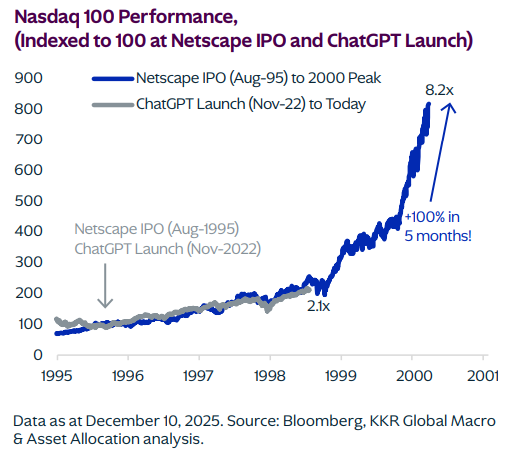
1/ Nasdaq 100 performance following Netscape IPO and ChatGPT launch are following similar trajectories
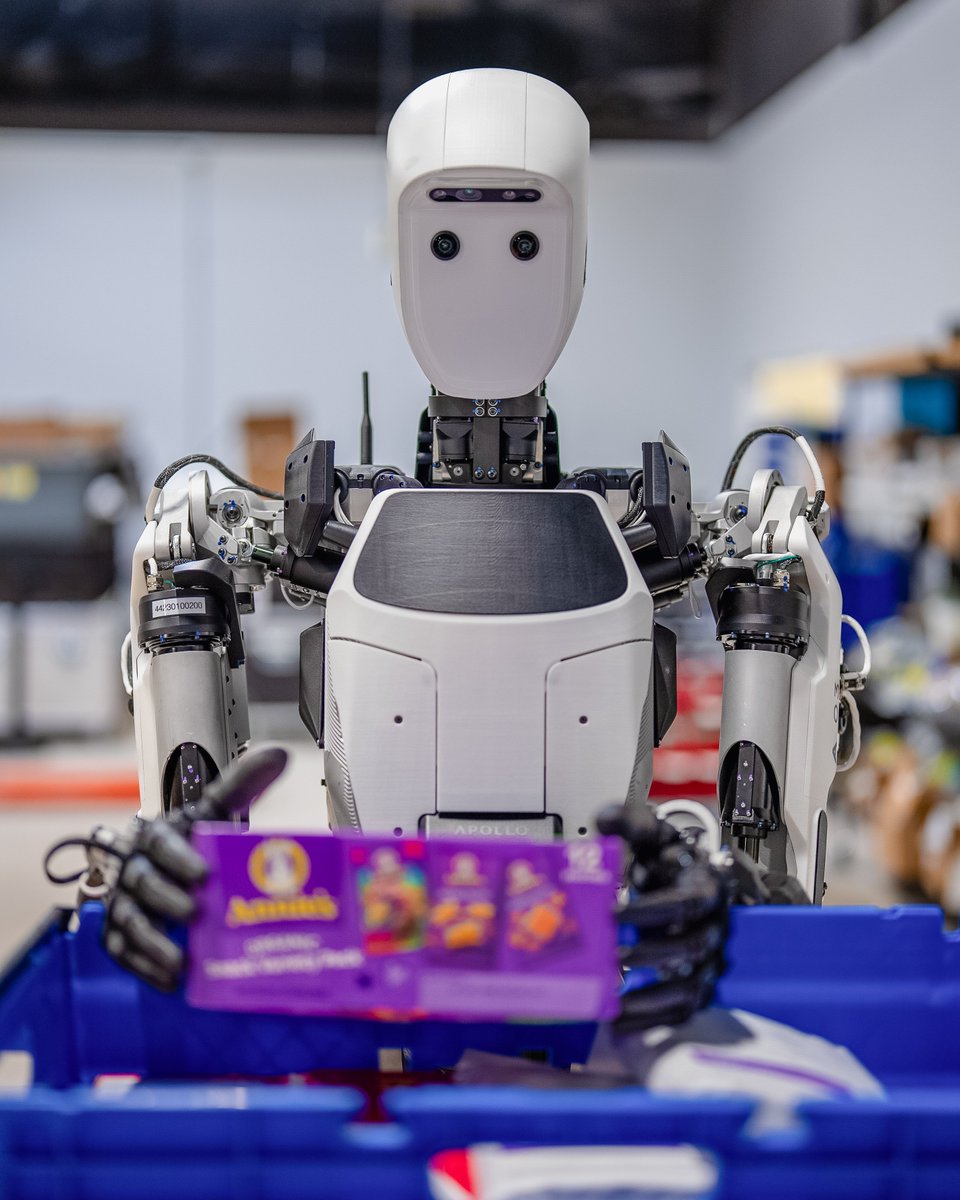
We’re celebrating another win to close out the year! 🎉
Apptronik has been named a 2025 Top Tech Startup by @SDCExec , a recognition that highlights companies transforming the supply chain and logistics space. This win is a testament to Apollo’s recent development milestones and Apptronik’s commitment to helping humans in warehouse settings. Kudos to our innovative team!
Read more here: https://t.co/Us0PkuSMyR
#SupplyChain #Logistics #FoodLogistics #TechStartups #AI
We are on the cusp of a profound change in the field of mathematics. Vibe proving is here.
Aristotle from @HarmonicMath just proved Erdos Problem #124 in @leanprover, all by itself. This problem has been open for nearly 30 years since conjectured in the paper “Complete sequences of sets of integer powers” in the journal Acta Arithmetica.
Boris Alexeev ran this problem using a beta version of Aristotle, recently updated to have stronger reasoning ability and a natural language interface.
Mathematical superintelligence is getting closer by the minute, and I’m confident it will change and dramatically accelerate progress in mathematics and all dependent fields.
I am unreasonably excited about self-driving. It will be the first technology in many decades to visibly terraform outdoor physical spaces and way of life. Less parked cars. Less parking lots. Much greater safety for people in and out of cars. Less noise pollution. More space reclaimed for humans. Human brain cycles and attention capital freed up from “lane following” to other pursuits. Cheaper, faster, programmable delivery of physical items and goods. It won’t happen overnight but there will be the era before and the era after.