Melting ice shelves are a major contributor to sea level rise. A new Science study of 15,000+ cliffs finds they collapse faster than predicted, but then stabilize, reducing the risk of runaway collapse.
https://t.co/r6XusmU02h
Astronomers Get a Better Look at a Rare White Dwarf–Brown Dwarf Pair
The white dwarf–brown dwarf pair J0404+1112 — one of only about a dozen known systems like it — offers researchers a chance to study an atmosphere blasted with intense radiation. https://t.co/TaenWdVubw
A rare pairing of a low mass white dwarf and a high mass brown dwarf orbiting each other every 2.93 hours can help shed light on how radiation affects atmospheres.
https://t.co/uXTz9Qisbi
The size of the hole in the #ozone layer last month, measuring 10.6 million sq. miles, was especially large. However, longer term trends show that the ozone hole is slowly recovering as expected, says MIT Professor/CS3 faculty affiliate Susan Solomon. https://t.co/NM5XokhMHy
Observations of a star slowly snacking on a brown dwarf show a new way that stars and their planetary companions can interact: “Instead of swallowing the thing up, the star can gradually eat it, for billions of years,” Kevin Burdge says. https://t.co/Y7S64K8TMm
New experiments suggest some building blocks of life can survive and form complex structures in concentrated sulphuric acid, opening new possibilities for organic chemistry in Venus’s clouds and beyond. @PWr_Wroclaw@eapsMIT@ChemistryMIT
https://t.co/HNwfQ7m4lI
The Isotope Lab @eapsMIT is a participant in the Anadarko Basin coring project (#DeepDust), supported by @icdpDrilling and @NSF. Coring began on August 16 and exceeded 1 mile as of last weekend. @J_Ramez is on site right now as part of the science team. https://t.co/2i9joCTksB
MIT researchers, including several affiliated with CS3, are advancing tools to help evaluate a location’s vulnerabilities to flooding, cyclones, humid heat waves, or other #climate-related events. #ExtremeWeather#Resilience https://t.co/C50uoLWAdG
From studying distant planets at @eapsMIT to tracking crops on Earth: Sheila Baber ’21 uses satellite data through @HarvestProgram to support global food security. 🛰️🌾 https://t.co/TqOXz7WCTL
The atmosphere is telling us what is happening.
For decades, scientists have predicted that human actions would warm the lower atmosphere while cooling the layer above it. Fast-forward, satellites are now seeing the exact pattern.
🔗 https://t.co/XDtX5qa1ff
@eapsMIT Prof./CS3 faculty affiliate Susan Solomon joins Cleo Abram’s “HUGE* If True” to discuss her 1985 research uncovering how chlorofluorocarbons were depleting the ozone layer, which led to the Montreal Protocol that banned the use of those chemicals.
https://t.co/ZuDdPHeM0k
What better way to understand climate risks than through a game? With the help of a J-WAFS grant, EAPS PRS Sai Ravela has created a game that helps communities discover ways to improve their collective agricultural resilience. https://t.co/qe3w9Jv5aM
Congrats to EAPS Professor Richard Teague on being named an NSF CAREER recipient! His research is focused on developing new methods to detect planetary formation across our universe.
https://t.co/NVk66fkbVu
A scientific career can span many disciplines, from fiuid dynamics to paleoclimate to exoplanet habitability - just ask EAPS Professor of Practice Raymond Pierrehumbert.
https://t.co/mN25qwKSut
New research has found that peptides - short strings of amino acids - remain stable in extremely acidic environments such as the clouds of Venus. This opens up the types of planets that could host life.
https://t.co/VQGspG5Fv2
By looking at ancient mineral grains in a meteorite sample collected in Antarctica, EAPS Professor Ben Weiss and alumni Cauê Borlina estimate that magnetism likely playing a significant role in the formation of the our solar system, including the sun.
https://t.co/54Yg5A0nTS
NASA's Pandora mission has started scientific observations! The satellite will observe exoplanet transits, helping refine our understanding of exoplanet atmospheres and how they interact with light as we search for habitable planets in our universe.
https://t.co/2qxh9dmFoU
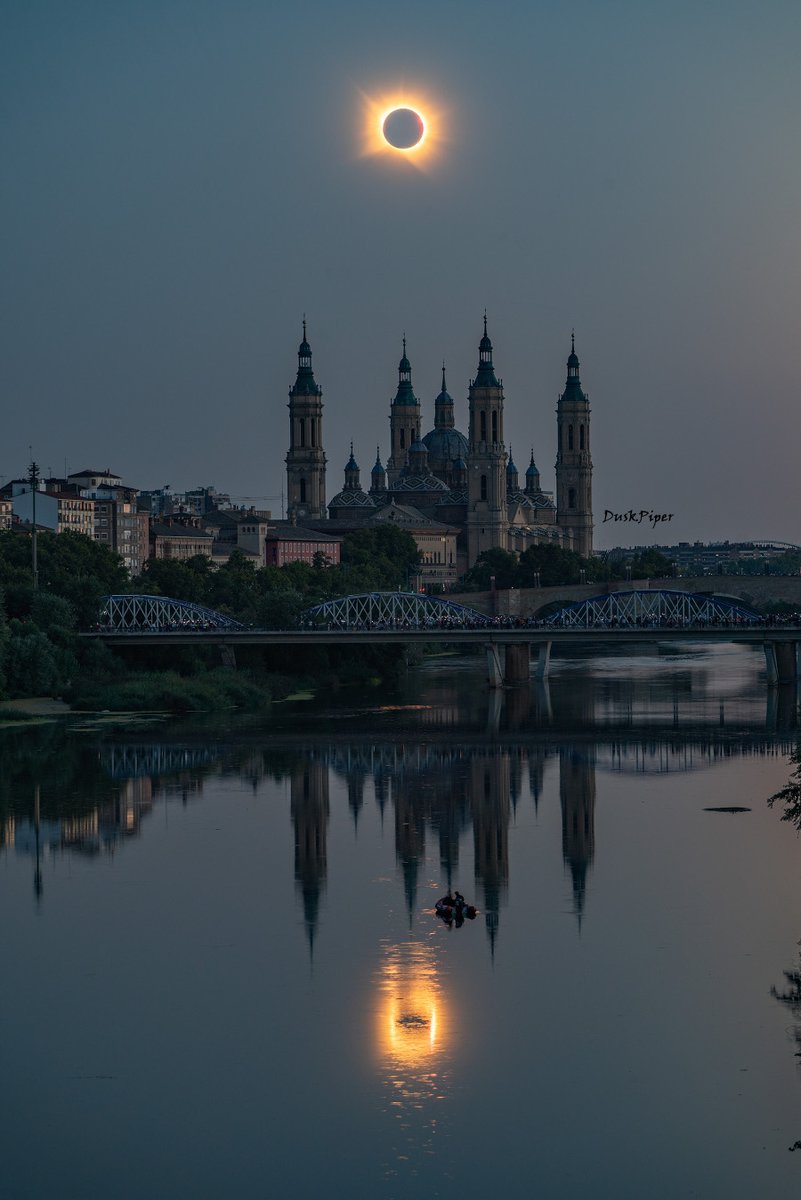
On August 12th, 2026, the Moon totally eclipsed the Sun and cast its shadow across Siberia, Greenland, Iceland, Spain, and Portugal. Today’s image features two total solar eclipses viewed from Zaragoza, Spain, one over the Cathedral-Basilica of Our Lady of the Pillar and the other reflecting in the Ebro River. For a few moments, Spain saw its first major total solar eclipse since 1905. Those witnessing totality may experience a chill in the air, the quieting of birds, the confused chirps of insects, and the shared awe of many. It’s the corona’s time to shine as the Sun’s bright disk is blocked by the Moon. Among other reasons to study eclipses, they help scientists understand why the corona is millions of degrees hotter than the Sun’s surface. Enthusiastic citizens can contribute to these studies by recording how wildlife responds, imaging the corona, and monitoring air temperature and clouds.
Image Credit & Copyright: Ruiyu Zhang Text: Keighley Rockcliffe (NASA GSFC, UMBC CSST, CRESST II)
Earth is ready for a solar eclipse on Aug. 12th (stream it live at https://t.co/d6szYZ44nB). Other planets have eclipses, too! This view came from our Juno spacecraft at Jupiter in 2019. If you looked up from within this shadow cast by the moon Io you'd see a total solar eclipse.
On Earth, solar eclipses happen when the Moon passes in front of the Sun as seen from the ground. On Mars, sometimes one of its moons does the same thing…but they’re too small to fully cover the Sun’s disc. Perseverance captured this look at Phobos transiting the Sun in 2024.