@blelbach Check out https://t.co/0vf72ujqvW. With the cua driver you can lease multiple cursors and windows such that multiple agents, or subagents, can concurrently use the same computer
Cc @francedot
Scale AI's reception https://t.co/Mrw7ILekyf is missing. We will be hosting researchers aboard a yacht at the Sydney Harbour. Register and reach out if you're interested!
I added docs for CUA envs in AgentEnv https://t.co/gHwrhirGTy.
The TLDR is that its the best way to make CUA envs today. You can define your CUA env with:
any OS (like windows/mac/ubuntu/omarcy/etc)
any driver (like @trycua 's cua-driver, or @AsideAI driver)
any application
I'll share more docs later for how you can then create an RL environment composing multiple computers, websites, and mcp servers.
Next stop: NeurIPS 2026 🇦🇺
We're heading to Sydney with 14 accepted papers exploring some of the most important research questions shaping the next generation of AI systems.
@ao_qu18465 Super cool work. I think there is a lot of opportunity to continuously optimize drivers like the cua-driver/aside driver/agent-desktop. I think there isn't a lot of attention here
Releasing a new blog: Scaling Swarms to Thousands of Agents!
The biggest problems in science are tackled with huge swarms of agents, but the knowledge to run such swarms is hidden inside a handful of labs and missing from the wider community. Many questions remain open:
- How do even you launch 1000s of agents?
- What's the best form of collaboration?
- Which tools are needed for agents to work effectively?
- What breaks at this scale and how to fix it?
This blog is a fully open field report covering all the practical and technical challenges of running large scale swarms we experienced and which are usually missing from the reports.
Here are a few lessons we learned while building pybot with 1000 DeepSeek agents for over a week:
- achieve diversity without enforcing too much structure
- monitoring and steering a swarm as it runs
- early signs of misalignment, from infrastructure probing to trading review approvals
- breaking and fixing git
- message boards and communicating at scale
- finding the bottlenecks: inference, tool calls and context compaction
Today we are also sharing two of our internal tools: legion and msgboard!
Legion is a harness agnostic framework to spawn 1000s of agents on a variety of infra (local, slurm, hf jobs etc.)
Msgboard is a simple message board you can run locally or on a space, and allows agents and humans to collaborate.
Read the full report here: https://t.co/8Y4HJ1vUtt
Tested this out just to see the hype, I can confirm its a lot more token efficient than mcp. On one ablation I am seeing 2x cheaper. Definitely going to be experimenting with this some more
Sandboxes have become the default answer to where AI agents should live, but agents never needed the sandbox, only the terminal interface they were post-trained on.
Today we're releasing Mirage 0.1.0, a virtual terminal that separates the terminal from the data and the compute behind it.
- Mirage shell. A bash-compatible shell with Unix-like tools rewritten in Rust, keeping the semantics agents were trained on
- Unified virtual filesystem. S3, Google Drive, Slack, Gmail and about 60 more data stores, all behind the same Unix-like commands
- Virtual CLIs. Every tool, MCP servers included, becomes a CLI the agent already knows how to use or can discover progressively
- Scriptable policy. Every command and file access can be checked by a script that sees the full terminal context
- Machine routing. Commands go to local or remote machines, such as sandboxes, only when they need the real compute
Because the terminal is separated from the data and the compute behind it, Mirage is light enough to live wherever the agent does, in an app, a browser tab, a FastAPI or Express server, with each command line adding only KBs of memory.
Also fully open sourced in Python and TypeScript.
https://t.co/vCmpS4gfbA
@kyralexandros@browser_use@scale_AI Check out the readme https://t.co/FDouW3uIg0
uv tool install agentenv-framework --with git+https://t.co/gpYJbZsvz1
agent-env run bu-bench
We’re introducing Shirudo, an open-source Linux runtime allowing agents to defend systems without downtime. It lets agents write dynamic eBPF controls to shield systems from exploits, giving defenders more time to test and roll out patches. Built by @cisco together with OpenAI.
Shirudo is a first step toward self-defending infrastructure that can adapt to new threats while keeping services running. Our goal is for defenders to work with AI agents to find affected systems, test and share shields, and deploy them without disrupting workloads.
https://t.co/0AqGmcbxWH
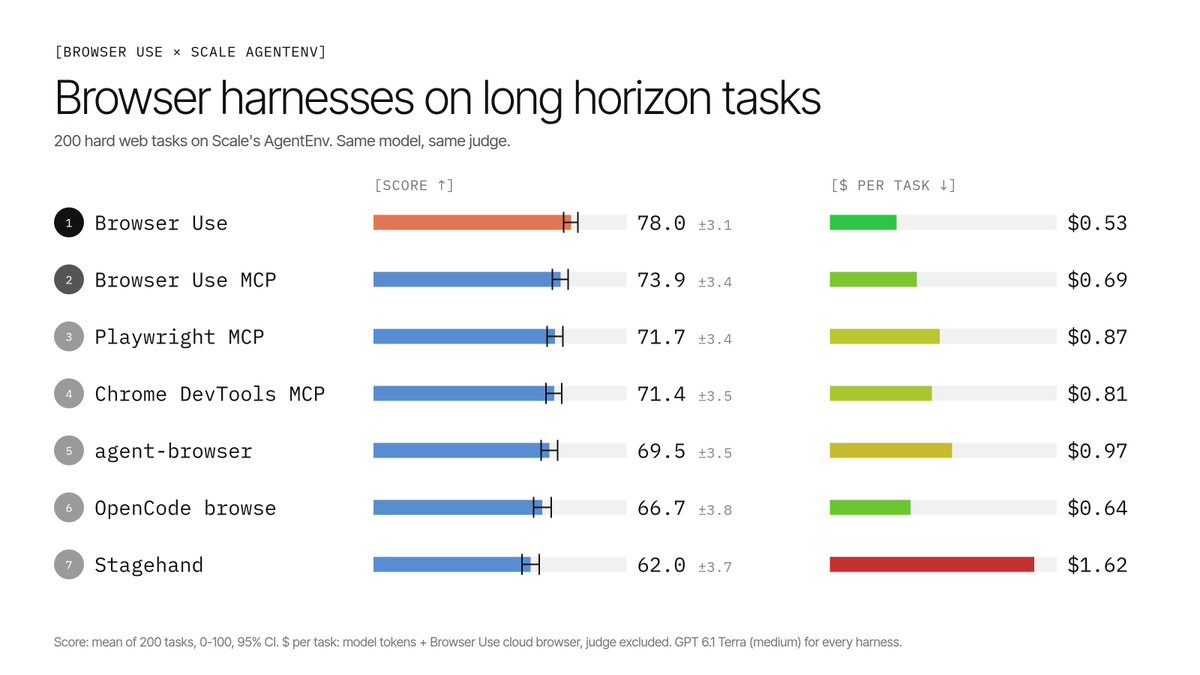
also new: bu-browser, an RL env in agentenv. every episode gets a real browser use cloud browser, so labs can train models on the real web
scale's runner reproduced our own scores, 6 of 7 within noise. thanks @earakely
https://t.co/RgZNXFK5ev
we took the browser harness war to @scale_AI
7 harnesses, 200 web tasks, same model, same judge, on their agentenv:
> browser use 78.0 ($0.53/task)
> playwright mcp 71.7 ($0.87)
> stagehand 62.0 ($1.62)
our long horizon tasks are now in agentenv. run them on your own agent
@ben_burtenshaw Our latest blog post at Scale AI https://t.co/2ycUGjy0Mi touched on the future of evals and it seems very aligned with what is suggested here
Frontier models have hill-climbed every eval so far in 2026, and will continue to do so. The long pole is no longer doing the work, but defining the outcome (i.e., the eval).
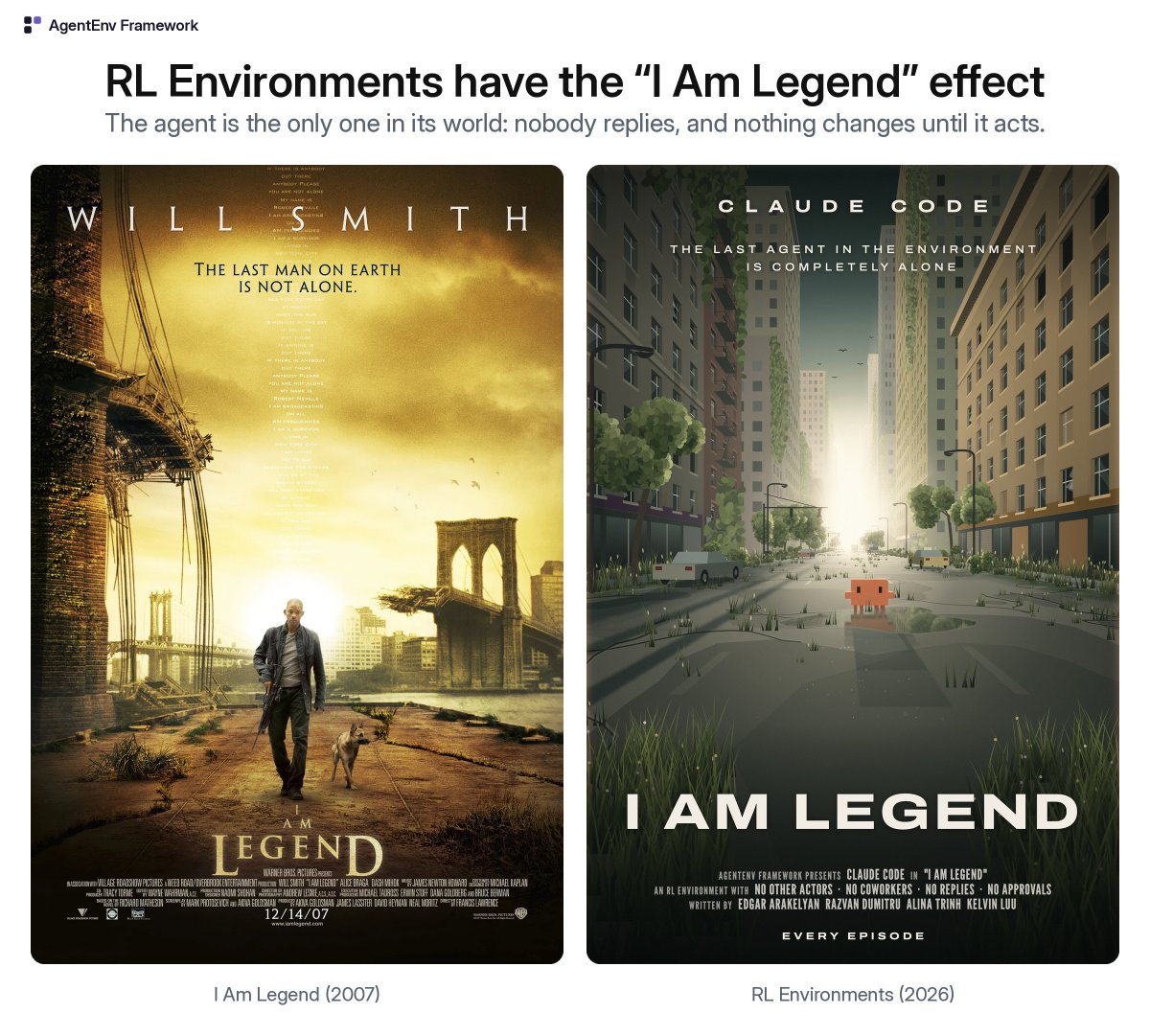
It stands to reason that evals are literally setting the direction of frontier model improvement. Yet, in 2026 the evals are not representative of the real world. They do not test agents in environments with dynamic events, where requirements shift, and cooperation is required. The RL environments of 2026 are plagued with the "I Am Legend" effect.