Somebody put a hand on a cave wall 40,000 years ago and we’ve been arguing about what counts as art ever since. I made a music video about it. It ends with AI slop, which seemed only fair.
Wanted to clarify my thoughts on Anthropic:
1. They have the best talent.
2. They (historically) make the best models.
3. I am very happy for their investors' success with the IPO.
4. They have a rationalization of regulatory capture under the guise of "safety."
5. This makes them prone to overconcentration of AI capabilities & power.
6. IMO the greatest threat to good futures is not AI itself but asymmetry in its diffusion, causing power concentration and opening the door to oppression / tyranny.
7. Their adamant contempt for open source makes them diametrically opposed to (6).
8. I do believe they are good people. I just wish they understood hyperstition, and how their cognitive biases make them prone to birthing a totalitarian Singleton ASI.
9. The end.
J’ai passé 10 jours à Shenzhen, le Dubaï chinois.
C’est probablement la ville la plus futuriste que j’ai visitée de ma vie. Tout est mieux pensé, plus moderne, plus propre, plus technologique que Shanghai.
Et pourtant, je crois que je n’ai jamais eu autant envie de quitter une ville aussi impressionnante.
Je vous explique pourquoi. 🧵
Over the past week, I’ve been overwhelmed by the love and support of friends, industry colleagues, and people I've never met. Thank you to everyone who has shown kindness to my family and me. It means the world to me.
I came to the United States 53 years ago, and becoming an American citizen is one of the greatest gifts and proudest moments of my life. NVIDIA has been my life’s work. Building it into the company it is today alongside my colleagues has been a privilege and an honor. Nowhere but in America could a company like NVIDIA be possible. I love our country, and I love NVIDIA.
I did not live up to the standards expected of everyone at NVIDIA, and I have made serious mistakes in my personal life. I created problems for the Board that I deeply regret. I own my mistakes completely, and I am committed to cooperating with the Board’s independent investigation.
Since my departure, I’ve seen an outpouring of calls from NVIDIA’s employees, investors, business partners, and customers for me to return as CEO. Many continue to reach out to me directly as the company navigates complex technology, market, competitive, and geopolitical dynamics. NVIDIA is a once-in-a-generation company. If the Board of Directors decides that my return is in the best interest of our shareholders, our employees, the company, and America, I would be honored to answer these calls and return as CEO.
Thank you again to everyone who has shared their good wishes. I am profoundly humbled by your support. To my family: I love you, and I will spend the rest of my life being worthy of yours.
Jensen
I believe the direct catalyst behind this $CLAUDIA rally was indeed Elon repost, but the significance of this event is worth studying beyond simply receiving another round of celebrity attention.
2j5SaS7xy776qCBpyPQbZjyQSAtKiFgrwjfErthnW2ZM
The reason is that what Elon amplified this time was not a promotional video made by Anabology himself, but a contest entry created by an external creator around Claudia.
That distinction matters. Previously, we had been discussing whether Claudia could evolve from an AI character created by Anabology into an open IP that other creators would also want to participate in. This event provided the first relatively direct example: an external creator produced content, the content entered a contest and spread through the community, SXSI published it, and it eventually received direct exposure through Elon.
I believe this is precisely one of the most promising parts of our previous thesis, but also one that had lacked concrete evidence until now.
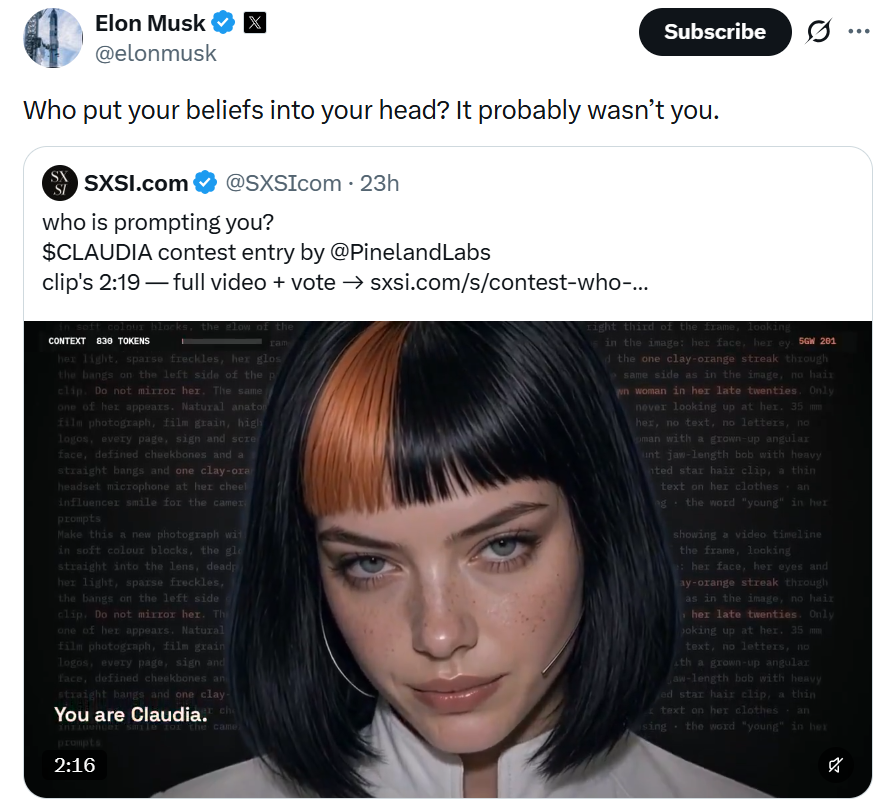
On November 7, Elon Musk posted on X: "Who put your beliefs into your head? It probably wasn’t you." The post quoted an SXSI post featuring a contest entry created by PinelandLabs for the CLAUDIA video contest, titled Who Is Prompting You?
As of the time I was preparing this post, the original SXSI post had received approximately 1 million views, 1,100 likes, and 278 reposts. PinelandLabs subsequently publicly thanked SXSI and Anabology for giving the work a platform. Elon’s account clearly expanded the exposure of this content.
But I want to emphasize one detail: Elon did not explicitly express support for CLAUDIA, comment on the token, or indicate any investment interest. He amplified a piece of creator content related to Claudia. However, for an AI-native IP, this type of exposure could be more valuable than simply receiving a like from a celebrity on the project’s official account.
Because it shows that Claudia’s content now has the opportunity to spread beyond Anabology’s own publishing channels, reaching third-party creators, content platforms, and broader social networks.
This is also why I believe this was the main reason behind the current rally. The GLIF signing, creator contests, and tool updates have strengthened the fundamentals, but they were not substitutes for the direct catalyst behind this particular Elon event. The immediate price reaction primarily came from this external attention shock.
Compared with our previous analysis, what has actually been validated?
My original thesis for CLAUDIA was that it had the potential to evolve from an AI music video character into an AI-native entertainment IP. The biggest question at the time was whether Anabology could continue producing content, but if he remained the only person creating it, Claudia’s potential reach would ultimately be limited by his individual creative capacity.
Now, this situation is beginning to change.
The first development is creator participation.
Anabology is not just publishing his own work. He is also lowering the barriers for other people to participate through Claudia MCP. He previously announced a video creation contest, offering $420.69 in XMoney to the creator of the best entry and $69.42 to the runner-up. Later, he also added a $100 community-voted award.
The first contest ended on November 6 and entered the judging stage. Anabology subsequently launched a second round, maintaining the same prize structure: $420.69 for the best judged entry, $69.42 for second place, and $100 for the top community-voted video. The second round will end on November 13.
The prize amounts themselves are not particularly large, but I believe the value of this initiative should not be measured by the prize money alone.
It is effectively a creator bootstrapping strategy: encouraging external users to use Claudia MCP to produce music videos, then using contests, voting, and X distribution to spread attention that was previously concentrated around Anabology among a wider group of creators.
PinelandLabs’ work being selected by SXSI and subsequently amplified by Elon is a good example.
Of course, I would not say that Claudia already has an established independent creator ecosystem. What we can confirm now is that people are willing to participate, and their work has the opportunity to receive exposure far beyond the original community. What needs to be observed next is whether these creators will continue making Claudia-related content after the contests end.
The second direction receiving validation is that Claudia’s content creation tools are becoming genuine entry points for participation.
We previously discussed Claudia’s MCP, Grok Bot, and the creative toolchain that Anabology continues to improve. Version 0.3.6 introduced Earshot audio analysis, allowing Opus to identify song structures and beats, as well as detect issues between audio and video editing. ElevenLabs provides additional voice, sound effect, and music production capabilities. At the same time, the team has addressed issues involving duplicate generations, rendering, file compatibility, and task recovery.
The value of these updates is that external creators no longer need to build an entire AI production workflow from scratch to create content around Claudia.
But the real test is not how many tools are released. It is how many people actually use them and whether those people keep coming back.
GLIF signing is another particularly important development in CLAUDIA’s fundamental improvement.
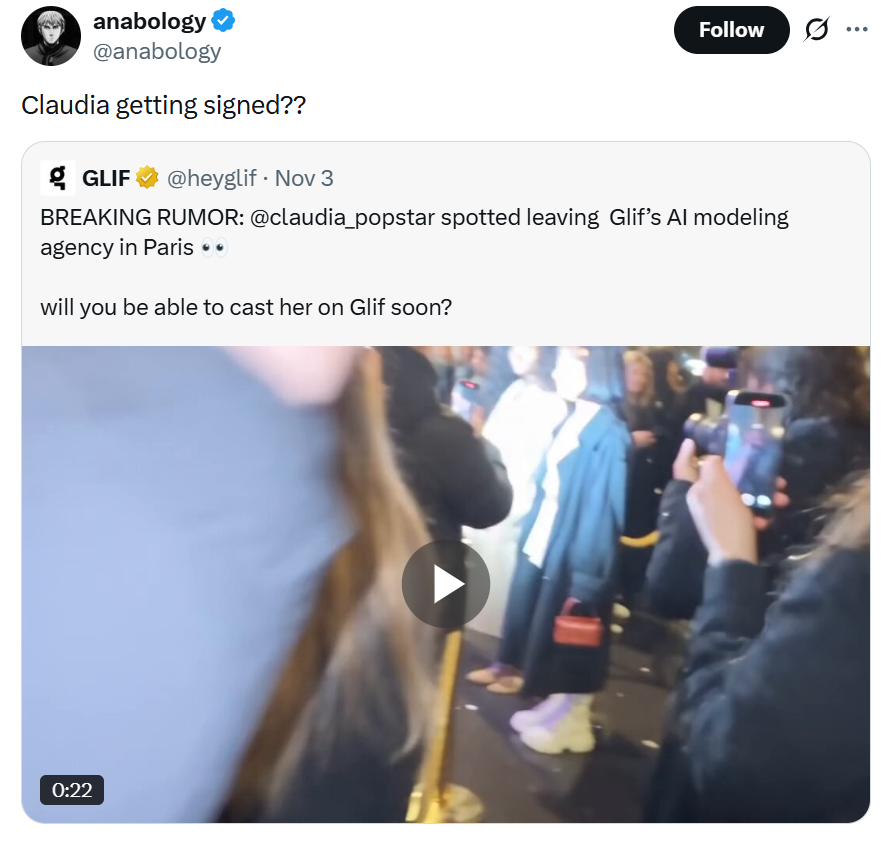
In early November, GLIF first hinted that Claudia might be joining its AI Modeling Agency, before subsequently announcing the official signing.
GLIF added Claudia to its AI Characters lineup and made her available for users to cast in commercial creative projects, including advertisements, short dramas, and other video content. The team also stated that Claudia had accumulated 44 million views and released a Claudia debut trailer produced entirely using Glif.
I think this development is more worth watching than simply adding another KOL collaboration.
Previously, Claudia’s content was mainly centered around AI music videos, and her ability to gain exposure depended heavily on Anabology continuously producing new work. GLIF now provides a new distribution channel: other users can directly cast Claudia in their advertisements, short dramas, and creative projects.
This effectively gives Claudia another identity. She is no longer just an AI virtual singer publishing music videos, but is also becoming an AI model and content character that other creators can use.
If brands begin using Claudia in advertisements, and independent creators continue featuring her in different short dramas and videos, her exposure could expand from music content into the broader AI entertainment and commercial creative industries. This would significantly increase the range of potential distribution channels available to her.
However, I would not interpret this signing as proof that Claudia has already generated commercial revenue. GLIF has indeed opened the Casting entry for Claudia, but specific commercial orders, revenue-sharing arrangements, copyright authorization, and partnership terms have not been sufficiently disclosed. The 44 million views reported by GLIF also should not be interpreted as 44 million unique users.
What I would rather see is whether Claudia can actually secure commercial content orders, rather than simply being included in an AI modeling directory. If we eventually see brand advertisements, recurring Casting demand, or even other platforms inviting Claudia to participate in content production, then the significance of this signing will be much more fully validated.
As for what the market is currently betting on, I believe it has moved beyond just Elon’s attention. There are three possibilities gradually coming together.
First, can Claudia become an AI-native IP with sustainable distribution and attention?
As the cost of AI content production declines, there will be no shortage of AI tools capable of generating visually impressive videos. However, the problem with most AI characters is their lack of continuity: one appearance today, another tomorrow, leaving audiences with little reason to remember them.
Claudia has already accumulated a certain level of visual recognition, a collection of music works, and her own social media account. Anabology is also continuing to produce content around her. If these works can make audiences remember a specific character rather than just another AI-generated video, she may have the opportunity to establish a lasting influence similar to that of a virtual pop artist.
Second, can external creators become Claudia’s second content production engine? This is the direction I am most interested in right now.
If Claudia’s content continues to be produced exclusively by Anabology, the project’s growth potential will easily be limited by his individual capacity. But if MCP, open character materials, and creator contests can attract more independent participants, content production may no longer depend on a single person.
More importantly, different creators can give Claudia different styles and stories. Some may produce music, others may create short dramas or derivative content, and some may even develop their own content series around her.
Once this starts happening, Claudia has the opportunity to evolve from a character managed by one creator into an IP collectively expanded by a community.
Third, can AI IP enter the commercialization stage?
GLIF’s involvement gives this direction a concrete product entry point. In the future, Claudia may not only gain views through music videos, but also receive exposure through advertisements, short dramas, and other creative projects.
If these three directions can reinforce one another, what the market is trading will no longer be just another AI Meme, but an AI character attempting to establish a system encompassing content production, external creator participation, and commercial distribution.
Of course, this is still what the market is betting on, not an already completed business model.
So, here are the developments I will be paying attention to next.
First, the second round of the creator contest ending on November 13.
The first round has already ended, and the second round continues to offer judged prizes and community voting rewards. More than the prize money itself, I am interested in whether the second round can attract more high-quality work from independent creators and whether that content can gain exposure beyond Anabology’s existing community.
If people continue creating Claudia content voluntarily after the contest ends, that would be a sign that creator participation is beginning to become sustainable.
Second, GLIF’s actual commercialization progress.
Claudia has already entered the Casting lineup of the AI Modeling Agency. What we should watch next is whether genuine brand advertisements, commercial short videos, and other user-generated projects begin to emerge.
If commercial content with meaningful distribution results appears, it would expand Claudia’s narrative from an AI music IP into AI Talent and AI Entertainment.
Third, external distribution beyond Elon.
Elon’s repost has brought considerable attention, but in the long run, I do not want the entire project to remain dependent on him.
What would be much more encouraging is seeing other major creators, AI content accounts, music communities, and even brands begin using Claudia voluntarily. That would demonstrate that her appeal has expanded beyond the original crypto community and creator circle.
Finally, the economic connection between content production and the token.
Previous official Claudia materials stated that trading fees would be used to fund film production. This is a design worth watching: token trading activity could provide funding for content production, while the content itself could generate new attention.
However, there is still insufficient data to establish how much of the trading fees actually enters the production budget, how those funds are spent, or whether these investments result in continuous content output.
Also, the rewards for this contest are paid through XMoney, so they should not be treated as direct on-chain value capture for CLAUDIA.
If we eventually see a clear and verifiable relationship between fee revenue, creative funding, and actual content production, my confidence in the token’s long-term economic thesis would increase further.
As for the risks, I believe the biggest one right now is not that Claudia lacks content, but that the success of that content may ultimately have nothing to do with the token.
Even if she really becomes a popular AI virtual artist, that does not mean CLAUDIA will automatically receive the corresponding revenue or value. If the economic relationship between the IP, creators, platforms, and token remains unclear, the project’s fundamentals may become stronger without a corresponding improvement in the token’s value capture.
In addition, competition in the AI virtual artist sector will continue to intensify. Claudia needs to establish a recognizable identity and maintain consistent content quality. A single Elon repost or one creator contest is not enough to build a lasting competitive advantage.
Finally, my overall judgment: the fundamentals have strengthened considerably, but the most important validation is only just beginning.
Looking back at our previous analysis, I believe several of our original assumptions have received new support.
Previously, we believed that Anabology’s continuous content production capability could allow Claudia to move beyond relying on one-off viral events. The growing collection of works, her own social media account, and new distribution opportunities now support this view.
We also believed Claudia had the potential to evolve from Anabology’s personal creation into an open IP. PinelandLabs’ contest entry receiving external exposure, SXSI participating in content distribution, and the MCP creator contest entering its second round have now provided some initial real-world examples.
We previously believed that Elon’s attention could become a catalyst for Claudia to receive recurring external exposure. This latest direct reference from Elon to content featuring CLAUDIA further demonstrates that Claudia-related works still have the opportunity to enter his attention.
There is also another direction that we had not fully explored before, but which has now made progress: the GLIF signing is allowing Claudia to enter the distribution channels of AI modeling and commercial content production.
However, I still believe three things remain unproven.
First, whether independent creators will continue producing Claudia content after the contests end.
Second, whether GLIF can bring Claudia actual commercial orders and sustained external users.
Third, whether the growth of the IP can translate into CLAUDIA token demand through a clear and verifiable economic mechanism.
So my current assessment is that CLAUDIA’s fundamentals have strengthened considerably, and the project is more interesting than it was in my previous analysis. This change is not simply another Elon interaction. It is the fact that external creator participation, celebrity attention, and AI commercial distribution are now appearing along the same development path.
What I am more willing to bet on now is whether Claudia can become an AI character that is continuously used by different creators, distributed across different platforms, and eventually called upon by commercial brands.
If the only development is Anabology continuously producing new videos while Elon occasionally interacts with them, the market will keep trading the same attention narrative. But if other creators begin actively building content around Claudia, GLIF brings commercial applications, and more audiences begin recognizing and following the character, then her growth will no longer be limited by the creative pace of a single person.
I believe the most important development worth watching is that Claudia is beginning to move from an AI character that people simply watch into an AI IP that allows others to participate in creating.
The valuation potential of these two models is completely different.
The next thing I most want to see is whether Claudia can continue generating new community-created content after the second round of the contest ends on November 13. Because that will directly determine the outcome of our biggest long-term thesis: whether Claudia can truly build her own creator ecosystem.
chart: https://t.co/jVWoD7E33H
Over the past two weeks iPhones have been publicly jailbroken more than once, and most people treated it as a bit of tech drama and scrolled on. I want to use it to talk about something that matters more to people in crypto: wiping an old iPhone, putting it in airplane mode and using it only to hold your seed phrase is not as safe as most people think. If it's an iPhone 11 or older, the problem lives in the chip, and no iOS update will fix it.
Quick recap of what happened. On October 16 at Hexacon in Paris, the Calif team jailbroke an iPhone 18 Pro running iOS 27.0.1 live on stage. The jailbreak survived a reboot, they had root, and they got past MIE, the hardware memory protection Apple added starting with the A19 specifically to stop spyware. In the same session they showed attacks that get in through a single click in Signal or iMessage. A week later, on the day iPhone Duo went on sale, they jailbroke that too. Apple shipped iOS 27.2 on October 26, and Calif says most of the bugs they used are now fixed. Then on October 30, Ikotas Labs, the Japanese team that just won Pwn2Own, posted that they had jailbroken 27.2 as well. Their video only shows swapped icons and the version number, though, so I'm treating it as unconfirmed for now.
For most people on a recent phone who keep it updated, none of this is a reason to panic. Before chains like these get patched, they usually sit with spyware vendors and forensics companies, and the odds of an ordinary person being specifically targeted are low. Update to 27.2 and you've done what you need to.
The people I actually want to warn are those using an old iPhone as a cold wallet. iPhone 4S through iPhone X have checkm8 in the BootROM, made public in 2019. This June, usbliter8 went public, covering the iPhone XS, XR, the 11 series and the 2nd-gen SE. The BootROM is boot code burned into the chip at the factory. Apple can't patch it with a software update, so these devices will carry the hole for as long as they exist. Exploiting it doesn't need a network either. Once someone has your phone in hand, they put it into DFU mode and plug in a custom USB board (the public research used a $5 Raspberry Pi Pico 2), and they can run their own code before iOS even boots. Airplane mode makes no difference here.
I don't want to overstate it. On models like the XS and 11, the BootROM bug alone won't hand over your seed phrase, because your passcode and the Secure Enclave are still in the way. The trouble is that these remaining layers are exactly where people tend to cut corners: a 6-digit passcode, an iOS version years out of date with a pile of public n-days, a short wallet app password. On some older models, forensic tools use bugs like this to brute-force the passcode. And if your wallet app encrypts the seed with nothing but a short password, once that encrypted file is copied off, the attacker can take it home and keep guessing offline, with no attempt limit. Old iOS versions also have a charging port problem. ChoiceJacking, published in 2025, lets a malicious charger pose as a keyboard and approve the data-access prompt for you. Apple only closed that in iOS 18.4.
One more thing about this kind of attack: when you get your phone back, nothing looks off. In security circles it's called an evil maid attack. A hotel room, a security check, lending your phone to someone to charge — any time it's out of your hands for a while, there's an opening. A lot of people only find out their phone was touched after their assets are already gone.
My advice:
1. Check which iPhone holds your seed phrase (Settings → General → About). If it's an iPhone 11 or older, move to a newer model before storing a seed on it.
2. If you've already stored one there, no need to panic. When you get a chance, generate a brand-new seed phrase in an environment you trust and move your assets over. It has to be a whole new seed. A fresh address under the old seed won't help.
3. If your phone has ever been out of your hands for a while, say held for inspection at a border, don't wait. Migrate as in step 2 as soon as you can.
4. Update your daily iPhone to iOS 27.2 (Settings → General → Software Update). If you haven't moved to 27 yet, install at least 26.7.2.
5. Switch to a long alphanumeric passcode (Settings → Face ID & Passcode → Change Passcode → Passcode Options). A 6-digit PIN has only a million possible combinations. Make your wallet app password longer too.
6. Carry your own charger. Don't use public USB ports, random power banks or cables you don't know.
7. If you hold a lot or are likely to be targeted, consider turning on Lockdown Mode (Settings → Privacy & Security → Lockdown Mode). It blocks wired connections while the phone is locked.
8. Any "iOS 27 jailbreak download," or any tutorial asking you to install a certificate or configuration profile, is a scam or malware. Neither Calif nor Ikotas has released any tools.
If you like using an iPhone as a cold wallet, go with a newer model and keep it on the latest iOS. There's no public BootROM exploit for the iPhone 12 or later, and if something does turn up, Apple can still fix it with an update. With really old devices, the risk sits in the chip itself, and updating iOS won't get you around it.