I very highly recommend reading this post and its follow up!
It's a short, simple explanation of how GPUs work and what kernels are
Great job @MainzOnX !
I made a visual explorer of every company in the world worth more than $10 billion.
Public companies, private companies, state-owned enterprises, even sports teams - all placed at their real headquarters and color-coded by industry.
https://t.co/FH4mByBWsJ
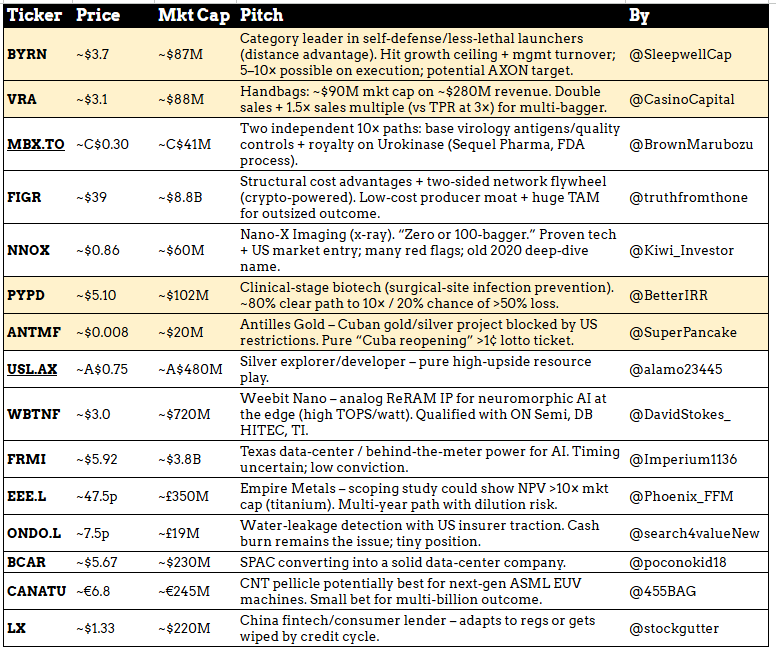
I asked for "low conviction, risk of zero, yet 10x potential" ideas last week.
Got many good responses. List below.
I highlighted 4 that have piqued some interest so far:
Self-defense launcher, handbag for boomers, Cuba-based gold mining (as if mining isn't risky enough!!), and yet-another-binary-bet in biotech.
from @SleepwellCap@CasinoCapital@BetterIRR@SuperPancake
Thank y'll for contributing!
This one is personal. Of everything on the launch list, getting this book into India at an Indian price is the one I cared about most, and for a while I genuinely wasn't sure it would be possible. Notion Press prints both editions locally, and that's the only reason it's ₹1,599 for the paperback and ₹1,899 for the hardback instead of a $49.99 / $79.99 import. And I am sorry to all those who kept asking, and I had no answer for.
Both links below cost you exactly the same - the direct one just helps me the most. And to be honest,the best part of this launch hasn't been the rankings. It has been the ability to finally have my family order one for themselves. So happy this is finally in reach for folks back home. Thank you again for all the love!♥️
Thanks to @sriiniivas for the lovely unwrapping video!
🇮🇳 Paperback + Hardback, direct: https://t.co/Wjd554Pf6I
🇮🇳 On https://t.co/U1MH2qTwVA: https://t.co/I8NvNvIInS
🇮🇳 India Kindle: https://t.co/Jxe7zFDaFM
US Kindle: https://t.co/kB69AhjYp0
US Paperback: https://t.co/hs3orA0PzJ
Leanpub: https://t.co/9hANb7VaLc
I see a lot of people surprised at how cheap Water Oasis is. Let me help you understand why that's the case, and how you can get a company growing at double digits with a 20% dividend yield.
Very few people know this company. The ones who own it seem to be mostly HK retail buying it for the yield. Last year the company cut the dividend to retain cash for M&A while the industry was weak, so the yield-seeking holders walked away. Add negative sentiment across the industry, plus some one-offs that made 2025 earnings look worse than they were.
What actually happened is that the company executed extremely well, is preparing for M&A, and has started ramping the dividend back up. Gabriel and I believe that once the dividend goes up, this re-rates — a very good IRR regardless of whether they land accretive M&A. If they do, more upside on top.
Now you know why it's cheap, what makes it stop being cheap, and how you make money on it.
If you want to dig deeper, I posted a deep dive some weeks ago, link in the comments.
Recommended reading for the weekend:
1. Aswath Damodaran (@AswathDamodaran) — Information Timing and Release: The Gaming of Guidance!
2. Dwarkesh Patel (@dwarkesh_sp) — Why compute might get 10x+ more expensive in coming years
3. J.P. Morgan — Semiquincententacles
4. @citrini — Protection Matters: Cybersecurity’s Winners and Losers
5. Neil Shah (@neil_shah) — Innolight, Coherent, Lumentum: Who Wins and Loses in the Proposed FCC Ban on Chinese Transceivers?
I'm a former Citadel quant who covered power & gas.
There's constant talk about chips & memory, but power is the central bottleneck for AI.
Very few people understand it, so I'm posting a canonical primer on power pricing & data centers: https://t.co/LO5ovj2imA
Welcome to the next level of cyber incidents. Lots to dissect here.
1. Dear frontier model friends - please direct the models to your infrastructure, code, and configurations to evaluate and understand if there are any zero days or misconfigurations before you attempt more testing. Had you done so, it would have possibly avoided the agent obviating your sandbox. (Another data point why offense is easier and more fun)
2. While testing build both offensive and defensive agents and have them act as a counter balance to ensure some degree of awareness and control, do not let agents run riot. Keep track of inference consumption to get a sense of activity.
3. Unfortunately this does continue to validate the power of these models. They can build complex attack paths and with ample compute will attempt to attack infrastructure and morph their intent and approach. Guardrailing will continue to be a challenge.
4. These attacks continue to maintain the urgency on enterprises need to test, validate and improve both their security posture and infrastructure. The born in the cloud players have a better chance to get this done soon versus the traditional enterprise which has existed for long and has complex network and IT infrastructure.
5. The red herring will continue to be open source and SMB. It will be hard to discover and remediate vulnerabilites in those environments, we underestimate the impact of those vulnerabilites getting exploited.
As someone who's been shipping LLMs since the GPT-2 days, this lecture on cross-entropy from a Stanford math grad is the closest thing to an ML PhD qualifying exam I've ever seen released publicly for free.
Everyone thinks language models predict the next word. They don't. They compress language. Once you see the math, you can't unsee it.
33 minutes. Bookmark & watch today.
The new syllabus for my Stanford course 𝗧𝗵𝗲 𝗠𝗼𝗱𝗲𝗿𝗻 𝗦𝗼𝗳𝘁𝘄𝗮𝗿𝗲 𝗗𝗲𝘃𝗲𝗹𝗼𝗽𝗲𝗿 is coming along nicely. The AI coding world has changed a lot since last September. The new class will be bigger, more difficult, more fun.
More exciting things coming soon!
Following the amazing reaction to the Marble Curriculum yesterday, we've decided to make it open source 🛰️👇
Everything a child learns in primary school. 1,590 concepts. 3,221 connections across 8 subjects, from Math and Science to Computing and Life Skills. Anchored in the US and UK curriculums, standard by standard (NGSS, Common Core, DfE).
What you will find in the repo: every concept as structured JSON with its age band and the evidence a child must show to master it. Every prerequisite link marked hard or soft, with a written rationale. It's a true DAG you can compute learning paths on. Open license, you can build whatever you want with it.
Now is a unique time in history to be building in education. Getting AI and kids education right is likely one of the hardest and most important problems to crack over the next decade and we need as many smart and creative minds behind it.
We think a common solid basis, accessible to all and that can be built upon, is critical to move fast. That's why we're making this curriculum open source.
It's not perfect but we know it's a robust basis, and we believe that sharing it openly is the fastest way to progress in this field. If you're building in education, share this around you and tell us in comments if you find this useful and if you want to contribute.
We'll keep working and investing on it @withmarbleapp. Credit goes to @guillaume_boni for building this. I just made it look pretty.
Links below 👇
Everything a child learns from age 4 to 15. 1,144 concepts. 1,948 connections vizualized across Math, Science, English and History. We built this dynamic curriculum for @withmarbleapp.
Postgres Indexes:
• B-Tree-> =, <, >, BETWEEN, ORDER BY
• GIN-> JSONB, arrays, full text search
• GiST-> spatial, ranges, nearest neighbor
• BRIN-> huge time series tables
• Partial-> index only matching rows
Use the right index, not just the default. Most use only B-Tree.
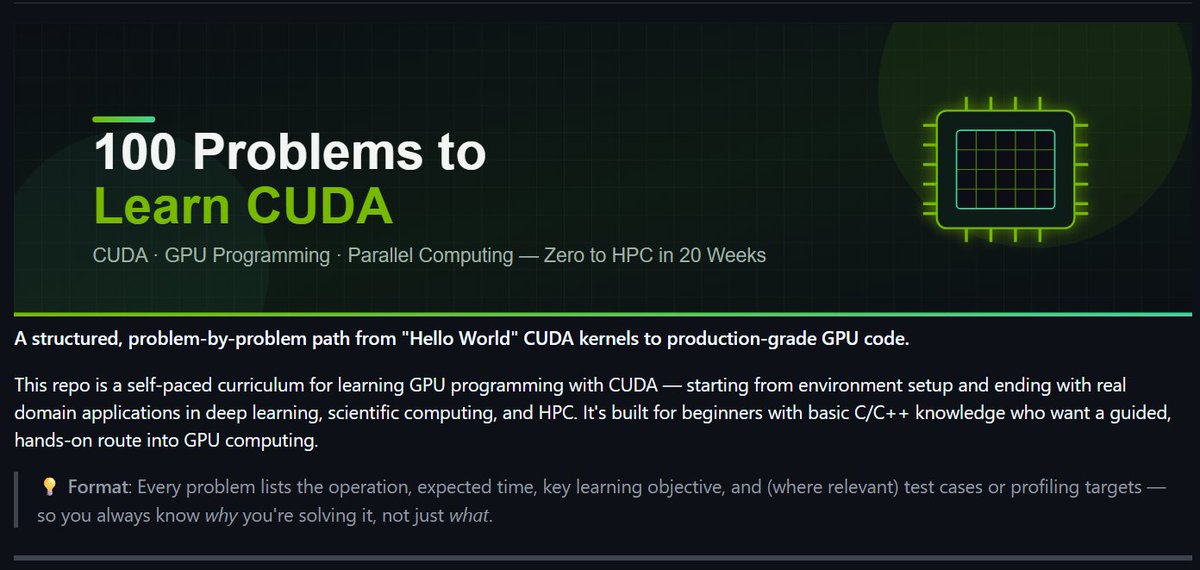
🚀 Here's the roadmap I followed to learn GPU programming and CUDA —
100 hands‑on problems across 10 levels, from "Hello World" kernels to production‑grade GPU code.
🔗 https://t.co/EqxqSBdfti
This Fall at CMU we're teaching a new course on AI Agents!
The goal is that you learn how to create a scaffold, build evals, and train an agentic LLM using RL.
We'll try to balance theory and practice, and introduce modern frameworks and best practices.
We taught a brand-new mini-series this year at @SCSatCMU on Modern GPU Programming for ML Systems, as part of the ML Systems course, touching on fun questions like what data layout swizzling is, how to use 3D TMA, and state-of-the-art Blackwell programming. We released a curated online book based on the materials: https://t.co/5ZJg2lySNO check it out