Un país que cuenta muertos todos los días y donde las decepciones son comunes, su gente también merece un momento de felicidad para oxigenar, para darse cuenta que el “sí se puede” está en su sangre y así recargar para seguir luchando. Felicitaciones a @LaTri 🇪🇨
es indescriptible. Es lo que nos merecemos, y que tantas veces nos pareció esquivo. Y es que, la verdad y como he dicho siempre: TENEMOS UN GRAN EQUIPO, que lamentablemente no han gestionado bien los entrenadores.
Nos merecemos estos milagros. Y mucho más.
Alguna vez hasta llegué a pensar que nunca tendríamos una gran tarde, un momento de paz en que los astros se alineen, que la pelota no pegue en el palo, que los jugadores tengan ganas de darnos una alegría.
Alguna vez llegue a pensar que nunca seríamos felices. Pero lo de hoy...
we are entering the Golden Age for the Elderly.
for most of history, getting old meant your body slowly failed and you lost your independence one piece at a time
AI is about to change that completely.
a Chinese brand just unveiled a robotic toilet on wheels built for elderly and mobility-impaired people
you press a button and it uses AI to drive itself across the room to you, steering around furniture on the way
it handles waste disposal, warm-water cleaning, and warm-air drying
then it cleans itself, runs a UV sterilization cycle, and drives back to its charging dock
about $4,000
sounds like a gag, but losing the ability to get to the bathroom on your own is one of the most common reasons people end up in a care home.
a $4k machine that solves it lets someone stay in their own house for years longer
and that's just the dignity layer.
the bigger shift is what AI is doing to aging itself:
• catching cancers on routine scans years before a doctor could
• powering one-time gene edits that switch off the genes behind heart disease
• doubling survival on cancers that used to be a death sentence
demis hassabis thinks AI cures most disease within 10 years
stack all of that on top of AI-powered robots that handle the physical side of care...
and old age becomes the stretch of life where the tech finally caught up to keep you healthy, independent, and at home
if you're under 50 and you stay healthy, the version of 80 you're picturing is probably nothing like the 80 you'll actually get
Major cheat code for life: Master the art of the fresh start. From a bad morning. From a bad interaction. From a missed workout. From a poor decision. The goal isn't to avoid the fall. It's to shorten the time between the fall and the reset. Fast recovery compounds.
“Donde realmente empecé a soñar fue en Independiente del Valle”. A ver si vamos entendiendo que el sistema de IDV forma jugadores y personas de talla mundial. No es suerte. No es maña. Es transformador referente.
Pana, en serio esto era impensable hace 20 años y hoy tenemos el gran privilegio de ser testigos de ello.
Dos ecuatorianos 🇪🇨 en la final de la Champions League 😍.
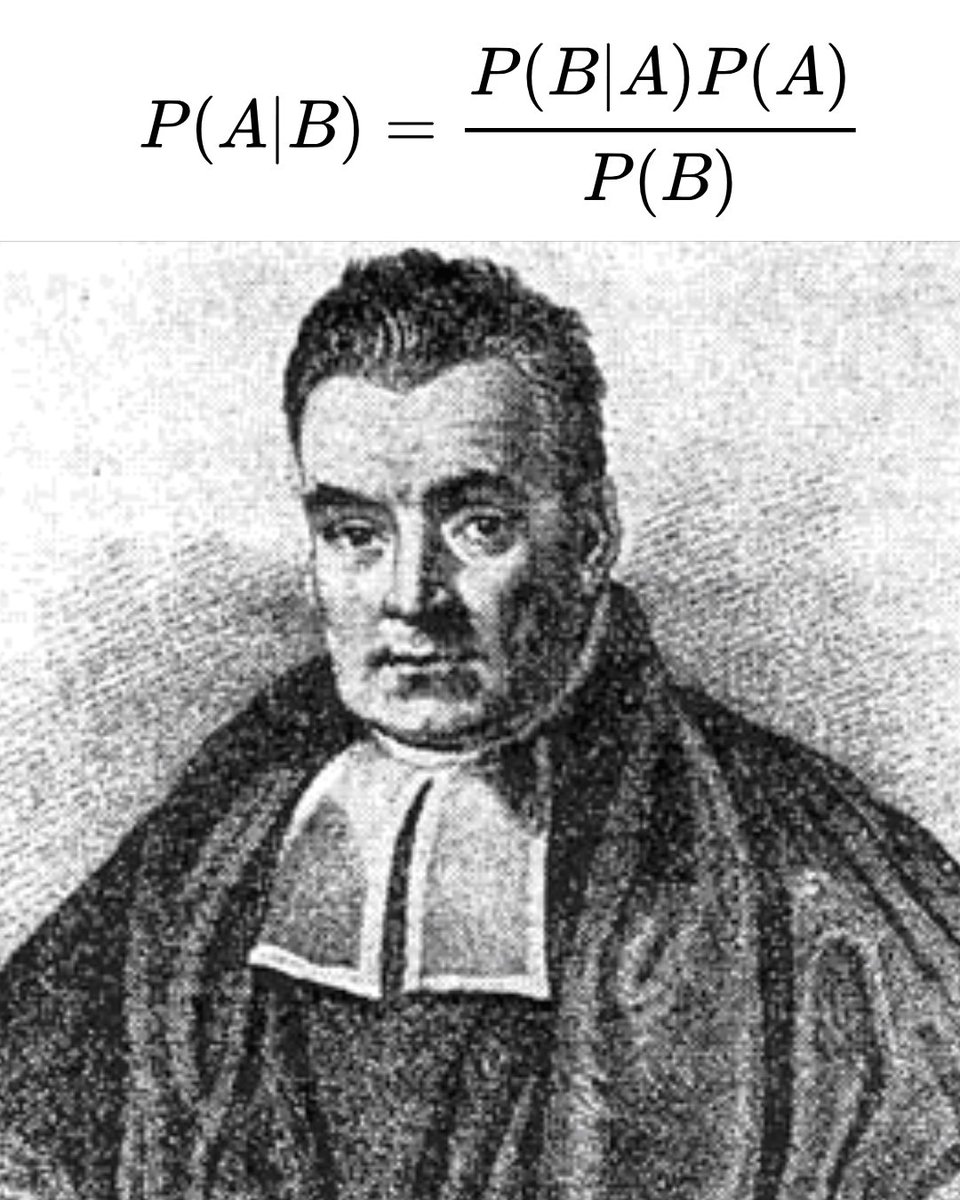
Bayes’ theorem is probably the single most important thing any rational person can learn.
So many of our debates and disagreements that we shout about are because we don’t understand Bayes’ theorem or how human rationality often works.
Bayes’ theorem is named after the 18th-century Thomas Bayes, and essentially it’s a formula that asks: when you are presented with all of the evidence for something, how much should you believe it?
Bayes’ theorem teaches us that our beliefs are not fixed; they are probabilities. Our beliefs change as we weigh new evidence against our assumptions, or our priors. In other words, we all carry certain ideas about how the world works, and new evidence can challenge them.
For example, somebody might believe that smoking is safe, that stress causes mouth ulcers, or that human activity is unrelated to climate change. These are their priors, their starting points. They can be formed by our culture, our biases, or even incomplete information.
Now imagine a new study comes along that challenges one of your priors. A single study might not carry enough weight to overturn your existing beliefs. But as studies accumulate, eventually the scales may tip. At some point, your prior will become less and less plausible.
Bayes’ theorem argues that being rational is not about black and white. It’s not even about true or false. It’s about what is most reasonable based on the best available evidence. But for this to work, we need to be presented with as much high-quality data as possible. Without evidence—without belief-forming data—we are left only with our priors and biases. And those aren’t all that rational.
I don't think people realize what just happened here.
Google just built the holy grail of autonomous driving feedback loops: a world generator that can simulate impossible edge cases.
Elephants wandering into intersections. Construction equipment materializing out of nowhere.
Every weird scenario that would take decades to encounter in real driving, compressed into training data.
This is sim-to-real transfer on steroids.
Instead of waiting for a car to encounter a rare situation in the wild, you generate thousands of variations and train on all of them before deployment.
The bottom visualization shows what the car's perception system actually sees.
That blue wireframe world is where the real learning happens. Every virtual mile driven in that space translates to safer real-world behavior.
I have to imagine this is what finally breaks through the long tail problem in autonomous driving.
You can't predict every edge case, but you can simulate them.
We're basically teaching robots to handle reality by showing them impossible realities first.
This makes me so excited about the future of healthcare and longevity
Imagine having Claude Code for your body, where you can debug problems at the cellular level
Current treatment for kidney stones is medieval:
1) Shock wave therapy that literally blasts the stones apart, or
2) Surgical procedures that require threading instruments through your entire urinary tract
Painful treatments. And then you have to deal with weeks of recovery
Now picture tiny robots swimming to exactly the right spot and dissolving the problem away.
I'm amazed about the precision here
We're talking about navigating microscopic spaces inside the human body with the same accuracy you'd use to edit a line of code
Except instead of debugging software, you're debugging biology