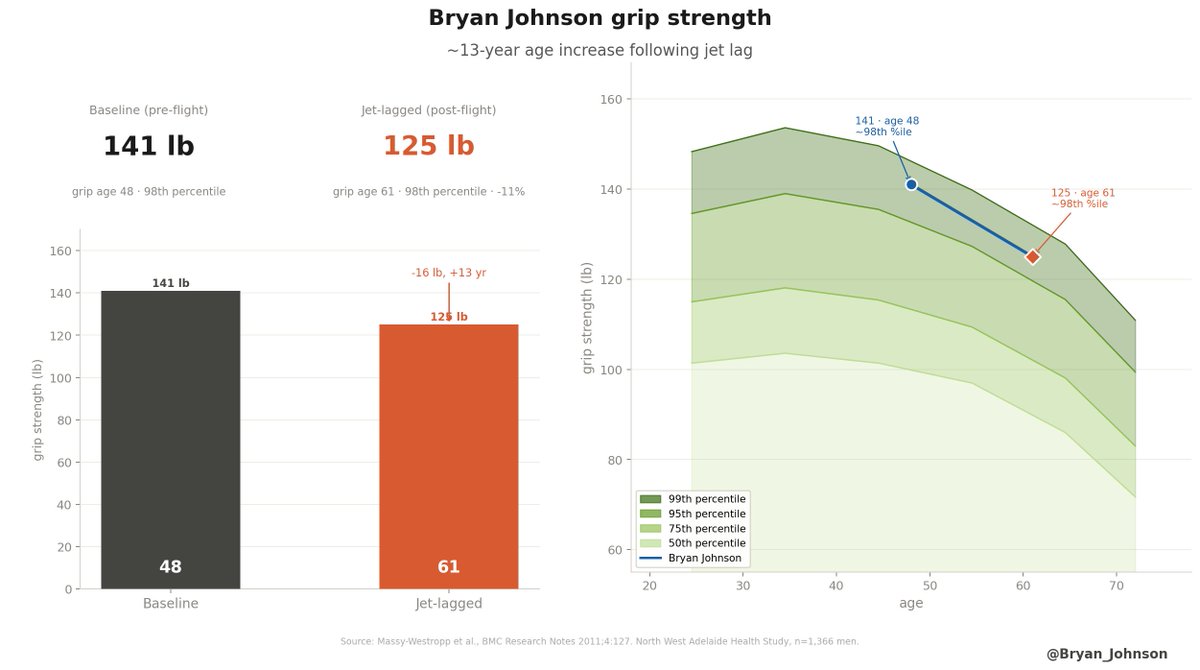
Jet lag increased my biological age by ~13 years.
> as measured by grip strength
> pre-travel: 141 lbs, grip age 48, ~98th percentile
> post-travel: 125 lbs, grip age 61, ~98th percentile
Traveled across 7 time zones, Los Angeles to Australia.
Grip strength predicts mortality better than almost anything you can measure at home.
A published study of a comparable eastbound flight found the same pattern, about a 7% morning drop.
This is exactly it. Every team building agent infra rebuilds durable execution by hand, then moves to Temporal a year later. We skipped the detour and built on it two years ago. The reinvention tax is real
every team that's been building agent infrastructure from scratch lately:
"we're building a system to checkpoint progress so agents can resume after failures"
us: we have that
"and handle retries with backoff"
us: we have that too
"and manage long-running workflows with human-in-the-loop pauses"
us: ...do you want to see the docs
The model is the most visible component. It is also the most replaceable – it won't be the same model in twelve months.
The harness is what doesn't change. It is what compounds.
We chose Temporal because durable execution is hard, and it solves that. We built the harness because durable execution is not the platform.
Full essay: https://t.co/srm3lhvJo8
Claude Code and Codex are excellent harnesses. One user, one machine, one process.
Enterprise agents are a different problem entirely – distributed across machines, across users, across time.
The harness is the platform. New essay:
https://t.co/wqSeG8PUgn
But @temporalio doesn't know what an agent is.
No notion of a model, a tool, a context window, memory across runs, cost attribution, a streaming protocol.
The conversation loop, the tool registry, credential injection, the audit pipeline – that's the harness. That's our layer
Go to bed.
Same time every night.
Non-negotiable.
If kids, tell them they’re on their own.
You have a schedule to keep.
No kids, no excuses.
Best thing you can do for yourself.
And others.
Better mood.
More willpower.
Clearer mind.
Better human.
ECM had the right idea, twenty years too early.
Metadata, taxonomies, schemas, lifecycle states, permissions — the whole apparatus was about making content usable by software. The category was right. The operating model was wrong.
Humans had to create the data layer, maintain it, keep it aligned with the business. Three full-time jobs nobody had budget for.
Agents change the operating model — not because metadata suddenly matters, but because the technology is finally able to do its own bookkeeping.
Coding agents are the ultimate test of agent harnesses. If you’re harness can run a coding agent, it will also excel at most knowledge work tasks. Coding is brutal on the harness
🚨 Sam Altman Walks Back His Claim That AI Outperforms Humans
“What I wish we had said then is that it outperforms professionals at small tasks in 44 occupations, which is more accurate.”
Yes. The happy path demo doesn't ship itself. Someone has to build the harness, the context layer, the audit, the governance, the integrations that don't exist yet. The agent is the easy part. The platform around it is the engineering load that's hiring
A meaningful portion of enterprises I talk to outside of Silicon Valley generally are looking to hire while also adopting agents.
There’s a huge wave of technical and engineering talent needed inside originations, building software or acting as FDEs for agents. And as AI drives efficiency in areas like the customer lifecycle, companies are leaning in even more heavily to client-facing jobs.
In a world where AI did everything for you with no human oversight needed, maybe we’d be having a different conversation. But that’s not how AI works.
Even for the areas that have the most automation potential, agents are automating tasks, not whole jobs. As they automate tasks, the agents need to be steered, their work reviewed, the outputs incorporated and more. All of this is requiring people to do the work.
And for the areas that have less automation potential, companies are freeing up dollars from efficiency gains elsewhere to hire in those areas now.
Yes, maybe AI lets you respond to front line support tickets automatically, but the companies (instead of just dropping the profit to the bottom line) will go and invest in new areas of sales and customer success that will add more differentiation for clients.
Companies don’t remain static. They automating tasks where they can and free up dollars to move onto the next thing that matters.
It’s not locked in senior people’s heads, it’s locked in documents - decks, policies, post mortems, procedures, projects reports, and the gigaton of content we have in various form. Thats what forms the context layer of any organization and what we’re building to unlock at @VertesiaHQ
This is the actual bottleneck. The models are smart enough already. What is missing is the company-specific context locked in senior people heads. Whoever cracks knowledge extraction at the company level unlocks the rest.
As you work on this, please consider using GBrain as your OSS retrieval layer
https://t.co/0F5uDQzPHu
Self improvement loop
Codex launching agent on our platform, monitoring them, analyzing runs, fixing/improving, iterate on this until edge cases and runs are consistents
People that run 24+ hours Codex tasks
Can you share what you’re running exactly?
Everyone is sharing the hours but not the task itself, I feel that most of them are just engagement baits
So every time I say the word 'workflow' in Claude Code...
(let's say, when I'm creating a new GitHub workflow)
...it tries to enter 'workflow' mode, spinning up dozens of subagents to complete my task.
Stupid fucking thing