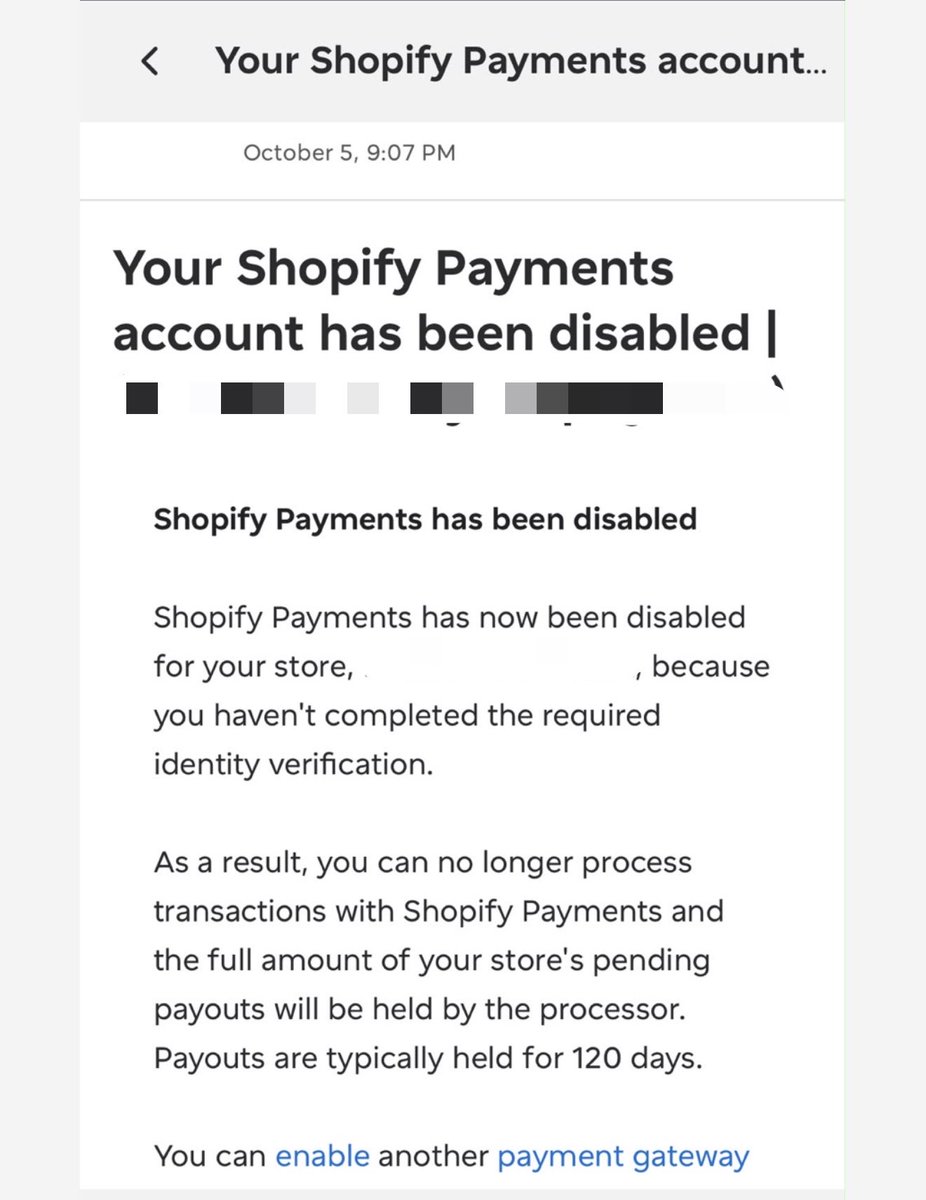
@Shopify@ShopifySupport@ShopifyEng@tobi Our Shopify Payments account was disabled just 2 hours ago. €84,000 is now frozen for up to 120 days and our customers can no longer pay on our store.
This is bringing our business to a complete stop overnight. We need urgent help.
The facts, all verifiable:
• 2,196 orders
• Only 2 chargebacks — 0.09%
• 0.82% refund rate — mainly customers who changed their mind after ordering and were immediately refunded
• Every order has been shipped
• Every customer inquiry answered within 24h
• Identity verification completed and requested information provided
We were told Shopify Payments was disabled because the required identity verification was not completed, despite us having completed the verification process and provided the requested information. We are ready to provide ANY document again immediately if necessary.
What makes this extremely difficult is the impact: €84,000 from our business is now frozen for up to 120 days, customers cannot complete their purchases, and our scaling has been stopped overnight.
This doesn’t just affect us. We have suppliers, freelancers and partners relying on these funds. We now find ourselves unable to pay people we work with because money generated by our business is suddenly inaccessible.
With a 0.09% chargeback rate across 2,196 orders and only a 0.82% refund rate, we genuinely don’t understand how a verification issue can result in our entire payment operation being shut down and €84,000 being held for months.
We’re not asking for special treatment. We’re asking for an urgent HUMAN REVIEW of Ticket ID: 745084c4-9d05-4589-a3ff-68988af93bd2
If anything is missing, tell us exactly what you need and we’ll provide it immediately.
@ShopifySupport please escalate this to the Shopify Payments team. Our DMs are open.
A RT could genuinely help us reach the right person at Shopify. 🙏
i don’t think most people understand what i mean when i tell them to lock in for a year.
i’m not talking about working hard for two weeks because you’re motivated.
i’m not talking about waking up at 5 a.m., posting your laptop on your story, then spending the rest of the day jumping between instagram, messages, group chats, youtube videos and random tasks.
that’s not locked in.
that’s one foot in and one foot out.
when i say lock in, i mean choosing a period of your life
one year, where you give the business your full attention.
not forever. not for the rest of your life.
just long enough to find out what happens when you stop dividing your mind between the life you have and the life you say you want.
social media goes unless you need it for the business. notifications go off.
pointless conversations disappear.
you stop checking who texted you every ten minutes.
you stop telling yourself that watching another reel or another video is “research.”
you decide when you’ll call your family.
you decide when you’ll rest.
you protect your sleep,
your health and the people who genuinely matter.
everything else becomes secondary.
that might sound extreme, but look at what most people are doing right now.
they’re trying to build a business while carrying twenty other things in their head.
your brain has limited RAM, just like a computer.
every notification, conversation, piece of drama and unfinished thought keeps using some of it.
a little attention is on the offer.
a little is on the group chat.
a little is on what someone posted.
a little is on the message you haven’t answered.
a little is on the random opportunity you saw yesterday and are now thinking about chasing.
then you sit at your desk for twelve hours and call it work.
but you didn’t really work for twelve hours. you spent twelve hours switching between different versions of your life.
that’s why you feel exhausted without making real progress.
when you give your full mental capacity to one business, the difference is insane.
it’s almost unfair. it’s like having thousands of horsepower against people who are trying to compete while distracted by everything around them.
you start seeing problems faster.
you notice where the funnel is leaking, why the offer isn’t landing, where the copy loses attention and why the creative isn’t connecting with the customer.
things that used to take you weeks to understand become obvious because there’s finally enough space in your head to see the full picture.
and the funny thing is, once you’re truly focused, you often work fewer hours.
you don’t need sixteen zombie hours when you can do eight intentional ones.
but what matters just as much is what happens after those eight hours.
most people finish working and immediately fill every empty second with noise. they scroll, watch videos, answer messages and keep feeding their brain new information until they fall asleep.
then they wake up and repeat the same actions without ever thinking deeply about whether those actions are working.
when you remove the noise, boredom starts doing something powerful.
you finish working and go for a walk. you take a shower. you sit without reaching for your phone. you journal. you think.
your mind starts going back through the day on its own.
it connects what happened with why it happened. it notices patterns you missed while you were working. it finds the weak angle, the wrong assumption or the small detail that was hurting the entire campaign.
that’s where a lot of your best ideas come from.
not while you’re consuming more information, but when you finally stop consuming long enough to process what you already know.
this matters because business isn’t a checklist.
you can’t watch a course, copy every task like a VA and expect to build something great. your brand has its own product, customer, market, positioning and level of sophistication.
you need to think.
you need to make decisions.
you need to understand why something worked, why something failed and what should change next.
a mentor can give you direction, shorten the learning curve and point out the mistakes you can’t see yet. but eventually, you need to develop your own judgment.
that only happens when you stop moving through the business unconsciously.
every action needs a reason.
every result needs to be studied.
every failure needs to teach you something before you move on.
that’s what locking in means to me.
it doesn’t mean blindly doing the same thing every day.
it means being completely committed to the destination while staying brutally honest about the route.
if the product is bad, admit it.
if the creative is weak, fix it.
if the offer makes no sense, rebuild it.
if your current skill level isn’t good enough, stop protecting your ego and become better.
stay committed to the goal, not emotionally attached to your current method.
these guys are a perfect example.
they didn’t win every launch. they lost money seven times. they dealt with a rejected visa, tight finances and moments where the entire dream felt like it was dying.
but they stayed close to the problem.
they accepted real feedback, kept analyzing what was going wrong and continued improving instead of escaping into a new business model every time things got difficult.
the almost-$100k day is the part everyone can see.
what they can’t see is the judgment, resilience and pattern recognition that were built during the months when nothing seemed to be working.
that’s the real result of locking in.
you don’t simply work more. you compress years of distracted learning into one period of deliberate focus.
so when i say **lock in for one year**, i mean one real year.
not a year of watching videos and calling it progress.
not a year of applying tactics without understanding them.
not a year of working hard during the day and giving your mind to distractions every night.
one year of intentional action.
one year of studying your mistakes.
one year of letting your mind stay with the problem long enough to produce answers.
one year with no backup personality waiting to take over the moment it gets uncomfortable.
you don’t need to live this way forever.
but if you genuinely want to change your life, give one chapter of it everything you have.
not half.
not when you feel motivated.
not one foot in and one foot out.
fucking lock in.
L'IA est partout et pourtant il n'existe nulle part où apprendre à s'en servir.
Tu vois passer des UGC, des animations, des podcasts, des formats que tu n'avais jamais vus la semaine d'avant, et à chaque fois tu restes avec les mêmes questions sans réponse. Est-ce que ça vaut vraiment quelque chose, comment c'est fait, combien ça coûte, et est-ce qu'il va encore falloir payer un abonnement à un outil qui fait tout sauf ce que tu lui demandes.
Personne ne répond, chacun garde son truc dans son coin.
Ça fait des années qu'avec @jeanalexandre_b on travaille avec l'IA. De la production bien sûr, mais aussi des systèmes, des process et des outils qu'on a construits nous-mêmes parce que ce qui existait ne faisait pas le travail. On a eu beaucoup d'échecs ces dernières années et on a cramé beaucoup d'argent, mais on a réussi à exceller et surtout on a tout testé, que ce soit de notre côté ou avec les brands avec qui on travaille.
J'ai reçu beaucoup de messages et j'ai aidé beaucoup de personnes aussi. J'en reçois énormément tous les jours depuis des mois au sujet de l'IA.
Ce qu'on a construit avec JA, c'est exactement ce que j'aurais rêvé avoir il y a quelques années. J'aurais gagné des années-lumière.
C'est pour ça qu'on ouvre https://t.co/6g12g6rEHe
Plusieurs modules avec des vidéos, des skills à télécharger et des workflows déjà prêts. Les formats animation, les talking objects, les podcasts IA, l'UGC IA, les micro-trottoirs, les statics et les b-rolls produits. Les process de montage automatiques, comment utiliser Claude x Shopify, et un dev pour tes questions techniques.
Ce sont les mêmes skills qu'on utilise au quotidien, mis à jour quand les modèles changent parce qu'une formation figée aujourd'hui ne vaut rien à l'ère de l'IA.
Chaque mois il y a des intervenants, du créa strat aux owners de brand qui utilisent l'IA sur leur shop, et d'autres qui s'en servent dans toutes ses diagonales tous les jours, il y aura aussi des intervenants de grosses structures IA (vous les voyez passer tous les jours)
On ne t'apprend pas à te servir d'un outil spécifique, on t'apprend à comprendre comment l'IA fonctionne pour produire ce que toi tu as en tête.
Et il y a le Discord, c'est là que ça vit au quotidien et qu'on partage en continu ce qu'on trouve, ce qui sort, ce qu'on teste et ce qui rate. Il y a les lives prévus chaque semaine pour répondre à toutes les questions, des ateliers et bien plus encore, je serai en call bien plus souvent que ça parce que c'est la partie que je préfère : pouvoir aider et apprendre aux gens.
La Cuisine est ouverte.
GPT6 + SUNO = Créa musical en 10MIN ?
voilà ce que ça a coûté pour de vrai une créa de 1min30 faite en 10min, avec les ratés :
49 images générées, 29 gardées → 4,40 $
26 clips vidéo → 3,10 $
total : 7,50 $
peu de gens vous parlent des ratés, et c'est ça qu'il faut regarder
une créa qui coûte moins de 10 $, elle a vraiment coûté 10 $ ou 10 $ + 20 $ de fails ?
la recette :
paroles écrites par GPT6, chanson sur Suno
26 images générées
26 clips, image de départ + image d'arrivée, transitions continues sans coupe
tout piloté depuis une conversation GPT6 (même le montage oui oui)
pas de "seulement 1 prompt", pas de "2 centimes la créa"
juste le vrai process