We are an Argentinean research group formed by senior, early-career scientists & PhD students. We aim to understand #EcologicalProcesses with a #ComplexSystems approach, using mathematical and #modelling tools.
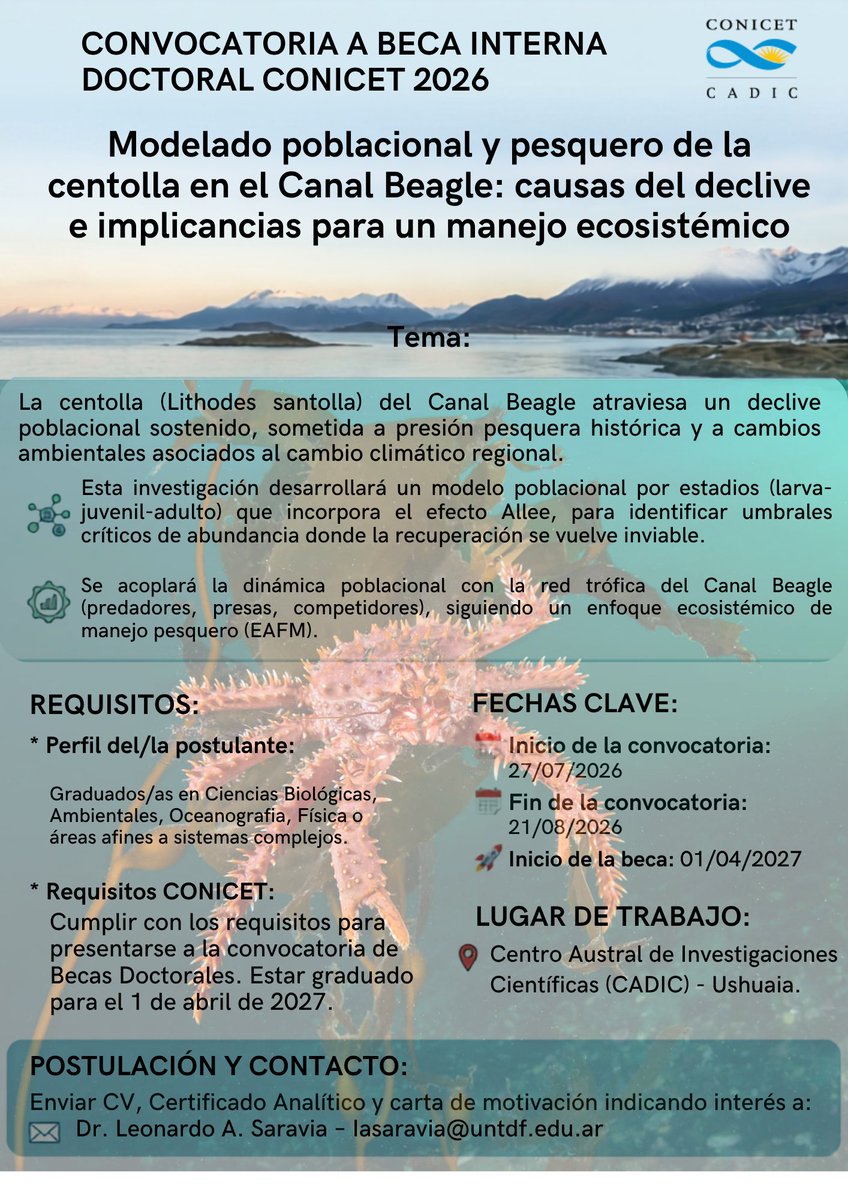
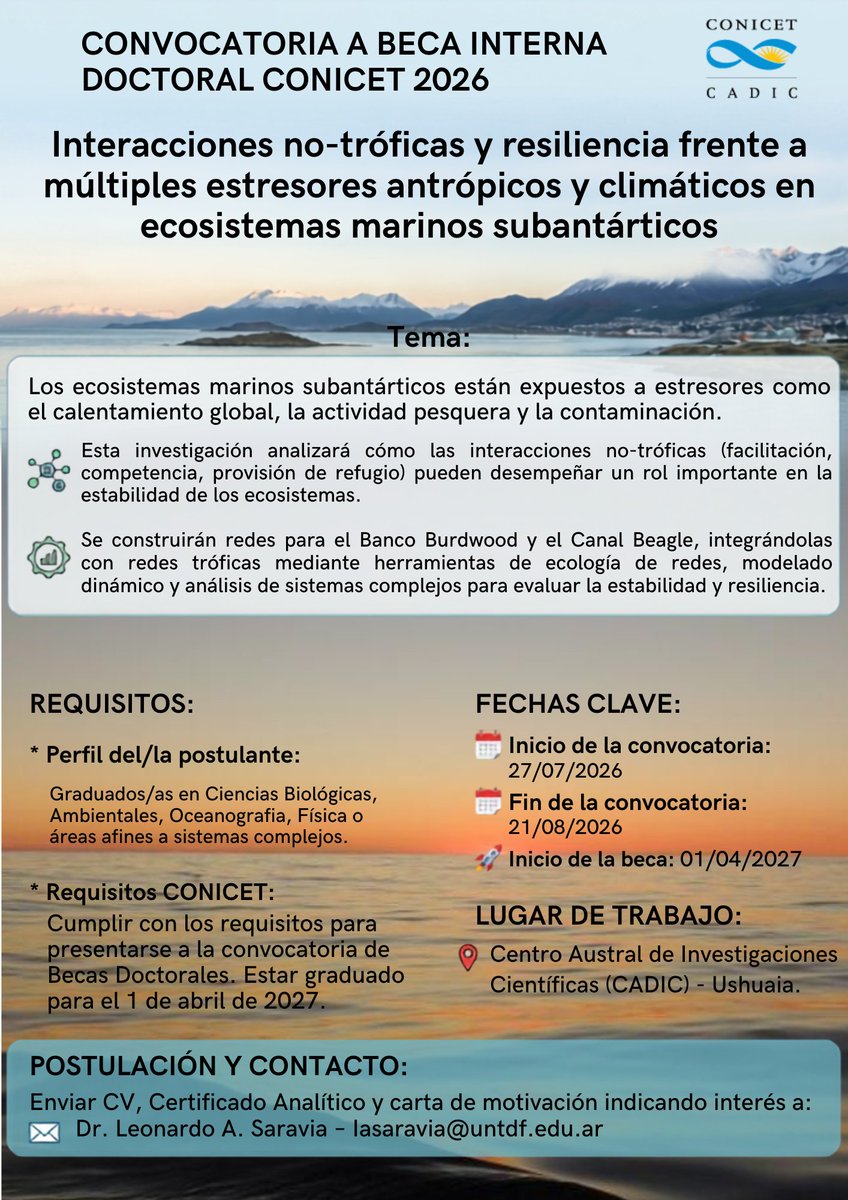
SE BUSCA candidata/o a Beca Doctoral #CONICET
Vení a #Ushuaia 🇦🇷 a estudiar redes ecológicas multicapa, interacciones no tróficas y resiliencia de ecosistemas marinos frente al cambio global. Modelado matemático, programación en R y ciencia de la complejidad. ¡Escribime! [RT 🙏]
📢 El Centro Austral de investigaciones Científicas (CADIC, CONICET) invita a toda la comunidad a seguir participando del ciclo de charlas Bitácora Fueguina.
📍 KRUND Ushuaia – Deloqui 289.
📅 Jueves 30 de julio.
🕡 18:30 hs.
🎟️ Entrada libre y gratuita
¡Los y las esperamos!
Epi- and mesopelagic zooplankton and micronekton vertical zonation patterns in the Slope Sea resolved with acoustics, imaging, and nets.
https://t.co/Hsk7peUDRM
El ataque al sistema científico nos afecta a todos! Este video lo hicimos quienes trabajamos en elCONICET, el INTI, el INTA, la CNEA y el SMN, que estamos viviendo un cientificidio
Paro docente en Santa Cruz, permanencia en el Consejo Provincial de Educación reclamando recomposición salarial y devolución de los días descontados ilegalmente.
Hoy a las 18 h moviliza el Frente Sindical
#santacruz#rgl#adosac#ate#paro
Remotely tracking animals in their natural habitats has become a central pillar of wildlife research. But on land, the process often involves fitting a collar around an animal’s neck that contains a GPS tracker and various sensors. This requires capturing the animal, which isn’t just expensive—it’s also stressful and dangerous for everyone involved.
But a biologist sees a better way forward for this field of study, known as wildlife telemetry.
He’s now building and experimenting with devices, described in a recent preprint, that would allow researchers to apply collars on animals without needing to capture them.
Rethinking how we put collars on animals, he argues, could bring many benefits to wildlife research, such as improving animal welfare and the quantity and quality of data collected at the same time.
Learn more: https://t.co/JopJYqYVkI
We recently published a paper looking at archiving of code and data at the BES, giving recommendations for improvements.
https://t.co/AsL3bhdIEW
This paper has 138 authors from 29 countries! 🌍
Read below to find out how this paper came to be👇 (1)
Hoy se conmemora el Día de la Afirmación de los Derechos Argentinos sobre las Malvinas, Islas del Atlántico Sur y Sector Antártico en alusión a la creación de la Comandancia Política y Militar de las Malvinas y las adyacentes al Cabo de Hornos en 1829.
➕https://t.co/o7tOMyhV8i
I'm so excited to announce that we are hosting a *funded* workshop on Integrative Ecology in the Global South near Kaziranga in March 2026! Early career researchers working in the Global South, apply to attend! https://t.co/fnUGwFdkpl
2025
"Food web structure and species’ role in the sub-Antarctic Marine Protected Area Yaganes"
M. Scian L. Riccialdelli @tomimarina1
in #Polar#Biology@SpringerNature
https://t.co/ylFGgoHHLq
We are an Argentinean research group formed by senior, early-career scientists & PhD students. We aim to understand #EcologicalProcesses with a #ComplexSystems approach, using mathematical and #modelling tools.
Cada 11 de febrero se conmemora el Día Internacional de la Mujer y la Niña en la Ciencia, con el objetivo de visibilizar el trabajo y brindar apoyo a las mujeres científicas.
Ilustración: Luján Pagnossin. Personal técnico.
Texto: Eloísa Giménez Irós. Becaria posdoctoral.
Sigue 🧵
📖Published📖
EcologicalNetworksDynamics.jl: A Julia package to simulate the temporal dynamics of complex ecological networks. Read the article here 👇
https://t.co/dgRMoAFVYn
Today's recommended lecture📰
"The Spatiotemporal Variability of Marine Plankton Ecosystem Services at the Regional Scale: A Combined Approach Using a Systematic Review and Network Analysis"
By Luca Russo et al🇮🇹🇪🇸 2025
In @Sus_MDPI#OpenAccess
https://t.co/cpr0pAg5Xt
🌿MSc students and doctoral researchers are encouraged to apply to iDiv’s 5-day Summer School on deep learning for biodiversity and ecological research from 25-29 Aug 2025 in Leipzig! 🌎
🗓️ Apply by: 28 Feb 2025
🔗 More info: https://t.co/915oyNQ3fA