New publication!
“China’s efforts to increase discourse power in the Arctic and Antarctica through fisheries management”
First co-authored article with Annie Young Song. A small step on my study of China’s ocean governance.
https://t.co/QVxq2sVHDR
In response to some commentary about the @LowyInstitute paper I co-authored with @DavidGVallance, published yesterday, a few thoughts on military capabilities and the intentions to use it: https://t.co/Ng9YIMjTwa
My first book, Authoritarian Markets: The Politics of China’s Banking Explosion (Cornell University Press), is officially out today!
It explores the political foundations of China’s banking market development—and how that development both drove the rapid growth of the Chinese economy in the past three decades and incubated its deeply intertwined challenges: shadow banking, the housing bubble, and local government debt.
The China story isn’t sui generis—not once you see how contract-intensive markets expand in other autocracies. Authoritarian states produce authoritarian markets: markets with three coherent properties, the three “Rs”—rationed entry, reflective competition, and rigged regulation. I won’t give away details but post the epigraph to each chapter below :)
I hope you find the book readable, rigorous, and refreshing—a different set of three Rs, but ones I hope characterize the book as much as its argument.
Finally—here’s a promo code (40% off!): 09EXP40.
https://t.co/qe0SMQnLlO
p.s. So many teachers and friends to thank---see my acknowledgement :)
🚗🔋 Many think Beijing masterfully planned China's EV takeover. Fengming Lu (@ANUBellSchool ) and I spent 3 years and 60+ interviews finding out what actually happened in our latest article @TheChinaJournal. A thread 🧵
My new piece in @ForeignAffairs explains why it is so difficult for the Chinese government to stop misallocation of resources and wasteful spending, how waste in China differs from waste in democracies, and what it means for China’s development.
This is a really fascinating paper that everyone interested in China's industrial policy should read.
It destroys so many myths (see below), and is written by deeply credible people who conducted over three years of fieldwork in China and interviewed 60+ Chinese officials, entrepreneurs, and engineers. When it comes to China studies, it literally doesn't get more rigorous than this.
First myth it destroys: contrary to popular belief, Beijing's industrial policy didn't build the companies that became China's EV champions. They rose largely **despite** it, through its cracks.
For sure, Beijing did favor EVs as an industry and pushed hard for it but their big bet was SOEs (State Owned Enterprises): research grants, pilot programs, licenses, cheap credit - virtually all of it flowed to state firms.
The result? China's actual EV champions - BYD, Geely, NIO, XPeng, Li Auto, etc. - are overwhelmingly private firms that succeeded despite Beijing favoring their SOE competitors.
How so? Because, when favoring SOEs, the central government didn't just pick winning companies, it picked winning cities, each SOE being anchored in a specific city: Shanghai (SAIC), Changchun (FAW), Wuhan-Shiyan (Dongfeng), etc.
Which means that every city not on the list, that wanted a piece of the auto boom, had only one option left: team up with private entrepreneurs who were equally excluded from central government favor.
That's what truly fueled China's EV miracle: an alliance of the excluded, between local private entrepreneurs and local mayors.
This is the biggest misconception this paper destroys: the reality is that the "Chinese state capitalism" that many in the West think powered the EV boom actually tried to block many of these companies from existing. In effect, it was closer to an obstacle course that local actors (mayors and provinces) learned to game.
Geely - now the third largest automaker in China - is a fantastic example of this.
First of all, it started off illegal since, to build passenger cars, you had to have a central government license and they couldn't get one. Zhejiang Province told them to go ahead regardless because the province had hundreds of auto parts suppliers but no carmaker of its own.
It's only a couple of years later, recognizing the fait-accompli that Geely was producing cars and was competitive, that the central government admitted them to the National Sedan Catalog - effectively legalizing them retroactively because there were facts on the ground.
Then there was the Volvo acquisition in 2010, which is fair to say - looking back - proved to be the most strategically valuable acquisition in Chinese automotive history. Despite it being presented at the time (and still described this way today) as "China buying Volvo", all 3 major state-backed banks in China (Export-Import Bank, China Development Bank, Bank of China) refused to finance the deal. The only state-bank money Geely managed to get was a $200 million loan from a provincial branch of China Construction Bank - a tiny fraction of what the deal required.
Geely actually did the deal with Goldman Sachs money via Hong Kong plus loans and equity from four local governments (Chengdu, Zhangjiakou, Daqing, Shanghai's Jiading district), each of which bought in by securing a Volvo plant or headquarters for itself.
In effect, the doors that Beijing controlled were largely closed to Geely, but it made it because the doors subnational actors controlled were opened.
Which all means this paper destroys another very common myth: the big merit of the central government in all this was to be relatively chill about it, to NOT be dictatorial.
I just imagine if that had happened in France and you had - say - the mayor of Lyon or Marseilles open, fund and promote an unlicensed carmaker against Renault: the préfet would shut it down within weeks, and the mayor would be lucky to escape prosecution.
That's the irony: on industrial policy, the supposedly "totalitarian" Chinese state proved more tolerant of local defiance than most Western liberal democracies would be. Beijing's greatest contribution to the EV miracle wasn't the plan - it was looking the other way while the plan was being violated.
To be sure, the paper doesn't hide the costs of this system: ferocious local competition also produced what's known today in China as "involution" (内卷-Neijuan, basically a hypercompetitive price war), as well as some spectacular failures. For instance one county lost 6.6 billion yuan on a carmaker that never really made cars.
But that's precisely the point: this is a high-risk, high-reward model of decentralized experimentation, the very opposite of the careful central planning Westerners imagine.
I've repeated this countless times but it bears repeating again: the single greatest misconception people have about China is - probably because we wrongly associate communism with centralized control - that it is a monolith run from Beijing. Some even say it's run by "one man."
The reality is the exact opposite: China is, in practice, one of the most decentralized countries on earth. Roughly 85% of government spending in China happens at the subnational level - against about 30% in the average OECD country (and even less in France, which is actually one of the most centrally controlled countries on earth). A Chinese mayor commands fiscal resources, land, investment funds and policy latitude that virtually no Western mayor could dream of.
Last but not least, I'd be remiss not to mention what the paper has to say on the positive legacy of Mao and its role in the rise of EVs (given I myself wrote an article titled "Mao's economic record wasn't bad, actually": https://t.co/1NZgHqBHwg).
When it comes to China myths, none is more entrenched than the idea that Mao left behind nothing but ruins.
This paper confirms a key argument of my article: Mao's deliberate dispersal of industry across China (during the Great Leap Forward and Cultural Revolution decentralizations) left dozens of cities with their own small auto works. Inefficient, yes - but these scattered factories survived into the 1990s and became the seed stock of everything that followed: the industrial base, the engineers, and the production licenses that EV startups would use to enter the market.
The paper even says it outright: the fragmentation that industrial policy "sought to eradicate" is "precisely" what "ironically enabled" the EV sector's rapid rise.
This is exactly the mechanism I described in my Mao article: structures built in the Mao era - communes becoming township governments, commune enterprises becoming TVEs, Third Front factories seeding interior industrialization - became load-bearing foundations of the reform miracle.
Fittingly, the spark for China's first municipal carmaker adventure was literally a TVE (Township and Village Enterprise), the institutional descendants of Mao's commune enterprises: Tongbao, a kit-car maker in Wuhu whose success stunned local officials into building what became Chery (one of China's biggest carmakers today). You can't tell the story of China's EV miracle without crediting the legacy of Mao.
What's the biggest lesson in all this for Western policymakers?
The obvious one is that the part of industrial policy that most people assume China does and that they sometimes want to copy - i.e. the state picking winners - is actually the part that failed.
The part that did succeed is the China nobody in the West believes exists: a radically decentralized system with a high degree of tolerance for disobedience and experimentation.
We imagine China as a country where nothing happens without Beijing's approval when the reality is closer to the opposite: China's EV miracle happened precisely because localities asked for forgiveness rather than permission.
All in all, and this is the lesson I often come back to, this is yet another illustration of the importance of understanding China for what it is as opposed to the caricature we've built of it. This matters whichever "camp" you're in. If you see China as a rival, you can't compete with someone you don't understand. If you see them as a source of lessons, you can't emulate what you've misunderstood. Whatever you want from China - to compete with it or learn from it - the entry fee is the same: genuinely understanding it.
Why did private firms, not state-owned enterprises (SOEs), come to dominate China’s EV sector?
My new @ChinaJournal article (co-authored with Xiao Ma @maxiaoalex) challenge the "top-down industrial policy" narrative.
The real engine? Strategic alliances between local governments and private capital. 🧵
Based on 3+ years of fieldwork, 60+ interviews (with officials, entrepreneurs, and engineers), and rich first-hand accounts, we show how strict central regulations inadvertently drove local states to bet big on private EV players.
Here is the story: (1/15)
Please, join our webinar on "THE IMEC, THE THREE SEAS INITIATIVE AND THE GULF CRISIS", Monday, 8 June, from 11 am to 12:15 pm (CEST, UTC+02:00).
Speakers: @swasrao, @DaganLauren, @mihaisebe.
Event organized by the AEGES Working Group "Connectivity and Conflicts".
(Link below)
With the PLA leadership deserting the Shangri-La Dialogue again this year by sending a low-ranking (and press-shy) academic delegation, Chinese state media has stepped into the breach.
What is the “constructive strategic stability” framework Beijing is now promoting for US-China relations?
Despite the new branding, it largely repackages familiar PRC formulations — from the “new type of great power relations” to “mutual respect, peaceful coexistence, and win-win cooperation.”
Xi’s presentation makes clear that “constructive stability” is contingent on what Beijing sees as “concrete actions” by both sides. Notably, this is immediately paired with a warning that the United States must handle Taiwan with caution. The emphasis on “equal-footed consultation” is also significant, as Beijing will likely use that formulation to criticize what it views as future U.S. “unilateral actions.”
Beijing needs to do more than take Taiwan; it needs to govern it as well, a task that its own scholars admit will be a fraught, decades-long. A research paper with Jude Blanchette of @RANDCorporation https://t.co/8G32NN54ok
🚨 🚨 My new article in The China Journal (@TheChinaJournal): "Historical Nihilism: The Rise of a Political Technology." It traces how 历史虚无主义 went from a fuzzy polemical label into an institutionalized apparatus of epistemic control under Xi
https://t.co/LFNocVfCa0
1/
Chinese Foreign Ministry statement on the meeting between Penny Wong and Wang Yi in Beijing. A quick thread to follow shortly 1/ https://t.co/Xizfp84hoh
#REMINDER📢Applications for the China Matters-UTS:ACRI Fellowship 2026-27 close Fri May 15, 5pm AEST. Join our info session on Mon May 4, 4-4:30pm AEST with mentors @j_laurenceson, @JakobsonLinda & inaugural Fellow @edwardsychan. Register: https://t.co/h4rQnecttU
New Faces in Chinese Politics Conference
MIT, September 1-2, 2026
Application materials due by May 22, 2026
We invite advanced PhD students and post-doctoral fellows who study Chinese domestic and international politics to apply for the sixth New Faces in Chinese Politics Conference at MIT on September 1-2, 2026, just before the APSA annual meeting in Boston. The New Faces in Chinese Politics Conference is an opportunity to get feedback on job market papers and job talks with peers, conference co-organizers, and invited senior scholars.
The papers should be based on original, rigorous research, employing quantitative or qualitative methods. The in-person conference is open exclusively to job market candidates for the 2026 job market. Successful applicants are fully funded for travel, lodging, and food.
Applicants must submit a curriculum vitae, a full job market paper or dissertation chapter (for chapters, we would prefer an empirical chapter with a short summary of the theory), and a letter of support from the dissertation committee chair. Application materials are due by May 22 via email attachment to [email protected]. Applicants should put their full name in the subject heading of the email.
The letter of support should be emailed separately to that address and should endorse the applicant’s decision to be on the job market in 2026, with the subject heading including the full name of the applicant.
Fiona Cunningham, University of Pennsylvania
Iza Ding, Northwestern University
Taylor Fravel, Massachusetts Institute of Technology
Melanie Manion, Duke University
Yuhua Wang, Harvard University
Story on this here: Vanuatu has furiously denied that it is on the cusp of signing a security pact with China and warned that it will not be "dictated to" in a row which threatens to disrupt delicately poised negotiations for the Nakamal Agreement https://t.co/pkPUQVNL8l
Interested in the China Matters-UTS:ACRI Fellowship 2026-27? Hear from Fellowship mentors @j_laurenceson and @JakobsonLinda, and inaugural Fellow @edwardsychan at our online info session on May 4 2026, 4pm AEST. 🔗Register to attend: https://t.co/aWN6pvW5c0
Apply now for the @ChinaMattersAUS@acri_uts Fellowship 2026-27! Australian early career researchers: explore policy-relevant issues for AU and conduct research in CN with mentorship by @j_laurenceson & @JakobsonLinda. Apply by May 15 2026, 5pm AEDT. More info: https://t.co/ozPk8YZ0gN
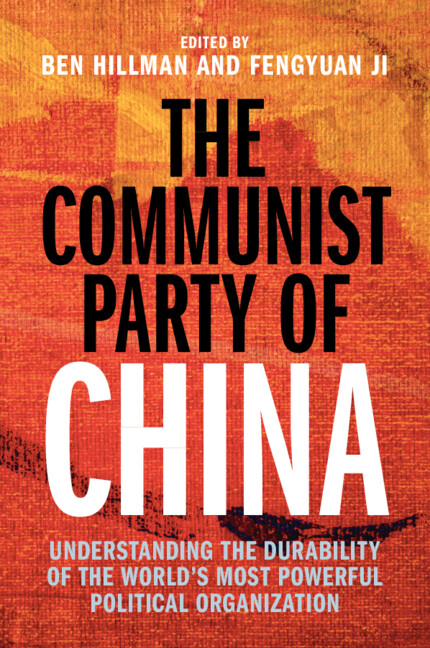
The Communist Party of China by Ben Hillman and Fengyuan Ji
An interdisciplinary collection exploring the ideology and mechanisms behind the Communist Party of China's grip on political power.
📚 https://t.co/2v1Va8E37u
Pretty interesting high-level meeting for China's senior military officers held on April 8 at the PLA's National Defense Univeristy —
an "army wide senior cadre training course" (全军高级干部培训班)
1/