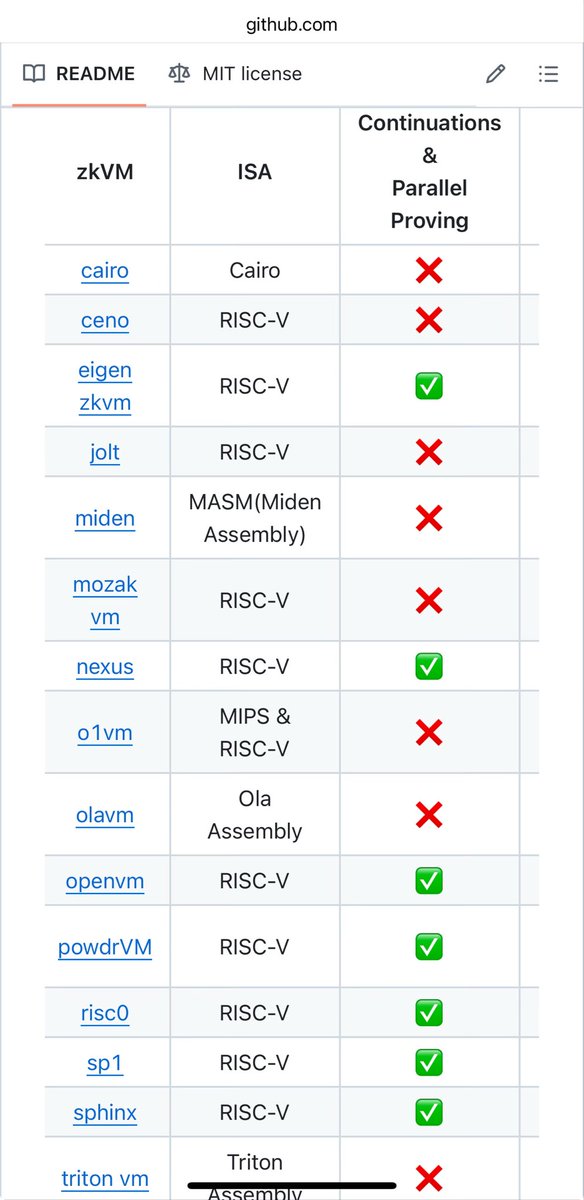
A Proof Market To Scale Fully Onchain Applications. We build the general-purpose zkVM with native privacy-preserving gadgets on its modular proof system.
Privacy WIN! #zkp#privacy#TornadoCash#zkvm
Summaries about the legal analysis, https://t.co/VFti37g92U
The International Emergency Economic Powers Act and the North Korea Sanctions and Policy Enhancement Act vest the President with the authority to regulate “property” in which a foreign “national” or “person” has an “interest.”
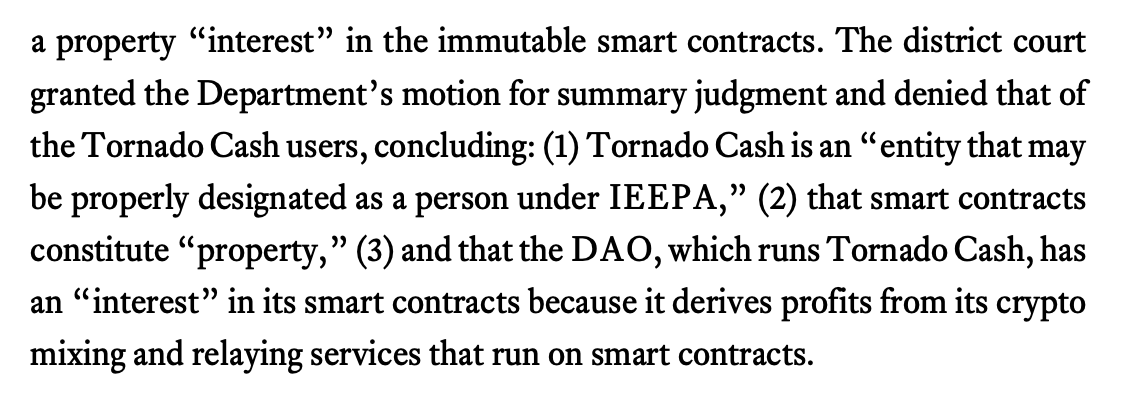
The court must determine if Tornado Cash and its smart contracts fall within this definition.
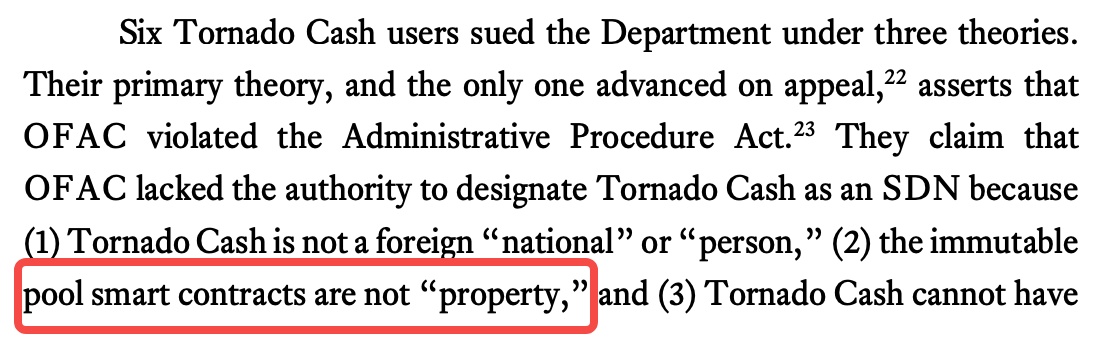
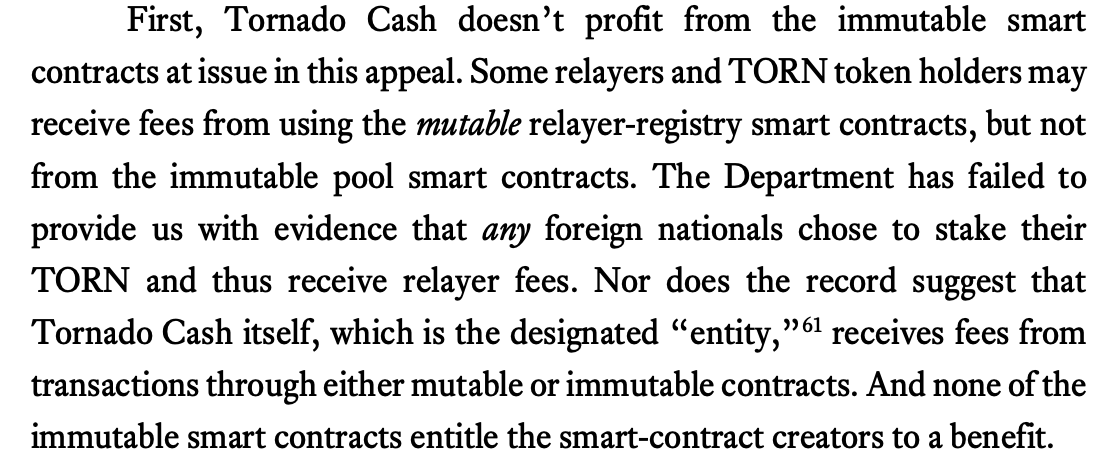
Analysis of “Property” Definition: The court starts with the statutory text and the ordinary meaning of “property,” which is something capable of being owned. The dictionary definitions and the Supreme Court's interpretation support this understanding. The immutable smart contracts at issue are not property because they are not capable of being owned. More than one thousand volunteers participated in a “trusted setup ceremony” to make the code unchangeable and uncontrollable, so no one can exclude others from using the contracts. Even with the sanctions, the contracts continue to operate, and some users may become liable when digital assets are transferred to them via Tornado Cash without their knowledge or consent.
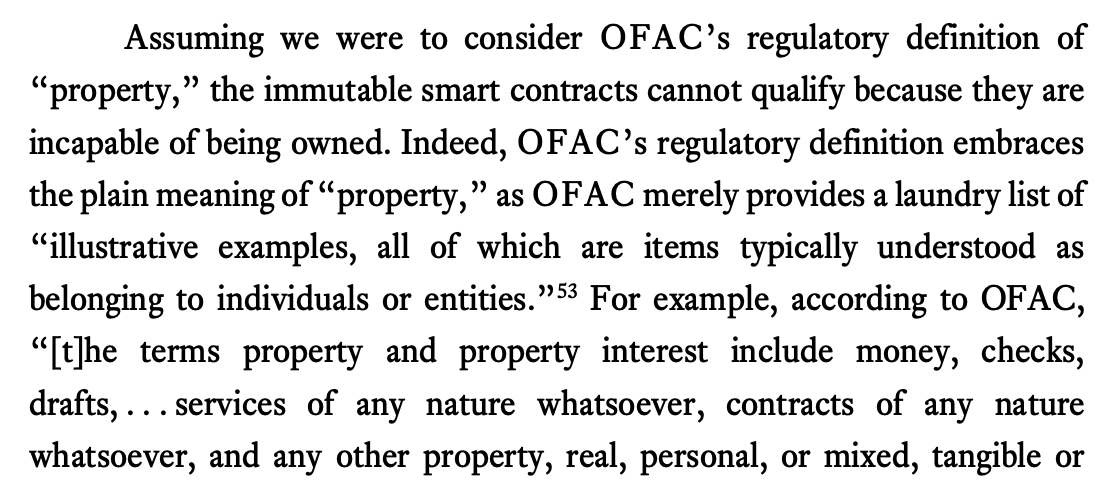
OFAC's Regulatory Definition: The court also considers OFAC's regulatory definition of “property,” which includes “contracts of any nature” and “services of any nature.” However, the court finds that even under OFAC's definition, the immutable smart contracts do not qualify as property. They are not ownable, not contracts (as they lack an agreement between two or more parties), and not services (as they are merely tools used in providing a service and Tornado Cash does not own the services). The court rejects the Department's attempt to conflate “interest” with “property” and emphasizes that the catch-all for “any other property” still requires the item to be property.
Conclusion: The court holds that OFAC exceeded its statutory authority in designating Tornado Cash. The immutable smart contracts are not “property” under the common or regulatory definitions, so the court need not address whether Tornado Cash qualifies as an “entity” or has an “interest” in the contracts. The court reverses and remands the case to the district court with instructions to grant Van Loon's partial motion for summary judgment based on the Administrative Procedure Act.
#TEE vs #ZK
1. Transparency&Security
TEE: trust the hardware vendor, but no one provides an opensourced audit report for the hardware’s security implementation. Especially, some enclaves use its own certificate server to manage the hardware’s identifies. Think about that what we can do if there’s a backdoor in the CPU.
ZK: trust the math, and everything is transparent, and the proof can be verified by anyone.
2. Performance
TEE: can even do LLM inference, like Llama 7B with less than 10% efficiency overhead. Basically it can offers several hundreds TFlops in a single GPU TEE instance. Note, this is from some benchmark only, not from production environment.
ZK: can proving with several millions HZ in a single GPU server.
3. Use cases
TEE: #Oasis, #SECRET network, #flashbot
ZK: #Zksync, #Starkware, #R0, #ZKM, #Scroll, #Zcash,…..
We released a SGX framework https://t.co/vtBhb9G2kL three years ago, and then built https://t.co/sWZtdyNPPy.
We have to say, just choose the RIGHT tech stack for your customers.
Three months ago, Apple #PCC pushed its trustless cloud AI to another security level with its secure enclave, this is a huge step. For #zkVM, there is no doubt that we can take the advantages of TEE's native auditability for prover.
Check out our pure Rust #eSTARK implementation.
ZK Hack Montréal: Polygon - The eSTARK Proving System & Plonky3 https://t.co/UEeFTETTHV via @YouTube