think that there’s just diff magnitudes of order being discussed here
@JaredKubin point is that there’s some marginal impact (this is economically indisputable), and perhaps part of a larger structural shift that could play a role in a broader event
@DratchCap point distills into - being one sigma right in a high vol instrument has huge absolute return, and 100bp shift in funding isn’t sufficiently large to have material impact on r/r calcs.
Just depends on the portfolio/holder/utility function on cash vs risk etc. if you’re super levered idioboy this matters more, if concentrated low leverage high vol guy matters way less
Wide range of possible distributions on AI outcomes, but it is clear that the tech has made a second quantum leap in the last 6 months. This matters in more than just technology - we must rethink incentive structures as companies can more easily capture IP, organization design as fewer people can do more “work”, and fundamentally what the value of human participation is in any labor process.
The largest wave of impact is yet to be seen - companies being built by domain experts natively calibrated from day 1 to maximally create value from synthesis between man and machine.
A big pivot from Ken Griffin on AI:
“Number one is, in the last few months, there has been a step change in the productivity of the AI toolkit. It is profoundly more powerful than it was just nine months ago.
And for us at Citadel, that has allowed us to unleash a much broader array of use cases for AI. And it has been really interesting to watch, to be blunt, work that we would usually do with people with masters and PhDs in finance over the course of weeks or months being done by AI agents over the course of hours or days.
These are not these are not mid-tier white collar jobs. These are like extraordinarily high skilled jobs being, I'm going to pick a word, automated by agentic AI. And I gotta tell you, I went home one Friday actually fairly depressed by this because you could just see how this was going to have such a dramatic impact on society.
When you witness it in your own four walls, when you see work that used to be man years of work being done in days or weeks, it's like, wow, like that's the first time I've seen real impact in our four walls.”
This echoes my own experience with agents and the conversations I am having with students, friends & clients. The toolkit has dramatically transformed and it feels like in finance, for the first time, AI is real.
@chrismartenson@wbmosler This is misleading.
The US net imports crude oil because the refineries process heavier more sour crudes. But we net export far more in crude equivalent of refined products (jet fuel, diesel, etc - and separately also natgas, yes)
Schrodinger's Taco, yet again.
Now some pushback from elements of Iranian regime (IRGC claiming they have assumed control, no negotiations with other parties apply).
The only card Trump has to get the strait open and claim victory of some kind (even delusional) is: "Iran is open for business globally, the new regime is far more reasonable and loves trade and it will be very good for our economy, and best of all they LOVE Trump!" followed by SPX pump to 7200...
Same old story, same old song and dance
A corollary to this:
The fragmentation argument cuts both ways. The harder it is to coordinate all parties on Iranian side also means that the probability of repeated “deals” being struck with some faction of Iranian side (which don’t end up holding) is also high.
There is little central coordination function in Iran left to negotiate with.
Israel does not want ceasefire on any terms the Iranians would accept currently even if there were.
Takes two to TACO
There is little central coordination function in Iran left to negotiate with.
Israel does not want ceasefire on any terms the Iranians would accept currently even if there were.
Takes two to TACO
it is harder to forecast further in time because the interaction terms lead to combinatorial explosion. Higher rate of change of tech->larger compounding effect.
Many things will get strange - but people (and systems) will have time to adjust. I spend less time on trying to figure out end state, more time trying to understand path, and even more importantly - being set up to adapt along the way.
Man plans, God Laughs.
Here is a Citrini critique from a Macro-AI lens.
Citrini's "2028 Intelligence Crisis" direction of labor market impact is sensible. The velocity is wrong. His scenario timeline is off by ~ 5 years + because his AI capability assumptions are anecdotal, not grounded in the math of how models actually improve.
His core assumptions:
1) The AI feedback loop is sustained by "AI Investment Increases & AI Capabilities Improve" — implying that as long as you throw money at compute, you get better models that unlock capabilities replacing humans at a given task
2) He extrapolates from what he's observed anecdotally about AI agents to "smooth sailing" toward autonomous multi-week agents by 2027. This is a guess, not an informed view
Let's rigorize his feedback loop with some Macro-AI:
scaling laws → capabilities → task automation → displacement
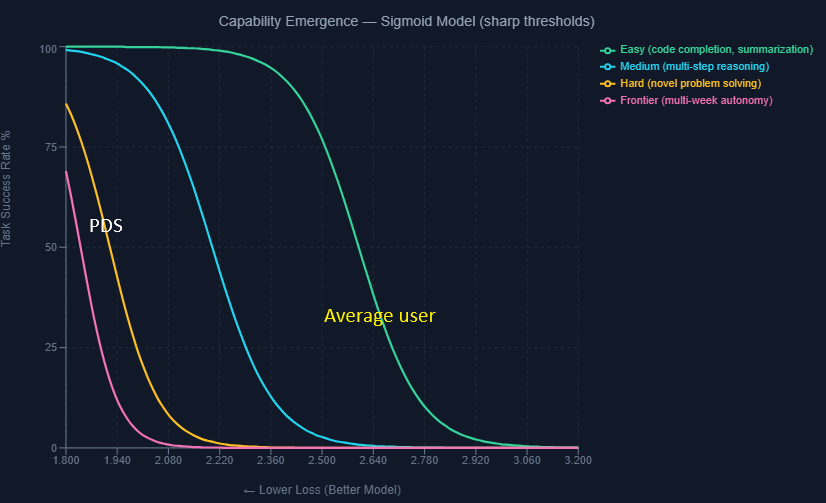
The relationship between scaling laws and capabilities is determined by a "Capability Transfer" function. This relationship is non-linear and task-dependent. Capabilities don't emerge linearly from loss improvements — they phase-transition at specific thresholds (I model this with a sigmoid in pic below). Du et al. (2024) validates pre-training loss as the sufficient proxy for capability emergence below task-specific thresholds.
The hard tasks Citrini envisions — autonomous multi-week work by 2028 — likely have thresholds near the irreducible loss floor (E ≈ 1.82 nats). But here's the deeper issue: next-token prediction is a proxy objective. A model can approach E without acquiring the causal reasoning, goal persistence, and calibrated uncertainty that autonomous work demands. The frontier labs' pivot to post-training (RLHF, inference-time compute, tool use) is an implicit admission of this gap. All this to say, some hard tasks may not be solvable by scaling compute alone - which is what Citrini assumes.
If we know the capability transfer thresholds and map them to loss levels (and thus compute), we can estimate when complex tasks become feasible. (yup -> we can actually model this)
Using 0.40 OOM/year in compute growth and 0.30 OOM/year in algorithmic efficiency gains, I model that professional replacement (defined workflows: customer service, routine legal, basic analysis) starts mid-2026 — but cognitive displacement (multi-week autonomy, novel problem solving) only arrives ~2031. Citrini's crisis requires cognitive displacement. So his timeline starts at 2031 at earliest.
**AND** we haven't even addressed two more constraints that push it further: agent reliability decays exponentially with task complexity and the training data wall.
If I can vibe code myself into a web dev, I'll upload the interactive model at https://t.co/kdlYUwTjvt for you to stress-test the assumptions yourself.
Recently spent time updating an older analysis on where AI demand is actually going and came away still thinking we’re massively short compute (~8–50x short) on consumer inference alone. Big range (future is humbling), but even the low end makes the point.
I dropped a link to the fuller write-up for anyone inclined over a slow week. It also hits a few popular debates / my steelman AI bear case. Some of this may be optimistic (or wrong). I’m a dreamer, so be kind :)
Consumer is easiest to parameterize. If we’re massively short just on that, you start to understand why the biggest players are building so aggressively.
Framework: tokens are the kWh of knowledge work and demand scales as price drops, leading to new workloads and moving us from 100-token prompts to agentic loops + multimodal + “robotic episodes” that can consume orders of magnitude more tokens.
Supply: we’ve installed mid-teens GW of frontier compute using Jensen’s rule of thumb. Other accounts suggest it may already be closer to the mid-20s GW. Either way, it sounds huge until you realize cluster-level effective performance is ~5–10% of chip specs once you net out site power overhead, MFU, and fleet mix.
Steelman bear: AI creates massive shadow output gap, but much of it is competed away or shows up as deflation/consumer surplus rather than immediate EPS gains.
More detail in the write-up: https://t.co/9Lph4Nd6aI
Appendix (topics covered):
• TPU vs GPU
• China/Huawei
• Robotics + world models
$nvda $orcl $crwv $nbis
@TMTLongShort tariffs won’t be able to fund that right? But I guess if he can “appropriate” by some other means, then it’s possible. Do think 4k p.p would move the needle
this is well said. I think of positioning vs liquidity as “positioning density” which is a base value from which to derive alpha measure of “what are smart investors doing” and risk measure of crowding. I think of crowding specifically as a conditional risk measure, or like potential energy.
@systematicls Think something underappreciated re proprietary data is having that data structured/stored/accessible in a way such that it’s actually useful. Much of the corpus of “gated” knowledge exists in disparate poorly labeled and inconsistently structured xlsx files.
@bennpeifert “Form and build relationships with people who can teach you or you can learn from” 💯. Such an underappreciated skill. There is no esoteric secret knowledge/man behind the curtain, but there is domain expertise that isn’t accessible without relationship with those experts.
Systematic/prop/quant firms have versions of this by nature as they have a) more distributed value creation/less key-man value, b) generally cleaner ability to attribute value creation given current/past available tech (execution value, alpha value, portfolio construction value, etc)
Question becomes as the synthesis process that underpins discretionary trading investing becomes more codified/“systematized” (even if still not “systematic” properly), and value creation of research+investment process extends beyond own-pnl how then does value attribution and compensation get distributed.
Answer is: probably some mix of rev share + own-pnl!
For those interested in the intersection of hedge funds x tech and the many questions (and perhaps a few answers) I have about the future of the space, alongside the ever-insightful experience of my good friend @detroitcoder , check out the below discussion we recorded
https://t.co/2whqsAeUF4
@tszzl In “Surely You’re Joking Mr Feynman”, he talks about the greatest transition point in his career (and the work that eventually led to his Nobel prize) coming on the back of him ceasing to work at physics, and beginning to “play” physics. It is a lesson I come back to regularly.