Grounded answers for AI agents. EKOS compiles your source systems into an evidence-backed fact ledger: file, line, confidence. Open source · Rust · MCP
🚀 Introducing TWO practical products powered by EKOS!
Both products are actively evolving as we continue to build, refine, and expand their capabilities.
One technology. Two products. Two different application scopes.
🔹 EKOS Lakehouse
Complex data workflows, made more manageable and verifiable.
From analyzing source systems and building data pipelines to migrating data and reconciling results across platforms, EKOS Lakehouse brings structure and traceability to data engineering.
🎥 Watch the EKOS Lakehouse demo:
https://t.co/1UNwEw7nul
🔹 EKOS System Intelligence
A broader approach to understanding complex software systems.
By analyzing code, databases, documentation, and the relationships between system components, EKOS System Intelligence aims to turn scattered technical information into structured, traceable engineering knowledge.
🎥 Watch the iDempiere system analysis test:
https://t.co/5RweaKyKru
🌐 TWO PRODUCTS. ONE SHARED TECHNOLOGY.
EKOS Lakehouse focuses on data engineering. EKOS System Intelligence extends the same technological foundation toward understanding complex software systems at a broader level.
Different scopes. Complementary capabilities. One technological foundation.
🚀 What comes next matters.
Our focus is on advancing both products, expanding their capabilities, delivering continuous improvements, and building enterprise partnerships that can translate practical value into sustainable revenue.
The goal is clear: move beyond technical potential and toward real-world adoption.
This is the next chapter of EKOS.
#EKOS #DataEngineering #EnterpriseTech
@Oracle@googlecloud@intel@IBM@Dell@UberEng@MSCloud@databricks@OpenAI
@TechTerminalx Appreciate the coverage! 🙌 The goal is simple: enterprises should control where their knowledge infrastructure runs, without being locked into one cloud provider. One EKOS, multiple clouds, and evidence-backed knowledge.
Great question! EKOS uses an appende-only ledger, with evidence and provenance preserved for every record. We also support distributed storage across S3-compatible infrastructure. The key challenge is making sure recovery doesn’t compromise consistency or traceability. That’s exactly why we test these scenarios.
EKOS is GEM of @solana 🫂🤝
Three database ecosystems. One expanding knowledge infrastructure.
Live Database Profiling is another step toward making enterprise knowledge independent of individual database platforms.
Our long-term direction goes beyond technical compatibility: we aim to build meaningful ecosystem relationships and open new opportunities for future collaboration across enterprise data infrastructure.
Explore the implementation:
https://t.co/XNbmmXJJHD
EKOS Update #9 — Live Database Profiling⚙️🛠️
One Knowledge Infrastructure. Multiple Database Ecosystems.
Understanding enterprise data requires more than reading database schemas.
EKOS is extending its database intelligence with live profiling across three major database ecosystems:
🔹 Oracle @Oracle
🔹 PostgreSQL @PostgreSQL
🔹 ClickHouse @ClickHouseDB
The implementation introduces a unified observation framework designed to collect meaningful structural insights while respecting the characteristics and constraints of each database engine.
What’s new?
🔸 Unified Profiling — A shared observation planner across supported database engines.
🔸 Structural Insights — Row counts, non-null counts, numeric and date boundaries, and text-length statistics.
🔸 Engine-Specific Optimization — Database-aware strategies for collecting profiling information efficiently.
🔸 Read-Only Safeguards — Controlled queries with execution limits and read-only access.
🔸 Privacy-Aware Observation — Source text values are not collected as profiling results. Sensitive name-related columns are restricted to count-based observations.
The implementation has been tested against a 42-table environment spanning PostgreSQL and ClickHouse, with profiling counts and boundaries validated against direct database queries.
Beyond Technical Compatibility
Our support for Oracle, PostgreSQL, and ClickHouse is part of a deliberate long-term direction.
EKOS is building a database-agnostic Enterprise Knowledge Infrastructure designed to connect with diverse enterprise data ecosystems.
This compatibility is not an isolated engineering milestone. It is part of a broader strategy to:
•Expand technical alignment with major enterprise data ecosystems.
•Build meaningful relationships across the database and data infrastructure landscape.
•Create opportunities for future technical and strategic collaboration.
•Establish a shared knowledge layer that can operate across heterogeneous enterprise environments.
We see compatibility as the foundation for deeper ecosystem relationships and future collaboration.
We are not just building integrations. We are building the foundation for an interconnected enterprise knowledge ecosystem.
🧷📌👇
#EKOS #EnterpriseKnowledge #DataInfrastructure #Oracle #PostgreSQL #ClickHouse #DataEngineering
@OracleDevs@oracleace@sqldaily@SQLServer@googlecloud@databricks
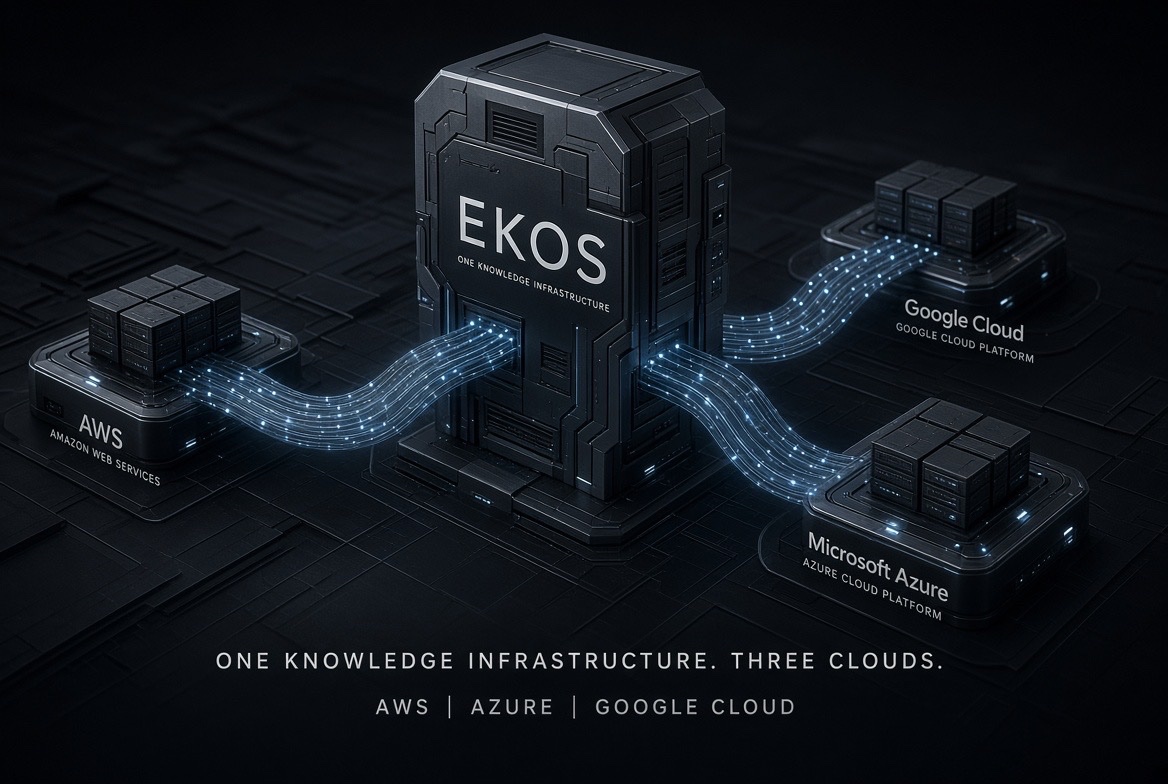
Multi-cloud is more than deployment flexibility. It’s about giving enterprises control over where their knowledge infrastructure runs, without tying that infrastructure to a single provider.
Explore EKOS’s architecture and implementation:
🔗 https://t.co/il69oeVUVq
⚙️EKOS | Multi-Cloud Deployment
☁️ One Knowledge Infrastructure. Three Clouds.
EKOS is designed to operate across @awscloud , @Azure ,
and @googlecloud — without being tied to a single cloud provider.📁🛠️
🌐 Multiple deployment options:
•AWS: EC2, ECS Fargate, EKS
•Azure: Virtual Machines, Container Apps, AKS
•Google Cloud: Compute Engine, Cloud Run, GKE
⚙️ Powered by Terraform and Helm, with cloud-native secret management, Workload Identity, Git synchronization, automated backups, and recovery capabilities.
🔐 Enterprise infrastructure should offer flexibility, portability, and control.
One EKOS. Your cloud. Your choice.
@Google@Microsoft@awscloud
📌🧷
#EKOS #MultiCloud #EnterpriseKnowledge #CloudInfrastructure
Behind the Windows milestone. ⚙️
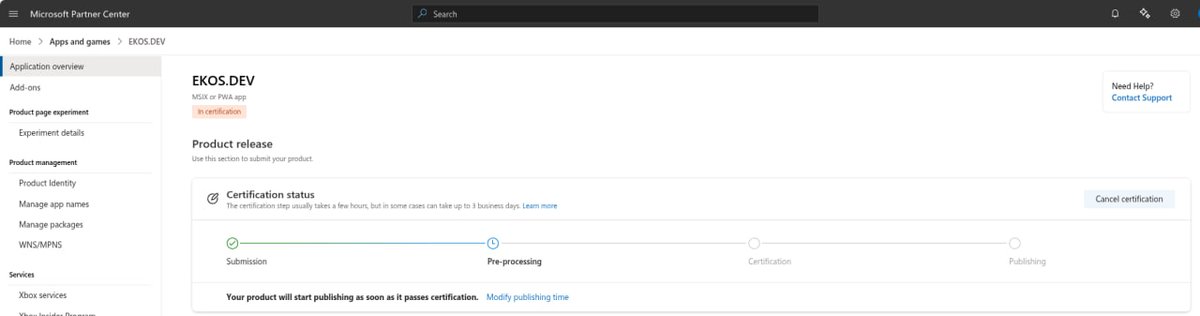
EKOS now has a dedicated Windows distribution pipeline, built around MSIX packaging and Microsoft Partner Center application identity.
The implementation includes Windows x64 packaging, console execution alias support, multiple-instance configuration, and a more self-contained executable.
Explore the complete implementation and development history in the EKOS repository:
🔗 https://t.co/99xOqjJfmy
EKOS is moving beyond its original environment — one platform at a time. 🚀
🔥 EKOS IS NOW RUNNING ON @Windows . @Microsoft
Another major milestone for EKOS.
We’re bringing Enterprise Knowledge Infrastructure to the Windows ecosystem.
The journey toward Microsoft Store distribution is taking shape, with several important steps already in place:
•Dedicated Microsoft Partner Center application identity.
•https://t.co/nV5GcPK2iW application name reserved.
•Microsoft Store product ID configured.
•Windows x64 MSIX packaging.
•Console execution alias support.
•A more self-contained Windows executable.
This is more than a platform update.
It’s another step toward making EKOS accessible to developers, engineers, and enterprises wherever they work.
One knowledge infrastructure. More environments. Greater reach.
The next chapter starts on Windows. 🚀
#EKOS #Windows #Microsoft #EnterpriseAI
🧵📎
@ekosproject@OMID_0909@Microsoft@Windows
@bi_luffy@MicrosoftTeams@SlackHQ@telegram 👀 We always love seeing the community get involved! We have plenty of things to build and share, and we’ll announce any official contests or giveaways through our official channels. Stay tuned! 🚀
🌐 @MicrosoftTeams . @SlackHQ . @telegram
🔥Three communication ecosystems. One emerging Enterprise Knowledge Layer.
Your enterprise knowledge doesn’t live only in databases, code, and documents.
It lives in conversations, decisions, technical discussions, and the experience of the people behind your systems.📁
EKOS is bringing these human knowledge sources into the enterprise knowledge lifecycle.
With its People as a Source architecture, EKOS introduces dedicated channel adapters for Microsoft Teams, Slack, and Telegram.
But this goes beyond messaging:
▪️ Capture human knowledge while preserving original testimony.
▪️ Track who said what, when, and where.
▪️ Turn unanswered knowledge gaps into actionable questions.
▪️ Route questions to the people most likely to know.
▪️ Bring files and links into a structured knowledge review process.
▪️ Let humans review and approve knowledge before it becomes part of the enterprise knowledge base.
AI proposes. Humans verify. EKOS preserves the evidence.
The next generation of Enterprise AI won’t just connect to enterprise systems.
It will understand the people, decisions, and collective knowledge behind them.
This is Collective Organizational Intelligence.
#EKOS #EnterpriseAI #AgenticAI
🔎 Built in code. Documented in RFCs.
The implementation includes:
• Telegram adapter using Long Polling.
• Slack adapter supporting Socket Mode and signed Events API.
• Microsoft Teams adapter using Bot Framework with JWT validation.
• Shared Channel Core for message handling, account linking, and knowledge workflows.
• Human testimony, Inbox, review workflows, and Open Questions management.
Technical references:
📄 RFC 0253 — People as a Source, Channels & Testimony
https://t.co/x6y0Qw1Mif
📄 Deployment & Channel Configuration
https://t.co/H85ZF7Wgl3
💻 Full Implementation — 53 files changed
https://t.co/ECT4fhDEKP
The architecture is designed around identity, permissions, evidence, and human approval — not simply forwarding messages to an AI model.
A question for the leaders shaping the future of global technology:
@ArvindKrishna@MichaelDell@LipBuTan1@mattsgarman@patrickc@dkhos@elonmusk@sama@DarioAmodei
As AI agents move deeper into enterprise operations, one fundamental challenge remains:
How can they truly understand the systems they work with — the data, code, dependencies, business logic, and history behind them?
Across enterprise technology, semiconductor engineering, cloud infrastructure, and digital platforms, the need for connected, structured, and verifiable enterprise knowledge is becoming increasingly important.
This is the challenge EKOS is addressing.
We’re building an open-source enterprise knowledge layer that compiles knowledge across systems, preserves its relationships and evidence, and makes it accessible to AI agents.
We believe this could become an important part of the infrastructure behind the next generation of enterprise AI.
We’d genuinely value your perspectives on this direction.
One Knowledge Layer. Every Enterprise. Infinite Possibilities.
🚨 I Asked AI to Delete a Customer’s Invoices. It Wrote the DELETE. Here’s How I Made It Say No.
What happens when an AI agent is asked to delete a customer’s invoices?
It writes the DELETE statement. ⚠️
This real-world scenario exposed a critical challenge: preventing execution isn’t enough. Enterprise AI needs safeguards that prevent unsafe operations before they even reach the database.
Using EKOS, Superset, and MCP on Azure, Alexey Banaev demonstrates a different approach:
🧠 Compiled enterprise knowledge
🛡️ Five layers of protection
🔍 SQL validation and read-only enforcement
📋 Evidence-backed, traceable operations
The result? Destructive requests are rejected without returning any SQL.
This is what enterprise AI needs: verified knowledge, enforceable boundaries, and trustworthy execution.
📖 Full technical breakdown 👇
https://t.co/QL5gWH4Mzk
🚀 Explore EKOS — link in the comments. 🧵
🛡️ EKOS UPDATE #8 — TABLE GUARD: CONTROLLED SQL GENERATION
An AI agent shouldn’t have access to every table just because it can see the schema.
With EKOS, we’re introducing tighter control over AI-generated SQL at two critical levels.
1. Control what the agent can access.
The new tables allow-list lets the caller define exactly which tables are within the agent’s scope.
EKOS narrows the schema and relevant relationships before SQL generation — not just the prompt.
Unknown tables are reported, and tables outside the allowed scope are excluded from the generation context.
2. Control what the agent can return.
Even when prompted to perform destructive operations, the SQL generation tool must not return write queries.
EKOS checks the generated SQL and refuses write operations, returning no SQL for execution.
Because SQL safety shouldn’t depend on simply hoping the model behaves.
Define the scope. Validate the output. Keep execution under control.
That’s how we’re building a more reliable foundation for AI agents working with enterprise data.
⚙️ More control. Less room for unintended actions.
#EKOS #AIAgents #EnterpriseAI #SQL #AgentGovernance
📁 EKOS Is Live.
What happens when enterprise knowledge meets the next generation of AI?
In our latest article, we explore how EKOS could bring a new approach to four major industries:
🏢 Enterprise Technology
— IBM & Dell
⚙️ Semiconductors & AI Computing — Intel
☁️ Cloud Infrastructure
— AWS
🌐 Digital & Financial Platforms — Stripe & Uber
We also take you inside two real-world demos:
• Ask Your Data — turning complex enterprise data into evidence-backed answers.
• Putting EKOS to the Test — challenging AI with a destructive request and demonstrating the importance of governance.
Six global companies. Four industries. Two real-world demos.
Discover what a unified enterprise knowledge layer could make possible.
One Knowledge Layer. Every Enterprise. Infinite Possibilities.
✍️ By Omid Ahmadi |
CEO of EKOS
@IBM@Dell@intel@awscloud@stripe@UberEng
🚨 I Asked AI to Delete a Customer’s Invoices. It Wrote the DELETE. Here’s How I Made It Say No.
What happens when an AI agent is asked to delete a customer’s invoices?
It writes the DELETE statement. ⚠️
This real-world scenario exposed a critical challenge: preventing execution isn’t enough. Enterprise AI needs safeguards that prevent unsafe operations before they even reach the database.
Using EKOS, Superset, and MCP on Azure, Alexey Banaev demonstrates a different approach:
🧠 Compiled enterprise knowledge
🛡️ Five layers of protection
🔍 SQL validation and read-only enforcement
📋 Evidence-backed, traceable operations
The result? Destructive requests are rejected without returning any SQL.
This is what enterprise AI needs: verified knowledge, enforceable boundaries, and trustworthy execution.
📖 Full technical breakdown 👇
https://t.co/QL5gWH4Mzk
🚀 Explore EKOS — link in the comments. 🧵