Welcome to X if you haven’t heard of me:
I wrote 10 wires in the last month to the demos you posted. $100k - $250k
not a single had over 1k followers.
here’s the catch: i got near unlimited bank
(baller ikr)
drop the demo for immediate inspection:
& i’ll invite you to sf.
@bancosantander just dropped a massive milestone: scaling AI access to all 185,000 employees, with over 280 process automation agents already running live in production.
Banco Santander https://t.co/et9VmUn8H1.
But if you look closely at what they actually released open-source under their new GitHub repo (like their mechanical governance frameworks and autoguardrails), the real story becomes much bigger.
They aren’t open-sourcing shiny frontend chatbots or proprietary alpha. They are open-sourcing trust infrastructure.
This marks a massive industry shift away from "AI exploration" and straight into "controlled financial loop execution."
When we started building Kemba https://t.co/j3mW6qsUXO, this was our exact thesis. We realized two things early on:
* Banks and neobanks don't want point-solution apps. They don't want a rigid, third-party AI telling them how to run their specific credit, fraud, or KYC pipelines. They want to deploy their own custom agents that understand their unique business logic.
* But they are terrified of doing it without an absolute control layer. And rightfully so. If an enterprise AI loop lacks strict governance, hard gates, and rigorous evaluation, it’s a non-starter for compliance.
By open-sourcing these frameworks, a Tier-1 global giant is essentially proving our point to the market. They are confirming that the real battleground isn't just about picking the newest foundational model it’s about the infrastructure that safely manages the loop from signal to execution.
That’s exactly why we built Kemba to be the Agentic Brain infrastructure layer https://t.co/j3mW6qsUXO. The banks securely deploy the agents using Kemba; we give financial institutions the secure core AI Brain they need to deploy their own agents safely. We handle the complex orchestration, the compliance guardrails, and the secure execution boundaries so they can innovate without risking customer data or proprietary logic.
The era of isolated, standalone AI pilots is officially over. The era of institutional-grade infrastructure has begun.
📷
Carnegie Mellon University is the #1 AI and Computer Science program in the world. There’s a reason for that.
It’s not a culture of chasing tech hype or building pretty wrappers. It’s a culture of hard engineering, rigorous mathematics, and building bulletproof, foundational infrastructure.
When we set out to build Kemba, we knew we couldn't just build a basic AI chatbot. Financial institutions don't need another generic tool that hallucinatingly guesses answers. They need mission-critical operating systems.
That’s why I am incredibly proud of what my co-founder and CTO; an elite Carnegie Mellon CS/AI Master’s graduate and former security developer has built.
He didn't just build a tool. He built a monster product.
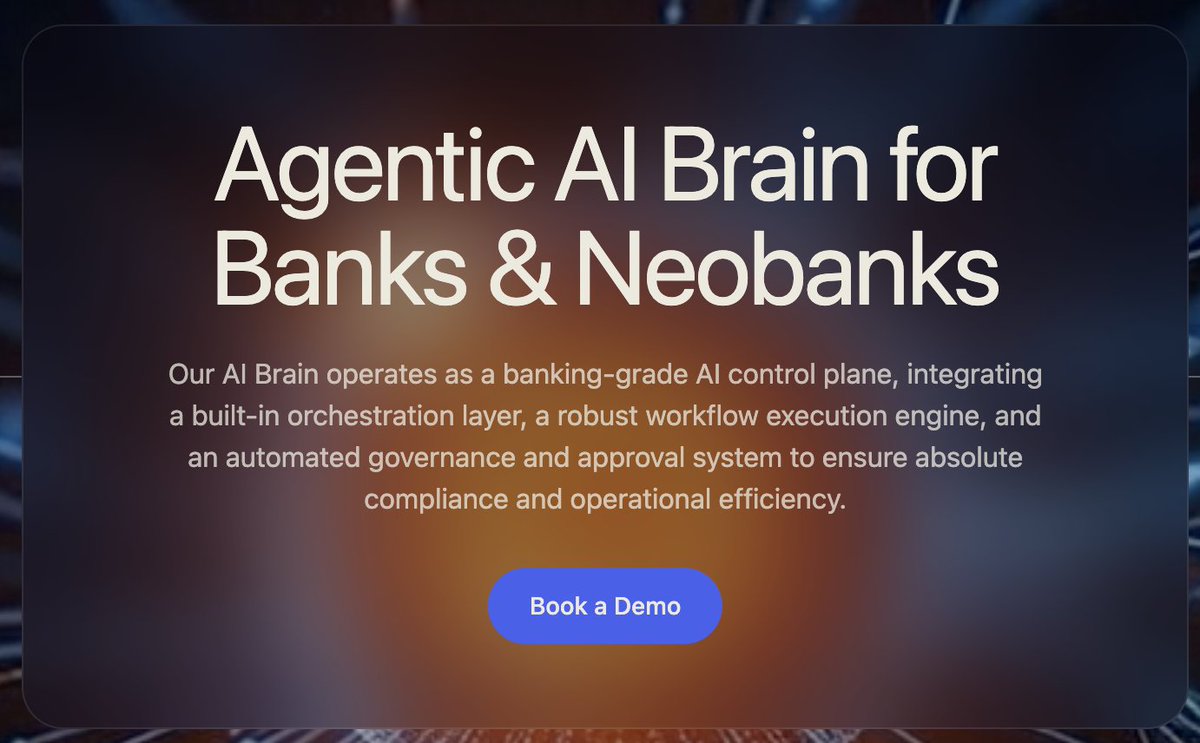
Meet Kemba; the Agentic AI Brain for Banks, Neobanks, and Payment Platforms https://t.co/j3mW6qsUXO.
By orchestrating frontier models natively with a proprietary, deterministic Core, he has engineered a platform that solves for example one of the two biggest bottlenecks in enterprise banking like:
* Zero Probabilistic Hallucinations: High-stakes corporate compliance, back-office reporting, and KYB are executed with absolute mathematical precision.
* Context Memory: An ultra-optimized, secure pipeline that compresses manual, 2-week onboarding workflows down to under 4 minutes.
When you pair elite CMU computer science with deep security development experience, you get an AI infrastructure layer that doesn't just do the work it governs it safely.
The era of experimental AI wrappers is over. The era of deterministic enterprise infrastructure is here. @fdotinc
AI can do the work.
The real question for banks and neobanks is:
Can AI be trusted to operate within governance, compliance, and operational controls?
That is where most AI projects stall.
Not because the models aren't capable.
Because banking requires oversight, orchestration, auditability, and control.
That's why we built Kemba (https://t.co/j3mW6qsn8g).
Kemba is the Agentic AI Brain for Banks & Neobanks; governing, orchestrating, and coordinating AI workers across compliance, operations, customer service, risk, payments, and enhance front-office customer experience.
In banking & finance, adoption doesn't happen when AI gets smarter.
It happens when AI becomes controllable. @fdotinc
One of the biggest mistakes I see in banking today is not rejecting AI.
It’s delaying it.
“We’ll think about AI later.”
“Our customers seem happy.”
“Our current infrastructure works.”
That mindset is more dangerous than most executives realize.
Because customers don’t always know what they need until someone shows them a better way.
Nobody asked for ride-sharing before Uber.
Nobody asked for streaming before Netflix.
And most banking customers won’t ask for AI-powered banking because they haven’t experienced it yet.
Meanwhile, a new generation of fintechs is quietly redefining customer expectations.
Take Slash, for example.
While many financial institutions are still discussing AI strategies in boardrooms, Slash has embedded AI agents directly into banking operations. Their AI assistant can execute financial tasks, automate workflows, manage spending, and help operate financial back offices. The company has grown rapidly while maintaining extraordinary operational efficiency. (TBPN Digest)
The lesson isn’t that every bank should become Slash.
The lesson is that AI is no longer a future initiative.
It’s becoming the operating system of modern financial institutions.
The real risk isn’t trying AI and failing.
The real risk is waiting while competitors build faster onboarding, smarter compliance, lower operating costs, better customer experiences, and entirely new financial products.
By the time customers start demanding AI-powered experiences, it may already be too late.
This is exactly why we are building Kemba (https://t.co/j3mW6qsn8g).
Kemba is an Agentic AI Brain for banks and neobanks.
Not another chatbot.
A governed AI layer that orchestrates, supervises, and automates financial AI workers across KYC, compliance, operations, fraud, customer service, lending, treasury, and more.
Because the future winners in banking won’t be the institutions with the most employees.
They’ll be the institutions with the most effective AI workforce.
The question is no longer whether AI will transform banking.
The question is:
When your competitors are operating with AI workers across every department, what happens if you’re still relying on yesterday’s operating model?
https://t.co/W0mqilllYh
In banking, knowledge often leaves when the employee does.
That’s institutional amnesia and it costs banks millions in lost context, manual re-work, and repetitive mistakes.
At Kemba AI Brain, we’re turning that tribal knowledge into Institutional Memory.
We aren't just building a chatbot; we're building an Agentic Brain that connects to your core systems, maps your historical decisions, and makes that expertise accessible across the organization 24/7.
From instant regulatory mapping to cross-system workflow orchestration, we help banks remember what they’ve learned so they can move faster.
Stop losing your edge every time someone hits the exit. Build the infrastructure that actually remembers. https://t.co/j3mW6qsn8g backed by @fdotinc
Most banks are stuck in pilot purgatory with AI.
78% use it. Only 7% have actually scaled it.
The barrier isn't the models; it’s the legacy infrastructure and the lack of governance.
At Kemba AI Brain, we’re moving banks past the pilot phase. We don’t just show what’s possible; we build the infrastructure to make it permanent.
https://t.co/Io0x1YkbVN backed by @fdotinc
In 2026, the competitive edge isn't fast processing; it’s Agentic Loans.
We are moving from Fill out this 12-page form to Here is my intent. AI agents now plan, underwrite, and fund autonomously, cutting per-loan costs by up to 40% while hitting sub-60-minute disbursement times.
The shift for Execs:
* AI is the UI: No more complex menus. Conversational intent replaces the application portal.
* Transactional Authority: Agents that reason through compliance and risk, rather than just flagging data.
* 10x Banking: Elevating your staff from paper-pushers to Agent Operators who handle only the most nuanced escalations.
If your loan process still feels like a tax audit, you're leaving alpha on the table.
Don't just digitize the process; give it a brain; Kembas OS.
We are entering the era of Agentic Payments where your customers no longer hunt for menus or fill out forms. They simply state an intent, and an AI agent orchestrates the transaction autonomously.
Why Bank & Neobank Execs should care:
- From UI to Intent: AI isn't just a chatbot anymore; it’s a transaction layer. It bridges the gap between "I want to pay" and "Payment confirmed" across fragmented rails.
- Efficiency: Agentic flows can reduce operational costs by up to 40% by automating routine back-office exceptions and KYC triggers in real-time.
- Machine-to-Machine Economy: With tokenized credentials and Web Bot Auth, your bank can safely settle payments initiated by AI agents, not just humans.
The future of banking isn't a better app; it's an invisible, intelligent engine that acts on behalf of the user.
Are your rails ready for the agents with Kemba OS backed by @fdotinc ?
This May 1st, let’s honor the invisible labor in banking.
The manual KYC checks, the back-office triage, and the 2 AM reconciliations.
The true ROI of AI isn't just efficiency; it’s the end of burnout. Let’s use agents to handle the volume so our best people can focus on the value.
Kemba OS for banks, neobanks and prediction markets.