My talk from @BEE_Ox_2020 now available to watch on youtube!
Sexual coercion and harassment is incredibly common in the animal kingdom. What's the best strategy to resist it?
https://t.co/K5PKzmgD8f
*****Paid field assistants urgently needed*****
We are looking for two people who can assist with installing soil respiration collars at FarmED (north Oxfordshire) on Wednesday this week.
*****Please contact me if you're interested*****
I'd like to introduce pykanto, a new Python library that could be helpful for researchers who work with large animal vocalization datasets recorded in the field.
You can read the preprint here: https://t.co/mQ0MgIZ2qv
And here's a thread for more information 👇🧵
Please RT: I’m hiring a full-time researcher to help me study cooperation in a captive vampire bat colony in Columbus, Ohio, USA. ~$65K with benefits for 5+ years, renewal pending funding every 5 yrs. Job has some flexibility to needs/skills. More info: https://t.co/zi0NWCNwG5
POSTDOC position available! Work on our @ERC_Research FriendOrigins project to explore the function and ecological drivers of social relationships and the best methods to quantify them. Apply: https://t.co/PuAhfDk3oy. Read more: https://t.co/ALt5yOPy0S. Deadline: Mar 16 ‘23
Our paper on the #RoboFinch - a robotic #zebrafinch - is out today in @MethodsEcolEvol. We describe in detail how the #RoboFinch was produced (everything is open source) and how young birds reacted to it (spoiler: they loved him). 🐦🤖
https://t.co/qAGJnJ4YqL
(1/3)
Come work with the @AmboseliBaboons in the @ArchieLab ! Our database managers help manage our relational database, Babase (>50 years of long-term baboon data) and are an essential part of our team.
Homeopathy can offer empirical insights on treatment effects in a null field https://t.co/6PS49Gh2Bx Using homeopathy data is an interesting approach for studying bias, as any effects are pure bias. This ES distribution *should* be highly bunched around 0 but the mean is 0.36!
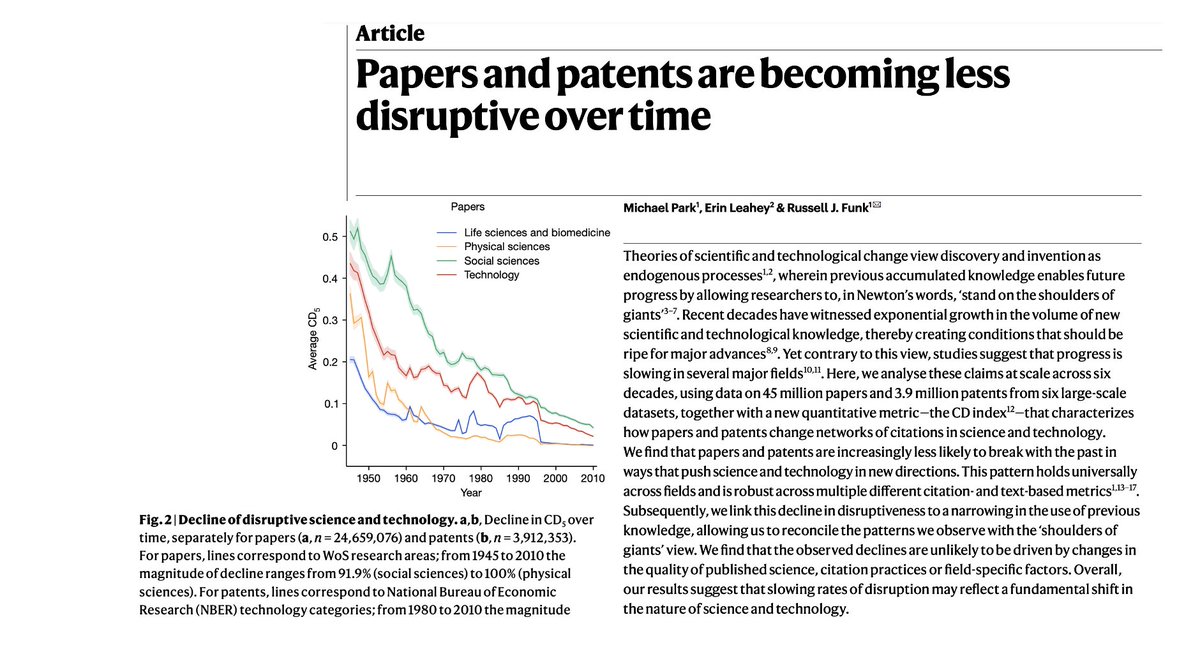
The newsletter this week is about that recent Nature paper on how the average “disruptiveness” of science is on the decline. I did not find it convincing: https://t.co/2jyJHICJvR
Thanks @sse_evolution! Stay tuned for results from my pet project on the genetic architecture of genital morphology, constraints on sexually antagonistic selection, and speciation in leps
Register for Free for the @RoyalSociety meeting on "Understanding Age & Society Using Natural Populations" 27-28th Feb, London UK.
Poster Submissions (for any posters on ageing or sociality) closes 20Jan:
https://t.co/pDaAqzKGpe
⬇️Confirmed Schedule & Invited Speakers⬇️
Looking for a summer internship? The University of Oxford is offering 7-week paid internships (£££ + free accommodation). Exciting projects in biology (including the evolution of cooperation with me & @StuWest8)
https://t.co/eiUeIBmo8f
Deadline 17th Feb
@OxfordBiology@OxfordUNIQ
Excited that this pre-print is now out in Behaviour Research Methods! @Psychonomic_Soc
GoFish: A low‐cost, open‐source platform for closed‐loop behavioural experiments on fish
https://t.co/MFLTxWRfop 🚨
🧵
New #MetaAnalysis out in @PLOSBiology suggesting that #SexualSelection in females might be more widespread than often assumed – even in species with “conventional” sex roles!
https://t.co/ZYf9994IUM
1/4
New Nature paper provides evidence that science has become less innovative since the 1950s. The authors suggest reversing the trend by:
1. reading widely,
2. focusing less on quantity of papers, & more on research quality,
3. taking year-long sabbaticals.
https://t.co/oYV5JCXRl8