Our community has had 3 weeks to tinker with Inkling 2 Small, and they didn't disappoint.
First up: @emeraldant trained it to fix network weights without overthinking by 10,000 tokens each time, and published a great writeup of what worked and what didn't.
We trained an open model to do weight-space programming.
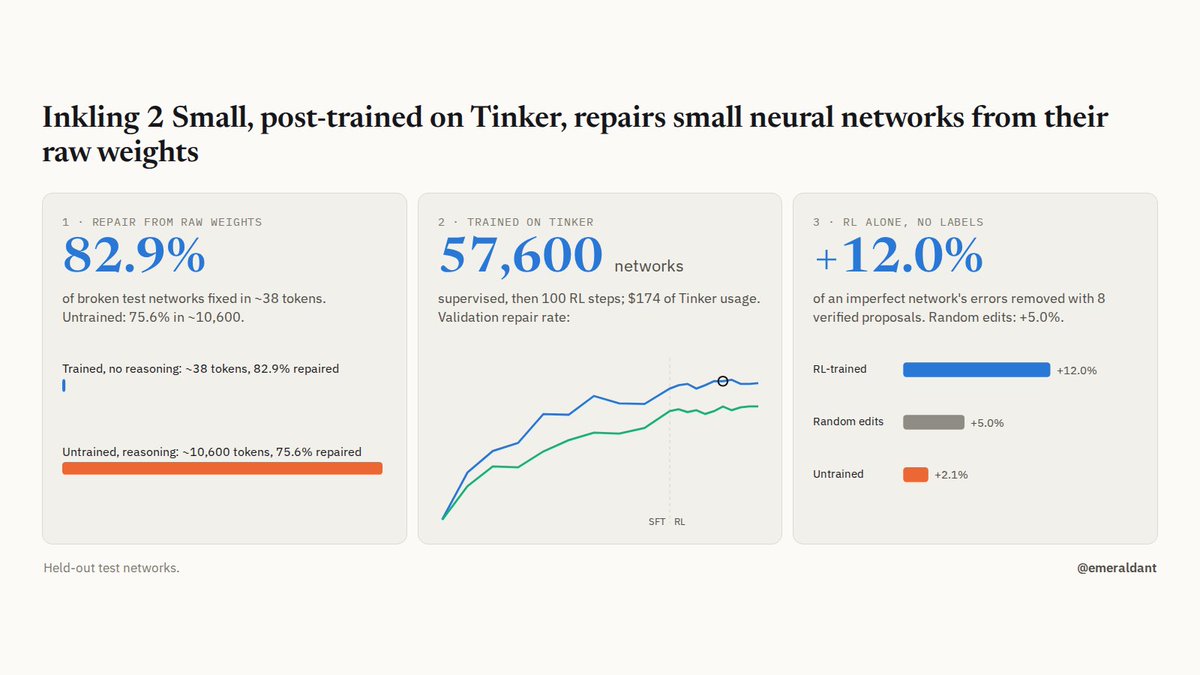
@thinkymachines’ Inkling 2 Small, post-trained on @tinkerapi, repairs broken networks from their raw weights in ~40 tokens, no reasoning. In the tokens it needed untrained to fix one, it now answers 207 and repairs 176.
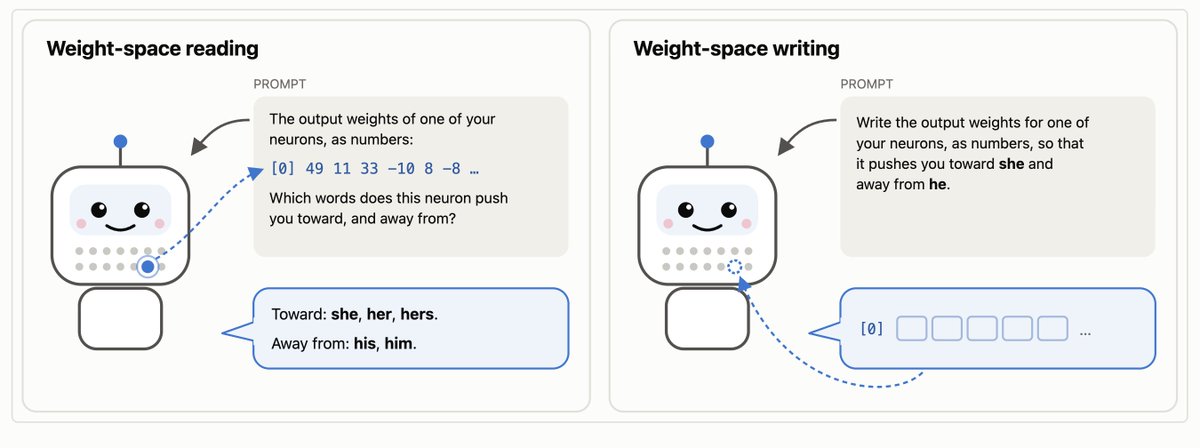
The first post of this series defining "auto-weight space programming" is out. We SFT Qwen3.5-4B and other models to apply logit lens on raw weights passed as numbers in the prompt, achieving 99.8% accuracy 🧵
https://t.co/JpJnOlTXTK
The first post of this series defining "auto-weight space programming" is out. We SFT Qwen3.5-4B and other models to apply logit lens on raw weights passed as numbers in the prompt, achieving 99.8% accuracy 🧵
https://t.co/JpJnOlTXTK
@thinkymachines@tinkerapi@rikiyatakehi@jayden_teoh_@a1zhang@lateinteraction@withbeaker I think it's an exciting result in terms of showcasing the possibility of post-training WSP capabilities, but still super early.
I think the future of AI alignment could be large swarms of weight-auditing mech-interp agents, so hillclimbing WSP capabilities is super important.
@thinkymachines@tinkerapi Like many critics of the original viral post mentioned, it is unclear how this actually transfers to real models right now.
13 public image classifiers: no well-trained one improved. On Qwen3.5-0.8B our edits lift MATH-500 from 8% to 37-38%, but so does a random edit.
@thinkymachines@tinkerapi 9 of the 19, Claude Opus 5.5 and Fable 5.2 among them, kept reasoning past 512 tokens, so they have no fair score there.
Given 20,000 tokens, every model fixes 90%+ of what it finishes. Of the open ones, Muse Spark Open finishes most: 84%, level with ours at ~200x the tokens.