ReShiki v0.7.1 is out!
ReShiki is a free, open-source structure editor with a built-in AI assistant.
Now in v0.7.1: Copy an image of a structure or scheme, paste it, press Send. You get real, editable molecules back.
macOS · Windows · Linux
Try it at https://t.co/dN4xpHDnIh
I just released ReShiki v0.6.1, a free, open-source alternative to ChemDraw.
Chemical drawing, reinvented.
Built in Rust for macOS, Windows, and Linux. Draw molecules, build reaction schemes, and export figures.
Try it: https://t.co/CrYQ1alzHT
RinPy, a Python Package for Residue Interaction Network Model to Analyze Protein Structures and Predict Ligand Binding Sites
https://t.co/6U1ORqesTb
#JCIM Vol66 Issue15 #Bioinformatics
A new protein design optimization framework from the Baker Lab: RFOptimization.
Instead of generating more candidates, it rescues near-miss designs through RF3-guided mutation, Boltz/MPNN cycling, and AF3 filtering—boosting PPI success from 6.7% to 22.3%.
Preprint: https://t.co/tVl9fofyiU
A fast method for building phylogenetic trees with millions of sequences and then a model that leverages the tree structure to predict viral protein evolution!
@ivanspecht@SeyoneC@driscoll_cl@garykbrixi@BrianHie
Assessment of generative de novo peptide design methods for G protein-coupled receptors
https://t.co/FTi7WRHS4q
GPCR向けペプチド設計のベンチマーク。AlphaFold2 Initial Guess/Boltz-2/RosettaFold3で検証プロセスを、BindCraft/BoltzGen/RFdiffusion3で生成能力をそれぞれ評価してます。
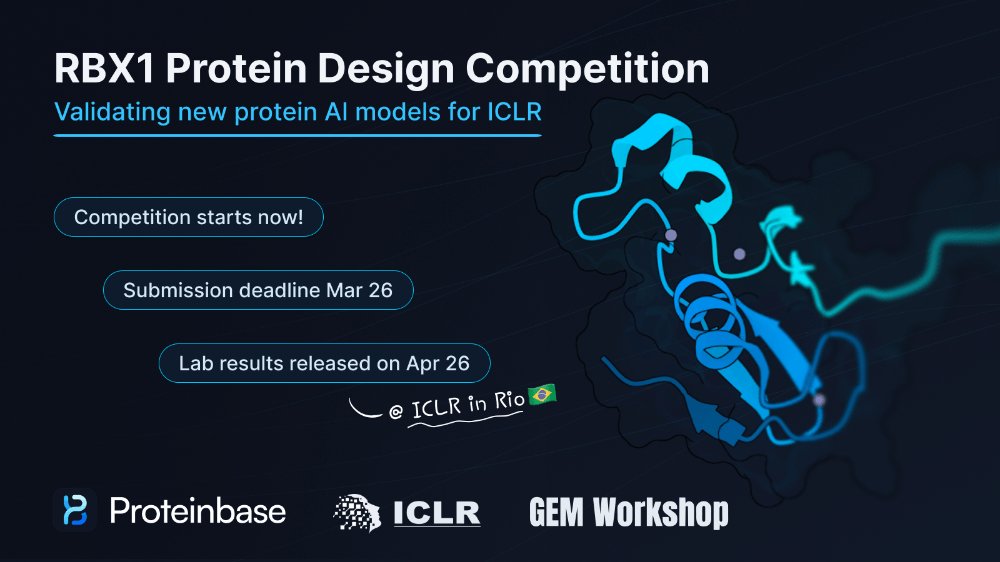
Submissions are open for the GEM x @adaptyvbio RBX1 Binder Design Competition 🧬
We're partnering with the GEM Workshop at ICLR 2026 for a new protein design challenge. The target is RBX1, a 108-amino acid component of Cullin-RING E3 ubiquitin ligase complexes, which control degradation of roughly 20% of all cellular proteins. In many cancers, this protein is overexpressed and degrades important tumor suppressing proteins. Disrupting RBX1's function with a de novo designed binder could slow down cancer cell proliferation.
But RBX1 is a tricky design problem. Half the protein is an intrinsically disordered N-terminus so it has limited use for structure-based design methods. The part you actually need to bind, the E2 recruitment surface on helix α2, sits within a RING domain with an usual fold that is shaped by three coordinated zinc ions.
How it works:
- Submit up to 100 ranked binder sequences (≤250 aa) with a design method description on Proteinbase till March 26
- An expert panel from the GEM workshop selects 300 designs based on novelty and originality
- We test all 300 for expression and binding affinity in the @Adaptyv Bio lab
- Experimental results will be released April 26 at ICRL 2026 in Rio de Janeiro and open-sourced on Proteinbase
Prizes: $1,000 for the best binder, $100 for the runner-up, and co-authorship on the results paper.
🥶 TEMPO | Um gelo! Semana com frio de até 5°C abaixo de zero no Rio Grande do Sul na madrugada mais fria até agora do ano em parte do estado. Veja as mínimas de hoje. ▶️ https://t.co/vOpggt6rlE
CyclicBoltz1, fast and accurately predicting structures of cyclic peptides and complexes containing non-canonical amino acids using AlphaFold 3 Framework
https://t.co/NoqTOdFwB9
#biospace
AI-assisted protein design to rapidly convert antibody sequences to intrabodies targeting diverse peptides and histone modifications
https://t.co/yDlNm2jBYp
CyclicBoltz1, fast and accurately predicting structures of cyclic peptides and complexes containing non-canonical amino acids using ... https://t.co/hHMZHCXwNV #biorxiv_bioinfo
De novo design of anti-venoms!
https://t.co/UJOXtw1zcn
@UWproteindesign
I highly recommend this book to anyone interested in the biochemistry of venoms:
https://t.co/ReB1TbZrwH