We just launched a new video course on how to get started building with Computer Use, in collaboration with @DeepLearningAI.
It's the first real course we've made on Computer Use, highly recommend checking it out!
There are 3 main buckets in life:
1. Health
2. Purpose
3. Connection
If you have a fit body and mind, a reason for living, and amazing friends and family?
You're wealthier than 99% of people.
Respect is earned not given. I will truly only focus henceforth on replying back to people deserving of interaction.
The rest I will either ignore or block. I have 0 time left to waste.
In the time to come over the next few months is also important to be focused and cancel out lost of noise.
We need real men more than ever, to design, to engineer, to build, to inspire.
Men that can make decisions, men to say no to their kids, men to take care of things, men to re-imagine the world of tomorrow.
Hard times create strong men, strong men create good times.
Multi-agent collaboration has emerged as a key AI agentic design pattern. Given a complex task like writing software, a multi-agent approach would break down the task into subtasks to be executed by different roles -- such as a software engineer, product manager, designer, QA (quality assurance) engineer, and so on -- and have different agents accomplish different subtasks.
Different agents might be built by prompting one LLM (or, if you prefer, different LLMs) to carry out different tasks. For example, to build a software engineer agent, we might prompt the LLM: "You are an expert in writing clear, efficient code. Write code to perform the task …".
It might seem counterintuitive that, although we are making multiple calls to the same LLM, we apply the programming abstraction of using multiple agents. I'd like to offer a few reasons:
- It works! Many teams are getting good results with this method, and there's nothing like results! Further, ablation studies (for example, in the AutoGen paper cited below) show that multiple agents give superior performance to a single agent.
- Even though some LLMs today can accept very long input contexts (for instance, Gemini 1.5 Pro accepts 1 million tokens), their ability to truly understand long, complex inputs is mixed. An agentic workflow in which the LLM is prompted to focus on one thing at a time can give better performance. By telling it when it should play software engineer, we can also specify what is important in that subtask: For example, the prompt above emphasized clear, efficient code as opposed to, say, scalable and highly secure code. By decomposing the overall task into subtasks, we can optimize the subtasks better.
- Perhaps most important, the multi-agent design pattern gives us, as developers, a framework for breaking down complex tasks into subtasks. When writing code to run on a single CPU, we often break our program up into different processes or threads. This is a useful abstraction that lets us decompose a task -- like implementing a web browser -- into subtasks that are easier to code. I find thinking through multi-agents roles to be a useful abstraction.
In many companies, managers routinely decide what roles to hire, and then how to split complex projects -- like writing a large piece of software or preparing a research report -- into smaller tasks to assign to employees with different specialties. Using multiple agents is analogous. Each agent implements its own workflow, has its own memory (itself a rapidly evolving area in agentic technologies -- how can an agent remember enough of its past interactions to perform better on upcoming ones?), and may ask other agents for help. Agents themselves can also engage in Planning and Tool Use. This results in a cacophony of LLM calls and message passing between agents that can result in very complex workflows.
While managing people is hard, it's a sufficiently familiar idea that it gives us a mental framework for how to "hire" and assign tasks to our AI agents. Fortunately, the damage from mismanaging an AI agent is much lower than that from mismanaging humans!
Emerging frameworks like AutoGen, Crew AI, and LangGraph, provide rich ways to build multi-agent solutions to problems. If you're interested in playing with a fun multi-agent system, also check out ChatDev, an open source implementation of a set of agents that run a virtual software company. I encourage you to check out their github repo and perhaps even clone the repo and run the system yourself. While it may not always produce what you want, you might be amazed at how well it does!
Like the design pattern of Planning, I find the output quality of multi-agent collaboration hard to predict. The more mature patterns of Reflection and Tool use are more reliable. I hope you enjoy playing with these agentic design patterns and that they produce amazing results for you!
If you're interested in learning more, I recommend:
- Communicative Agents for Software Development, Qian et al. (2023) (the ChatDev paper)
- AutoGen: Enabling Next-Gen LLM Applications via Multi-Agent Conversation, Wu et al. (2023)
- MetaGPT: Meta Programming for A Multi-Agent Collaborative Framework, Hong et al. (2023)
[Original text: https://t.co/4gTbcQfikx ]
#Bitcoin this how good is this predictor of Price. You combine hodling time of new and old Bitcoiners, hash rate, addresses and you get the price almost 1 to 1 (the n above is how proportional the predictor is to the price).
It is pretty astonishing. Price is basically due to these onchain parameters almost exclusively.
Probably price also affects these parameters this why it is still not yet a perfect 1 to 1.
PS
Notice introducing issuance or any other measures related with supply doesn't help the model at all.
The Yen carry trade is blowing up in front of us and #Bitcoin is trading above $71,000
Few understand this (mainly because it's nerdy as hell)
But it's a big deal.
And every investor should at least kind of get it to grasp what's really going on with their portfolio.
In simple terms: Japan has kept interest rates artificially super low for over a decade.
Even lower than the US and Europe.
That forced Japanese investors to invest overseas to seek better returns.
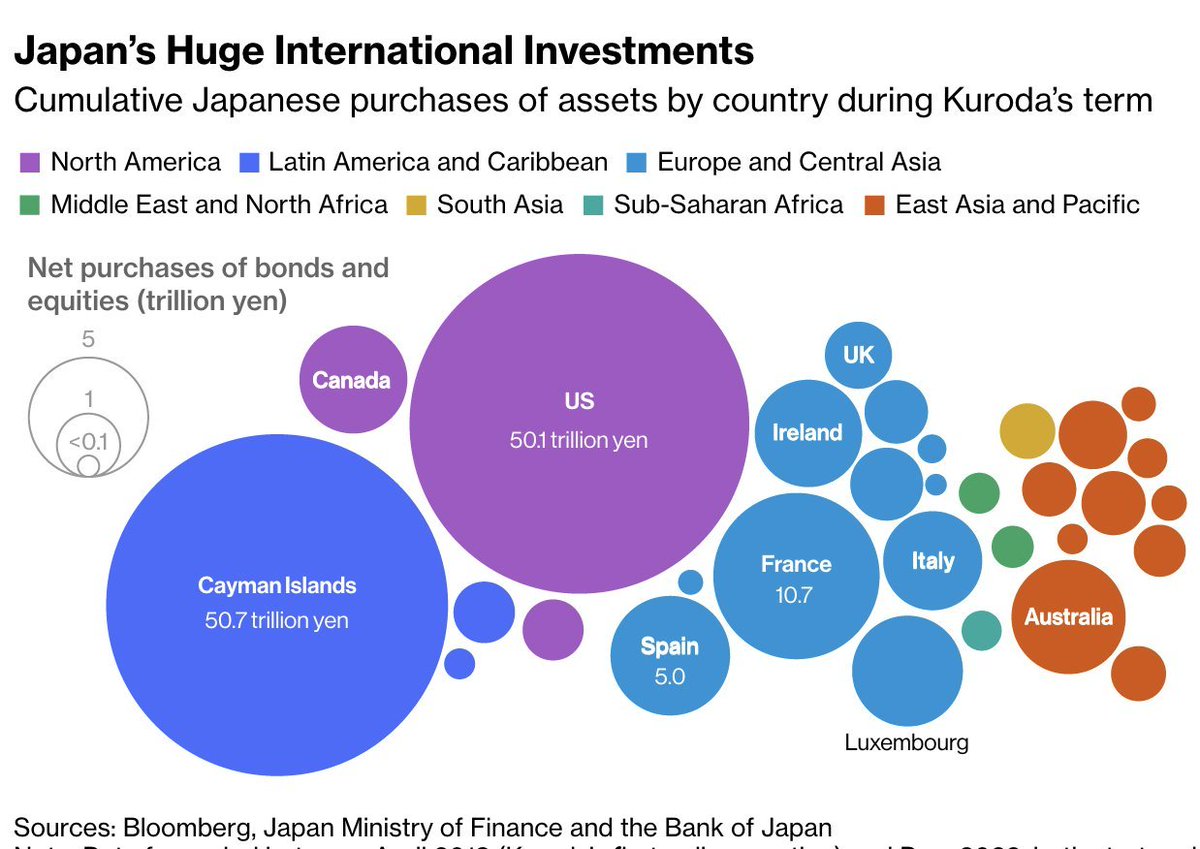
Over $3 Trillion found its way into overseas markets, pumping up asset prices and keeping US and EU borrowing costs artificially low as they happily deficit spent.
What were the Japanese investors buying?
Mainly US and European bonds to get better yields than they could get at home.
But since they live in Japan, they care about their returns in Yen terms - not dollar or euro terms.
So they had to hedge their foreign investments to protect themselves in the case of currency volatility.
Why?
Because if you buy a European bond and the Euro suddenly crashes vs the Yen, you could end up losing in Yen terms.
So you buy some insurance for that scenario and pay a premium to protect against that risk.
That works fine until Yen volatility increases.
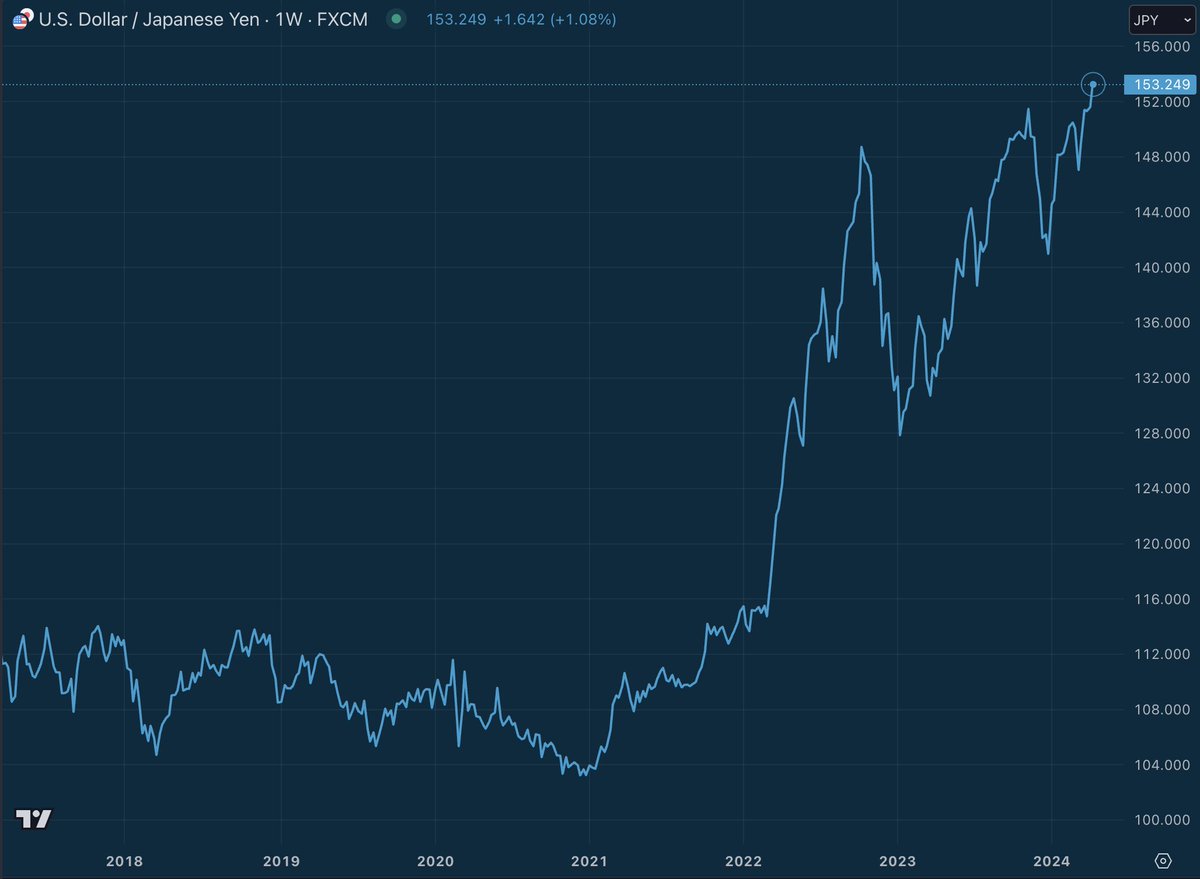
Which is exactly what is happening now:
As currency volatility increases, the insurance to protect against it gets more expensive.
The insurance starts to eat into the returns you could get by holding US and EU bonds.
So what do you do?
You sell the foreign bonds when they no longer earn you more than holding a Japanese bond.
And if the Japanese bond yields are rising, then that also increases their relative attractiveness.
Which is ALSO happening now, and needs to happen even more to protect the Yen from devaluing too much.
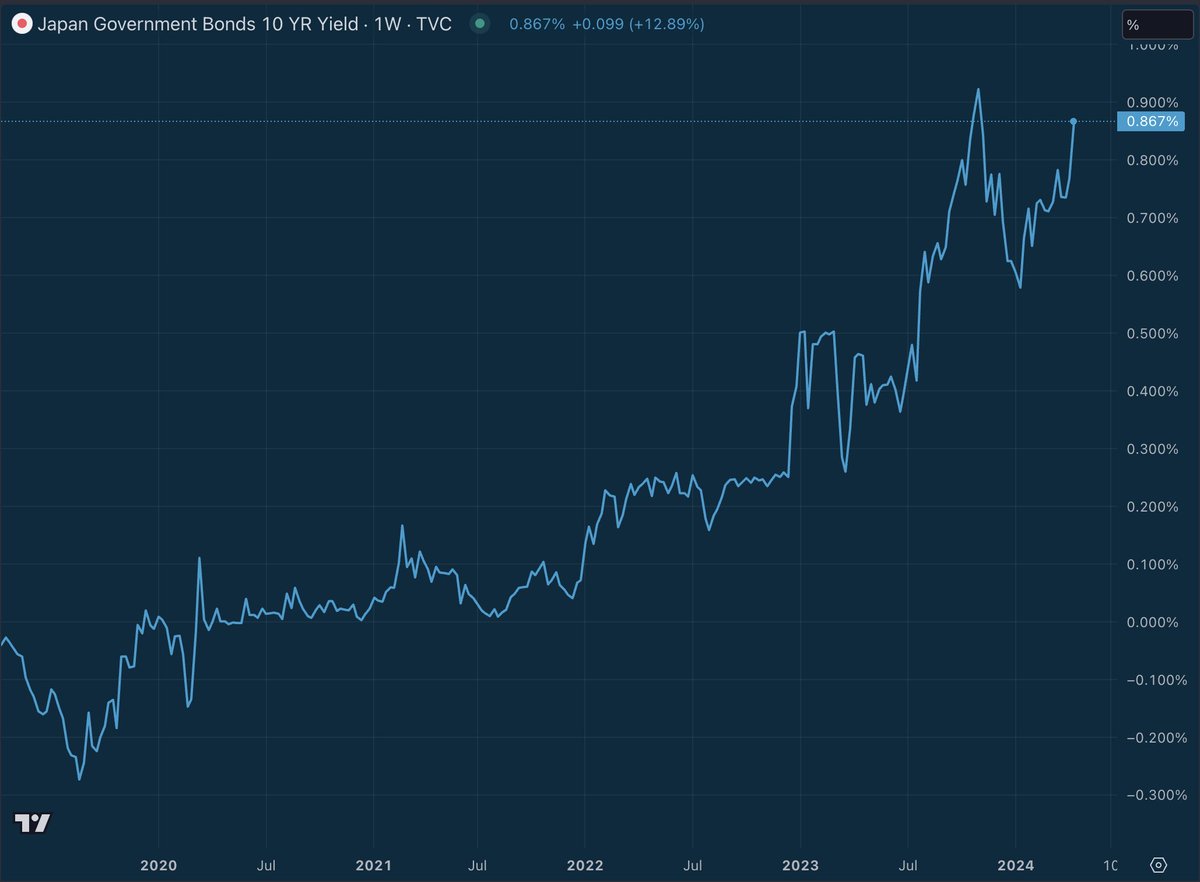
Japanese bond yields are surging towards decade+ highs as I type this:
This is why people care about the Yen and Japanese government bonds.
When Yen volatility rises and Japanese government bond yields rise, investment capital flows out of US and EU bonds and back into Japan.
When investment capital flows out of US and EU bonds, then US and EU bond yields rise.
When those yields rise, highly indebted governments (like the US) start to look even more insolvent than they already look.
Why?
Because higher yields mean higher interest payments on the debt in the near future.
And considering the US is already deficit spending trillions of dollars, those interest payments can only be paid with more borrowed money.
Borrowing more money increases the bond supply, which sends yields even higher.
Which increases the interest payments further, and increases the need for the government to borrow.
Starting to make sense? It's a vicious feedback loop.
So what's the solution?
There's only one solution: When debt becomes impossible to pay in real terms, governments debase their currency to pay it in nominal terms.
And that's why this is tied to #Bitcoin
The fact that Bitcoin is rising over $70K as global bond yields once again surge indicates the market understands that higher yields simply means the timeline for currency debasement is accelerating.
It's an open secret that the fiat endgame is massive currency devaluations.
It's already happening (that's why all assets are sitting near highs), but it can accelerate.
It's all a big game of musical chairs, and investors are becoming increasingly aware that there are only 21 million seats.
When a wave of debasement hits, you want to be holding the hardest assets you can find.
And finite Bitcoin is the hardest asset.
With the recent push by BlackRock, it is increasingly perceived as the Ark for the coming fiat flood.
But there's still plenty of room left on the Ark.
So you might want to secure a seat just in case.
I’ve traveled the world for 20 years and the most common trait amongst successful people is a great damn attitude.
You can literally outperform 90% of people by being excited to serve others.
An update to the classic "what happens if you miss the 10 best days in the market" where advisors tell you that "it is not timing the market but time IN the market that matters"
But here we show the other side where you can also miss the 10 WORST days in the market.