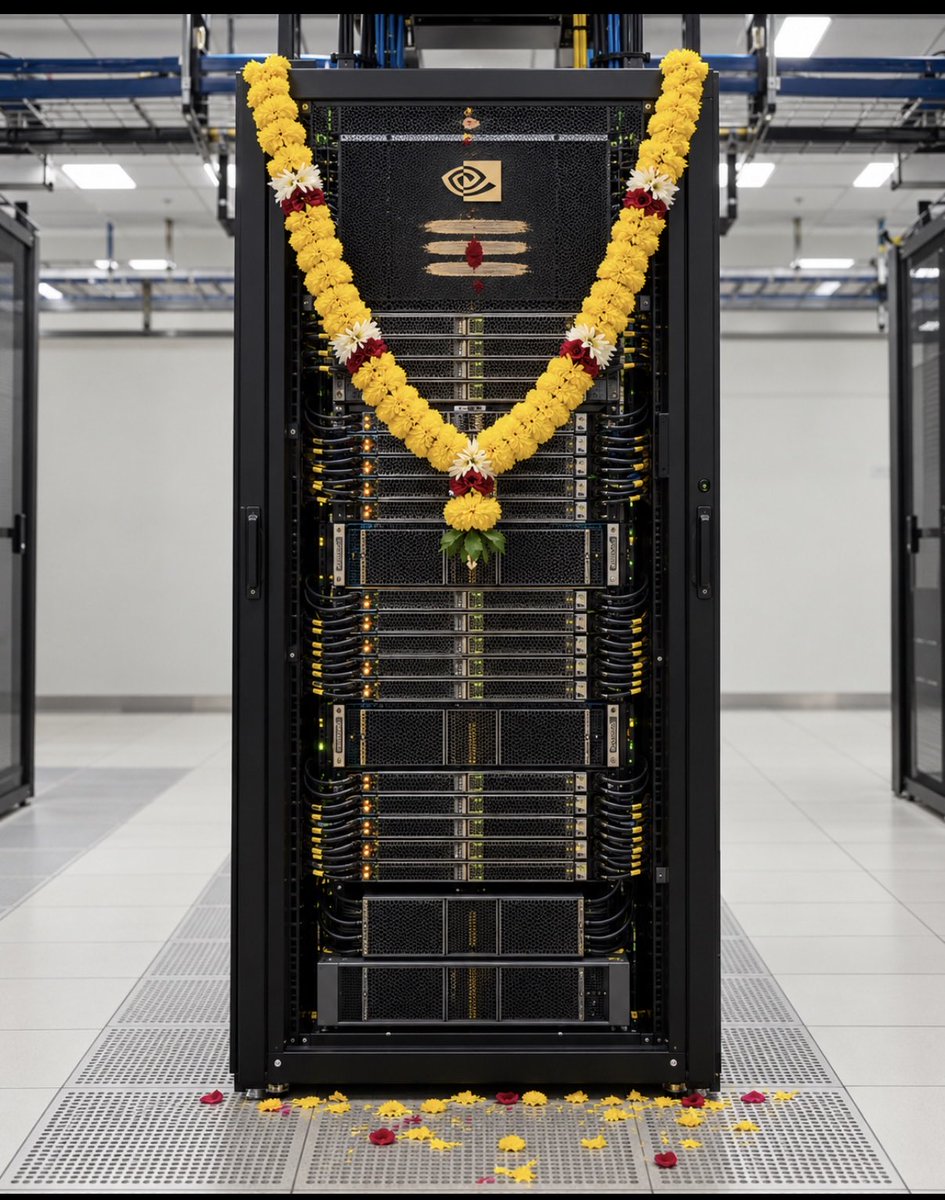
We're really, really excited: we're now serving DeepSeek V4.1 Flash at Gödel Machines, hosted in India.
1M-token context, tool calling, reasoning, and it's still free to use.
That does mean we can no longer run Qwen 3.8 27B. We don't think you'll miss it. DeepSeek is something else, and we can't wait to see what you build with it.
Hi all, I have a new result I'm excited to share. It turns out that *all existing implementations* of softmax and cross-entropy (that's JAX, PyTorch, textbooks, etc) have a subtle bug --- two bugs, actually. A simple rewrite fixes both, and eliminates "slingshots" when grokking:
@shashidigital What do you think of govt sponsored compute becoming the subsidized rail, allowing private service providers to innovate on top?
https://t.co/4B5DHnMVAF
It's great that the Indian govt is sponsoring compute capacity, but why is the last-mile UX a govt portal?
Taking lessons from UPI, govt could provide the subsidy rail as an open protocol, with private players solving the UX problem to induce rapid adoption. Wrappers could range from compute rental to tokens via hosted APIs -- and would make a competitive market for innovation.
Currently, we have precious compute locked behind hurdles, while Indian service providers innovating on UX and applications are starved of capacity.
This feels like a better architecture for what is already becoming core infra -- whether India wants to become the use-case capital of the world, or train next-gen AI models.
It's great that the Indian govt is sponsoring compute capacity, but why is the last-mile UX a govt portal?
Taking lessons from UPI, govt could provide the subsidy rail as an open protocol, with private players solving the UX problem to induce rapid adoption. Wrappers could range from compute rental to tokens via hosted APIs -- and would make a competitive market for innovation.
Currently, we have precious compute locked behind hurdles, while Indian service providers innovating on UX and applications are starved of capacity.
We reported on an important story around AI and compute demand in India earlier this week.
Question to academics, founders and VCs- why is there no demand for compute in the domestic market? So much so that govt is now allwping those empanelled with IndiaAI to sell it overseas.
Is it a question of red tape (access), paucity of capital or lack of training/consumer AI startups that need compute
(Anecdotal) I recall stories from my professors at the IIT-M telecom group about how India was being fleeced by Ericsson/etc for a long time, till we developed our own tech. And that was absolutely necessary to bring down the cost of telephony in India to something affordable & scalable.
https://t.co/2hpnpIwWFB
Fair point on usability. That's what we've been obsessing over at Jarvislabs.
Containers launch in under 2s, VMs in under 90s. InfiniBand clusters, serverless endpoints and token factories too, all built in India.
We're seeing a big jump in Indian customers on GPUs. Honestly, our biggest problem right now is compute supply, and we're actively adding more.
Try our CLI with Claude Code, Codex or OpenCode. Stuck anywhere? Email [email protected], real engineers reply.
@Kaju_Nut I like the ending where there is a suggestion of moving from "shut up and calculate" to "slow down and think". This aligns very closely with how (and I suspsect many others) think about AI in Physics