These names $FORM, $AEHR, $KEYS, $TER, $ASX, and $AMKR—should have been on your investment radar. Next year is a big testing/packaging year.
I have no idea what $COHU does. should be related to test handlers. will look at it tmr
AI Drug Discovery Is Becoming a Bottleneck Trade
I get excited when an industry starts going through a real regime change. AI drug discovery (“AIDD”) increasingly looks like one of those moments.
Two things are happening:
1/ Upstream: the frontier AI labs are piling in.
2/ Downstream: The supply chain is clearly moving.
Supply-chain checks suggest the upstream picks-and-shovels of discovery and early preclinical R&D are starting to feel the increase in experimental volume.
DNA → protein → assays → sequencing → automation → preclinical testing
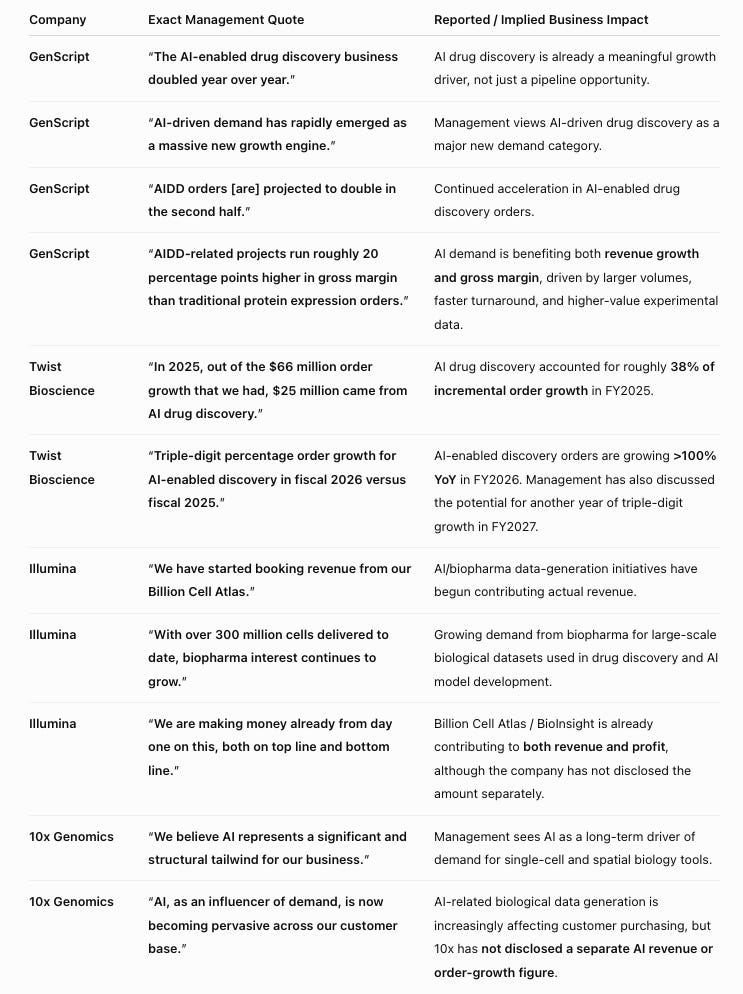
Names across that stack include $TWST , @GenScript , $ILMN , $TXG , lab-automation vendors and CROs.
$TWST expects triple-digit percentage growth in AI-enabled drug-discovery orders in FY26, and another year of triple-digit order growth in FY27.
@GenScript's AIDD business doubled YoY in 1H26. Its current platform advertises industrial-scale validation of 4,000+ designs/day, with integrated sequence-to-data workflows. Our channel checks suggest the ramp is moving even faster: roughly 8,000 designs/day currently, with a path toward ~16,000/day by YE26.
---
Why does AI drive more wet-lab demand?
1/ AI makes hypothesis generation almost free → way more shots on goal.
The bottleneck is moving from expert-driven design to biological validation.
2/ AI models need continuous experimental feedback — and both good and bad data are useful.
Traditionally, only the highest-conviction A+ candidates might get pushed into expensive validation. With AI, even the B/C candidates can be valuable because failed experiments generate training data.
@GenScript has said its sequence-to-binding workflow can return data in 4–7 days, and that faster cycle times matter because AI models depend on continuous experimental feedback.
@Anthropic is a clean example. @claudeai designed 1,320 protein binders. @adaptyvbio converted those digital sequences into DNA, expressed the proteins and tested binding. Only 354 actually bound. And the 966 failures are not wasted. They are useful negative labels: what does not express, what does not bind, what has poor affinity. Those results help train the next model iteration.
3/ Wet labs are no longer just making drugs. They are making training data.
$TWST / @GenScript increasingly look like biological data foundries.
$TWST explicitly talks about generating model-ready data from AI-designed sequences. In some workflows, the customer may care less about receiving the physical protein than about getting structured experimental results back into the model.
Traditional drug discovery asks: “Does candidate X work?”
AI drug discovery also asks: “What can this experiment teach the model?”
---
TAM of AIDD
If AI is simply a better R&D tool, the relevant spending pool is the $300–400B of annual global pharma R&D. If AI meaningfully increases the number of viable drug programs, the opportunity is larger because it expands downstream demand for DNA synthesis, protein production, assays, and preclinical work.
Near term, we can also size demand from AI-company spending. If Anthropic reaches $80B of ARR in 2026 and spends just 1% on AIDD, that alone would imply ~$800M of annual investment.
---
Trade setup
This is a trade that could have long legs. It’s hard to really stop working until PhaseI/II results (2028+)
It smells a lot like the bottleneck trade we just saw in semis: GPUs → HBM → networking → power/cooling. In biology, It basically follows the drug discovery process downstream: AI models → designs → DNA/protein → assays → preclinical capacity.
After the upstream picks-and-shovels, animal testing could become the next bottleneck. Monkey prices are already near prior highs and CRO capacity is tight. AIDD pushing more candidates into preclinical development would only add demand.
?? But clinical trials are still the bottleneck?
This is the biggest pushback I keep coming back to. No matter how fast discovery becomes, drugs still need to go through preclinical → Phase I → Phase II → Phase III → approval. You still need patients, time and capital.
But that doesn’t mean the bottleneck trade won’t work. More viable candidates — especially with higher success rates — still means more demand throughout the development process.
And who knows: clinical trials themselves may eventually be optimized by AI.
?? What breaks the trade?
Near term, the picks-and-shovels trade breaks if experimental budgets stop growing, AI-generated designs don’t translate into useful wet-lab hits, or capacity catches up too quickly.
Longer term, the thesis breaks if AI drugs look great in discovery / Phase I but fail at normal rates in Phase II/III. That is why Phase II matters so much.
?? Milestones
Late 2026–2027: first Isomorphic-designed drugs enter human trials; more AI-native programs move into IND-enabling work / tox.
2028–2030: clinical trial results start telling us whether AI-designed drugs actually perform better than conventional drugs.
Calling all the "bottleneck bros". :) @jukan05@zephyr_z9@aleabitoreddit@ParadisLabs
+++
More comprehensive analysis: https://t.co/vaTuiyyYB6
For sell into strength, I use the distance from 5D MA as a way to measure if it needs cool down.
For buy pullbacks, I often use gap support, previous ATH, 8 week EMA, 21D/50D EMA, previous breakout point, previous lows in head&should lows/double bottom pattern as the buy entry.
AI stocks on my watchlist, currently at compelling prices:
$NVDA — Massively undervalued compared to $AMD which is ludicrous in my opinion. Been working on a proper “research” style post for more nuanced thoughts.
$ALAB — Expensive name based on traditional metrics, but will keep printing thanks to Nvidia and AMD + hyperscalers.
$BE — Pretty rare to find any AI related company rn that’s not capacity / order constrained like Bloom. Earnings recently were huge at first $1B+ quarter, and they’ll keep on growing.
$BESI — Ongoing hybrid bonding growth, especially for HBM4E/HBM5 roadmaps. I think there’s a huge order wave coming.
$CIEN — Inter-DC bandwidth constraints (along w/ compute and power) which Ciena’s solving. Backlog of $7.7B w/ ~80% converting to rev within 1Y is chunky.
$GFS — Turnaround trade at depressed valuations.
Kioxia — Priced for cyclicality, which gets removed mainly through LTAs forming the backbone of fwd earnings. 800B yen buyback too.
$NOK — Feels like ~36% down is too much. AI & Cloud segment is compounding around triple digits at legacy telco multiples lol. DC optics shift for Nokia has been un-priced in after the sell-off imo..
SK Hynix — Same as Kioxia basically. I recommend watching the CNBC video I mentioned on Friday, very cool.
---
All of these names are current holdings in my portfolio, just at more compelling prices after the July sell-off.
Apart from GlobalFoundries which would probably just be a swing trade if all goes well.
NFA - just posting ideas in case anybody was interested and wanted to do some independent DD / analysis.