Looking for free ways to access AI? Your company or university likely provides secure access through their purchase of @Microsoft 365. Follow the steps in this video to access the latest models. #AISafety#Copilot#AppliedAI
this is the future of education
teachers vibe coding interactive apps with custom 3D models instead of boring slides.
Make your own assets with Tripo this way 👇
Fun interactive science app ideas | Part 3
Played around with generating 3D biological structures and made an app to explore them interactively
UI Design
GPT Images 2
Code
Gemini 3.1 Pro
More demos ↓
10 things I'm seeing on the frontlines of AI adoption in the enterprise:
1. Chat is where 90% of employees still live. It's the gateway drug. Everything else is downstream of getting people comfortable here first.
2. Power users discover Cowork and lose their minds. It's the "wait, it can actually do the work?" moment.
3. Claude Code has very little penetration with non-technical users in the enterprise still.
4. Microsoft being the "approved" tool doesn't matter. Employees route around Copilot and pitch their managers for Claude access on their own.
5. Artifacts in Claude are a breakout feature. People don't want to view them — they want to deploy them, connect them to Snowflake, etc., ship them as internal MVPs for their org to actually use.
6. Cowork is crossing the line from "demo" to "real work." Legal teams redlining contracts. Ops teams running workflows. Then immediately asking: how do I automate this for production?
7. The next unlock → automated cloud workflows that leverage an agent like Claude while keeping non-technical users within the tools they're already using and in a chat interface. The demand is screaming.
8. Terminology is major blocker. Projects vs. skills vs. plugins vs. agents. I've explained "what is a skill" 200+ times. The moment it clicks, people get excited — but the path there is too long.
9. Enterprise IT restrictions (locked connectors, no browser access) quietly strip Cowork of its superpowers. The features that make it magical are the first ones IT disables.
10. There is a high level of "AI insecurity". For the first time in a long time, people at all levels (even C-Suite) need to signifcantly upskill in order to stay world class in their positions, and this is causing people to be insecure about their skill set across the org.
General note on Microsoft: I spent a lot of this past week deep in Power Automate and Copilot Studio trying to build an automated solution in the cloud — given it's the native tool with sanctioned access to their org's data.
It's ~90% there. But the final 10% is riddled with terrible UX, inconsistent behavior, and a generally poor experience.
Honestly feels like Microsoft is fumbling the biggest moment in their company's history with software that has all the features on paper but lacks the magical "just works" moment for non-technical team members. The gap is wide open and they're letting others
"eat their lunch" right now.
Free @Replit usage all day tomorrow, May 2nd! Please sign up with my link: https://t.co/AU0ePkSl13 - If you've ever wanted to see how AI works at the highest level, now is the time to give it a try.
prediction re the end of spreadsheets
AI code gen means that anything that is currently modeled as a spreadsheet is better modeled in code. You get all the advantages of software - libraries, open source, AI, all the complexity and expressiveness.
think about what spreadsheets actually are: they're business logic that's trapped in a grid. Pricing models, financial forecasts, inventory trackers, marketing attribution - these are all fundamentally *programs* that we've been writing in the worst possible IDE. No version control, no testing, no modularity. Just a fragile web of cell references that breaks when someone inserts a row.
The only reason spreadsheets won is that the barrier to writing real software was too high. A finance analyst could learn =VLOOKUP in an afternoon but couldn't learn Python in a month. AI code gen flips that equation completely. Now the same analyst describes what they want in plain English, and gets a real application - with a database, a UI, error handling, the works. The marginal effort to go from "spreadsheet" to "software" just collapsed to near zero.
this is a massive unlock. There are ~1 billion spreadsheet users worldwide. Most of them are building janky software without realizing it. When even 10% of those use cases migrate to actual code, you get an explosion of new micro-applications that look nothing like traditional software. Internal tools that used to live in a shared Google Sheet now become real products. The "shadow IT" spreadsheet that runs half the company's operations finally gets proper infrastructure.
The interesting second-order effect: the spreadsheet was the great equalizer that let non-technical people build things. AI code gen is the *next* great equalizer, but the ceiling is 100x higher. We're about to see what happens when a billion knowledge workers can build real software.
Apparently the kids in my son’s school (Alpha School) have been using AI to generate songs to help them memorize their spelling words.
He always makes his heavy metal.
I have to admit this would have 100% worked on me.
NEWS: Aurora’s driverless trucks can now run longer than humans drivers are legally allowed.
The company said the latest software update to its driverless hardware suite will enable its trucks to drive nonstop from Phoenix to Fort Worth. That trip is roughly 1,000 miles long and takes 15 hours to complete. By contrast, a human driver would legally have to take a 30 minute break after 11 hours of driving.
The company currently has five autonomous trucks carrying cargo without safety monitors between Dallas, Houston, Fort Worth and El Paso, Texas. By the end of 2026, the startup expects to have over 200 driverless trucks in operation.
Their trucks use lidar, radar, and cameras.
via @InsideEVs
I can’t imagine when @ericries wrote The Lean Startup that he ever imagined entrepreneurs having the ability to copy and paste customer feedback to an AI agent. We’ve been teaching the principles for years in entrepreneurship programs, not realizing we were missing the tools.
Which management department will be first to offer the class “Managing Agentic AI”? The course should highlight the ways management is the same and the ways it is different when hiring/managing humans versus AI agents.
As a business school professor, its striking that a lot of the AI folks on this site, as they increasingly delegate authority to coding agents, are re-encountering the basic problems that underlie management theory and practice. Many delegation problems are old & well-understood!
We developed an internal workflow app in Replit that saved us $1.2m in annual expense.
I took us a week from idea to launch.
Also, this past week our head of HR (no coding experience) in preparation of a large acquisition built an HRIS app to automate most of the admin/onboarding functions and is able to handle 300 employees by herself.
🚁 We’ve taught drones to see what engineers once had to climb for.
This fascinates me — combining drones and 3D modeling is transforming how we inspect and maintain the world’s infrastructure.
Instead of slow, risky manual checks, drones now scan entire bridges in minutes — spotting even the tiniest cracks or signs of wear invisible to the naked eye.
The result: faster insights, safer inspections, and data-driven maintenance that helps prevent failures before they happen.
To me, this is what progress looks like — when technology doesn’t replace human expertise, but extends it.
Could AI-powered drones become the new guardians of our cities’ infrastructure?
#AI #Innovation #Technology #Drones #Engineering #Infrastructure #Automation #SmartCities #Data #FutureOfWork
Credits: Marc Theermann
@techguyver When I say software will be solved, I just mean software work will almost entirely just be directing AI.
I think almost no code will be hand written by 2027.
Probably just incredibly low-level stuff at that point for a tiny % of devs.
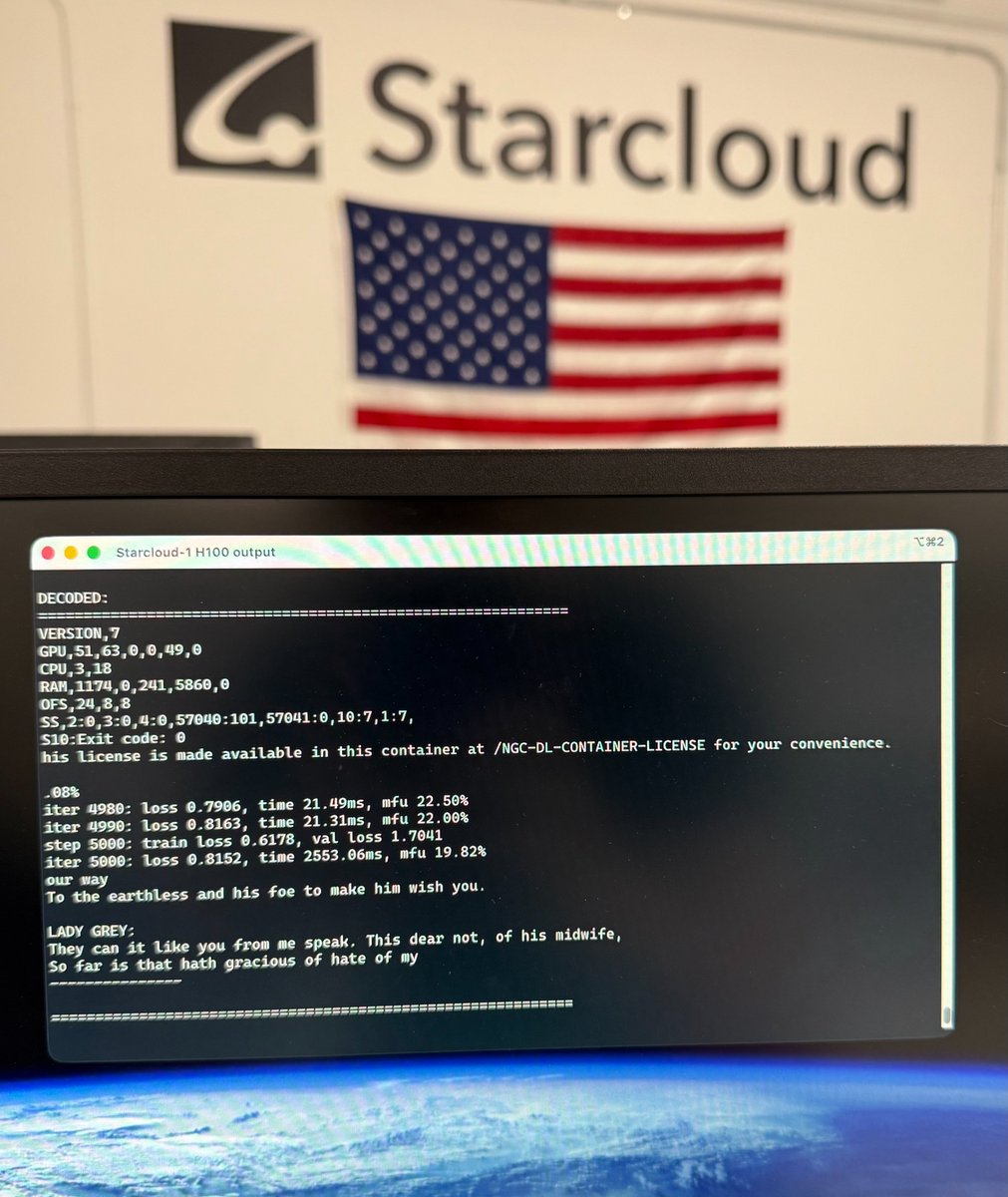
We have just used the @Nvidia H100 onboard Starcloud-1 to train the first LLM in space!
We trained the nano-GPT model from Andrej @Karpathy on the complete works of Shakespeare and successfully ran inference on it.
We have also run inference on a preloaded Gemma model, and we plan to try more exciting models in the future.
Getting the first H100 to work in space required a lot of innovation and hard work from the incredible Starcloud team to make this breakthrough.
This is a significant first step toward moving almost all computing off Earth to reduce the burden on our energy supplies and take advantage of abundant solar energy in space! 🚀