assistant superintendent (ret.); husband, father—Navy Dad; Rotarian... “Children are the living messages we send to a time we will not see.”-Neal Postman.
Hakeem Jeffries says he won’t even speak to the President’s Chief of Staff.
What a horrendous tone to set for divided government!
How does any of this help bring costs down for Americans?
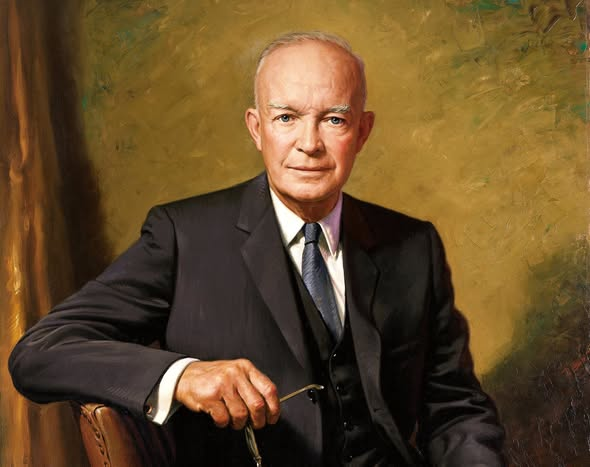
In July, 1964, General Eisenhower had a long interview with Walter Cronkite on the beaches of Normandy on the 20th anniversary of D-Day. He said then:
"I think Ulysses S. Grant is vastly underrated as a man and as a general. I know people think this and that about his drinking habits, which I think have been exaggerated way out of line. The fact is, he never demanded more men or material from the war department, he took over an army that had a long history of retreating and losing. That army had no confidence in their fighting ability and Grant came in as a real outsider. He had so many disadvantages going into the 1864 campaign, now 100 years ago. But he met every test and rose to the occasion unlike I’ve ever seen in American history. He was a very tough yet very fair man and a great soldier. He’s not been given his due.”
Eisenhower continued:
"Grant devised a strategy to end the war. He alone had the determination, foresight, and wisdom to do it. It was lucky that President Lincoln didn’t interfere or attempt to control Grant’s strategic line of thinking. Lincoln wisely left the war to Grant, at least in the concluding moves after he came east. Grant is very undervalued today, which is a shame, because he was one of the greatest American generals, if not the greatest."
When Richard Nixon told Eisenhower in 1956 that it was common knowledge Stonewall Jackson was the greatest Civil War general, followed by Lee, Eisenhower interrupted him:
"I wouldn’t say that, Dick. In fact I think it’s not a very reasoned opinion. You forget that Grant captured three armies intact, moved and coordinated his forces in a way that baffles military logic yet succeeded and he concluded the war one year after being entrusted with that aim. I’d say that was one hell of a piece of soldiering extending over a period of four years, the same time we were in the last war."
Dulles, who was present, remarked that Nixon said nothing in response!
General Eisenhower also stated that Grant’s memoirs were the best military memoirs ever written.
"A primary purpose of 'The Next 30 Years' is to turn up the lights on teachers, researchers, and instructional leaders who deserve a higher profile. Zach Groshell is one of them." Thank you @rpondiscio for this one. 👇
@ManhattanInst Taxing electricity the same way you tax everything else (4.5% NYC sales tax) is fine. But when you combine all 3 NYC taxes (ConEd prop tax, the GRT and sales tax), you're taxing delivery at over 36%. That's higher than the tax on weed!
Con Edison's new proposed bill design is going to shock the senses. NYC residents are about to learn they're paying roughly as much in taxes as they are the electricity commodity itself.
New Australian study finds that trainee teachers who received just five weeks of structured learning science instruction were substantially better at identifying educational myths and understanding how learning works than students who had not received this instruction. https://t.co/Dj8mQQ79jW
Ask a hundred Americans to name the most decorated warship in United States Navy history, and ninety-nine will guess USS Enterprise, USS Constitution, or USS Missouri.
All ninety-nine are wrong.
The most decorated vessel in U.S. Navy history is a Cold War attack submarine most Americans have never heard of: USS Parche, hull number SSN-683, awarded an astonishing nine Presidential Unit Citations and ten Navy Unit Commendations without firing a single torpedo in anger.
Why did presidents hand her crew the equivalent of nine Medals of Honor in total secrecy?
Because during the height of the Cold War, in missions like Operation Ivy Bells, USS Parche and her sister special-projects boats slipped undetected past Soviet warships right into Moscow's most heavily guarded territorial waters north of Japan, including the freezing Sea of Okhotsk and the Barents Sea.
Settling silently onto the ocean floor four hundred feet deep inside Soviet waters, where getting caught meant instant death or World War Three, saturation divers locked out of the submerged submarine in pitch-black freezing currents. Walking across the seabed, they located thick armored undersea communication cables linking top Soviet naval and nuclear missile commands, and clamped giant twenty-foot induction recording pods around the cables without cutting a single wire.
Because Soviet commanders assumed nobody on earth could touch a cable inside their own home waters, they sent unencrypted secrets straight through the line. American sailors simply crept back beneath the ice to swap out the tapes like checking a mailbox in the Kremlin's basement.
When Parche finally retired in 2004, her crew stepped ashore wearing rows of ribbons they still could not explain at dinner tables.
RE: Gas Prices, Mind Control and Breaking Bad
So I finally caught up with the rest of America and I'm watching "Breaking Bad" for the first time. It's an intense show, and so well written.
I was watching the season opener for Season 5 (released in 2012) and something caught my eye at the beginning of Episode 1. See the screenshot below?
Notice the gas price. $3.63 a gallon. Somewhere In 2011/2012.
Breaking Bad is famously set in Albuquerque, New Mexico. According to Grok, on this day in 2026 the average price for a gallon of regular unleaded in Albuquerque is $3.41.
14 years ago, during the what was likely campaign season for Barack Obama's second term, gas cost $0.22 cents more per gallon than it does today.
And if you want to adjust for inflation, 2012's $3.63 in 2026 dollars is $5.34. So when Barack Obama was running for President, gas was an inflation-adjusted $1.71 more than it is now under President Trump.
President Trump's initiatives to make America energy-independent have done more to make gas affordable than anyone else in our lifetimes.
Yet did you hear that from ANYWHERE in the media or on social media during the midterms?
NOPE.
All we heard about was an "affordability crisis" and gas prices were Exhibit #1.
It's mind control. It's the Democrat/Media Complex doing what it does best. Kick yourself if you fell for it.
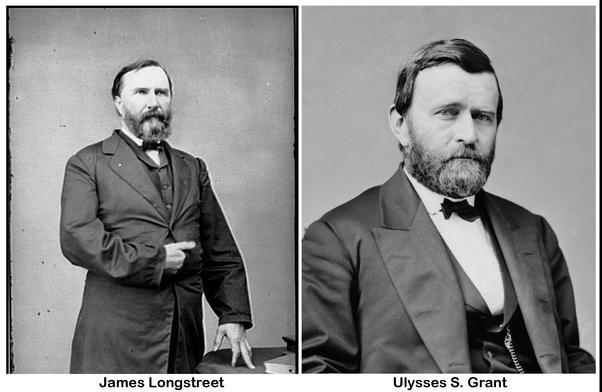
In 1844, a young lieutenant named Ulysses Grant was stationed at Jefferson Barracks outside St. Louis. Every chance he got, he rode out to a nearby plantation to see a girl named Julia Dent.
One of his closest friends in the regiment was James Longstreet, a tall, good-humored Southerner who had been a year ahead of him at West Point. Everyone called him Pete. He also happened to be Julia's cousin.
The two officers played cards together, drank together, and fought side by side in the Mexican War. When Grant finally married Julia in 1848, by many accounts Longstreet stood with him at the wedding.
Then their lives went in very different directions.
Grant drifted out of the army in 1854, dogged by rumors about his drinking. He failed at farming. He failed in business. By the late 1850s he was selling firewood on the streets of St. Louis.
Longstreet later remembered running into him there. Grant was shabby and broke, but he pressed a five dollar bill into Longstreet's hand. It was money he had borrowed years earlier, and he refused to let the debt stand.
Then came 1861.
Longstreet resigned and went south. He became Robert E. Lee's most trusted corps commander, the man Lee called "my old war horse."
Grant, the failed firewood salesman, rose faster than anyone in the Union army. Fort Donelson. Shiloh. Vicksburg. By 1864 he was commanding every Union army in the field, and he came east to face Lee.
Their first fight was in the Wilderness, May 1864.
On the second morning, Grant's army was close to breaking Lee's line. Then Longstreet's corps arrived at the last minute and slammed into them. Longstreet sent troops down an unfinished railroad cut and hit the Union flank, rolling it up like a carpet.
It was one of the best moments of his career. And then his own men, confused in the smoke and the thick woods, opened fire on his party. A bullet went through Longstreet's neck and out his shoulder.
It happened only about four miles from where Stonewall Jackson had been shot by his own men a year earlier.
Longstreet survived. He was back in the field by fall, his right arm partly paralyzed, fighting his friend through the trenches of Petersburg for the rest of the war.
April 9th, 1865. Appomattox.
After Lee surrendered, Longstreet was standing with a group of Confederate officers when Grant walked over. Grant took his hand, offered him a cigar, and said, "Pete, let's have another game of brag, to recall the old days."
Longstreet later wrote that the meeting brought back the old friendship.
It lasted the rest of their lives, and it cost Longstreet dearly.
After the war he joined Grant's Republican Party and urged the South to accept Reconstruction. When Grant became president, he appointed Longstreet to a federal job in New Orleans. Much of the South never forgave him. Old comrades called him a traitor, and for decades writers blamed him for losing Gettysburg.
He stood by Grant anyway.
When Grant died of throat cancer in 1885, a reporter asked Longstreet about him.
"He was the truest as well as the bravest man that ever lived."
Emperor Hirohito once stood up in the White House and thanked America from a small folded card. Look at his hands in this photo.
This is the State Dining Room, October 2, 1975.
Hirohito was 74 years old. It was the first state visit ever made to the United States by a reigning Emperor of Japan.
Thirty years earlier, his country and this one had been at war.
Betty Ford sits to his left. President Gerald Ford is on the right, watching him.
Ford had already raised his glass.
"This first state visit to the United States by an Emperor and an Empress is an occasion of great, great importance to all of us."
Then the Emperor unfolded his card. He spoke in Japanese, and an interpreter gave the English.
"It has been my wish for many years to visit the United States."
He said there was one thing in particular he had hoped to tell the American people himself.
He thanked them "for the friendly hand of good will and assistance their great country afforded us for our postwar reconstruction immediately following that most unfortunate war, which I deeply deplore."
That most unfortunate war. Which I deeply deplore.
Those words came from the man in whose name it had been fought.
He was not finished.
"I am confident that the story of the generosity and good will of the American people will be retold from generation to generation of Japanese for the rest of time."
I am Japanese, one of those generations. So I am retelling it.
The next morning he went to Arlington National Cemetery. A wreath was laid at the Tomb of the Unknown Soldier while a bugler played taps.
A few days later, in California, he visited Disneyland and met Mickey Mouse.
He went home with a Mickey Mouse watch.
TIME magazine later reported that for years afterward, the watch could be seen on the imperial wrist.
He came to America with a thank you written on a folded card.
He left with Mickey keeping time on his wrist.
Wow. Wow. So blessed….When the last living officer, General John Raaen, from Omaha Beach and the last Ranger from 1500 on D Day …. offers to show you a sketch he’s not shown anyone before of where he landed.
@neetu_arnold@Mark_J_Perry The NYS Algebra Regents Exam is a joke—dumbed down long ago. The focus should be on improving instruction and teacher preparation to teach math ….
🚨 LMAO! An NBC reporter just tried to blame Trump for the ground stop, and Sean Duffy SHUT HER DOWN.
NBC asked why fixing air traffic control hasn't been a priority when Republicans control Congress.
Duffy fired back with "Who are you with?" Then he told her maybe she hasn't covered the "HUNDRED PLUS PRESS CONFERENCES" he's done on this exact issue.
He reminded her that Trump got $12.5 billion for the system in the One Big Beautiful Bill, and NOT ONE DEMOCRAT VOTED FOR IT.
Duffy says the digital IP centers held up today, and only the old analog ones failed.
NBC should be asking every Democrat why they voted no.
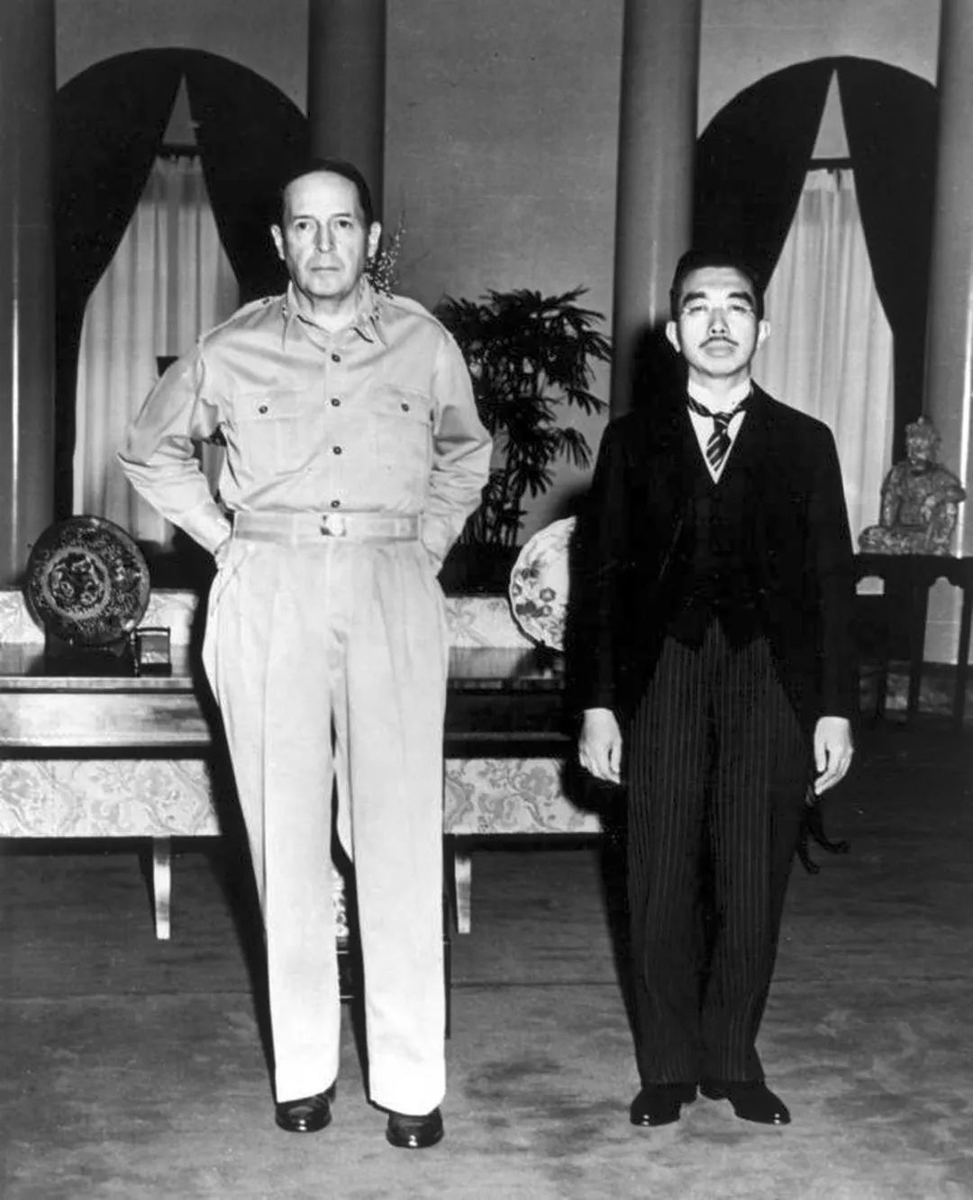
One of the first orders Douglas MacArthur gave his soldiers when he landed in Japan was that none of them were to eat Japanese food.
Virtually the entire Japanese population was starving. The cities had been firebombed. Harvests had failed. The demands of the war had drained the countryside. Food that used to flow in from Korea, Taiwan, and China had stopped coming. Around 5.1 million Japanese soldiers and civilians were returning home from across Asia, and another million would follow the next year, all of them hungry.
MacArthur arrived in Tokyo on August 30, 1945. He had been appointed Supreme Commander by President Truman. His first priority, before democracy, before the constitution, before the war crimes trials, was to set up a food distribution network.
He decreed that no Allied personnel could assault Japanese people or eat the scarce Japanese food. American soldiers who had been killing Japanese weeks earlier were now ordered to leave Japanese rice alone.
Then American food started arriving. Large quantities of foodstuffs and medical stores were poured into the country from American sources. American military government teams were sent across Japan to supervise the distribution.
In fiscal year 1946, the U.S. government provided $92 million in loans through a program called Government Aid and Relief in Occupied Areas. From April 1946, private American relief organizations were allowed in as well, under an umbrella called Licensed Agencies for Relief in Asia. Even with all of this, millions of Japanese were still on the brink of starvation for several years.
A Japanese observer named Kazuo Kawai put the whole project in one sentence.
"Democracy cannot be taught to a starving people."
I am Japanese. There is almost no Japanese family tree that does not pass through that winter. The grandmothers who fed my parents lived to feed them because American food reached the ports.
Most Japanese have never been told this clearly. They should be.
The old enemy fed us.
On this National Day for the Victims of Communism, look at this memorial in Budapest for those who suffered under Communism but were not murdered. One of the most powerful monuments I've ever seen.