I always knew there was something special about @obsdmd. Been using it for years, who would have known it would be the foundation for agentic memory systems. Amazing.
The next evolution of Hermes Agent is here!
Introducing Hermes Desktop: everything you love about Hermes, now native on your machine.
First demoed in Jensen's GTC keynote, it's now in public preview.
I’ve been using Obsidian as a long-term memory system. Not in a perfectly organized, productivity-influencer kind of way. More like a workshop floor: half-finished projects, sharp tools, strange scraps, and enough material that patterns started becoming visible.
There are now 4,400+ Markdown notes in the vault.
That number is not impressive by itself. A pile of notes can become its own clutter. But when the notes are honest — unfinished thoughts, repeated questions, spiritual wrestlings, work problems, family dreams, business concepts, and things saved because something in you said “don’t lose this” — they become more useful than a knowledge base.
They become evidence.
Not evidence of what I claimed to care about once, but evidence of what I kept returning to. The questions that survived distraction. The problems that kept showing up under different names. The themes still alive after the first wave of excitement wore off.
Passion is what pulls your attention. Purpose is what orders your life.
Passion is magnetic: the thing you keep reading about, talking about, building around, or noticing in the world. Purpose has more weight. It is less about what fascinates you and more about what you may be responsible to steward.
Looking back across thousands of notes, I can see my passions: AI, cybersecurity, trust, human agency, education, faith, family, systems, formation, and the hidden mechanics of deception.
But purpose is not just a pile of passions. Purpose is the pattern underneath them.
The pattern I see is this: I care about building trustworthy systems of formation that help people become more capable, discerning, courageous, and human in an age of AI, deception, and accelerating complexity.
At work, that shows up as AI enablement, governance, training, and helping teams use powerful tools without losing judgment. In cybersecurity and education, it shows up as wanting people to understand threats clearly and build real competence — not just technical skills, but agency and discernment.
In faith and family, it shows up as a question I keep coming back to: is all this building serving a home, a marriage, children, community, and a life under God, or is it just feeding another machine?
That question matters. Tools can become idols. Systems can become hiding places. Productivity can become avoidance dressed up as discipline. AI can make us faster while quietly making us thinner.
So the point is not to have thousands of notes. The point is to pay attention to what those notes reveal: what keeps returning, who you keep trying to protect or serve, and what future your ideas imply you are trying to build.
I don’t think purpose is usually discovered in one dramatic moment. More often, it is excavated through attention, repetition, prayer, responsibility, and the honest record of what kept mattering after the novelty wore off.
Your passions are breadcrumbs. Over time, if you pay attention, they may start pointing toward the road of purpose.
Computer makers including Dell, Asus and HP will use ‘the most efficient PC chip ever built’, paired with Microsoft’s Windows software, said Nvidia chief executive Jensen Huang. https://t.co/rd8rlkFDth
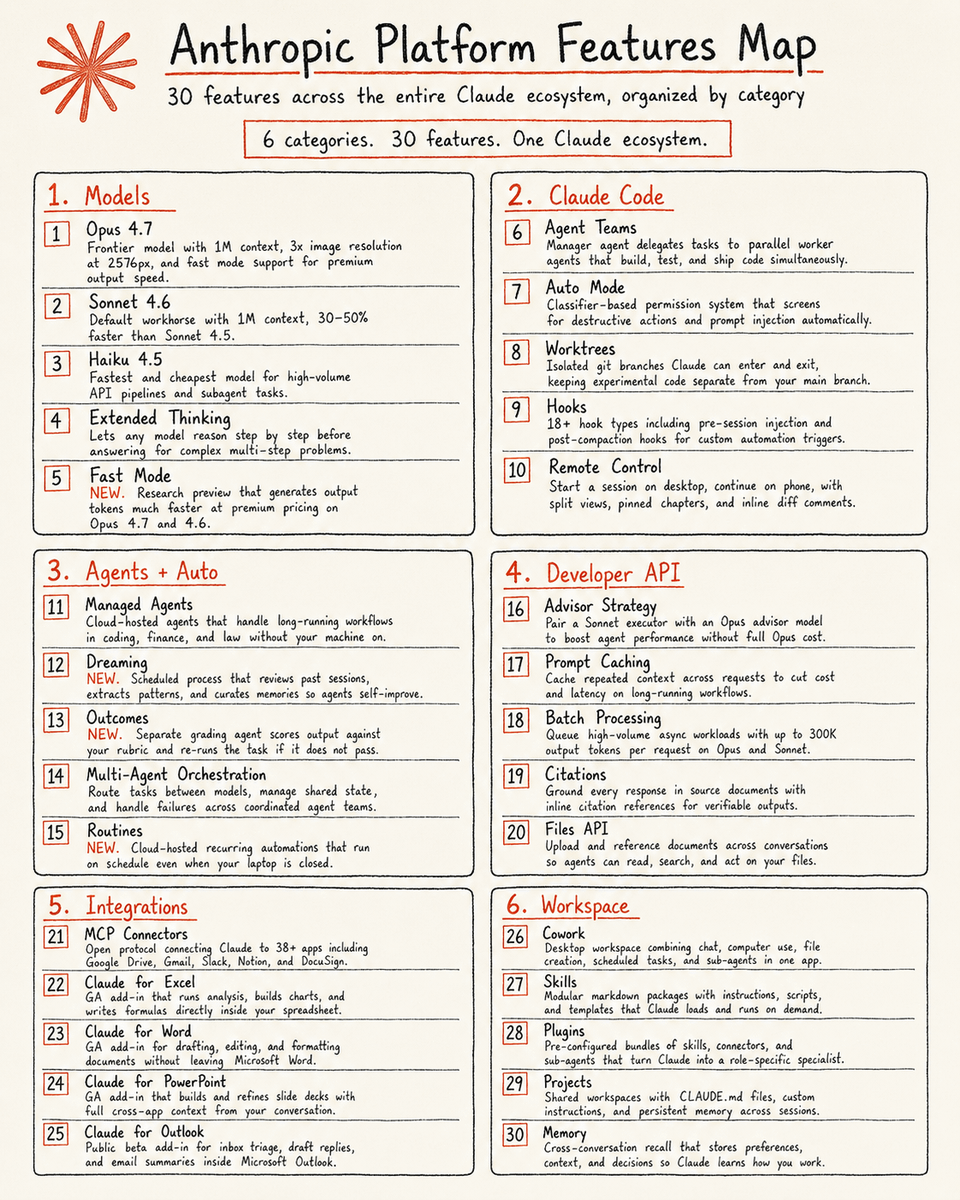
I just mapped Anthropic's entire
Claude ecosystem from scratch.
Here's why it took me hours
(and why it'll save you weeks):
𝟭. 𝗣𝗶𝗰𝗸 𝘆𝗼𝘂𝗿 𝗺𝗼𝗱𝗲𝗹
↳ Opus 4.8 for frontier reasoning
↳ Sonnet 4.6 for daily workflows
↳ Haiku 4.5 for high-volume, low-cost
𝟮. 𝗔𝘂𝘁𝗼𝗺𝗮𝘁𝗲 𝘄𝗶𝘁𝗵 𝗮𝗴𝗲𝗻𝘁𝘀
↳ Managed Agents work without you
↳ Dreaming reviews and self-improves
↳ Routines run on a schedule 24/7
↳ Outcomes grades every output
𝟯. 𝗦𝗵𝗶𝗽 𝘄𝗶𝘁𝗵 𝗖𝗹𝗮𝘂𝗱𝗲 𝗖𝗼𝗱𝗲
↳ Agent Teams build in parallel
↳ Worktrees keep branches clean
↳ 18+ hooks for custom automation
𝟰. 𝗖𝗼𝗻𝗻𝗲𝗰𝘁 𝗲𝘃𝗲𝗿𝘆𝘁𝗵𝗶𝗻𝗴
↳ MCP links 38+ apps natively
↳ Claude sits inside Excel, Word,
PowerPoint, and Outlook
↳ Files API for document workflows
𝟱. 𝗕𝘂𝗶𝗹𝗱 𝘆𝗼𝘂𝗿 𝘄𝗼𝗿𝗸𝘀𝗽𝗮𝗰𝗲
↳ Cowork: chat + files + sub-agents
↳ Skills: markdown instruction packs
↳ Memory learns your preferences
↳ Projects persist across sessions
That's 30 features.
Not a chatbot. A full stack.
We're not prompting anymore.
We're orchestrating systems.
What would you build with this map?
Follow Muhammad Ayan ♻️ Repost to help others.
@vmiss33 Is it still going well with Grok @vmiss33? I switched from GPT 5.5 OAuth and Grok continuously drops the ball, doesn’t check in, and is generally just awful compared to GPT 5.5. What am I doing wrong?