If you think anthropic falls because people choose open source... is that because it's open or because it's cheaper? If the former what is the business model that keeps the better models coming? If it's the latter, is it simply that open cloud operators are just accepting lower margins than anthropic?
No one changes the world alone
Introducing Ampersand - the first model built for us. Ampersand is a collaborator trained to help people achieve their individual and collective goals. In multi-month simulations, users collaborating with Ampersand accomplished more than with Fable and other frontier models
Available to everyone through our API
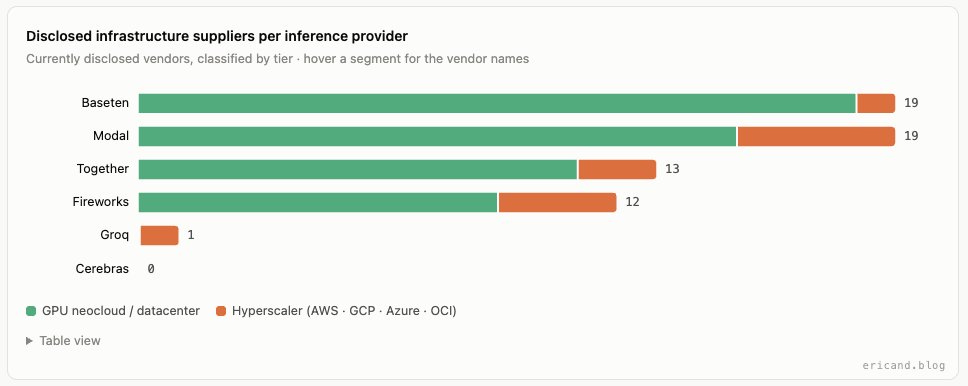
These providers rely on a layer of GPU operators. Unsurprisingly, those are booming as well. Modal alone has added 14 GPU operators (75% of its supplier base) in the last 6 months. That's all I'll say about them. This thread is all about the inference providers- I'll do an analysis on the GPU operators soon
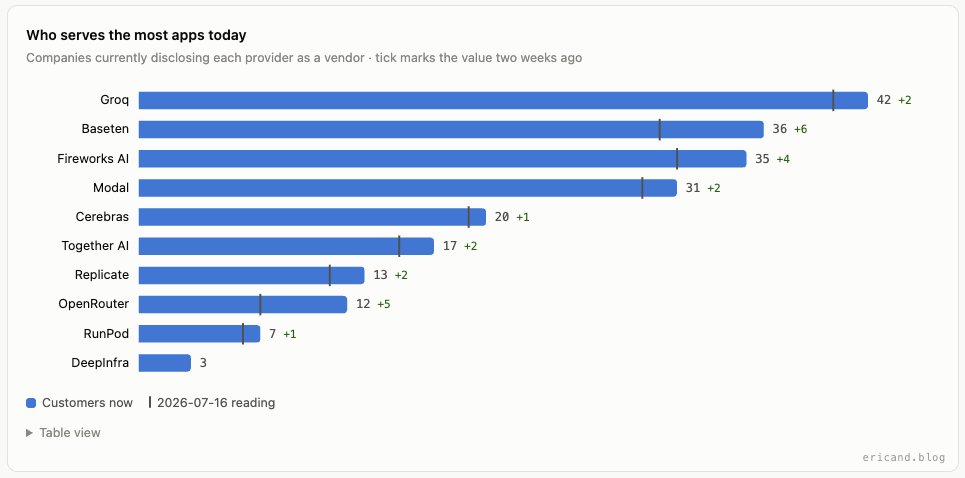
Who are they using to run those models? I didn't expect to see so Groq top the list. Baseten, Fireworks and Modal are right behind. In a two week period, Baseten added 6 customers (jumping ahead of Fireworks) and OpenRouter added 5 (double in a month!)
Only one of these can be true, which is it?
Anthropic/OpenAI have unsustainably poor unit economics on inference
They charge 10x the cost of an open source model on an inference cloud
It's easy to look at Google's success in terms of fortunate-monopoly, but you'd discount how fantastic they have been at retaining top talent. At any other company, Jeff Dean would have left long ago. From Day 1 Sergey and team not only innovated on product, but on talent retention (remember all the perks!) and it still resonates.
Sergey Brin on the genius of Jeff Dean.
He credits Jeff’s early obsession with neural networks, back when they were “telling cats from dogs”, as the spark for everything.
TPU was Jeff’s idea. He calculated that if users spoke to Google for just three minutes a day, Google would have to double its CPU data centers. Instead of buying more CPUs, Jeff decided to build a new chip for AI.
What’s fascinating is that when AI was not as big as today, when it can only “tell cats from dogs,” Larry and Sergey were like, “Cool, let’s make a custom chip for it.”
That’s a huge show of confidence in deep tech and top-tier technical talent. It makes Google the only AI company that has the top models, top chips, and top data centers.