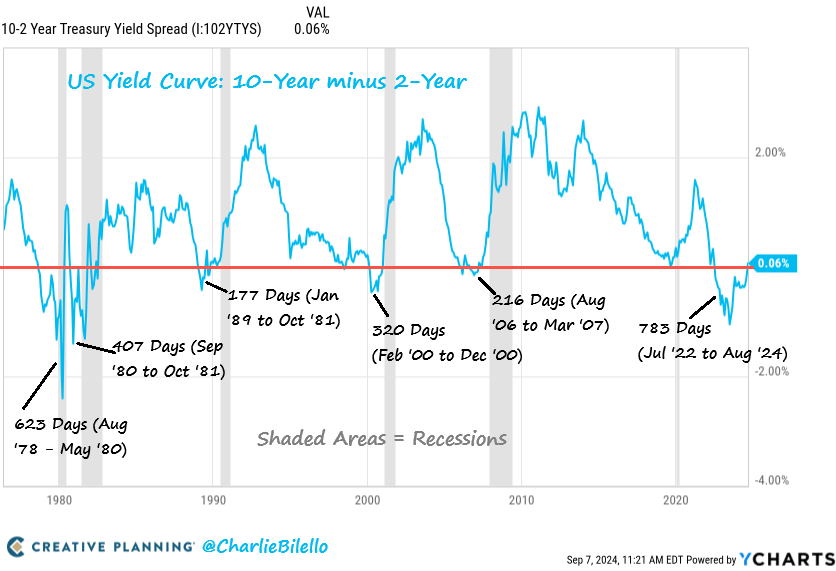
The longest yield curve inversion in history has ended w/ the 10-yr Treasury yield (3.71%) now 6 bps above the 2-Yr yield (3.65%). Historically, the flip back to positive after a long inversion has occurred near the start of recessions.
Video: https://t.co/RbBAs8DvJ9
Implementing Cache Management in Memory Controllers
This implementation simulates a memory controller using class called MemoryController. This class acts like a manager for all the information a computer uses. Think of it as the brain that decides where to store and retrieve data.
At the heart of this manager are two main components: main memory and a cache. Main memory is like a giant storage box where the computer keeps all its data. It is represented using a large array in the code. The cache is a smaller, faster storage area, like a special shelf for the information the computer uses most frequently.
This makes things much faster because the computer doesn't need to go to the large main memory box every time. A "4-way set-associative cache" is used here, providing a good balance between speed and flexibility.
The MemoryController class handles several key tasks. First, it manages memory access, allowing the computer to read and write information to both main memory and the cache. Second, it manages the cache effectively, keeping track of what information is stored and deciding what to remove if it gets full.
This process is crucial for keeping the cache efficient. Finally, the class includes a "displayCacheStatus" method which lets us see what's happening inside the cache. This is very helpful for debugging and understanding how the controller works.
When the computer needs to access some information, the "MemoryController" checks the cache first. If the information is already there (a "cache hit"), the controller quickly retrieves it and gives it to the computer. If the information isn't in the cache (a "cache miss"), the controller has to go to the main memory to get it. It then adds the new information to the cache so it's ready for next time.
To make the "MemoryController" even more efficient, two cache replacement policies are used: LRU (Least Recently Used) and Random. LRU removes the information that hasn't been used for the longest time, while Random removes a random piece of information.
Finally, a write-back policy is implemented, which means the main memory isn't always updated immediately when information is written to the cache. This saves time and effort, only updating main memory when it's absolutely necessary.
Understanding the Memory Controller's Role
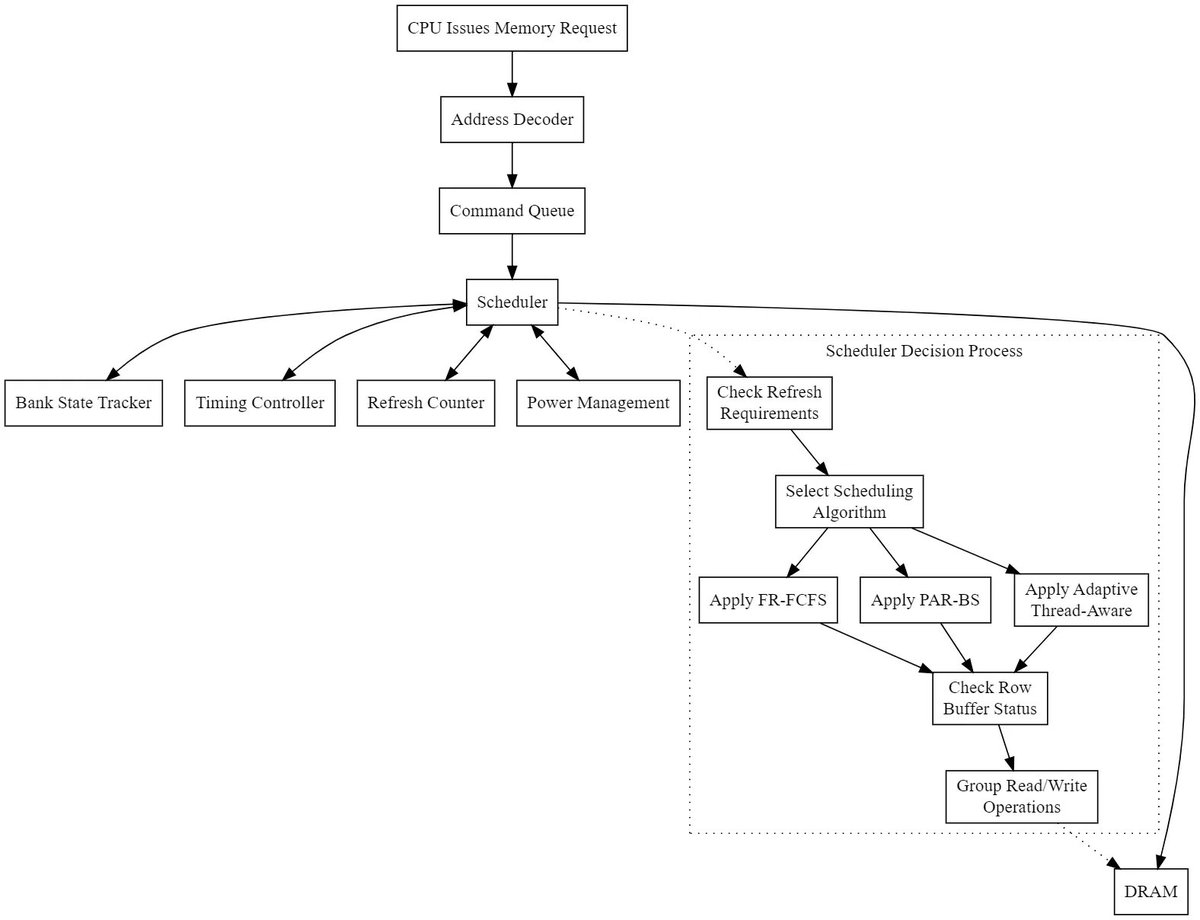
When a process initiates a request to the memory controller, a series of events unfolds. First, the CPU generates a memory access request, which includes the memory address and the type of operation (read or write). This request is sent to the memory controller.
The memory controller then checks if the requested data is present in the cache. It does this by examining the cache lines corresponding to the set determined by the address. If the data is found in the cache (a cache hit), it is quickly returned to the CPU for a read operation, or the cache is updated for a write operation.
If the data is not in the cache (a cache miss), the memory controller must fetch it from the main memory. In this case, the controller sends a request to the DRAM, waits for the data to be retrieved, and then updates the cache with the new data. Finally, the requested data is sent back to the CPU.
Throughout this process, the memory controller manages various tasks such as cache replacement, write-back of dirty cache lines, and handling of concurrent requests.
I've covered most of the relevant details in my previous tweets. However, there are a couple of additional points that are crucial for understanding the situation.
Write Policies: Memory controllers must manage how writes are handled, both in the cache and main memory. Two main policies are write-through and write-back. In a write-through policy, every write operation updates both the cache and main memory immediately.
This ensures consistency but can lead to unnecessary memory traffic. My implementation uses a write-back policy, where writes only update the cache initially, marking the cache line as "dirty." The main memory is only updated when a dirty cache line is evicted. This reduces memory traffic but requires more complex management and the use of a "dirty bit" for each cache line.
Prefetching and Prediction: Although not implemented in our basic version, advanced memory controllers often include prefetching mechanisms. Prefetching involves predicting future memory accesses and fetching that data into the cache before it's requested. This can significantly reduce cache misses and improve performance.
Prefetchers can be simple (e.g., always fetching the next sequential block) or use sophisticated algorithms to detect complex access patterns. Effective prefetching requires balancing the potential performance benefits against the risks of fetching unnecessary data and potentially evicting useful cache lines.
Concurrency and Request Handling: Real-world memory controllers must handle multiple concurrent requests from different CPU cores or I/O devices. This requires sophisticated queuing and scheduling mechanisms to maximize memory bandwidth utilization while ensuring fairness.
Controllers may reorder requests to optimize for DRAM access patterns, grouping requests to the same row to minimize row activation overhead. They must also manage dependencies between requests to maintain correctness.
Power Management: Modern memory controllers play a crucial role in system power management. They can put DRAM chips into low-power states when they're not being accessed, carefully balancing power savings against the latency of bringing the chips back to an active state.
Controllers also manage DRAM refresh operations, which are necessary to maintain data integrity in dynamic memory. Sophisticated refresh schemes can reduce power consumption by refreshing only the rows that need it, rather than refreshing the entire memory periodically.
Conclusion
In conclusion, memory controllers are complex systems that require careful design and implementation of numerous interrelated components. From cache management and address translation to sophisticated prediction and power management schemes, each aspect plays a crucial role in overall system performance and efficiency.
As memory technologies continue to evolve, memory controllers must adapt, incorporating new features and optimizations to keep pace with increasing demands for performance, efficiency, and reliability in modern computing systems.
What Next?
1. Prefetching
2. Non-Uniform Memory Access (NUMA) Architectures
3. Memory Controller Optimizations for Big Data and AI Workloads
4. Persistent Memory and Memory Controllers
In the QA Waller notes that he still thinks the equilibrium monthly job growth is around 80 to100k a month, so he thinks jobs market is softening rather than deteriorating.
IMO 25bps for September.
Governor Tim Walz accompanied by Gov. Roy Cooper stopped at a Cookout in North Carolina for ice cream.
It’s 93* here.
Walz got mint chocolate chip and Cooper got M&M.
@josephwang But does that mean the Fed should operate on "gut feeling" like he suggested? Or that the President should have a more heavy handed or direct say?
@byHeatherLong Though the stock market isn't the real economy, and has already started to rebound. We also knew this was what it could take to bring down inflation. But do we actually have enough data to start making calls on an imminent recession vs classic business cycle economic slowdown?