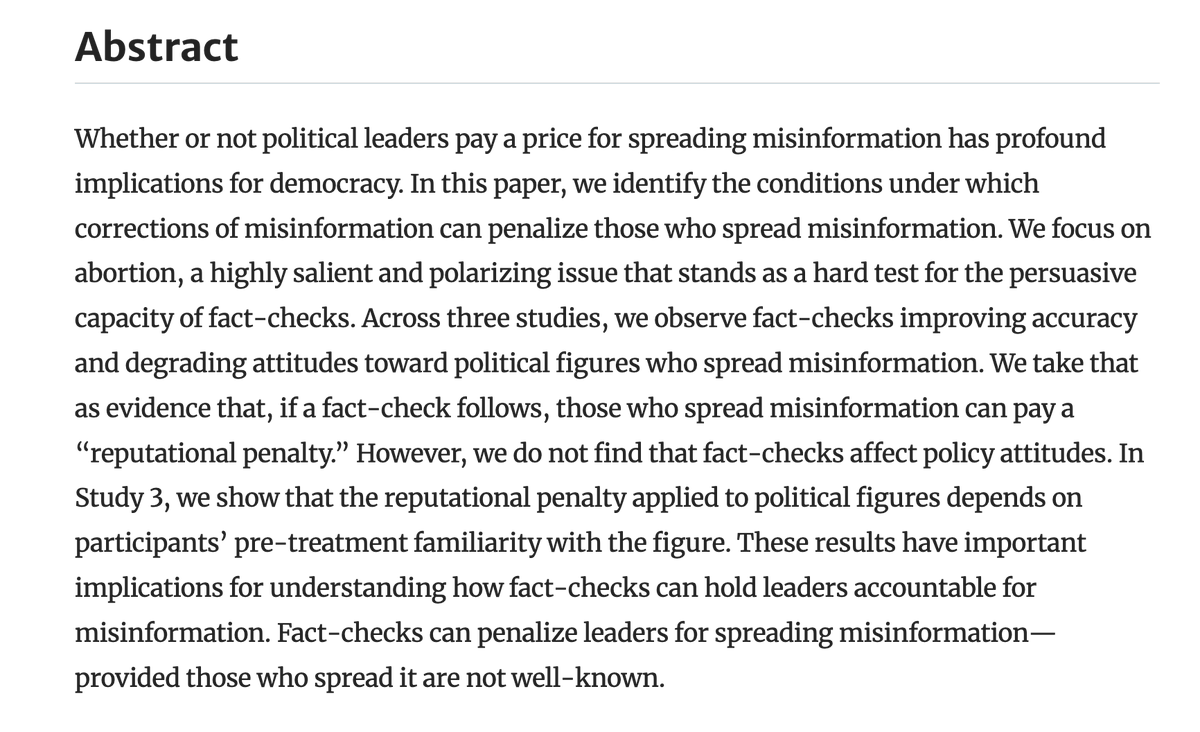
Fact-checks improve accuracy. But can they penalize spreaders of misinfo? At @PolBehavior, @jacobausubel, @nnikdav and I show that the answer is yes-sometimes. Unknown misinfo producers can be penalized, but well-known figures get off. Link: https://t.co/DFcYVoIqGS
parallel with the Knicks' extraordinary penchant for magically rallying, coming-up-from-behind to triumph at virtually the last minute was the weirdly fascinating drama of "Wemby" on the court distinctive not only by his height but the thinness of his body which appeared, beside his teammates, almost pre-pubescent, lacking maturity. no matter where you looked, there was always "Wemby" charging about anticipating an opening to shove, push someone with a solid adult body with a baby-faced look of insouciance: "Who? Me? I' m just a kid."
1) Prediction markets can be wrong and may not even be calibrated (https://t.co/Uchfi3XHu7). If the market is wrong we usually blame the market, not the election.
2) The reason voters have birthdates like 1/1/1900 is because they have been registered so long they didn't need to provide a birthdate when they first registered, or have another reason for a placeholder birthdate. They are not 126 years old.
3) Me pointing out (1) and (2) does not mean I endorse California election administration policy. We can be (and I am) frustrated about how California administers elections without endorsing ridiculous fraud claims.
Our first of issue of 2026 is out (with a bit of delay due to the transition from Now Publishers to @EmeraldGlobal). We have great papers from AG Dixit and M Sulaiman; A Coppock, D Green, @EthanVPorter; CM Horz and @Korhan_Kocak; G Egorov and @k_sonin.
I see people making jokes about Hampshire college, but if you really think AI is going to push human labor into artisanal task that are hard to automate, you may wish we had more experimental colleges that offered the kind of experience Hampshire College provides.
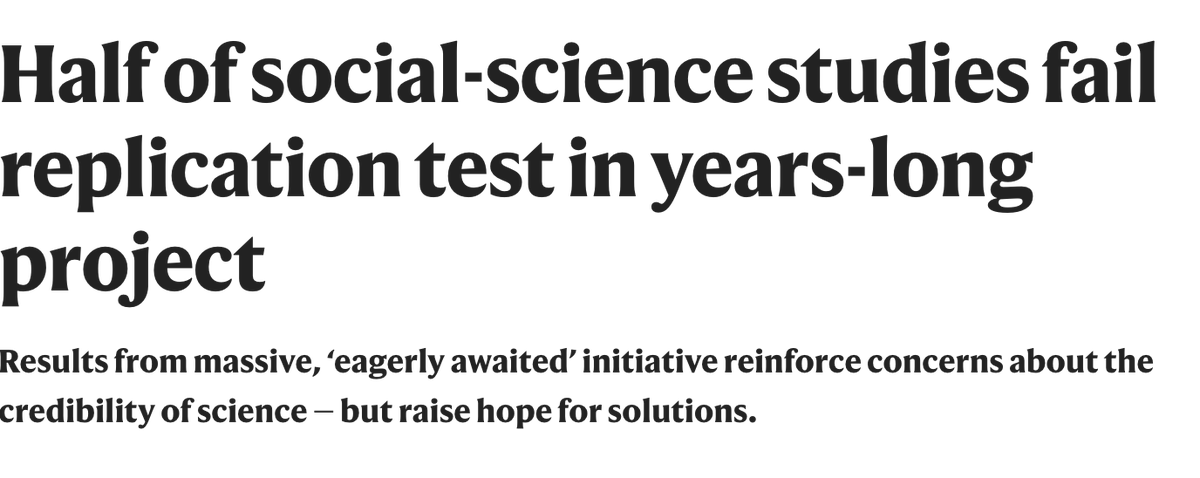
It's kind of funny that Nature is publishing misleading clickbait, where the clickbaity lead is "look you can't trust anything in Nature!!"
I wish it was an April Fool's joke, but I'm afraid this is sincere.
Clicking through, there are several replication exercises, and all except one have success well over 50%.
Why do this? Why undermine your own institution for clicks? It boggles the mind.
My previous post on LLMs for self-study has sparked considerable debate about the role of “traditional” higher education.
In response to some of the comments, I want to enumerate the arguments supporting the survival of “traditional” higher education. In my next post, I will assess how each might be affected by AI. Think of today's post as a taxonomy of arguments that I will review tomorrow in terms of their strength and robustness.
I count twelve.
First, signaling. The value of, let’s say, a degree from MIT is that you were smart enough to get into MIT and survive the grueling workload. The best example of signaling was the old way the British civil service selected its high-flyers: students with a first from Oxford in Literae Humaniores, not because they learned anything particularly useful there, but because it was hard to get in and hard to master all the Greek and Latin.
Second, credentialing. Societies, for a variety of reasons (some justified, some not), have decided that a degree is required to perform certain tasks. Sometimes, the requirement is statutory. For example, I cannot teach economics in a high school in Pennsylvania because I do not have a teacher’s certificate. Sometimes, the requirement is a social norm. Many firms insist that their recruits for many positions have a B.A.
Third, networking. The friendships, relationships, and (often) sentimental partnerships formed at a university are very valuable, as they occur at a key moment in life when students transition from adolescence to adulthood. Personally, networking was the most valuable component of my undergraduate education.
Fourth, peer effects in learning. This is distinct from networking. Being in a room with other smart students who challenge your thinking in real time, study groups, and classroom debate: the value is in the interaction during the learning process, not in the connections formed afterward. This was the most valuable aspect of my graduate education.
Fifth, commitment. Most students suffer from some form of time-inconsistency, and, in the absence of a formal degree, they would not complete more than a small fraction of the required work. Abysmal completion rates at Coursera courses illustrate the importance of this channel.
Sixth, curation of topics. Universities curate the topics and content that a well-balanced degree requires.
Seventh, skill acquisition. Students learn accounting, marketing, or biochemistry, and these skills are valued by the market.
Eighth, cultural capital. Students learn social norms and preferences that are valuable for positioning games in society and might have value in themselves (for example, university graduates tend to exhibit healthier behavior, even after controlling for selection and higher lifetime income).
Ninth, a “hold-out” period. Students are parked at universities while they mature, break links with their parents, and figure out what to do with their lives.
Tenth, proximity to the research frontier. The professor who teaches you monetary economics is also producing monetary economics. There is something qualitatively different about learning from someone working at the boundary of knowledge versus learning from someone, or something, that transmits existing knowledge well. This is not skill acquisition. It is exposure to how knowledge gets made.
Eleventh, assessment and feedback. The structured loop of writing, receiving criticism, and revising is a distinct mechanism from the discipline of showing up or the curation of content.
Twelfth, physical infrastructure. For many fields (chemistry, biology, engineering, medicine), the university provides labs, equipment, and supervised access to materials that cannot be replicated at home.
Some of these arguments are strong. Some of them are weaker than universities would like to believe. And some of them are about to be tested in ways they have never been tested before. Next time, I will go through each one.
Can Party ID be changed? New paper at @qjps_editors with Alex Coppock + Don Green says: yes-hypothetically! Subjects shown hypotheticals of extraordinary events shifted their party; ads + mail had no effect. Fig shows fx of hypotheticals. Paper: https://t.co/paTwu6iYd2
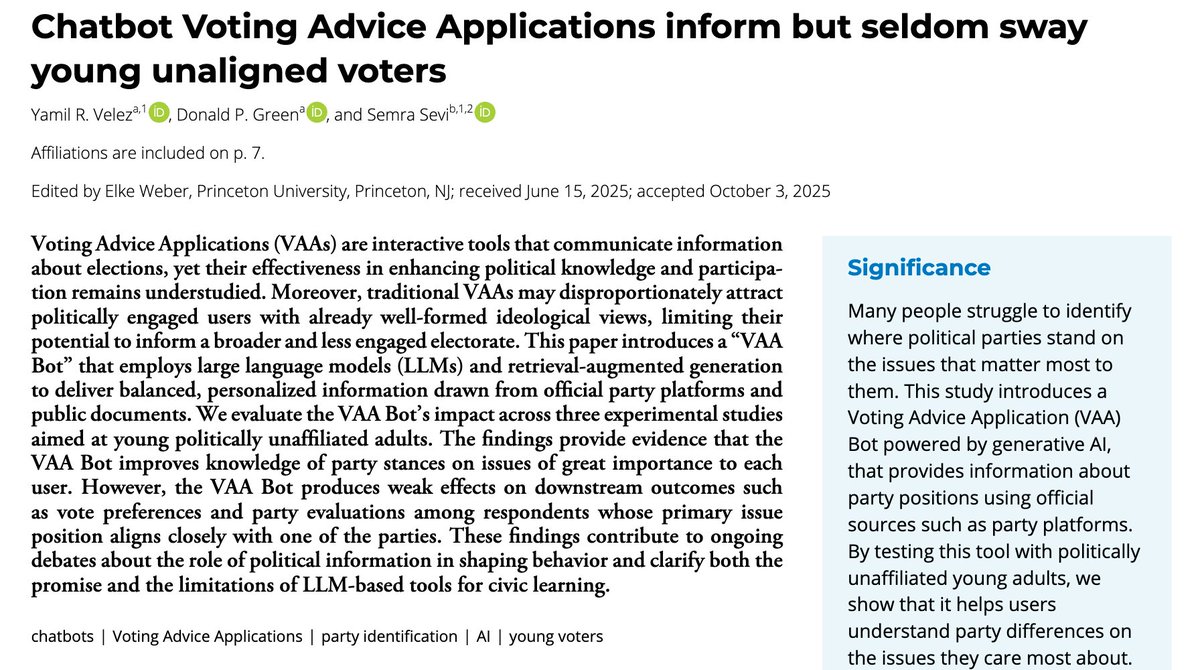
Excited to share our new paper published in PNAS (joint with @SemraSevi and Don Green)! AI can enhance political knowledge and provide balanced information about politics with proper guardrails and vetted sources (e.g., party platforms).
https://t.co/xKA0cFyATW
From September 2025 -
Rethinking Citizen Competence: A New Theoretical and Empirical Framework - https://t.co/a42VrIytJV
- @stevenmklein & @EthanVPorter#OpenAccess
This thread by Simon is spot on. Most advice is dumb—it’s too general to be useful—and I always tell my students I have no advice to give unless it’s very specific (eg run this analysis).
But “live over your skis” is good advice.
The fall of "When prophecies fail": Another social psychology classic turns out to be based on fabrications and lies.
In 1954, Dorothy Martin predicted an apocalyptic flood and promised her followers rescue by flying saucers. In “When Prophecy Fails “ (1956), the now-canonical account of the event, Festinger, Riecken and Schachter claimed that the group doubled down on its beliefs and began recruiting—evidence, the authors argued, of a new psychological mechanism, cognitive dissonance.
When Prophecy Fails is one of the most influential case studies in 20th-century social science. It shaped popular understandings of how belief survives disconfirmation, and became a touchstone for explaining the origins of religious movements...
But the case was misrepresented. The cult did not persist, proselytize, or reinterpret its failure as a spiritual triumph. Its leader recanted, the group disbanded, and belief dissolved. Drawing on newly unsealed archival material, this article demonstrates that the book's central claims are false, and that the authors knew they were false. The documents reveal that the group actively proselytized well before the prophecy failed and quickly abandoned their beliefs afterward.
They also expose serious ethical violations by the researchers. The newly unsealed Box 4 of papers contain transcripts, telephone logs, research notes, channeled messages, and internal communications among the researchers. Collectively, they reveal serious ethical breaches: fabrications, covert manipulation, and at least one instance of interference with a child welfare investigation.
One coauthor, Henry Riecken, posed as a spiritual authority and later admitted he had “precipitated” the climactic events of the study. This article shows that the authors of When Prophecy Fails misled their readers—and that scholars in psychology, sociology, and religious studies have been building theories atop a collapsed foundation.
The full scope and variety of the misrepresentations and misconduct of the researchers needed the unsealed archives of Festinger to emerge, the full story could not be written until now. Every major claim of the book is false, and the researchers’ notes leave no option but to conclude the misrepresentations were intentional.
While we're all procrastinating waiting for election night, consider: Our journalism at Bolts has no paywall, but it requires a lot of resources. We're a nonprofit, and we thrive with your support & subscriptions.
And right now is the GOLDEN time to make your support multiply:
If you were a devoted opponent of the United States you would be watching this with confusion, trying to work out what the catch is. Like watching your rival dismantle their own roads.